
Why are you trusting a program with your career when they cannot even keep their own website honest, updated, or coherent?
If you think residency websites are just “marketing fluff” that you can ignore, you are setting yourself up for some very preventable pain. Programs tell you who they are by what they choose to publish… and what they quietly leave out. I have watched students match into disaster because they ignored obvious warning signs that were sitting on the homepage the entire time.
Let’s walk through the residency website red flags that should make you slow down, dig deeper, or remove a program from your rank list altogether.
1. “Resident Life” Sections That Look Suspiciously Fake
If the website shows five pictures of residents hiking, smiling at breweries, and laughing in front of a skyline—but gives you zero specifics—do not just shrug and rank them anyway.
The usual pattern:
- Same 6–8 residents in every photo
- No names, no PGY labels, no graduation years
- No actual schedule examples, salary breakdown, or call structure in that section
- Overly generic captions: “Our residents enjoy spending time together outside the hospital!”
This is lifestyle theater. When a program is healthy, they usually have no problem showing you something concrete: intramural teams, interest groups, morale committees, real traditions with dates and context, or honest discussions of wellness initiatives.
Red flag moves:
- A “Resident Life” tab that’s essentially a stock-photo collage
- No resident quotes about real parts of life (commute, housing, kids, cost of living)
- Resident “testimonials” that sound like they were written by marketing, not a human
If they will not get specific about life outside the hospital, you should assume they do not think deeply about it—or worse, they are hiding a reality you would walk away from if you saw it.
2. Outdated Information Everywhere (Dates Do Not Match Reality)
If the website still says “Our program director, Dr. Smith, has led the program since 2013” and you met Dr. Patel on interview day as the PD, that is not a cute oversight. It is a systems problem.
This goes beyond a stale news page. Watch for:
- Conference schedules last updated 2019
- Call schedules or rotation blocks labeled “proposed for 2020–2021”
- Lists of residents that stop two years ago
- “New curriculum” from 2018 still labeled as “new”
That kind of neglect means one of three things:
- No one owns communication and transparency.
- Leadership turnover is chaotic and they cannot keep up.
- They do not prioritize applicant-facing honesty.
None of those are good.
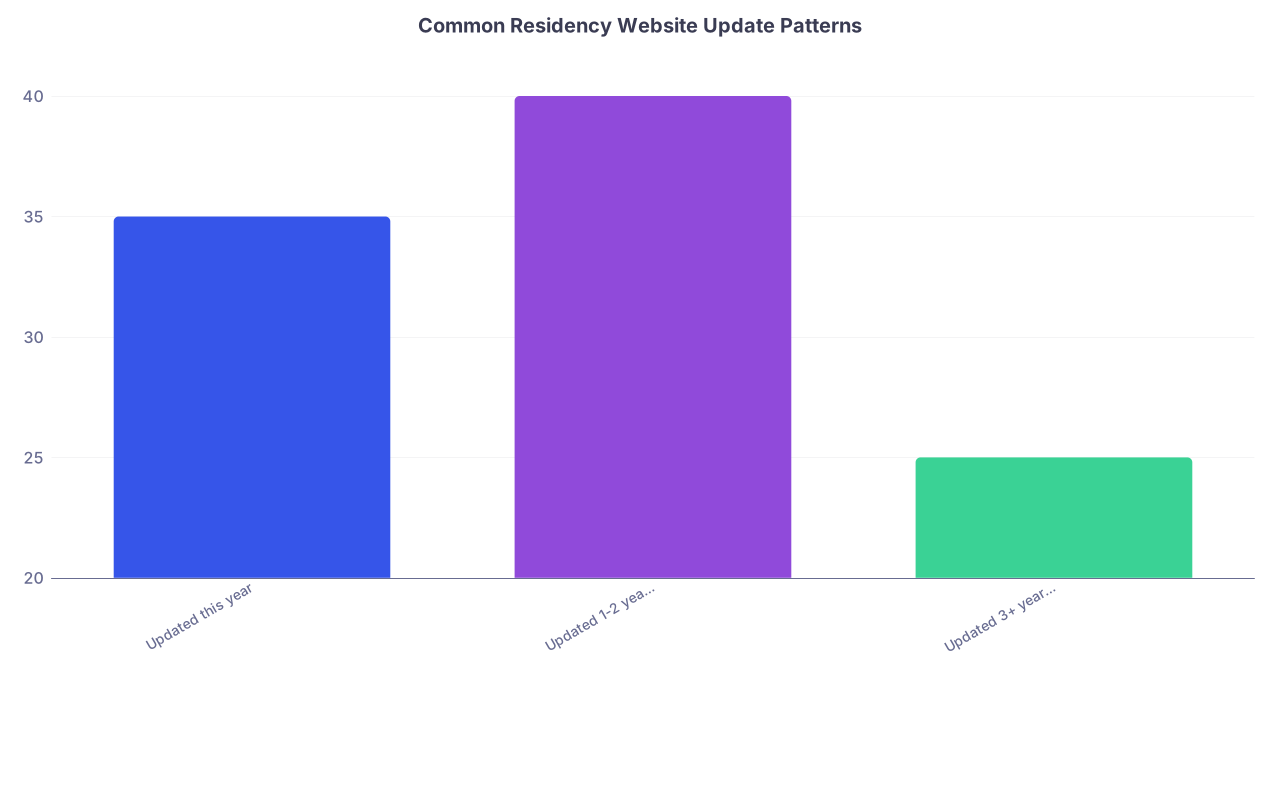
| Category | Value |
|---|---|
| Updated this year | 35 |
| Updated 1-2 years ago | 40 |
| Updated 3+ years ago | 25 |
You are not just looking for “recent.” You are looking for consistency: if one page is from 2024 but another core page is clearly stuck in 2020, that mismatch is a story. Programs that function well usually communicate well.
3. “Our Residents” Page That Doesn’t Add Up
A residents page can tell you more about a program’s culture than an entire interview day—if you stop and actually study it.
Here are the mistakes applicants keep making:
- Not noticing when there are obviously missing residents
- Example: They say “10 residents per class,” but you only see 7 PGY-2s listed. Where did the others go?
- Accepting “Under construction” for months, especially mid-application season
- Ignoring a lack of diversity so extreme it borders on absurd—every headshot same gender, same ethnicity, same medical school type
Red flags:
- No resident medical schools listed at all
- No chief residents clearly identified
- “Residents” page only shows PGY-1s and no seniors (attrition? culture problem? rushed rebuild?)
If residents have left or the program has had to downsize, that will often show up as weird gaps and inconsistencies in the resident list. Do not gloss over that.
4. Hidden or Vague Information About Call, Hours, and Workload
You should not tolerate fuzziness about how much you will be in the hospital and what your nights look like.
Problem patterns:
- “Residents participate in a variety of inpatient and outpatient experiences” with no call frequency listed
- No mention of night float or how many weeks of nights you do per year
- Vague phrases like “our residents work hard but also have time to enjoy the city” with zero structure or numbers
A good program does not hide this. They publish something like:
- “PGY-1: 4 weeks of night float, q4 call on X rotation”
- “No 24-hour call after PGY-1” or “All calls converted to night float”
- “Typical weekly hours on inpatient: 60–70”
If you have to ask three residents on interview day and get three different, hesitant answers, and the website gives you nothing concrete, you are staring at a major red flag.
5. Faculty and Leadership Pages That Are Ghost Towns
A faculty page that looks like it was built in 2012 and never touched again is not just ugly—it is telling you about academic structure and leadership stability.
Red warning signs:
- Half the faculty with no academic rank listed (Assistant/Associate/Professor)
- Few or no photos, just a list of names
- Emails missing or clearly outdated institutional addresses
- No program director bio or only a single sentence like “Dr. X is our Program Director”
But the biggest one: leadership turnover that is obvious on the website but not clearly addressed.
Example scenario I have actually seen:
- Website: “Interim Program Director – Dr. A” with a one-sentence bio
- Interview day: They casually mention they “recently transitioned leadership”
- No mention of the previous PD, no messaging about vision, no timeline
Interim leadership can be fine. Hiding the story of why there is interim leadership is not fine.
You want to see:
- PD and APD biographies with clear academic interests
- Evidence that multiple faculty are invested in education (roles, awards, teaching titles)
- Stable leadership, not a revolving door of interim titles
6. Research, Education, and “Curriculum” That Is All Buzzwords, No Substance
Do not fall for the phrase salad: “robust scholarly activity,” “cutting-edge curriculum,” “innovative educational framework.” This is often code for “we know we are supposed to say this, but we do not have anything real to point to.”
A serious education culture will show its work.
Look at what they actually publish:
- Do they list conferences, journal clubs, board review sessions with real schedules?
- Do they describe specific research tracks, protected time, or a research requirement?
- Do they list recent resident publications or presentations?
| Aspect | Strong Program Website | Weak Program Website |
|---|---|---|
| Conferences | Specific days/times and topics listed | “Weekly conferences” only |
| Research Output | Recent resident publications named | “Opportunities available” |
| Tracks/Pathways | Details, requirements, sample projects | Just a list of track names |
| Board Prep | Named resources, schedules, expectations | “We support board success” |
If their “Curriculum” page is two paragraphs and one stock photo, they are not invested in education. They are checking a box.
7. Alumni Outcomes That Are Missing, Vague, or Manipulative
This one is huge. Alumni destinations are one of the clearest signals of what a program actually does for its residents.
Red flags:
- No alumni list at all
- Alumni page that stops 3–4 years ago
- Only the “top” matches listed (the one person who went to a big-name fellowship) with no mention of the rest of the class
- “Our graduates pursue diverse careers” with nothing more concrete
Sometimes you will see cleverly framed claims like:
- “Our graduates have matched at programs such as MGH, UCSF, Johns Hopkins…”
But no years, no numbers, and no names. That can mean they are referencing a tiny handful over an entire decade.
You want to see something like:
- A list of each class and where each resident went (fellowship vs hospitalist vs primary care, etc.)
- A consistent pattern that fits what you want: e.g., solid mix of community jobs and some fellowships if that is your goal
If you cannot tell what residents usually end up doing, you are not evaluating a program—you are gambling.
8. Compensation, Benefits, and Contract Details That Are Buried or Absent
If a program expects you to sign a contract and devote your life to them for 3–7 years, they can at least be transparent about what they pay you and how they treat you.
Watch for:
- Salary tables that are clearly outdated (e.g., “Effective July 2019”)
- No mention of educational funds, exam fee coverage, or conference support
- Vague language like “competitive salary and benefits” with no numbers
This is not about squeezing every last dollar. It is about transparency and respect. Programs that value residents will usually make this information easy to find. Those that underpay or nickel-and-dime residents tend to bury or obscure it.
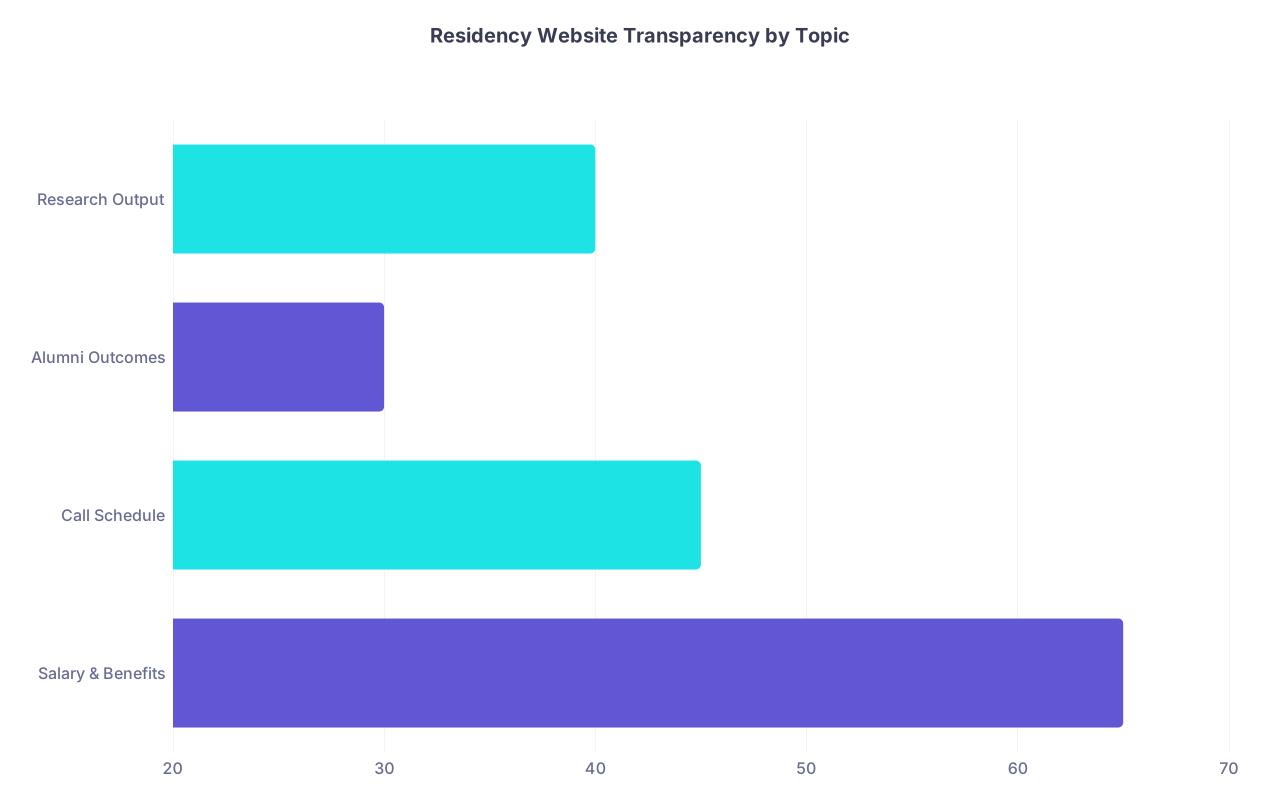
| Category | Value |
|---|---|
| Salary & Benefits | 65 |
| Call Schedule | 45 |
| Alumni Outcomes | 30 |
| Research Output | 40 |
If an institution posts GME-wide salary scales but the program website never links to them, that is lazy at best and evasive at worst.
9. Glossy Marketing That Does Not Match Resident Reality
You are probably smart enough to notice when the drone footage of the city skyline is doing more work than the actual program description. But many applicants still let aesthetics override substance.
Common trap:
- Professionally produced video with music, drone shots, faculty in suits, residents laughing in slow motion
- Zero residents actually talking—just voiceover from administration
- No mention of challenges, growth areas, or honestly acknowledged pain points
Real programs that know who they are will talk about downsides. Commuting. High volume. Underserved populations with complex social challenges. They will frame it as part of their mission and training, not pretend everything is effortless.
If all you see is marketing polish and zero grit or nuance, be suspicious.
Then cross-check: Did what you saw on interview day match the online branding?
- If the website says “strong female leadership” but every conference you joined was run by men, that mismatch is a data point.
- If the website shows a super diverse group of residents, but your interview room had 10 residents that all looked and sounded exactly the same, another data point.
Marketing can lie. Consistency is harder to fake.
10. DEI and Wellness Pages That Feel Performative
Diversity, equity, inclusion, and wellness have become standard tabs on many residency websites. The existence of these pages means nothing by itself. The content tells you everything.
Red flag patterns:
- A DEI page that is one paragraph and one stock photo of a diverse group of people
- No actual data: no demographic breakdowns, no specific initiatives, no named leaders in DEI roles
- Wellness page that only lists yoga classes and “free snacks” but ignores systemic issues like coverage for medical appointments, protected time, mental health access
If a program is serious about this, you tend to see:
- Named DEI committee members (often including residents)
- Recurring events or initiatives with dates and descriptions
- Concrete policies: parental leave, lactation accommodations, disability support
- Wellness infrastructure tied to scheduling and culture, not just snacks and “resilience”
If the DEI or wellness content feels like a checkbox exercise to you, it probably feels like that to the residents too.
11. Sloppy Errors, Broken Links, and General Neglect
This is the unglamorous one, but it matters. You are evaluating a system that will handle your schedule, pay, evaluation, and board eligibility. If they cannot maintain a functioning website during recruiting season, what else falls through the cracks?
Things I always tell applicants to check:
- Are there broken links on key pages (curriculum, leadership, application information)?
- Do you see obvious copy-paste errors from other programs or older versions?
- Do they misspell faculty names in different ways on different pages?
- Is the information architecture a mess—three different “Apply” links that disagree with each other?
Individually, any of these could be minor. Collectively, they are a pattern of organizational sloppiness.
This does not always mean “bad training.” But it usually means high friction for residents. Lost forms. Confused rotation assignments. Last-minute schedule changes “because the system is a mess.”
If that sounds familiar from medical school, you already know how exhausting it is.
12. No Honest Discussion of Future Directions or Program Growth
You are not just ranking what the program is today. You are ranking what it might become during your years there. But many websites act like the program is frozen in time.
Red flags:
- Zero mention of upcoming changes (new rotations, new hospitals, new EMR) even though residents hint at them
- Expansion in class size with no discussion of how they are adding faculty or resources
- Major institutional upheaval—mergers, acquisitions, closures—barely acknowledged
A mature program will say something like:
- “We are increasing our class size from 10 to 12 over the next 2 years and have added X and Y rotations and additional faculty to support this.”
- “We are transitioning to a new hospital campus in 2026; here is what will change for residents.”
If you hear about these things only through rumor, off-hand comments, or whispered resident side conversations—and see nothing on the website—that gap is a red flag. Leadership either does not have a plan or does not feel obligated to be transparent.
How to Use These Red Flags Without Overreacting
Do not make the opposite mistake and throw away a good program because of one poorly updated page. The point is not to panic. The point is to infer.
Look for patterns:
- One or two minor issues: probably noise
- Repeated vagueness, outdated content, and missing key data across the site: that is signal
Combine with:
- Your interview day impressions
- Resident tone when asked direct questions
- Word-of-mouth from people you trust
The biggest mistake is pretending the website tells you nothing. It tells you exactly how the program chooses to present and prioritize information about itself. Ignoring that is reckless.
Bottom Line: What You Must Not Overlook
Keep these core points in your head as you finalize your rank list:
- Vague, outdated, or obviously curated websites are usually hiding uncomfortable truths—often about workload, attrition, or outcomes.
- Strong programs show their work: clear resident lists, real curricula, honest outcomes, and transparent compensation and policies.
- Do not hand over 3–7 years of your life to a place that cannot even be straightforward on its own website. If they are fuzzy online, expect worse once you sign.
Protect yourself. The red flags are often right there on the screen. You just have to stop scrolling long enough to see them.