The most dangerous part of your residency contract is the section you skim because you’re too tired, too excited, or too trusting: the call schedule language.
You can survive mediocre conference schedules, clunky EHRs, and ugly call rooms. But a bad call structure, baked into your contract with vague language and loopholes? That will break you. Physically, emotionally, and sometimes financially.
Let’s walk through how people get burned here and how you can avoid being the next cautionary tale.
Why Call Schedule Red Flags Are So Costly
Everyone obsesses over salary, signing bonus, and relocation money. Meanwhile, call schedule details are trapped in legalese three pages down, under “Duties,” “Hours of Work,” or “On-Call Requirements.” That’s where the landmines sit.
Here’s what you pay when you miss those red flags:
- Sleep debt that no amount of “golden weekends” can fix
- Chronic burnout before you even hit PGY-2
- Missed moonlighting or side income because you’re always recovering from call
- Strain on relationships that never really recovers
- Real safety risks: bad decisions at 3 a.m. that haunt you
I’ve watched interns sign contracts for “q3–4 call, average 60–80 hours per week” thinking, “That’s just residency.” Then three months in they’re doing “q2 in practice, plus home call that functions like in-house,” charting post-call at 3 p.m., and wondering how they got blindsided.
They didn’t get blindsided. They ignored the red flags.
The Sneaky Contract Phrases That Should Make You Stop
Let’s get concrete. These are the phrases that should make you grab a pen and start asking hard questions, not just initial and move on.
1. “As Assigned by the Program” With No Limits
On its own, “as assigned by the program” is normal. Residency has variability. The problem is when it appears alone, without any numerical guardrails.
Look for things like:
- “Resident shall take call as assigned by the Program Director.”
- “Resident agrees to participate in in-house and home call as needed to ensure patient care coverage.”
- “Resident will comply with all scheduling and coverage requirements as determined by the Program, in compliance with ACGME duty hour standards.”
That last part sounds safe—“in compliance with ACGME”—but it’s not a protection. It’s a ceiling, not a target. Programs can drive you right up to that ceiling and still claim everything is “compliant.”
If you don’t see any of the following, that’s a problem:
- Maximum number of call nights per month
- Distinction between in-house and home call
- Specific rules for post-call (e.g., guaranteed relief time)
If you sign a contract that only says “as assigned,” you just handed over all leverage. Do not make that mistake.
2. “Home Call” That’s Actually In-House Call In Disguise
This trick is common, especially in surgical and some subspecialty services.
On paper:
“Home call” sounds gentle. Maybe you imagine your phone on the nightstand, one or two calls, then back to sleep.
In reality:
You’re physically in the hospital until midnight “finishing cases,” then “free” to go home, but your pager explodes all night. Then you round at 6:00 a.m. The program reports this as home call (“the resident is free of clinical duties while at home”) and magically, duty hours are “fine.”
Red flag language:
- “Home call is not counted as duty hours unless called in to the hospital.”
- “Resident is expected to be immediately available during home call.”
- “Home call may convert to in-house call at the discretion of the attending or program.”
If they’re calling you in constantly, it isn’t home call. It’s poorly disguised 24-hour coverage.
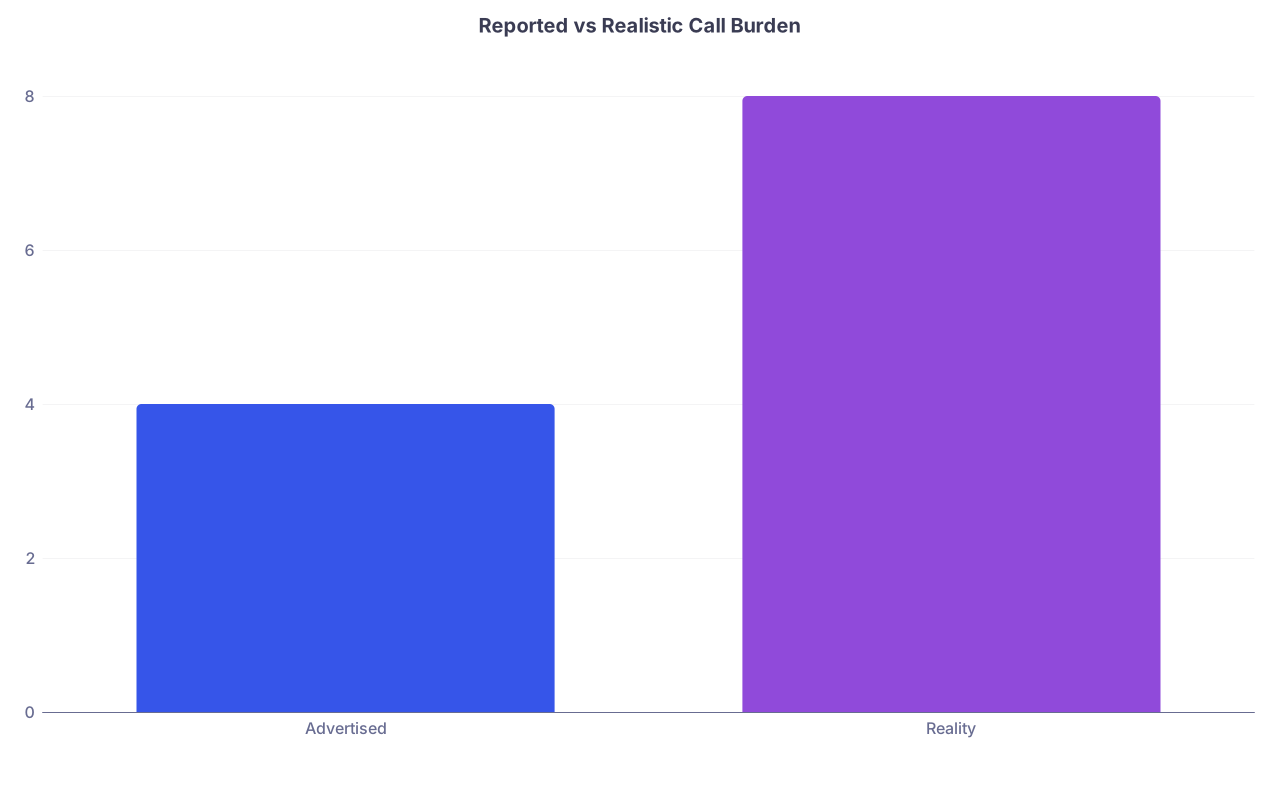
| Category | Value |
|---|---|
| Advertised | 4 |
| Reality | 8 |
(A common real-world pattern: they promise 4 “light” calls a month; residents experience 8 nights that effectively function as call because of stay-late culture and “voluntary” extra coverage.)
3. “Average” Language With No Definition
Any time you see the word “average” in your contract, your guard should go up.
Examples:
- “Average 60–80 hours per week.”
- “Average one in four nights on call.”
- “Average duty hours will not exceed ACGME standards.”
Average over what?
- The whole year?
- One rotation?
- Entire residency class?
- Including electives where you barely hit 40 hours?
I’ve seen programs hide brutal ICU or trauma months by diluting them with electives and “research blocks.” On your worst month, you won’t care that your “average over the year” is technically under 80. You’ll care that you’re on q2 or q3 and falling apart.
You want ranges by rotation and confirmation from current residents, not soothing averages on paper.
4. No Explicit Post-Call Protection
Huge miss if you don’t look for this.
Some contracts say:
- “Resident may be relieved post-call as patient care and educational needs permit.”
Translation: If the service is slammed or the attending likes “old school training,” you’re staying. I’ve watched residents on paper “post-call” still be there at 4 p.m. because “we have to finish sign-out” or “it’s important you see this interesting case.”
What you actually want to see somewhere (contract, handbook, or written policy):
- Clear rule for leaving by a set time post-call
- Assurances that didactics or “optional” teaching don’t trap you on-campus
If it’s vague, assume it won’t benefit you.
The Structural Red Flags Hidden Behind Call Language
This isn’t only about hours. Call schedule wording often exposes much deeper program problems.
1. Programs Chronically Using Residents as Cheap Staffing
Look for clues like:
- “Resident may be required to assume additional call responsibilities to cover service needs.”
- “Resident may cover for absent residents or fellows as necessary.”
If “service needs” constantly override your supposed schedule, you’re dealing with a staffing band-aid program. They rely on resident labor instead of hiring nocturnists, advanced practice providers, or more attendings.
You’ll see this in:
- Weak or absent night float systems
- Frequent “emergency coverage” texts
- Pressure to pick up extra call “for the team”
If they needed three residents at night but only got funding for two, you are the third. On paper you’re “q4.” In reality, you’re plugging gaps all the time.

2. Weak Enforcement of Duty Hour Rules
Here’s the quiet truth: ACGME rules exist, but enforcement inside programs is wildly variable.
Call schedule red flags for duty hour abuse:
- No written explanation of how duty hours are tracked
- “Residents are responsible for self-reporting duty hours” with cultural pressure not to “get the program in trouble”
- Duty hour violations framed as resident “time management” failures, not structural problems
You’ll hear:
- “Just don’t log every hour you’re here.”
- “Finish notes at home and don’t count that time.”
- “You’re post-call, but just stick around for one more admission.”
If your contract name-drops ACGME but doesn’t clarify real protections or tracking, that’s not a duty hour safeguard. That’s legal cover.
3. Unclear Distinction Between PGY Levels and Call
Another classic oversight: assuming call gets better each year.
Sometimes it does. Sometimes it just…doesn’t.
If the contract (or attached policy) doesn’t specify:
- Which PGY levels do in-house vs home call
- Whether seniors transition to more supervisory, less scut-heavy call
- Changes in call frequency as you advance
…then don’t expect it to magically improve. I’ve seen PGY-3s still doing brutal cross-cover that should have been delegated or improved with staffing.
| Program Type | In-House Call | Home Call | Night Float Presence |
|---|---|---|---|
| Strongly Structured | q4 max | Limited | Yes, defined blocks |
| Vague/Red Flag | As assigned | Heavy | Minimal or none |
| Balanced | q4–q5 | Moderate | Yes, partial |
The Contract vs Reality Problem: What You’ll Be Told
Do not rely solely on what’s written. And absolutely do not rely solely on what the PD says on interview day.
You’ll hear lines like:
- “Our call is very manageable.”
- “We respect post-call time.”
- “We’re ACGME compliant; we take that seriously.”
- “We’ve just restructured our night float system. It’s much better now.”
Some of that might even be true. For someone. But you’re not signing up for marketing; you’re signing up for the worst-week-of-the-year reality.
Your job is to cross-check:
- Contract language
- Resident handbook / policy documents
- What current residents quietly tell you when no admin is around
Programs with nothing to hide welcome those questions. Programs that shift, deflect, or minimize? You just found a red flag.

| Step | Description |
|---|---|
| Step 1 | Receive Contract |
| Step 2 | Locate Call Language |
| Step 3 | Request written clarification |
| Step 4 | Verify with handbook |
| Step 5 | Talk to current residents |
| Step 6 | High risk red flag |
| Step 7 | Lower but monitor |
| Step 8 | Clear limits? |
| Step 9 | Stories match? |
How To Actually Protect Yourself (Without Being “That Applicant”)
You don’t need to come in swinging like a lawyer. But you do need to stop acting like you’re powerless. You do have leverage before you sign.
Step 1: Ask for the Call Policy in Writing
Not just the contract. Ask for:
- Resident handbook
- Call policy or scheduling policy (sometimes separate)
- Any recent changes to call structure (they love to brag about this if it’s legit)
Phrase it simply:
“Before I sign, could I see the written call and duty hour policy that applies to residents at my PGY level?”
If they dodge, delay, or say, “It’s being updated,” assume the current version is something they don’t want you to see.
Step 2: Talk to Current Residents Strategically
You’re not looking for vague vibes. You’re trying to trap inconsistencies.
Ask:
- “On your worst month, how many nights are you in-house or effectively on call?”
- “What time do you usually leave post-call? Not the rule—the reality.”
- “How often do you feel pressured to under-report duty hours?”
- “Has anyone gotten in trouble for accurately logging their hours?”
- “Does call improve as you become a senior, or is it just different work?”
Listen for that long pause before the answer. That’s your answer.

Step 3: Pin Down Vague Language Before You Sign
You won’t rewrite the whole contract. That’s fine. But you can get clarifying emails or addenda. These matter later if things go sideways.
Examples of specific questions you can send:
- “Can you confirm that in-house call for PGY-1s is no more frequent than q4 on average per rotation?”
- “For home call, how is time counted toward duty hours, especially if we’re handling frequent overnight calls?”
- “What is the expected latest time for leaving post-call on standard rotations?”
- “Is there a cap on the number of consecutive days worked, including call shifts?”
Get answers in writing. Even an email from the PD or coordinator is helpful. They’re less likely to blatantly contradict their own written statements later.
Step 4: Learn to Spot the “Culture Excuses”
There are programs where the contract looks okay, but the culture destroys any protections you think you have. The red flags sound like:
- “No one actually leaves at that time; we all pitch in.”
- “Sure, duty hours are logged, but we’re a hard-working program.”
- “If you log every hour, it looks bad on us during site visits.”
- “We’re not a lifestyle residency.”
Translation: whatever call protections exist on paper get steamrolled by guilt and peer pressure. If the most honest residents roll their eyes when you mention “post-call,” you’ve learned what you needed.
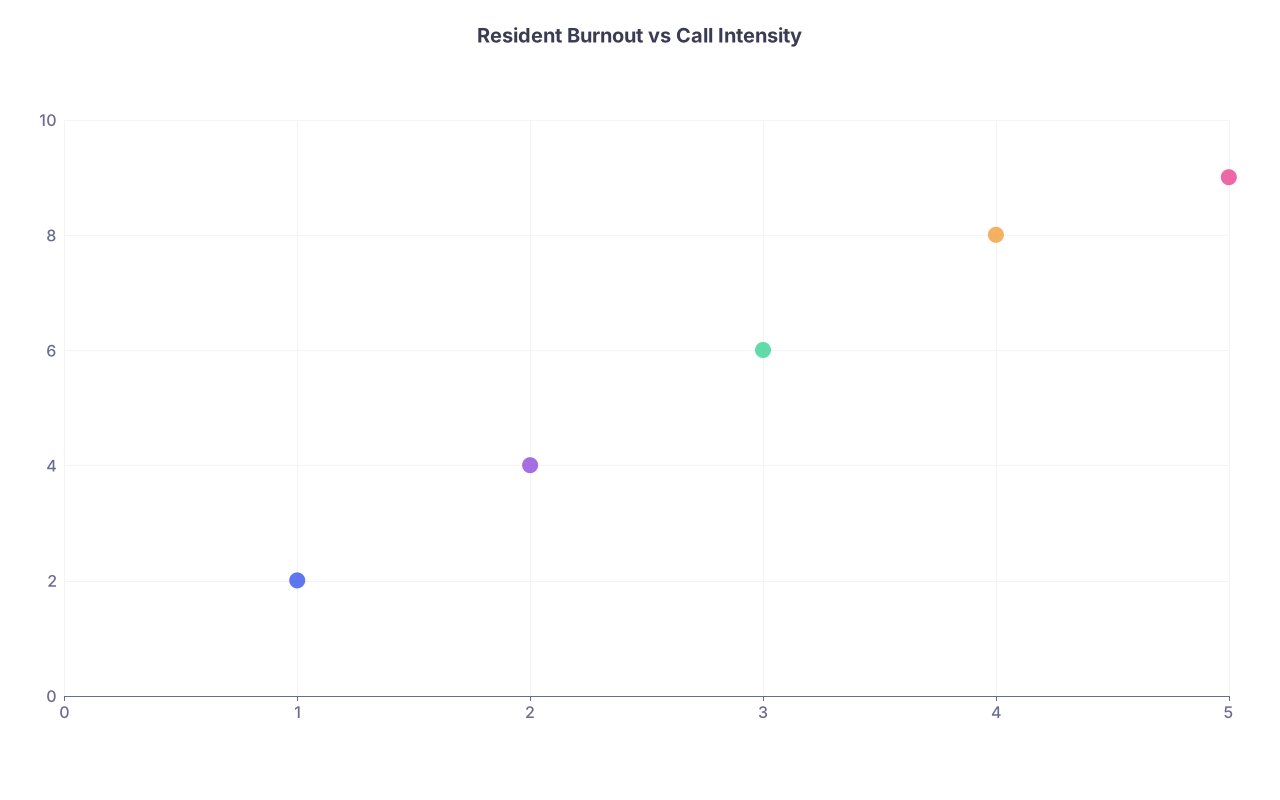
| Category | Value |
|---|---|
| Light call | 1,2 |
| Moderate call | 2,4 |
| Heavy call | 3,6 |
| Hidden heavy call | 4,8 |
| Abusive call | 5,9 |
(X-axis = call burden from 1–5, Y-axis = burnout severity from 1–10. The “hidden heavy call” group—where expectations weren’t clear—is where people feel most trapped.)
Special Cases That Catch People Off Guard
A few scenarios are repeat offenders.
1. Community Programs Tied to Multiple Hospitals
Residents rotate through a patchwork of sites. Call rules can vary wildly by hospital.
Watch for:
- “Call responsibilities vary by site and are determined by local needs.”
- “Residents may be required to comply with call policies at affiliated hospitals.”
You might be fine at the main site and destroyed at the community affiliate that doesn’t really “believe” in duty hours.
Ask explicitly:
- “Which sites have the heaviest call?”
- “Do call protections and post-call policies apply uniformly across all affiliated hospitals?”
If nobody can answer cleanly, assume there’s a bad rotation they don’t want to describe.
2. New Programs or Newly Expanded Classes
Newer programs often oversell “flexibility” and “opportunity to shape the program.” Translation half the time: the call schedule is chaos.
Red flags here:
- Rapidly expanding class size without clear increase in attending or nocturnist support
- “We’re still working out the schedule details; you’ll help define that.”
- Heavy reliance on residents to cover services without prior track record
You’re not joining a well-oiled machine; you’re joining a startup being built on your back.
3. Subspecialty and Surgical Fellowships
If you’re looking at fellowships, the bait-and-switch can be nastier.
Sometimes the contract says very little about call, because they assume you “know what you’re signing up for.” Dangerous assumption.
Ask:
- “How many weekends per month are you on call?”
- “Do fellows ever pull resident-type cross-cover shifts at night?”
- “How many nights are you truly not available—pager off—per month?”
Fellowship can be amazing or absolutely exploitative. The call language often reveals which.
Why This Matters for the Future of Medicine, Not Just Your Sanity
This isn’t only about you being tired. Call structure is a bellwether for how a program sees trainees:
- As learners with rights and limits
- Or as cheap 24/7 labor to keep the machine running
Programs that abuse call now are the same ones that will resist safer scheduling, ignore wellness data, and burn out generation after generation. That culture bleeds into patient care quality, error rates, and long-term physician retention.
If you shrug and sign anyway, assuming “this is just how it is,” you feed that system. When applicants start walking away from call-abusive programs explicitly because of call, change happens faster. I’ve seen it. Programs suddenly “restructure night float” when recruitment suffers.
You have more power than you think—before you sign. After? You’re negotiating from a position of exhaustion and sunk cost.

| Stage | Activity | Score |
|---|---|---|
| Training | Heavy abusive call | 5 |
| Training | Hidden heavy call | 4 |
| Early Career | Avoid similar jobs | 4 |
| Early Career | Exit clinical practice early | 3 |
| System Effects | Staff turnover | 4 |
| System Effects | Reduced mentorship | 3 |
FAQ: Call Schedule Red Flags in Contracts
1. If the contract only mentions “ACGME-compliant duty hours,” is that enough protection?
No. That’s the bare legal minimum, not a promise of humane scheduling. ACGME compliance still allows you to be worked right up to 80 hours per week with frequent call. You need more detailed expectations—call frequency, post-call policies, and whether home call is counted—plus confirmation from current residents.
2. Can I actually negotiate call schedule terms in a residency contract?
You almost never renegotiate the entire call structure as an individual resident. But you can and should ask specific clarifying questions and get answers in writing. You can also use red-flag answers as a reason to choose a different program before signing. Your real leverage is in choosing where to go, not rewriting their system.
3. What if residents tell me the call is bad, but the contract looks fine?
Believe the residents. Paper looks good in many places that still destroy people in practice. Cultural norms, under-enforced policies, and “expected” extra work time can completely erase what’s technically written. If lived experience and written policy don’t match, assume you’ll get the worst version.
4. Is heavy call always a bad sign, or is some of it just part of training?
Some intense rotations are normal and can even be valuable. The red flag isn’t heaviness alone—it’s lack of transparency, lack of limits, and a culture that guilt-trips you for needing rest or accurately logging hours. Intense but honest and well-supported is tolerable. Intense, hidden, and shame-driven is toxic.
5. What’s the single biggest call-related mistake residents make when signing contracts?
They accept vague phrases like “as assigned,” “average,” and “ACGME-compliant” without drilling down. They don’t talk to current residents about the worst months. They assume misery is normal and unavoidable, so they ignore the warning signs. Do not do that. Demand clarity, cross-check with people living it, and be willing to walk away from a program that shrugs off your questions.
Key points to keep:
- Vague call language—“as assigned,” “average hours,” “home call”—isn’t harmless; it’s how programs hide brutal schedules.
- Your only real leverage is before you sign: get written policies, confirm with current residents, and walk away from places that dodge specifics.
- Call structure isn’t just about your fatigue; it’s a window into how a program values (or exploits) its trainees and, ultimately, its patients.