
The residents are talking to you in code. If you miss the code, you will walk straight into a toxic program with a big smile on your face.
The quiet resistance: how residents actually warn you
Let me be blunt: residents are not allowed to tell you the truth on interview day.
Every program has some version of the same speech from leadership before interview season:
“Be positive. Don’t air dirty laundry. Emphasize the strengths. If you have concerns, bring them to us, not the applicants.”
I’ve sat in those meetings. I’ve heard chiefs get pulled aside after saying one mildly negative thing to a candidate. People have been “talked to” by the PD for “hurting recruitment.” In some places, evaluations and fellowship letters are quietly influenced by how “loyal” you are during interview season.
So no, residents are not going to look you in the eye and say, “This place is malignant, run.”
Instead, good residents have evolved a whole underground language. Half-truths, tone, what they do not say, how they say it, and when they suddenly go quiet.
Let me walk you through the signals they actually use.
The most honest part of the day: the resident-only session
If you want to know whether a program is toxic, the classroom lectures and faculty presentations are almost useless. The real information is in that “resident lunch,” “resident-only Q&A,” or “informal breakout” where no faculty are supposed to be present.
That’s where the quiet resistance happens.
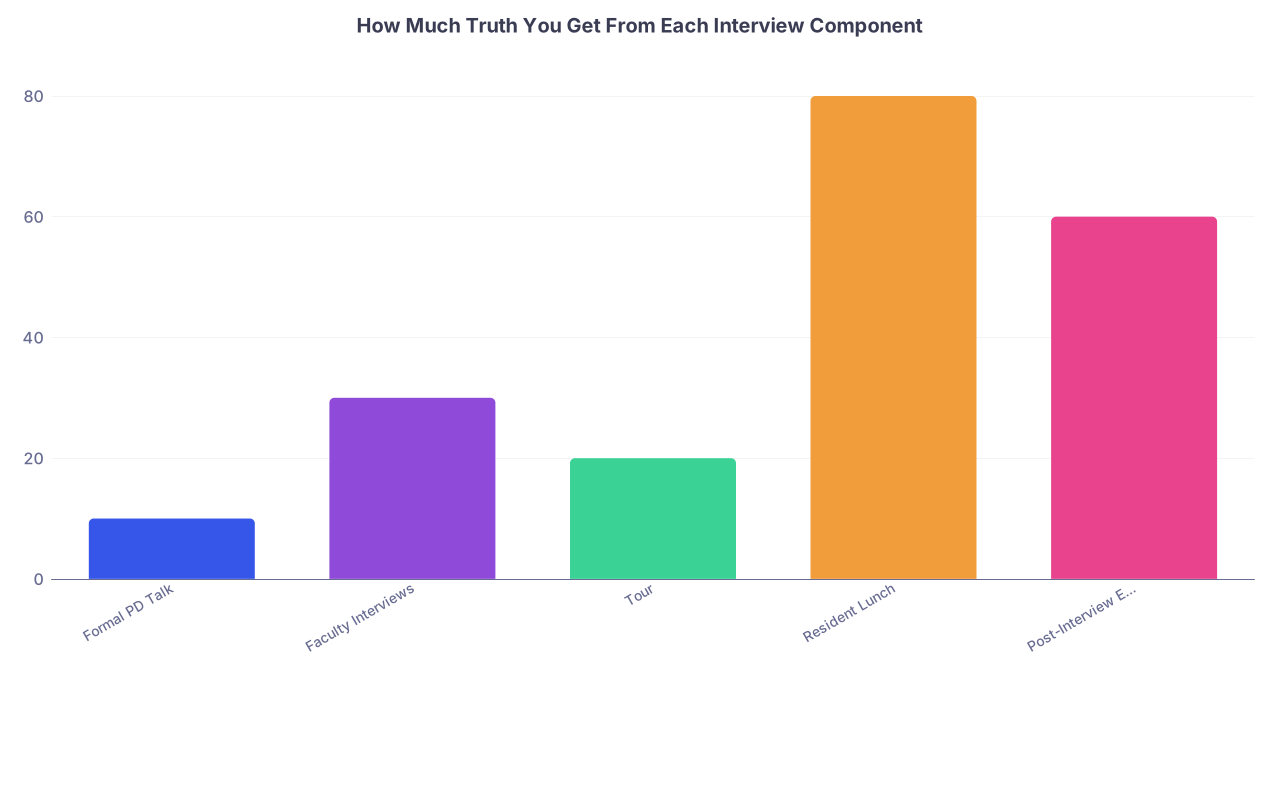
| Category | Value |
|---|---|
| Formal PD Talk | 10 |
| Faculty Interviews | 30 |
| Tour | 20 |
| Resident Lunch | 80 |
| Post-Interview Emails | 60 |
1. The overly polished, unanimous script
You walk into the resident room. Everyone is smiling the exact same plastic smile. Every answer is instant, smooth, and the same.
You ask: “How is the workload?”
Three residents, in chorus: “Busy but manageable!”
You ask: “Do you feel supported?”
“We’re like a family!”
You ask about wellness. “We have a wellness committee!” “Free pizza!” “Retreat!” No one ever uses words like “time,” “sleep,” “protection,” “backup,” “we are never alone.” Just vague “wellness stuff.”
Behind the scenes, what’s going on is simple: they’ve been coached. And more importantly, they’re scared.
I’ve seen PDs email talking points before interview season. I’ve watched senior residents tell interns: “Don’t talk about X rotation. Don’t mention the ED coverage. Definitely don’t say the word ‘malignant’ even as a joke.”
When the script is too smooth and no one breaks from it, that’s not “we’re really aligned.” That’s “we know we’ll get in trouble if we say the wrong thing.”
Normal, healthy programs have variation. One resident might say “I love it here but the ICU is rough.” Another might say, “Honestly, the ED months are heavy but night float is chill.” Differences, nuance, even small complaints. That’s what you want.
Zero variation? Be suspicious.
2. The one honest resident in the corner
There is almost always one. Not always the loud one. Often the quieter PGY-2 or PGY-3 at the end of the table who isn’t making eye contact with leadership when they pop in.
You ask a slightly real question like:
“How are you guys doing with duty hours and burnout?”
The loud, PD-favorite resident jumps in: “Oh, we’re really well-balanced, I never log over 80, and we’re super supported!”
Then the quieter one, after a pause, adds: “We do work a lot. Some months are tough. Especially X rotation. But the seniors really look out for you.”
That second sentence? That’s where the truth lives.
In a toxic program, the “one honest resident” will start a sentence, glance at the doorway, and course-correct mid-answer. You’ll see it if you’re paying attention:
“I mean, last year we had some issues with… well, things have been improving.”
That chopped-off clause is your red flag.
The code words and phrases residents use when they can’t be blunt
Residents rarely say, “It’s bad.” They use phrases that sound fine if a PD is standing nearby but are clearly warnings if you’ve been on the inside.
Here’s the translation dictionary you actually need.
| What they say | What it often means |
|---|---|
| "We’re very independent here." | You will be alone more than you should be. |
| "You learn to be very efficient." | The workload is borderline unsafe. |
| "You get a ton of exposure." | Service is huge, work never ends. |
| "We’re like a family." | We trauma-bond over shared suffering. |
| "People who are self-sufficient do well." | There is minimal support or backup. |
| "You have to be a hard worker to thrive." | System is uncompromising and unforgiving. |
| "Administration is working on it." | It’s been bad for years, no change. |
A few of the more subtle ones I’ve heard residents use as quiet warnings:
“You definitely get your 80 hours’ worth.”
Translation: We hit 80, sometimes above, and you will not be leaving early.“We really know our patients well because we’re always here.”
Translation: The workload keeps you perpetually in-house.“You become very prepared for attending life.”
Translation: You are functioning as an attending far earlier than you should.“Graduates feel ready to practice anywhere.”
Translation: We throw you into situations you probably shouldn’t be in.
Pay more attention to how they say these than the words themselves. Forced laugh. Side glance. That little shrug that screams “I’m trying not to get in trouble.”
Who is in the room… and who’s mysteriously missing
Programs choreograph resident presence like a stage play. Which is exactly what it is.
1. Only chiefs and golden children
If everyone at lunch is a chief, rising chief, or a very polished PGY-3, that’s deliberate. Those are the most loyal and least likely to talk.
A healthy program usually has a mix: interns, PGY-2s, seniors. The PGY-1s are sometimes too new to fully know everything, but they’ll react more honestly. PGY-2s often crack and accidentally tell you things. That’s why some malignant places “forget” to invite them.
If interns are “on nights,” “all on busy rotations,” or “not available” at every single interview date, it’s not an accident. I’ve seen chiefs explicitly schedule interns away from interview lunches because they “complain too much.”
2. The resident that everyone talks around
You’ll sometimes notice this: one resident is quiet, withdrawn, looks tired. When you ask a tough question, they start to say something and another resident jumps in on top of them.
I remember an applicant lunch where a PGY-1 began, “Honestly, the ED month was brutal—” and the chief immediately cut in: “But that’s changing! We’re working closely with the ED to improve things and it’s much better for the newer class.”
That PGY-1 looked down and didn’t say another word for ten minutes.
That silence? A louder message than anything the chief said.
If you see someone trying to talk and repeatedly getting overridden, that tells you the internal culture: hierarchy, suppression, image > honesty. Toxic programs don’t just oppress residents with workload; they control the narrative.
The nonverbal red flags: body language and fatigue
You cannot fake how a truly supported resident looks by January.
Everyone’s tired in residency. That’s baseline. But there’s “I’m a resident tired” and there’s “I’m being slowly crushed” tired. Candidates can tell the difference if they stop staring at the PowerPoint and actually look at the people.
Here’s what I watch on interview days:
Eyes during certain questions. Ask about night float or call. Watch if the smiles drop for a half second before they answer. You can see the internal “oh god, that rotation” flash across faces and get smothered.
Who looks physically wrecked. One or two tired faces? Normal. When half the table has that hollowed look, dark circles, and flat affect, across multiple interview days? That’s not a bad call month. That’s the culture.
Laughter pattern. Healthy programs have residents who genuinely laugh at each other’s jokes, tease, tell stories. In malignant programs, the laugh is brittle, obligatory, reactive. It dies quickly.
What happens when a faculty member unexpectedly walks in. I’ve watched rooms go from honest, unguarded answers to tight-lipped, clipped sentences the moment a PD or APD steps into the doorway “just to say hi.”
If you ask a question and a resident glances toward the door before answering, that tells you everything you need to know.
Questions that unlock the truth (and how residents answer when it’s bad)
You’re asking the wrong questions. That’s part of the problem.
“What do you like about this program?” is useless. They’re not going to say, “Not much, honestly.”
Ask questions that force them into narrative, not slogans. Toxic programs struggle with real stories, because stories leak truth.
Ask things like:
“Can you walk me through your last golden weekend? What did your schedule look like leading up to it?”
Healthy resident: specific, recent, casual. “Oh yeah, last weekend I actually got both days. The week before I was on wards but pretty reasonable, out by 5 most days.”
Toxic program resident: vague, reaching back months. “Uh… I think last… maybe November? Schedules vary a lot. You get days off, but it depends.”“If you had to change one thing about the program right now, what would it be?”
Healthy: they’ll tell you something real but finite. “I’d fix the EMR. I’d reduce the number of clinics on one rotation. I’d improve communication with the ED.”
Toxic: they dodge or go abstract. “Every program has issues.” “We’re in a period of transition.” “Administration is aware of some challenges.”“How has the program responded when residents have given critical feedback?”
Healthy: “We complained about X, and then they did Y. It took a while, but it actually changed.” Specific example.
Toxic: “We’ve brought things up. They’re… working on it.” Same phrase every time.“Do people ever leave the program or switch out?”
Everyone will say “occasionally.” What matters is the follow-up. In a healthy place: “We had one person leave for family reasons,” or “One person switched specialty and we still hang out with them.”
In a toxic place: a pause, a glance, and then something like: “We’ve had some attrition but that happens everywhere.”
It does not happen at the same rate everywhere. Residents know that. They’re trying to warn you without getting documented as “negative.”
The post-interview DMs, emails, and second-look whispers
The truth often comes after the official show is over.
At many places, residents will not say the full truth on interview day. But watch what happens if:
- A resident gives you their personal email “if you have any questions.”
- Someone reaches out on social media after you visit.
- You schedule a “second look” and request time with residents without faculty.
I’ve seen residents use these channels to be more direct. Not “It’s malignant, run,” but:
“I want to be transparent that last year there were some major schedule issues, and some people really struggled.”
“We’ve had some problems with X attending and support has been mixed.”
“Things are improving, but I’d think carefully about whether you want a very high-service program.”
If no one is willing to say a single critical word even privately? Either the program is truly fantastic (rare) or the culture of fear is that thick (more common than you’d like).
Look at who follows up. In solid programs, residents will tell you both pros and cons with a relaxed tone. In malignant ones, you may get overly aggressive recruitment from a single “program spokesperson” resident while others stay quiet or never respond.
The mismatch between marketing and resident reality
This is the part most applicants miss: compare what leadership says in the morning to what residents say in the afternoon. Do they match?
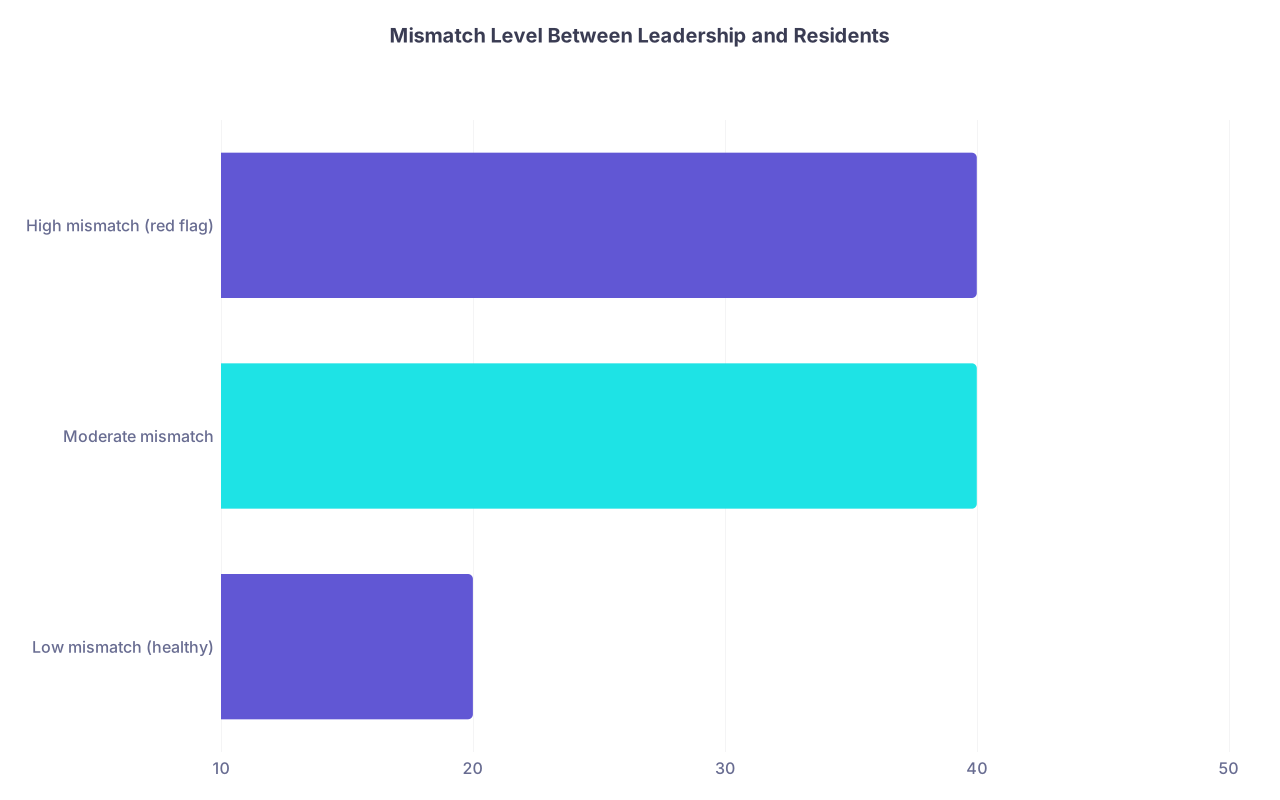
| Category | Value |
|---|---|
| Low mismatch (healthy) | 20 |
| Moderate mismatch | 40 |
| High mismatch (red flag) | 40 |
If the PD spends 20 minutes talking about “work–life balance,” “protected didactics,” and “we never violate duty hours,” but the residents:
- Joke about charting at home every night
- Mention staying late “to help out” even after sign-out
- Talk about “getting creative with how we log hours”
You’ve just been shown the gap between the PowerPoint and the truth.
Programs that are actually supportive do not have to insist so loudly that they are. They show it through resident stories, not slide decks with “WELLNESS” in 72-point font.
Another trick: count how many times leadership uses the word “family.” The more times they say “we’re a family,” the more closely you should watch their residents’ faces. A real functional “family” doesn’t advertise itself that hard.
Future of this dance: will residents ever be allowed to be honest?
You might think this entire game is unsustainable. It is. But change is slow.
Off the record, PDs will admit they know residents talk. Some rely on it: “If someone really wants to know, they’ll read between the lines.” Others clamp down harder every year: stricter messaging, pre-interview “reminders,” selecting only hand-picked residents as ambassadors.
What’s changing is that applicants are starting to cross-check. Reddit, specialty-specific Discords, alumni from their med schools, sub-I gossip. When one program’s “we really care about wellness” is contradicted by five former students who say “they chewed my classmates up,” that reputation sticks.
I’ve already seen programs quietly lose ground in the Match because the residents’ coded warnings got decoded by a few sharp applicants who told everyone behind the scenes.
But until the culture shifts, you will still be sitting in those rooms, trying to interpret half-truths in real time. You cannot rely on anyone outright saving you from a toxic program. Residents are trying to warn you—but they have to protect themselves first.
Your job is to be sharp enough to catch it.
FAQs
1. If residents seem happy and relaxed, can I safely assume the program is good?
No. You can assume it is probably not malignant, but that’s it. Some extremely high-workload programs still have genuinely happy residents because they value the training above all else. The real question isn’t “Are they smiling?” It’s “Can they tell me something they don’t like without tension in the room?” and “Do their stories match what leadership told me this morning?” Happiness alone is too blunt a tool; you need nuance.
2. What if I loved a program but noticed a few of these red flags—should I drop it from my rank list?
Not automatically. What you do is weight it. Ask yourself: can I tolerate a high-service, high-work environment if the training is excellent and the red flags are more orange than blood-red? Then, before you certify your list, reach out privately to a recent grad or a resident one-on-one and ask pointed questions. If the private answers match the public ones, you might still rank it. If the private answers are darker, move it down or off.
3. Is there any totally reliable way to know if a program is toxic before matching?
No. That’s the uncomfortable truth. You can dramatically reduce your risk by reading residents’ coded language, cross-checking with alumni and online reports, and paying attention to mismatches between message and reality, but you cannot get to 100%. What you can do is avoid the obvious landmines: heavily scripted residents, no variation in answers, visible fear around faculty, and zero willingness to admit any flaws. When residents are forced to lie that hard, it is never about something small.
Key takeaways:
Residents are warning you; they’re just doing it in code because the system punishes blunt honesty. Watch for mismatched stories, scripted answers, and the one quieter resident who accidentally tells you the truth. And remember: if everyone in the room looks over their shoulder before they answer, you already have your answer.