
The most dangerous sentence you’ll hear on the trail is: “Yeah, we just lost a few residents, but everything’s fine now.”
No, it’s usually not “fine.” And the way they explain it tells you far more about the program than the fact it happened at all.
Let me walk you through what that phrase actually means behind closed doors—what PDs say in the conference room when you are not there, what faculty whisper about at morning report, and what chiefs argue about on WhatsApp at 1 a.m.
Because residents do leave good programs. But the pattern, the timing, and the spin? That’s where the truth lives.
First: Residents Leaving Is Not Automatically a Red Flag
I’ve sat in those meetings where a PD sighs and says, “We lost Sara to derm; she matched out.” No one is angry. They’re proud. They’ll use her as a recruiting story next year.
There are three broad buckets when a program “just lost a few residents”:
- Benign or even positive loss – career shifts, couples match, family relocation, competitive re-match.
- Neutral, sad but understandable loss – medical leave, serious family issues, visa disaster, personal crises.
- Structural, toxic, or systemic loss – burnout, bullying, unsafe workload, chronic under-support, residents fleeing en masse.
PDs will present all three to you in almost the same polished language.
You’re not trying to detect whether a resident left. You’re trying to figure out why and how the program responded.
Here’s the real rule:
One resident leaves = story.
Multiple residents leave from the same year or same service = signal.
Multiple residents leave over 2–3 consecutive years = problem.
How Programs Actually Talk About Lost Residents Internally
Let me show you the contrast.
What they say to you at interview lunch:
“Yeah, unfortunately we had a couple residents decide this wasn’t the right fit and pursue other opportunities. We wish them the best. It helped us reflect and make some improvements.”
What gets said in the closed-door meeting with the DIO and faculty:
- “We’ve had three resignations in 18 months. ACGME is going to start asking questions.”
- “If one more PGY-2 quits, we can’t safely cover nights without violating duty hours.”
- “The chiefs are getting hammered. They’re threatening to not sign up for another chief year.”
- “We keep hiring ‘resilient’ residents and they still burn out. This isn’t a resilience problem.”
Nobody tells applicants that part.
So when you hear “we just lost a few residents,” assume there’s a more complicated truth and start pulling on the threads.
The Patterns That Separate a Fluke from a True Red Flag
Forget the official line. Watch the patterns.
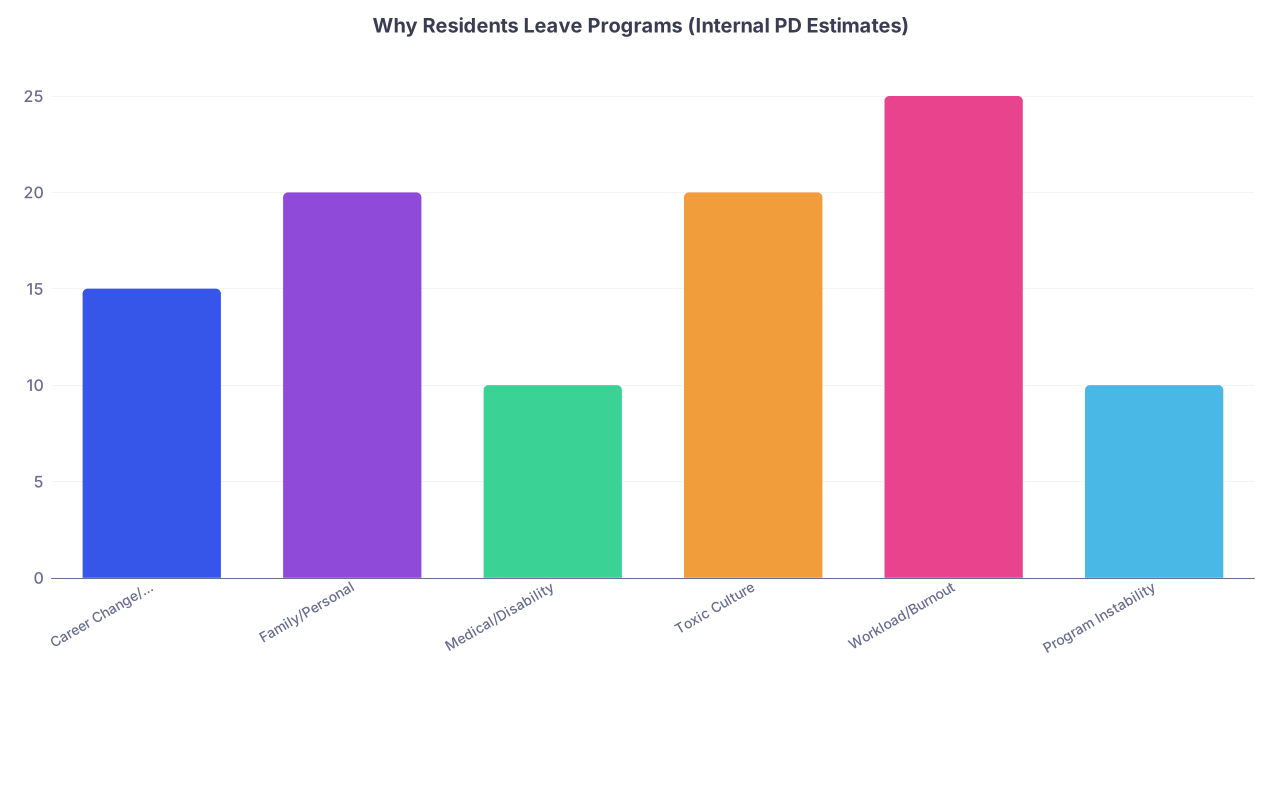
| Category | Value |
|---|---|
| Career Change/Re-match | 15 |
| Family/Personal | 20 |
| Medical/Disability | 10 |
| Toxic Culture | 20 |
| Workload/Burnout | 25 |
| Program Instability | 10 |
Those rough percentages are what PDs privately toss around when they talk about attrition—not what shows up in the glossy brochures.
Now, here are the patterns that matter.
1. Who Left and When
One PGY-3 leaving in March to start a fellowship in a different specialty next year? Shrug.
Three PGY-2s leaving in November of the same academic year? That’s a bonfire.
Red-flag pattern:
Residents bailing early (PGY-1/PGY-2), especially mid-year, or several from the same class.
That tells you they didn’t just “reassess their career goals.” They couldn’t stand another year.
Good-program pattern:
Occasional PGY-3/PGY-4 attrition, often tied to research career pivots, spouse relocation, or a re-match into a super-competitive field with full program support.
I’ve seen IM residents at places like MGH or UW IM leave to re-match into derm or rad onc. The program brags about it. That’s not a red flag. That’s a weird flex they’ll even use in their slideshow.
2. How the Story Gets Told
If the PD or APD can not tell you exactly what they changed after losing residents, they did nothing.
Listen for language:
Vague, deflecting, red-flag style:
- “They had some personal things going on.”
- “It just wasn’t the right fit for them.”
- “We’re working on wellness and resilience.”
Clear, accountable, healthier style:
- “We lost two PGY-2s last year. They cited chronic night float overload and poor attending availability. We responded by adding a nocturnist, restructuring admissions, and starting a formal debrief meeting. Our current PGY-2s can tell you if it’s actually better.”
See the difference? Programs that own the problem name it and name what changed.
If all you get is “we learned from it” without specifics, they probably didn’t.
3. What the Current Residents Actually Say
The single most honest barometer is how the current PGY-2s and PGY-3s react when you bring it up.
Watch their faces, not their words.
- Do they exchange glances, pause for half a beat, then give a rehearsed line?
- Does someone answer too quickly with “Oh it was totally personal, nothing to do with the program” and then change the subject?
- Or do they say, “Yeah, it was rough. Morale was low. But here’s what genuinely improved since then,” with concrete examples?
I’ve watched residents trash a program in 20 seconds without using a single negative adjective. They just… over-explain.
“Yeah, she left but the PD was super supportive, and we did lots of wellness sessions, and they’re really trying, and we’re in communication, and they listen to us.”
That’s resident-speak for: it’s still bad, but they’re scared to say it out loud.
Ask this exact sequence:
- “I heard you lost a few residents recently. What happened from your perspective?”
- “What changed after that?”
- “How does it feel day-to-day now compared to before they left?”
If you get three variations of “they’re working on it,” without specifics—be wary.
The Hidden Operational Consequences When Residents Leave
Here’s what programs don’t tell you: losing even one resident is an operational headache. Losing multiple in a small program is a crisis.
Let me spell out what actually happens once the emails go out saying “X has resigned from the program.”
Schedules Get Quietly Rewritten
Everyone acts supportive in public, then the chiefs open Amion and start doing damage control.
What this often means in practice:
- Short-call becomes Q3 instead of Q4
- Night float blocks get longer
- Jeopardy and backup call actually start getting used—often
- Vacation gets “strongly encouraged” to be moved or split
- Clinic time mysteriously disappears as “service needs” dominate
No one announces, “Workload just increased 20%.” It just… shows up in your schedule.
In small programs (think 4–6 per class), one resignation can mean a permanent one-person deficit on a rotation. That means chronic cross-cover, half-day off instead of full-day, that kind of thing.
Faculty Stress Spills Onto Residents
When residents leave, attendings often have to pick up more direct work. Some handle it like professionals. Others take it out on whoever’s in front of them—you.
You’ll hear lines like:
- “In my day we did Q2 call, you all will survive.”
- “We’re short because people keep quitting; you need to be more committed.”
- “We’re all under stress; complaining doesn’t help.”
A program that protects its residents will blunt that and increase attending presence, not weaponize it.
ACGME and Hospital Politics Start in the Background
If attrition is more than a one-off, the DIO and GME office get very interested. Not in your well-being. In accreditation.
You’ll hear about new “task forces,” “climate surveys,” and “listening sessions.”
Reality: they’re trying to stay ahead of a citation.

| Step | Description |
|---|---|
| Step 1 | Resident Resigns |
| Step 2 | Chiefs Adjust Schedule |
| Step 3 | Increased Workload For Peers |
| Step 4 | PD Notifies GME Office |
| Step 5 | Informal Debrief With Class |
| Step 6 | Climate Survey and Meetings |
| Step 7 | Policy or Staffing Changes |
| Step 8 | Resident Morale Shifts |
| Step 9 | Single Event or Pattern? |
Programs that respond well move quickly from G to H in that diagram—real, structural changes. Bad programs get stuck in “climate survey” land for years.
Concrete Scenarios: What “We Lost a Few Residents” Can Actually Mean
Let me give you some archetypes I’ve seen up close.
Scenario 1: The “Re-Match to Competitive” Spin
You’re at a mid-tier IM program. On interview day, they proudly say:
“We recently had a resident leave to re-match into dermatology. We fully supported their decision.”
Reality behind the scenes:
- That resident was overworked, under-mentored, and realized they’d never be competitive for derm staying there.
- They did an away, got a mentor elsewhere, and quietly planned an exit.
- The program only became “supportive” once the new match was in hand and they could frame it as a win.
Is this a red flag? Maybe. Depends on whether:
- Others have been able to pivot successfully without leaving.
- The program has any realistic track record in those aspirational fields.
If every “success story” involves someone leaving, that’s a pattern.
Scenario 2: The “Family Reasons” That Everyone Knows Weren’t
You ask about a PGY-2 who left. The official line: “They had serious family issues and needed to move home.”
You pull a current resident aside later. They say quietly:
“Yeah, there was some family stuff. But she also kept telling the PD she felt unsafe with the volume on nights. Multiple near-misses. She asked for help, got told to ‘push through,’ and finally just left.”
Classic split-story.
The program isn’t lying exactly. They’re cherry-picking the least incriminating half of the truth. That’s a cultural tell. They protect the program’s image before they own their role.
Scenario 3: The “Mass Exodus” They Call a “Transition Year”
This one’s not rare.
You’re looking at a small community program. Rumor online: “They lost like four residents in two years.” PD’s line when you ask:
“We went through a transition period with some leadership changes, and a few folks decided it wasn’t the right fit. That’s behind us now.”
You talk to a PGY-3. They say, “Yeah… that was a rough year,” and then change the subject.
Here’s what’s probably happening:
- Program director turnover
- Hospital admin cut support (nocturnist, ancillary staff, etc.)
- New PD tried to impose more service at the same pay
- Residents pushed back, some quit, some didn’t have the leverage to leave
- Morale tanked, reputation online suffered, now they’re in damage control
“Transition year” is often code for: leadership fought with residents and some walked.
How to Interrogate the Situation Without Burning Bridges
You can absolutely ask about lost residents. In fact, PDs expect it when recent attrition is obvious.
Here’s how to do it like a grown-up, not a paranoid applicant.
Ask the PD/APD directly, but neutrally:
- “I noticed from the website that a couple of residents are no longer listed. Can you tell me what happened and how the program responded?”
Then shut up. Let them talk. The length and specificity of the answer tell you everything.
Later, with residents (away from faculty):
- “How did it feel in the program when those residents left?”
- “What changed afterward that affected your day-to-day life?”
- “Do you feel like the program has actually addressed the reasons they left?”
If they struggle to answer the second and third—there was no meaningful change.
You can also sanity-check with recent grads via email or LinkedIn. They’re often more honest; they’ve got less to lose.
When Losing Residents Is a Serious Red Flag
Let me be blunt. There are situations where I’d tell my own students: do not rank this place unless you’re desperate.
Here’s a compact way to think about it:
| Pattern | Risk Level | Why It Matters Briefly |
|---|---|---|
| 1 resident left over 3–4 years | Low | Normal career/personal variation |
| Multiple PGY-3s left for re-match | Low-Med | Ambitious cohort, may reflect poor fit |
| 2+ PGY-1/PGY-2 left in 1–2 years | High | Early burnout, culture/workload problem |
| Attrition after leadership change | High | Often linked to toxic or chaotic shifts |
| Chronic pattern over 3+ classes | Very High | Structural failure, ACGME risk |
I start to consider it a hard red flag when:
- The departures are clustered in early years
- The explanations are vague, defensive, or blame-shifting (“they weren’t a good fit”)
- Current residents obviously feel pressured to stick to a script
- Schedules have visibly worsened (“we had to add more nights recently”)
- Online resident forums show consistent, recent complaints that match what you’re picking up in person
If you see that combination—do not gaslight yourself because the hospital lobby is nice or they have a good brand name.
You’re the one doing those Q4 nights with two patients in septic shock and no backup, not the PD giving the polished speech.
When It’s Not a Red Flag at All
Let’s be fair. Sometimes “we lost a few residents” really is just life.
These cases usually don’t worry me:
- A single resident leaves to join their spouse who matched across the country.
- Someone with a new baby moves closer to extended family and the program helps them transfer.
- A PGY-3 changes career path and re-matches into a different specialty with obvious institutional support (letters, schedule flexibility, connections).
- The program can rattle off clear, thoughtful improvements they’ve made after any painful departures.
The throughline?
The program response is mature, specific, and resident-centered.
Residents talk about it with a tone of, “It sucked, but they handled it well.”
That’s not a red flag. That’s a sign of a program that will have your back when your life goes sideways.
The Bottom Line: What “We Just Lost a Few Residents” Really Means
Strip away the spin and you’re left with this:
Attrition is data. The pattern and the response matter more than the raw number. Early-year, clustered losses with vague explanations are trouble. Occasional, well-explained departures with clear program changes are manageable.
Good programs own their role in residents leaving and can name concrete fixes. If they cannot tell you what they changed—or residents cannot feel those changes—assume nothing changed.
Your best intel is always the current residents’ lived reality. Watch how their workload, morale, and schedules shifted after others left. That’s what you’re really signing up for.
If a program “just lost a few residents” and everyone rushes to tell you it’s no big deal, that’s your cue to slow down and start asking smarter questions.