The most dangerous time in a residency program is not Match week. It is when a new chair or program director walks in with a smile, a “vision,” and a mandate from the dean. That’s when programs quietly fall apart.
Let me walk you through what really happens behind those all‑hands emails and “town hall” meetings. Because the med student rumor mill only catches 10% of it.
The Myth of the “Exciting New Leader”
Every hospital PR blast sounds the same: “We’re thrilled to welcome Dr. X as our new Chair/Program Director. Dr. X is a nationally recognized leader in…” etc. You know the script.
What you do not see is the political reality behind that announcement.
There are three main ways a new chair or PD appears:
- The beloved leader retires after a long run.
- The current leader is quietly pushed out or “resigns to pursue other opportunities.”
- The department is in trouble and leadership is brought in as a fixer.
Only the first scenario is relatively safe. The other two are where careers get burned.
The PD you meet on interview day is not just “the person with the binder.” They are either:
- A stabilizer.
- An empire builder.
- Or an axe.
You need to figure out which, and how much collateral damage they’re willing to tolerate. Including residents.
How Chairs and PDs Are Really Chosen
This part applicants almost never understand. Chairs choose PDs, and deans choose chairs, for their priorities—not yours.
The dean’s filter:
“Will this chair grow RVUs, raise money, and keep the accreditation people off my back?”
The chair’s filter for a PD:
“Will this PD protect me from the ACGME, execute my agenda, and not cause political headaches?”
Your education comes fourth. Maybe fifth.
Here’s the unspoken power map:
| Role | Real Power Over Residency |
|---|---|
| Dean | Can replace Chair/close programs |
| Chair | Controls PD, hiring, resources |
| Program Director | Controls residents' daily life, evaluations |
| GME Office | Enforces ACGME minimums, optics |
| Residents | Influence only if unified & strategic |
When a new chair arrives, they usually get a quiet message from above:
“This department needs to look better on paper in 3–5 years.”
Translation:
- More grants or more RVUs.
- “Clean up” any residency or fellowship that looks weak on surveys.
- Restructure faculty and divisions.
- If necessary, sacrifice training culture in the short term.
You will never hear that directly. You’ll just feel it as “changes.”
Early Red Flags in the First 6–12 Months
Everyone asks the wrong question: “Is the new PD nice?”
Wrong frame. You should ask: “Is this leadership transition stable or unstable?”
Here’s what insiders watch immediately after a new chair or PD shows up.
1. The Faculty Exodus Pattern
You don’t need inside access; you just have to pay attention.
Red flags:
- Three or more core faculty leave within 12–18 months of a new chair or PD.
- The “nice” educators (the ones who actually like teaching) are gone first.
- Big names go silent during interview days or disappear from the website quickly.
Safe-ish:
- One or two older faculty genuinely retire after long careers.
- A PD handpicks a few new APDs but retains most core faculty.
- People who leave are replaced quickly and transparently.
What really happens behind the scenes is simple: the new chair meets with each division chief and senior person. Some are told directly, some indirectly: “Your role is changing.” The more those conversations end with “this isn’t the place for you anymore,” the more churn you’ll see. And resident education gets hammered in the chaos.
2. The “Vision” With No Details
Listen carefully during town halls and interview sessions.
The frightening pattern:
- Lots of words: “excellence,” “innovation,” “restructuring,” “alignment with institutional goals.”
- No specifics on duty hours, didactics, resident autonomy, or support.
- Questions about day‑to‑day training get brushed off with, “We’re still evaluating that.”
Experienced faculty will tell you: vague vision means the real plan is politically unpalatable. Usually that means:
- Consolidating services (less variety for you, more RVUs for someone).
- Pushing more clinical volume onto residents.
- Cutting unbillable teaching time.
When a new PD says, “We’re in a period of transition,” what they often mean is: “I’ve been told to move this ship whether or not it’s comfortable for residents.”
When a New PD Is a Real Risk to Residents
New PD ≠ bad. Some of the best programs I’ve seen improved dramatically under new leadership. But there are patterns that scare the hell out of experienced faculty.
1. The “Fixer” Brought in After Probation or Poor Survey Results
If you hear any of these:
- “We recently had some ACGME feedback, but we’re addressing it.”
- “Our residents expressed concerns on recent surveys, so we’re undergoing a major transformation.”
- “We’ve had some leadership restructuring to better support trainees.”
Translation from insider-speak:
- The program was on warning, or very close.
- The old PD either quit, was pushed out, or saw the writing on the wall.
- The new PD was hired to show the ACGME that “changes are happening.”
Risk to you: very high instability in the next 2–4 years.
What you’ll feel on the ground:
- Constant schedule changes, sometimes mid-rotation.
- Rotations abruptly redesigned or canceled.
- New “policies” dropping every month.
- Confusion around evaluations and expectations.
Residents become the test subjects used to prove to the ACGME that the program is “responding.” It’s exhausting.
2. The PD Who Is Clearly the Chair’s Political Shield
Watch how the new PD talks about the chair.
Concerning signs:
- All answers begin with “The chair and I…” or “The department vision is…”
- They seem more worried about aligning with “department metrics” than with resident experience.
- Any question about workload or mistreatment is reframed as “opportunities for growth.”
What’s happening: the chair picked a PD to implement unpopular decisions. The PD’s real audience is the chair, not you. These PDs often have short leashes and high pressure from above. In that environment, resident advocacy collapses quickly.
3. The “Brand Name” PD With No Educational Track Record
You’ll see this in competitive specialties a lot. Big research name. Minimal experience actually running a program.
Insurance risk:
- They care about reputation and fellowships more than daily training.
- They’ll chase away educators who “don’t fit the new brand.”
- They recruit residents to fuel their research or subspecialty pipeline, not to build a balanced program.
If they can’t answer straightforward questions about:
- How they handle struggling residents.
- How they structure remediation.
- How they protect education from service demands.
You’re looking at a PD who’s playing a different game than you.
Telltale Signs In How They Talk About Residents
Most applicants miss this entirely, because you’re dazzled by slides and numbers. Stop listening to those. Listen for how leadership describes residents as people.
Pay attention to these phrases:
Red flag language:
- “We’re looking for resilient residents who can handle a high volume.”
- “We have a demanding culture, and not everyone has succeeded here.”
- “We’re raising the bar, and some people will not like that.”
- “We’re changing the type of resident we recruit.”
Under the surface, that usually means:
- Residents have pushed back in the past.
- Leadership is angry about it.
- The new PD has been told to recruit a more compliant cohort.
Healthier language:
- “We’re working on protecting teaching time despite rising volume.”
- “We revised our call system after resident feedback last year.”
- “We’ve changed X because residents told us it wasn’t sustainable.”
Notice the difference: in stable, resident-centered programs, leadership openly talks about changing systems in response to resident input. In unstable programs, leadership talks about changing residents to fit existing or upcoming pressures.
How New Chairs Break (or Save) Programs
Residents obsess about the PD. Insiders watch the chair.
1. The Revenue-First Chair
You’ll know this type quickly:
- Constant talk about “productivity,” “throughput,” and “access.”
- Boasts about how the department has “grown volumes” or “captured market share.”
- Any question about education gets detoured into: “Of course, resident learning happens best in a busy clinical environment.”
Do not kid yourself: a revenue-first chair with weak GME values will absolutely cannibalize resident education to hit numbers. I’ve watched it happen more than once.
What you see on the ground 1–3 years later:
- More resident-driven clinics with minimal supervision, because it “increases access.”
- Faculty incentives that reward RVUs, not teaching.
- Protected teaching time eroding into “soft” expectations instead of guarantees.
You can’t fix this as a resident. If the chair is like this and the PD is weak, that’s a structural risk.
2. The “Restructure Everything” Chair
You’ll hear phrases like:
- “We’re moving to a new service line model.”
- “We’re aligning inpatient and outpatient under one leadership structure.”
- “We’re right-sizing divisions to better match institutional strategy.”
The translation: jobs will move, divisions will merge, and rotations will get twisted. Residents end up covering gaps while the chair redraws the org chart.
Here’s where residents get quietly used:
- New services piloted with residents as staffing backbone.
- Community sites added quickly without robust teaching oversight.
- Established rotations vanish because the new structure “doesn’t support it.”
If the chair is an aggressive restructurer, you absolutely need a strong, respected PD pushing back to protect your training.
Objective Signals You Can Actually Check
Let’s get concrete. You don’t have inside faculty gossip. But you do have time, Google, and pattern recognition.
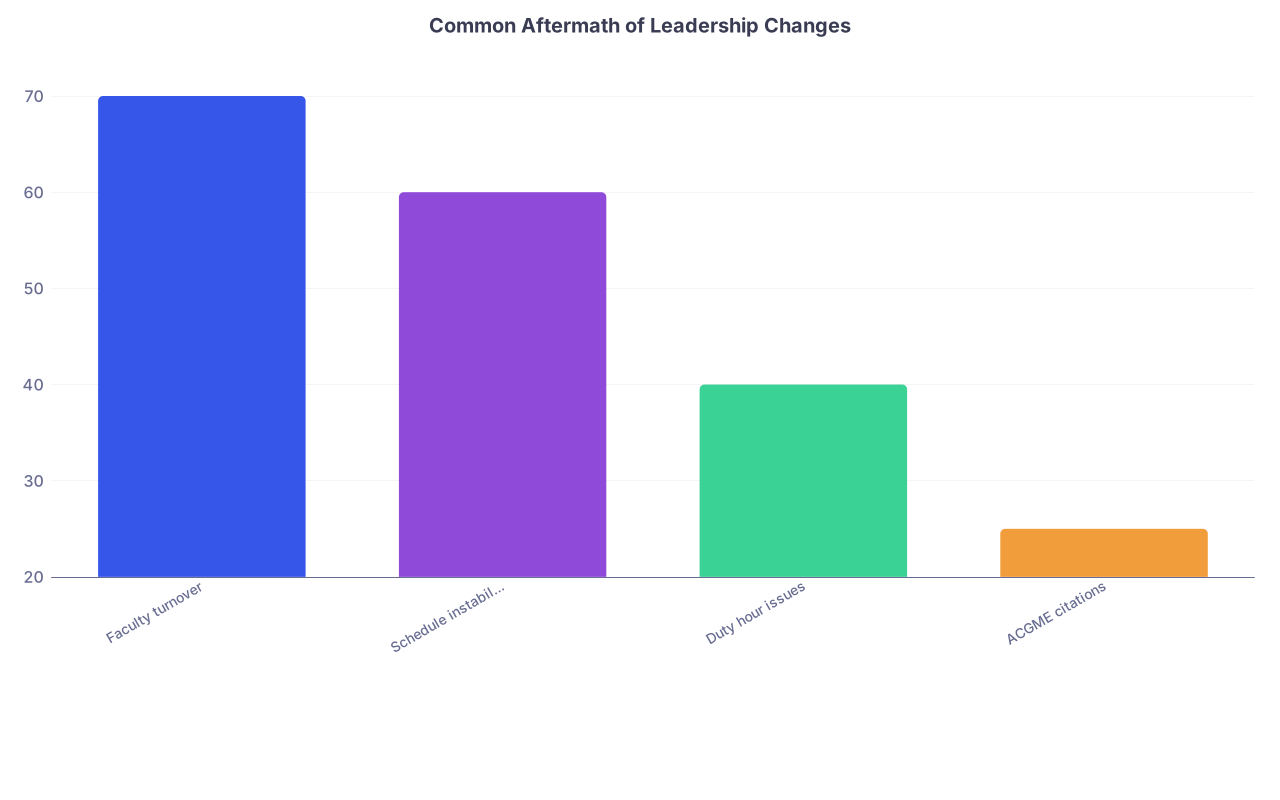
| Category | Value |
|---|---|
| Faculty turnover | 70 |
| Schedule instability | 60 |
| Duty hour issues | 40 |
| ACGME citations | 25 |
Those numbers are rough estimates from what I’ve seen across multiple institutions: major leadership shifts significantly raise the odds of turbulence in these areas.
Here’s what you can check as an applicant or junior resident:
Faculty/staff changes
Search the department site on Wayback Machine (or just scroll faculty lists year by year if available). Did 20–30% of core faculty vanish in 2 years after a new chair/PD? That’s not normal.PD tenure and APDs
Programs that churn PDs every 3–5 years are unstable. A brand-new PD after a short-lived prior PD is a big red flag.ACGME data (indirect clues)
You won’t see internal citations, but you can see:
- Rapid changes in program size.
- Sudden closure of tracks or sites.
- New programs spun up by the same department in short order.
Aggressive expansion plus leadership churn is a volatility cocktail.
How It Feels From the Inside (Stories You Never Hear on Interview Day)
Let me give you a few composites of things I’ve watched happen.
Scenario 1: The Surgical Chair With a “Vision”
New chair in a surgical department at a big-name academic center. Charismatic, big grant portfolio, recruited with fanfare.
Year 1:
- Two senior educators quietly retire.
- The long-time PD “steps down” to “focus on clinical innovation.”
- A research-heavy faculty member with minimal education background becomes PD.
Year 2:
- Call schedule changes 3 times.
- Residents lose a dedicated outpatient rotation so they can staff a new revenue-generating service.
- Morale tanks, but on interview day you still see the smiling “best” residents.
From the outside, the program still looks strong: name brand, good fellowships. From the inside, the juniors are miserable, and a bunch of them are trying to transfer.
Scenario 2: The Community Program After Probation
Mid-size IM program at a community hospital. Got hammered on ACGME survey; residents complained about duty hours and supervision.
Old PD leaves. New PD appointed: younger, very “enthusiastic,” presenting at the APDIM podium within a year about “turning programs around.”
On paper:
- New wellness committee.
- Revamped didactics.
- Fancy slides with “resident input.”
Reality:
- Call caps now “technically” met by creative labeling of shifts.
- Residents who speak up are labeled “negative” and tanked on evaluations.
- One or two residents leave; the message is clear to the rest.
The ACGME sees checkboxes. You feel the pressure and the fear.
Questions You Should Actually Ask on Interview Day
Forget the generic “Tell me about your program culture.” Ask things that force them to reveal stability, not marketing.
Targeted, destabilizing questions:
“How long has the current PD been in the role, and what prompted the transition?”
Listen for: was this a calm handoff, or did something break?“Have there been significant changes in faculty or leadership in the last 3–5 years? How has that affected residents?”
Healthy answer: they can name the changes, explain the rationale, and specifically describe how they protected training.“Can you give a specific example of something residents raised as a concern that led to a concrete change?”
If all you get is vague talk about “open door policy,” they’re either not listening or not acting.
- “What’s changed since the new chair/PD arrived?”
- “What’s better and what got worse?”
- “If you were an MS4 again, knowing what you know now, would you still rank this program where you did?”
You’ll see the micro-hesitation before the answer. That half-second tells you more than the words.
When a Leadership Change Is Actually a Good Sign
Not every new leader is a threat. Sometimes they’re the cavalry.
Positive patterns:
- A long-abusive, absent, or burned-out PD is replaced by someone who’s been the de facto advocate for years. Residents are relieved, not anxious.
- The new chair has a clear, specific history of building good training environments elsewhere—and former residents actually say so when you reach out.
- Changes roll out slowly, with resident input, and are explained clearly. You hear: “We piloted this with one class before rolling it out.”
One strong indicator:
Residents talk about the new PD or chair in a way that’s specific, not generic. “She fought to get us a night float cap” is real. “He’s very supportive” is fluff.
How to Protect Yourself If You’re Already In the Program
Let’s say you’re not an applicant. You’re there. New chair or PD just dropped. What now?
Here’s the insider play:
Stop guessing. Start documenting.
When rotations change, when duty hours creep, when supervision shifts—keep dates, specifics, and emails. ACGME citations are built on patterns, not vibes.Build a resident coalition that’s rational, not dramatic.
Chairs and PDs ignore lone complainers. They pay attention when the chief residents bring organized, concrete feedback backed by multiple classes. Emotion-light, data-heavy.Learn your GME office structure.
Sometimes the PD is actually fighting for you behind the scenes against a chair. Sometimes they’re not. The DIO (Designated Institutional Official) can be an ally if you present things intelligently and only after trying internal channels.Have an escape map.
If things look like they’re sliding hard—persistent violations, chronic instability, retaliatory behavior toward residents who speak up—you quietly:
- Strengthen relationships with outside faculty you rotate with.
- Explore transfer options early, not after you’re desperate.
- Keep your evaluations and exam performance as strong as you can; it gives you leverage.
Do not assume “it will get better when the dust settles.” Sometimes, sure. Often, it does not.
Quick Reality Check Table: Stable vs. Risky Leadership Change
| Area | More Stable Sign | Risky Sign |
|---|---|---|
| Faculty | 1–2 retirements, quick replacements | 20–30% core faculty gone in 1–2 years |
| PD Tenure | New PD after long, stable prior PD | Successive short PD tenures |
| Communication | Specific plans, clear resident role | Vague “vision,” constant buzzwords |
| Residents | Mixed but calm about changes | Anxious, guarded, “wait and see” comments |
| Schedules | Minor tweaks, well-explained | Frequent, last-minute major changes |

| Step | Description |
|---|---|
| Step 1 | New Chair or PD |
| Step 2 | High Instability Risk |
| Step 3 | More Stable Transition |
| Step 4 | Faculty stable? |
| Step 5 | Clear plans for education? |
| Step 6 | Resident feedback used? |
With all this said, here’s the bottom line: a new chair or PD is neither automatically good nor bad. But it is automatically higher risk. Most applicants don’t factor that in at all. You will.
You’re not just choosing a program. You’re choosing a moving train. Leadership transitions tell you whether the tracks ahead are mostly laid… or still being built while you’re already on board.
You’ll use this lens again later—when you’re picking your first job, evaluating a fellowship, or watching your own department start to “restructure.” But that’s a story for after you survive residency.