
The residency you’re interviewing at might effectively be “on probation” even if the ACGME never slapped an official label on it. And everyone in that building knows it—except you.
Let me tell you how we actually talk about these programs behind closed doors. Because the public-facing story (“We’re just going through some changes”) and the internal reality (“We’re one adverse action away from catastrophe”) are not the same thing.
This is the stuff PDs vent about at 11 p.m. over lukewarm conference pizza. The stuff chiefs warn each other about when advising friends’ younger siblings. The stuff you will only discover after you match there—unless you know what to look for.
This is what a residency looks like when it’s functionally “on probation” without ever saying those words.
What “Probation Without Probation” Really Means
There are three broad buckets these problem programs fall into:
- Programs with recent or ongoing ACGME citations that are serious but not yet public death sentences.
- Programs with internal crises (mass faculty turnover, toxic leadership, unsustainable workloads) that ACGME sees in surveys but hasn’t fully acted on.
- Programs in stealth survival mode—they know they’re under scrutiny, so they’re polishing the brochure while residents quietly drown.
No one sends an email to applicants saying:
“Hey, our last three site visits were rough, our survey scores tanked, and we’re one whistleblower away from adverse accreditation action.”
They just change the website banner to: “Exciting phase of growth and transition.”
Behind the scenes, this is how the conversation goes in the GME office:
“If the survey results don’t rebound this year, we’re in trouble.”
“We need to keep our fill rate up or the Dean is going to start asking why we exist.”
“Do not talk about the duty hour investigation on interview day.”
You’ll never hear that out loud. But the fingerprints show up everywhere.
The Tells: How “Soft Probation” Shows Up in Real Life
There’s a pattern to these places. Once you’ve seen it a few times, it’s impossible to unsee.
1. The “We Just Lost…” Syndrome
The biggest red flag: they’ve recently lost too many key people in too short a time.
You’ll hear versions of:
- “We just lost our program director, but the new PD is very excited…”
- “We’re in the process of recruiting new core faculty for several services…”
- “We’re transitioning to a new chair, so some things are in flux right now…”
One PD leaving? People move. Fine.
A PD and an APD and two key teaching attendings and the coordinator in a 12–18 month window? That’s not normal turnover. That’s a fire.
Inside conversations sound more like:
“The last PD walked right before the ACGME visit.”
“Two of our best faculty left for the hospital across town because they were done with the chaos.”
“The coordinator had been here 20 years and quit with no notice.”
Normal programs have leadership succession that looks planned. Problem programs look like an exodus.
2. The Scripted, Nervous Resident Panel
Watch the resident panel like a hawk. This is where the truth almost leaks out.
Programs in trouble coach their residents hard beforehand. You’ll see:
- All the same “safe” residents on every panel, usually chiefs or clearly favored seniors
- No interns or PGY-2s allowed to speak freely
- Weirdly uniform, rehearsed answers to culture questions
- Awkward glances between residents when someone asks about work hours or wellness
I’ve sat in rooms where the GME office literally said to residents:
“Remember, stick to the positive. If you have concerns, we handle those internally, not with applicants.”
At healthy programs, residents disagree with each other in front of you. A PGY-1 might say, “The transition was hard, and nights are rough, but we feel supported.” Someone jokes about scut. There’s spontaneity.
At a soft-probation program, everything sounds like a brochure. They dodge specifics:
You ask:
“How many months of night float do you do?”
They answer:
“It varies a lot, but we’re really prioritizing education and balance.”
Translation: “You’re going to live in the hospital, and we don’t want to lie, but we also can’t tell you.”
3. The Mismatch Between What PD Says and What Residents Live
Here’s one of the most reliable “insider” tests:
- Listen carefully to what leadership claims on interview day.
- Then quietly ask residents to confirm specific details later.
When a program is under quiet pressure, the gap between those two stories is big.
The PD says:
“We’ve made tremendous progress on duty hours; violations are rare now.”
The residents, one-on-one, say:
“We got told to stop reporting 90-hour weeks a few months ago because it ‘makes us look bad.’ We still do them.”
The PD says:
“Our board pass rate is solid, and our graduates do very well.”
You dig and residents say:
“We failed two people on boards in the last few years, and we had to scramble to get them extra help after the fact.”
The PD says:
“We’re expanding and adding more sites—great exposure!”
Residents say:
“We lost our primary inpatient site last year. We’re scattered over three community hospitals, and no one communicates. Expansion is code for ‘patching holes.’”
That mismatch is what ACGME sees in survey data—and it’s what props these programs right on the edge of formal action.
4. The “We’re Recruiting” Black Hole
The website is full of language like:
- “We’re actively recruiting new faculty.”
- “We’re in a period of major growth.”
- “Our curriculum is being redesigned.”
You ask, “How many unfilled faculty positions do you have?” and suddenly things get vague.
From the inside, this often means:
- Multiple unfilled core faculty positions for 6–18+ months
- Heavy attending burnout, with remaining faculty covering extra services
- Residents losing continuity because preceptors keep changing
There’s a difference between, “We hired two new subspecialists; we’re building something,” and “We can’t keep people here.”
Programs under quiet ACGME scrutiny often have to submit documentation about faculty stability, scholarly activity, and supervision. When those are weak, the pressure ramps up. That’s when you start hearing the “recruiting” dance.
5. The ACGME Survey Panic
If you want to know whether a program is hovering near the edge, ask how they use ACGME survey results.
At stable programs, the conversation is calm:
“We review the survey every year, share highlights with residents, and tweak things.”
At soft-probation programs, it’s panic-mode and control:
- Mandatory meetings about “how to answer the survey”
- Thinly veiled threats that negative responses “hurt the program and your future”
- Overemphasis on “loyalty” and “supporting the program”
Behind the scenes, I’ve heard exact lines like:
- “Your responses determine whether we stay accredited.”
- “If you tank this survey, it’ll affect your ability to get fellowships from a failing program.”
That is not how confident programs behave. That’s how scared programs behave.
And yes, the ACGME notices that pattern. But it takes time before it turns into an official action you can see online. Meanwhile, you’re matching there.
Where This Shows Up on Paper (When It Barely Does)
You probably already know you can look up accreditation status. Most students do it wrong.
They see “Continued Accreditation” and relax. Big mistake.
Here’s how the paperwork side actually works in practice.
| Surface Signal | What Applicants Assume | What Insiders Hear |
|---|---|---|
| Continued Accreditation | Program is fine | Could have recent citations and warnings |
| Multiple Recent Citations | Just paperwork issues | Unresolved structural or cultural problems |
| New PD within 1–2 years | Fresh leadership, exciting | Previous PD burned out, left amid conflict |
| Major Curriculum Revision | Innovation | Responding to ACGME concerns or weak outcomes |
| Site Expansion | Growth opportunity | Lost prior site, scrambling for case volume |
You won’t always see “Probation,” but you will see patterns:
- Frequent leadership changes documented in program materials
- Sudden shifts in clinical sites or structure
- Vague language in the public program info about “work in progress”
Programs on the brink learn to say as little as possible in public documents. Applicants who just skim for “probation” miss all the soft signals.
The Behavioral Red Flags on Interview Day
If you ignore every other part of this article, pay attention to this piece. Because this is exactly how programs act when they’re under internal fire and external pressure but cannot say the word “probation.”
They Over-Control What You See
You’re shuttled only to the shiny parts of the hospital. You don’t see:
- The overcrowded ED they actually staff
- The dingy call rooms where residents live on q3
- The chaotic off-site clinic that generates 80% of their continuity experience
I’ve watched coordinators tell residents: “Don’t walk them past the old call rooms; go the long way.” That’s not a paranoid fantasy. It happens.
They Fill the Day With Fluff and Very Little Real Contact
A full day of:
- PowerPoint-heavy “curriculum overviews”
- Long GME-wide talks about wellness, diversity, institutional strength
- Short, strictly timed resident exposure
Minimal:
- Time alone with residents without faculty hovering
- Time to ask specific logistical questions
- Actual shadowing of rounds or clinic
Busy programs respect your time and still find ways to let you talk to real residents. Programs in trouble drown you in presentations so you don’t have time to dig.
They Avoid Hard Metrics
Notice what they do not put on slides:
- Board pass rates over the last 5–10 years, broken down by first-time pass
- Fellowship match lists with actual program names
- Real duty hour violation data or moonlighting rules
- Case volume numbers for key procedures
Instead, you get hand-wavy phrases:
- “Our graduates are highly successful.”
- “We have excellent fellowship placements.”
- “Residents are busy but supported.”
At programs doing well, PDs are proud. They brag: “Our first-time board pass rate has been 100% for 6 years,” or “We’ve sent fellows to MGH, Penn, Hopkins.”
At programs on the edge? Everything stays vague because the hard numbers look bad.
The Morale You Can Feel in the Hallways
You can fake smiles in a conference room. It’s much harder to fake atmosphere on the wards.
If you get any patient-care exposure at all, watch:
- Are residents snapping at nurses constantly, or is there baseline collegial respect?
- Do people look just tired, or defeated? There’s a difference.
- Do senior residents seem protective of juniors or checked out and bitter?
Soft-probation programs feel heavy. You’ll sense it if you stop trying to impress and start just observing.
Why These Programs Don’t Just Close (And Why They Still Fill)
You might be wondering: if they’re this bad, why not shut them down?
Because closing a residency is a nuclear event for a hospital.
No residents means:
- Massive increase in staffing costs
- Loss of cheap labor that covers nights, weekends, and scut
- Risk to hospital’s ability to call itself a “teaching” institution
- Loss of prestige and pipeline for future faculty
So institutions fight to keep these programs alive. Hard.
What they need to survive:
- Enough residents to fill call schedules
- Acceptable ACGME survey scores on paper
- No catastrophic sentinel events tied directly to supervision failures
So they recruit. Aggressively. Often targeting:
- IMGs and FMGs who are grateful for any spot
- Applicants with lower scores or application gaps
- Students from less resourced schools who may not see the red flags
I’ve watched programs with abysmal morale still fill because applicants saw “unopposed” or “high volume” and stopped asking deeper questions.
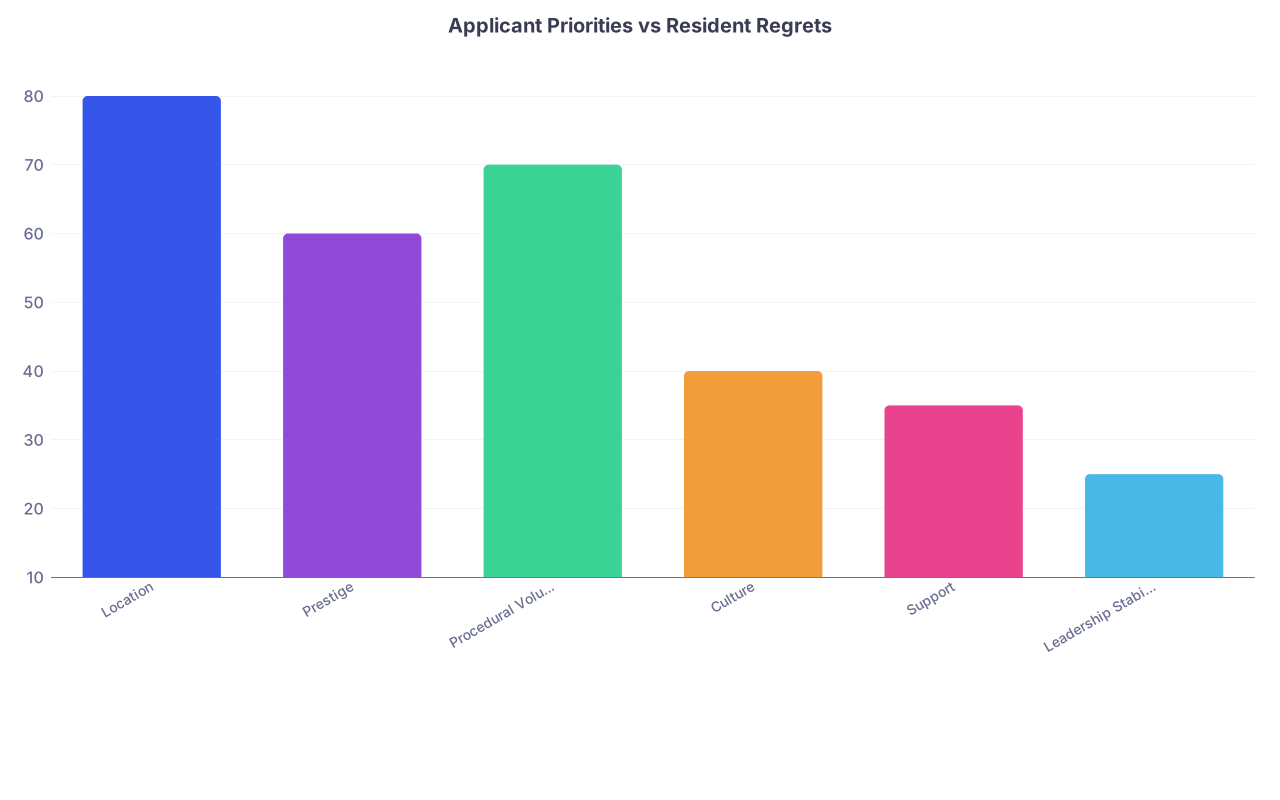
| Category | Value |
|---|---|
| Location | 80 |
| Prestige | 60 |
| Procedural Volume | 70 |
| Culture | 40 |
| Support | 35 |
| Leadership Stability | 25 |
The chart above is exactly the mismatch: what applicants think matters vs what burned-out PGY-3s will tell you actually mattered.
How to Test If a Program Is Quietly in Trouble
You cannot rely on the official status alone. You have to probe—strategically.
1. Ask Residents These Exact Questions
Not “How is the program?” That’s useless.
Try:
- “What’s one thing that’s significantly better now than it was two years ago?”
- “What’s one thing the program keeps saying it will fix but never seems to actually change?”
- “Have you ever been told not to report duty hour violations or negative feedback?”
- “If your best friend were choosing this specialty, would you want them to come here?”
Watch facial expressions more than words. The forced smile with a half-second pause before answering is very real.
2. Look for Patterns in Online Reviews, Not One-Off Horror Stories
Are anonymous reviews biased? Sure. But enough of them over time point in the same direction, and you’d be foolish to ignore it.
Pay attention to:
- Repeated mentions of toxic leadership names over multiple years
- Recurrent themes of intimidation around ACGME survey responses
- Multiple residents reporting leaving early or transferring out
One angry former resident can be noise. Ten residents over eight years saying some version of “we were afraid to speak up” is a pattern.
3. Track Leadership Timelines Like a Detective
Before interviews:
- Look at when the PD started.
- Look for references to prior leadership in older versions of the website (use cached pages).
- Note how often APDs have changed.
Inside GME, when we see:
- PD changed
- APD changed
- New chair
within a 2–3 year span, the whispered translation is: “That department has been unstable.”
Couple that with vague talk about “transition” and “growth,” and your risk profile just went up.
4. Listen for Defensive, Overcompensating Answers
When a program is fine, PDs and residents listen to your question and answer it.
When a program is soft-probation status in everything but name, you’ll hear a lot of:
- “Every program has issues, but we’re absolutely committed to…”
- “Do not believe everything you read online; those are just a few bitter people.”
- “We’re no different from any other busy residency; people these days expect too much.”
That defensiveness is telling. Healthy programs don’t need to gaslight anyone.
The Future: Why This Will Get More Visible (But Not Fast Enough for You)
The ACGME is slowly tightening the screws:
- Heavier weighting of resident survey results
- More attention to wellness, supervision, and culture
- Increasing scrutiny on board pass rates and outcomes
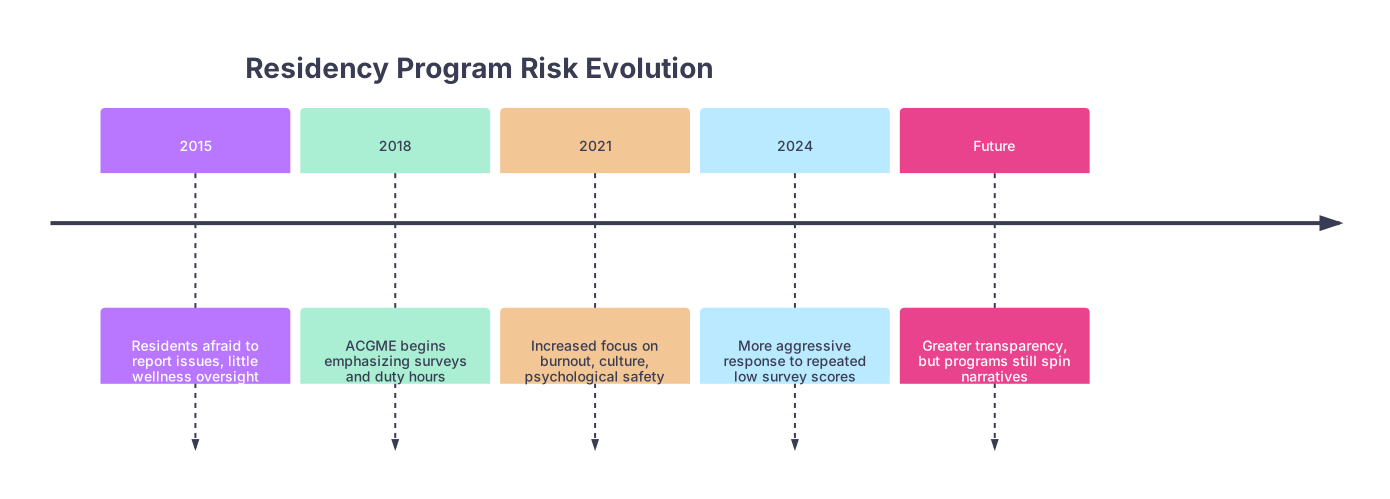
| Period | Event |
|---|---|
| 2015 | Residents afraid to report issues, little wellness oversight |
| 2018 | ACGME begins emphasizing surveys and duty hours |
| 2021 | Increased focus on burnout, culture, psychological safety |
| 2024 | More aggressive response to repeated low survey scores |
| Future | Greater transparency, but programs still spin narratives |
But reality: institutions move slowly. Politics are thick. Weak programs can limp along for years on “continued accreditation” while ACGME nudges, nudges, nudges.
So for your match cycle, you can’t assume the system will protect you. It won’t. You have to protect yourself.
A Simple Mental Model: Three Tiers of Risk
Strip away the noise. When you evaluate programs, put them in three buckets in your head.
| Tier | On Paper | In Reality | Your Risk |
|---|---|---|---|
| Green | Stable leadership, strong outcomes | Residents mostly aligned with leadership | Low |
| Yellow | Some turnover, vague “transition” talk | Mixed resident messaging, some red flags | Moderate |
| Red | Leadership churn, heavy spin, survey panic | Residents privately warn you off | High |
Most “probation without saying probation” programs are in that yellow-to-red gradient. They may not have the label, but they have the behaviors.
Your job is not to chase perfect. It’s to avoid the programs where your training, sanity, and future are collateral damage in someone else’s institutional mess.