
The residency program that shrugs at board pass rates is the program that will shrug at your career.
You ignore that at your own risk.
Why Board Pass Rates Are A Non-Negotiable Red Flag
Let me be blunt: if a residency program cannot reliably get its residents past the boards, you have no business training there. I do not care how “chill” the residents seem on interview day, how pretty the city is, or how nice the free lunch was.
A failed board exam is not a small inconvenience:
- You can be delayed in promotion.
- You may lose job offers or fellowship spots.
- You will be stuck paying for exam fees and possibly remediation courses.
- In some specialties, you can’t practice independently without board eligibility/certification.
I’ve sat in conference rooms where faculty tried to spin a 60–70% board pass rate as “we’re trending up.” I’ve watched residents quietly panic because they realized too late that their program’s culture treated test prep as “your problem.”
You don’t want to be that person, scrambling to fix a problem you could have avoided with one hard question during interview season.
The Numbers You Cannot Afford To Ignore
Board pass rates aren’t just trivia. They’re performance data. They tell you if the program:
- Selects appropriately prepared residents
- Teaches the right content
- Protects education time
- Responds when residents struggle
A strong program treats board passage as a program outcome, not a personal failing of individual residents.
Here’s how standard vs concerning performance typically looks:
| Description | 3-Year Rolling Pass Rate |
|---|---|
| Truly excellent program | ≥ 95% |
| Solid / acceptable | 90–94% |
| Yellow flag | 80–89% |
| Major red flag | 70–79% |
| Run away | < 70% |
Is this rigid? Yes. For a reason.
Programs love to say, “But we have some residents who choose not to take boards right away” or “We had a few outliers.” That can be true. But patterns matter. A single bad year I can understand. Three bad years in a row? That’s not an outlier. That’s a system.
How programs hide the problem
Common tricks I’ve seen or heard about:
Using “first-time” pass rate instead of overall
They’ll say “90% pass rate” but mean “eventually.” First-time pass rate is the real stress test. You do not want to be retaking this exam.Cherry-picking years
“Last year we were 100%!” Great. What about the last 3–5 years? If they only show you the best year, assume the others are ugly.Blaming residents
“The few who failed just didn’t study.” Translation: we don’t feel responsible for them and did nothing systematic to help.Using vague language
“Our pass rate is competitive” or “We are in line with national averages.” Without a number, assume they’re hiding something.
If they won’t give you a clear number, that’s your answer. It’s bad.
Silent Consequences: How Low Pass Rates Wreck Careers
Let me walk you through what actually happens when board pass issues are ignored.
1. Delayed or blocked careers
You match into internal medicine. You want a cardiology fellowship. You graduate, take ABIM, and fail.
Here’s what you are suddenly dealing with:
- Fellowship programs that quietly drop you or downgrade your file.
- Employers who’ll hire you only as “board eligible” and start asking about your retake timeline.
- Credentialing committees that get nervous if you fail more than once.
In some fields, being non–board certified long-term isn’t just annoying; it’s career-limiting. Hospital privileges. Insurance panels. Group practices. They all care.
2. Psychological burnout that no PGY-4 chief role fixes
Failing a major exam after residency is brutal. You’re:
- Working full-time as an attending or fellow.
- Trying to study on top of call, notes, and clinic.
- Often without protected time.
- Feeling ashamed enough that many people hide it.
I’ve seen people:
- Take unpaid time off to study.
- Burn through all their savings on board review courses.
- Question whether they belong in medicine at all.
And many of them trained at programs that “didn’t keep track” of board pass rates.
3. Reputation follows you
Programs talk. Fellowship directors talk. When a residency consistently has graduates who:
- Fail boards, or
- Need multiple attempts, or
- Show big knowledge gaps
that reputation spreads. Even if you pass, you come from a program known for being weak academically. It’s not a death sentence, but it’s not helping you.
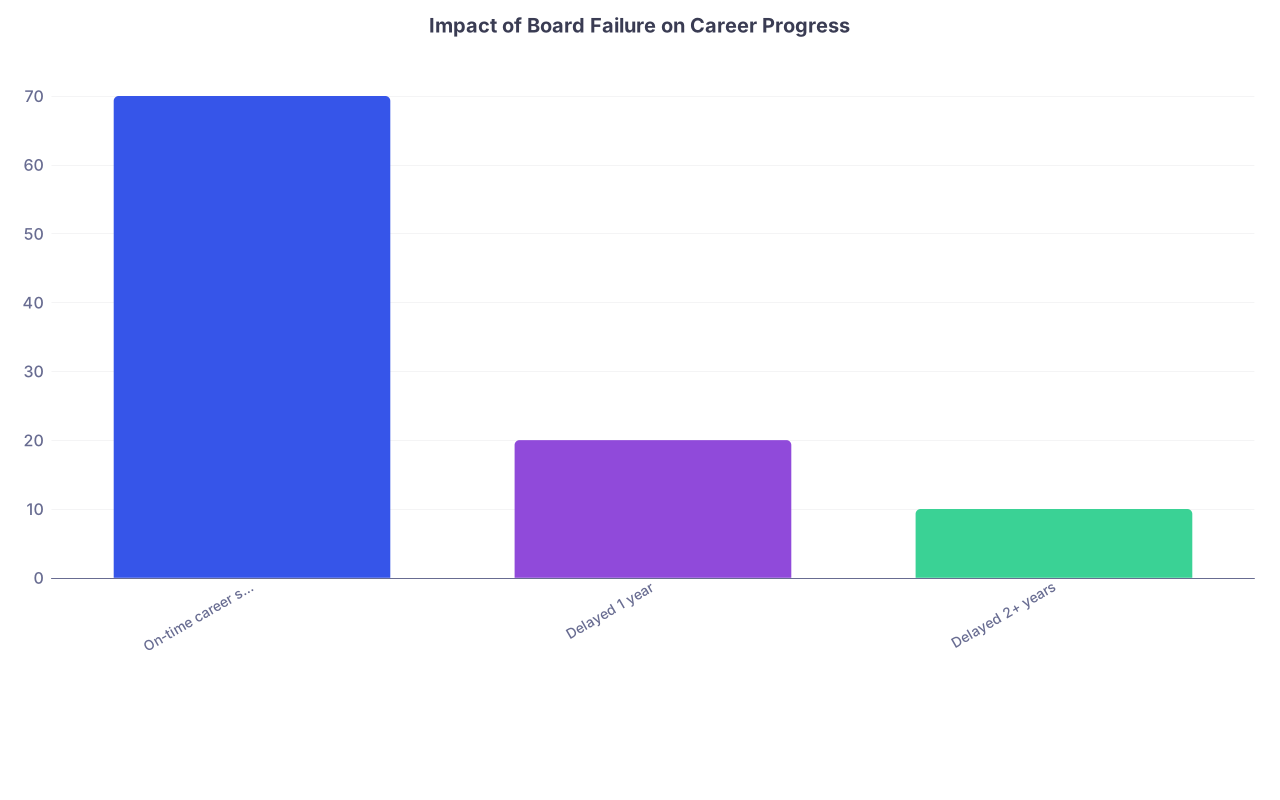
| Category | Value |
|---|---|
| On-time career start | 70 |
| Delayed 1 year | 20 |
| Delayed 2+ years | 10 |
Those delays? Often completely avoidable if people had taken board pass culture seriously when choosing their program.
Red Flags In How Programs Talk About Boards
You’re not just looking for numbers. You’re listening to how they talk.
Here are phrases that should make you immediately more skeptical:
“We don’t really track that, but our residents do fine.”
Translation: We either don’t know, don’t care, or both.“Our pass rate fluctuates a lot depending on the class.”
Translation: We blame individuals instead of our teaching system.“We expect residents to be independent learners.”
Good to a point. But if that’s their entire answer to “How do you support board prep?” that’s a problem.“We’re more focused on producing clinicians than test-takers.”
False dichotomy. Programs can and should do both.
The absence of certain things is also loud:
- No slide or handout about board pass rates during program overview
- Website has glowing text but zero data
- PD dodges the question or answers in circles
If they’re proud of their numbers, they will show you. Quickly.
Concrete Things You Should Demand To Know
You’re not a passive applicant. You’re choosing where to put 3–7 years of your life. You are allowed to be direct.
Ask these questions. Out loud. To the PD, APD, or chief residents.
1. “What is your first-time board pass rate over the last 3–5 years?”
Make them say an actual number. Then:
- Ask if that includes everyone or only those who chose to sit for the exam.
- Ask if they have the numbers by graduating class.
If they say “I don’t know off the top of my head,” the correct next line is, “Could you share that by email later?”
If that email never arrives, interpret that.
2. “What do you do when a resident fails in-training exams or boards?”
You’re looking for systems, not heroic one-offs.
Green answers:
- “We assign a faculty mentor for targeted remediation.”
- “We provide additional protected study time before boards.”
- “We buy board review resources for residents who are at risk.”
Red answers:
- “We encourage them to study harder.”
- “We tell them to adjust and take it earlier next year.”
- “It hasn’t really been an issue” with no specifics.
3. “Do you provide any institutional support for board prep?”
Examples of real support:
- Paid access to question banks (UWorld, Rosh Review, TrueLearn, etc.)
- Dedicated board review conferences or weekly sessions
- Protected time before the exam
- Funding for board review courses
Lip-service support:
- “We suggest they use [popular Qbank] if they can afford it.”
- “Residents usually study on their own.”

Hidden Patterns That Signal Board Trouble
Sometimes the program never says “our pass rate is bad,” but the environment tells the story.
Watch for these patterns on interview day, during second looks, or when you talk to current residents privately.
1. Residents constantly say “we don’t have time to study”
You’ll hear:
- “Our call is brutal; there’s no way to do questions consistently.”
- “On ICU months I barely sleep, forget studying.”
- “We just try to cram during vacation.”
If this is every senior resident talking, not just one overwhelmed intern, that’s structural. A program with:
- No real cap on workload
- Poor coverage for sick/vacation time
- Endless scut work
is rarely the program with stellar board scores.
2. Minimal didactics or chronic cancellation culture
You know the type of place:
- Noon conference gets canceled “because we’re short.”
- Teaching rounds are replaced by hallway sign-out.
- Simulation or structured teaching is “coming next year” every year.
If the only “teaching” is you reading on your own at 2 a.m., don’t expect miracles on boards.
3. Senior residents who seem unsure on basics
Talk medicine. Ask them:
- How do you prep for boards here?
- Do faculty quiz you on rounds?
- Do M&M or case conferences actually teach, or are they blame sessions?
If PGY-3s or PGY-4s:
- Dance around simple clinical questions
- Admit they’re “just hoping to get by” on boards
- Haven’t reviewed a single full-length question bank
That’s not a you problem. That’s a culture problem.
4. “We used to struggle, but we fixed it” with no evidence
Programs do improve. I’ve seen places dig themselves out of board pass disasters.
But if they claim:
- “We’ve turned it around!”
- “We’ve made a lot of changes!”
ask for receipts:
- “What was your pass rate before and what is it now?”
- “What exactly did you change?”
If they can’t answer that in concrete terms, assume the “fix” is mostly wishful thinking and nicer slides.
How To Compare Programs Rationally (Not Emotionally)
You will be tempted by:
- Location
- Significant others
- “Vibes”
- Prestige and name recognition
All those matter. But you’d be reckless to put them above your ability to become board certified.
Here’s a simple way to force yourself to see the risk:
| Factor | Program A | Program B | Program C |
|---|---|---|---|
| First-time pass rate (3y) | 97% | 88% | Not given |
| Protected board study time | 4 weeks | 1 week | None |
| Program-paid Qbank | Yes | Partial | No |
| Weekly structured review | Yes | Sometimes | No |
| Culture toward failures | Support | Neutral | Blaming |
If you’re ranking Program C above A and B because “it’s in a fun city” and “residents seemed laid back,” understand what you’re trading away.
You’ll have fun. Right up until you fail your boards.
Special Case: New or Rapidly Expanding Programs
New programs and rapidly growing ones are where people most often ignore board risk because:
- “They seem hungry and innovative.”
- “I’ll get more responsibility.”
- “I liked the PD; they care.”
All possibly true. But they may have:
- No historical board data.
- Unstable curriculum.
- Overwhelmed faculty stretched too thin.
If they’re new, ask:
- “How are you designing your curriculum to align with boards?”
- “What board prep support is built-in from day one?”
- “Are you modeling your teaching and schedule after any established programs with strong pass rates?”
If the answer is “We’ll figure it out as we go”… no. You’re not the beta test for someone else’s administrative learning curve.
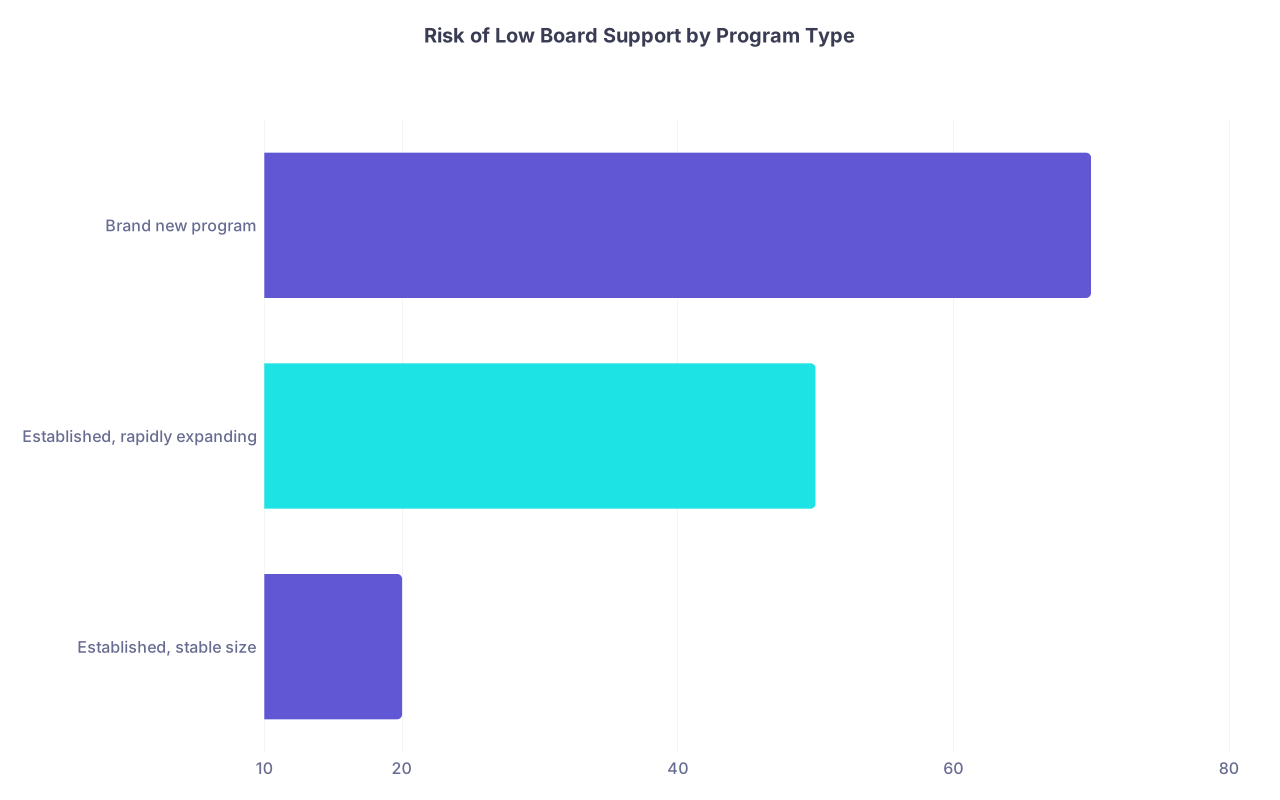
| Category | Value |
|---|---|
| Established, stable size | 20 |
| Established, rapidly expanding | 50 |
| Brand new program | 70 |
Those probabilities aren’t official numbers; they reflect what I’ve personally seen: the more chaotic the program growth, the more likely board support falls through the cracks.
How To Protect Yourself If You’re Already In A Weak Program
Maybe you’re reading this too late. You’re already in a program with:
- Vague board pass data
- No structured teaching
- Constant service pressure
You still have moves. Don’t just hope.
Get your own data
Ask chiefs quietly:- “How did our last few classes do on boards?”
- “Did many people need multiple attempts?”
Treat in-training exams like loud alarms
If you underperform:- Immediately set up a meeting with a trusted faculty member.
- Create a written study plan.
- Demand some adjusted rotations or protected time if you’re clearly struggling.
Buy your own resources early
Don’t wait for the program to suddenly wake up. Build a Qbank habit from PGY-1. Regular small doses beat desperate cramming.Use vacation strategically
Not for “escape only” but partly for high-yield, structured board prep during less chaotic periods.
Is this fair? No. But if your program is weak, you either compensate or you pay for it later.
The Bottom Line: One Number, Huge Consequences
Ignoring board pass rates is how smart, motivated residents end up:
- Delayed in their careers
- Carrying unnecessary debt and stress
- Fighting a reputation they never created
If you remember nothing else, keep these points burned in your brain:
If a program cannot clearly tell you its 3–5 year first-time board pass rate, assume it is bad. Refusal to show data is data.
Test culture is destiny. A program that minimizes teaching, cancels conference, and blames residents for failures will not suddenly support you when boards hit.
Do not trade board security for superficial perks. Location, vibe, and prestige mean very little if you can’t get certified and move on with the career you actually want.
You get one residency. Choose like your boards—and your future—depend on it. Because they do.