
The most dangerous residency red flags are not obvious. They’re buried in budget spreadsheets you’ll never see.
Everyone teaches you to watch for malignant attendings, awful call schedules, or terrible board pass rates. That’s surface-level stuff. The real rot in a residency program usually starts when the hospital or sponsoring institution quietly tightens the financial screws. And those cuts do not show up as a line item you can spot on a tour.
I’m going to walk you through how budget cuts actually show up in your day-to-day life as a resident—and how to recognize them from the outside before you sign your life over for 3–7 years.
The Hidden Chain: From CFO Office to Your On-Call Night
Here’s the part nobody tells applicants: the person who can wreck your training the fastest is not the program director. It’s the CFO.
When hospital margins shrink, GME looks like a “cost center.” I’ve sat in meetings where administrators literally say this: “Do we really need that extra resident? That course? That simulation day? Can’t they just learn on the wards?”
They never announce, “We’re cutting resident education.” They cut around it. Indirectly. Slowly.
It starts with a few quiet moves:
- Freeze on hiring new faculty
- Not replacing a retired or departed attending
- Canceling simulation time “temporarily”
- Tightening conference food budgets (yes, that’s often the first visible tremor)
- Reducing moonlighting hours
- Squeezing away admin support
What you see as an applicant: “We’re in a time of transition,” “some staffing changes,” “we’re re-evaluating our curriculum.” Those phrases are code. Behind the scenes, they usually mean money is bleeding and GME is absorbing the hit.
Let me show you what that actually looks like on the ground.
Red Flag #1: “We Lost a Few Faculty, But We’re Recruiting”
This line gets repeated every interview season. Sometimes it’s innocent. Sometimes it’s a five-alarm fire they’re trying to cover with a smile.
When budget cuts hit, hiring freezes are one of the first blunt tools. The hospital doesn’t announce, “We’re cutting faculty.” They just…stop filling positions. Or they let a 0.8 FTE “float” instead of replacing a full-time educator.
On paper, the program still has “12 core faculty.” Reality: four of them are burnt out, three are half-time, two are on their way out, and one is trying to carry the entire educational mission.
Here’s how this specific budget problem will show up in your training:
- Fewer attendings per resident. Your attending is covering more patients, more residents, and more administrative work. Teaching time evaporates because they’re just trying to keep the service afloat.
- Constant “coverage shifts” by whoever is available. Your ICU attending this month does three other jobs. You’re not getting focused subspecialty teaching; you’re getting whoever didn’t say no.
- “We’ll discuss that at conference” becomes code for “we don’t have time to teach you right now.”
On interview day, listen to how they talk about recent faculty losses.
If you hear:
- “We had three faculty leave suddenly last year, but we’re rebuilding,” and nobody can clearly say who’s been hired…
- Or “administration is determining whether we can replace that position”…
That’s budget-driven, not “natural turnover.”
Healthy programs absolutely lose faculty. But strong, well-funded ones replace them quickly, and residents know what’s coming. When residents give you vague or nervous answers about faculty departures, that’s the quiet echo of a budget problem upstream.
Red Flag #2: Conference Time That Sounds Better on Paper Than in Real Life
Official schedules are lies of omission. Every program lists:
- Daily didactics
- Protected education time
- Simulation curriculum
- M&M, journal club, board review
Budget cuts deform this in ways that don’t show up in a pretty PDF.
Here’s what happens when the hospital feels financial pressure: clinical productivity starts to dominate every conversation. Every hour you’re sitting in conference is an hour someone thinks could be spent billing. When faculty are under RVU pressure and services are short-staffed, “protected” time gets slowly eaten alive.
On the inside, it looks like this:
- Attending texts: “We’re slammed on the floor, can someone step out of conference and help with discharges?”
- Residents “sign in” to didactics and then get called back out constantly.
- Simulation days morph from a half-day event to “if census allows.”
- Noon conferences devolve into pharma lunches or a random case presentation because the dedicated educator was cut and nobody has time to prep.
Where’s the budget cut? The institution decided not to fund protected educator FTE or coverage attendings. So your time gets sacrificed instead.
On interview day, you can sniff this out. Ask the seniors, not the PD:
“Do you actually get protected conference time without being pulled away for scut or pages?”
If they say:
- “Most of the time”
- “Depends on the service”
- Or they visibly hesitate, look at each other, and then give a diplomatic answer…
That’s your sign. True protection requires money: coverage people, admin support, educator FTEs. When the hospital is trimming, that’s exactly where the quiet cuts land.
Red Flag #3: Rotations That Are “Pending,” “In Development,” or “Being Re-Structured”
Programs rarely admit, “We lost this rotation because we couldn’t pay anyone to teach it.” They’ll tell you they’re “reimagining” it.
Behind the scenes, this is often the sequence:
- Hospital pulls funding or support for a particular service (e.g., outpatient subspecialty clinic, community affiliate, rural site).
- The affiliate site says, “We can’t afford to have residents here under the current contract.”
- Department and GME argue over who’s going to pay.
- Residents get emails: “We’re temporarily suspending this rotation while we renegotiate.”
- A year later: nothing.
The program will still proudly mention that rotation in historical terms during your interview. “We’ve traditionally offered a robust X experience.” Watch the tense.
When budgets get tight, external rotations cost money:
- Liability coverage
- Travel housing stipends in some cases
- Faculty time that doesn’t always generate RVUs
So they get cut or quietly watered down. Current residents will say things like:
- “We used to have a really strong ___ rotation, but it’s on hold.”
- “They’re working on bringing back more subspecialty exposure.”
That “used to have” phrase is your siren. It often tracks closely with financial decisions at the hospital or department level.
Red Flag #4: Equipment, Space, and Systems That Feel Tired
No, you’re not an equipment engineer. But you can tell when a place is being starved.
Let me be blunt: a hospital that will not spend to keep core systems functional will absolutely not spend to make your training excellent. Period.
Budget cuts show up physically:
- Old monitors and machines taped together with labels that say “Do Not Turn Off”
- Ultrasound machines shared by three services, constantly “in use”
- Simulation mannequins that look like they were purchased before you were born
- “We’re transitioning to a new EMR” for three years straight—translation: they will not pay for a proper build or training
This is more than aesthetics. Limited capital spending spills over into training:
- Procedures get delayed or rerouted because “we only have one functioning scope.”
- You miss cases because rooms are closing early to save on staffing.
- Residents stop bothering with certain educational tools because access is unreliable.
When administration is cutting capital budgets, GME usually eats it too—simulation center hours reduced, software subscriptions dropped, educational tools not renewed. Nobody says, “We cut your simulation budget.” They say, “We’re optimizing utilization.”
You can see it with your eyes when you tour.
Red Flag #5: Admin Support Vanishes—and Everything Becomes the Residents’ Problem
You want to see the impact of budget cuts most clearly? Look at the program coordinator.
When a program is healthy and funded, the coordinator and GME office protect residents from bureaucratic garbage: schedule changes, credentialing disasters, evaluations, conference tracking, reimbursement, visa issues. When support staff are cut or overloaded, that work flows downhill. Straight to you.
I have watched this play out:
- Two coordinators become one “shared” position.
- The office manager retires and is never replaced.
- GME analysts are “reorganized” and now support twice as many programs.
Residents start doing work that should never land on a trainee’s plate:
- Chasing down their own evaluation completion
- Fixing their own schedules in a broken system
- Fighting HR for benefits or ID issues
- Tracking their own case logs manually because no one is checking completeness
From the outside, you’ll see:
- Disorganized interview days
- Late or conflicting emails about schedules
- Residents who vaguely complain about “administrative chaos”
That’s not just chaos. That’s underfunded infrastructure.
And it directly affects your life: lost vacation weeks, botched credentialing, missed opportunities because someone dropped the ball and there was no one paid to pick it back up.
Red Flag #6: Residents Talking About “Service Load” Far More Than Education
When money is tight, the hospital leans on the cheapest labor it has: you.
Administrators will never say this to your face, but they absolutely do the math. Replacing a resident with an NP/PA or hospitalist FTE costs real dollars. For a while, residents are “cheaper.” Until accreditation or labor rules force their hand, you’ll get used as workforce padding.
Here’s how budget pressure distorts the culture:
- Census caps become “soft.”
- “Non-educational” tasks mysteriously land on residents because no one wants to fund enough ancillary staff.
- New services open that rely heavily on residents, while backfilling nursing or APP staff is delayed “for budget reasons.”
Residents then start describing their program in a very particular way. Listen to their language during pre-interview dinners or after formal tours:
If you hear:
- “You’ll be busy, but you’ll learn a lot” repeated like a reflex
- “We’re very service-heavy, but it makes you strong”
- “You definitely earn your stripes here”
Translation: we are doing work that should be distributed across a larger, better-staffed system. Often because paying for that system was deemed too expensive.
Some service is good. Being crushed because the hospital is trying to save FTEs? That’s the red flag.
Red Flag #7: Moonlighting, Bonuses, and “Incentives” Quietly Disappear
This one is simple. When cash tightens, the extras are the first to go.
I’ve seen this story multiple times:
- Residents used to get paid for extra call or moonlighting on in-house services.
- Small “education” stipends covered books, question banks, or conference travel.
- That money gets frozen “temporarily” during a tough fiscal year.
Three years later, it never came back.
Programs will still talk about “past opportunities” in vague terms:
- “We had a great moonlighting setup, but it’s been on pause during the pandemic.”
- “We used to support national conference travel across the board.”
Used to. On pause. Being reevaluated. Same pattern.
From a training standpoint, the problem is not just losing the cash. It’s the message: administration does not see residents as long-term investments. You’re an expense line. When they need to balance the sheet, they cut you first.
If everyone around you is telling you, “Don’t worry, they say it’ll come back,” take that with a fistful of salt. Most financial “pauses” in GME do not magically reverse. They calcify.
What Strong, Well-Funded Programs Look Like Instead
To be fair, not every change or loss is a sign of decay. You need contrast to recognize pathology.
In programs that are actually stable and well-supported, you see patterns like:
- Faculty departures followed quickly by clear hires, with residents aware of who’s coming.
- Concrete, recent improvements that cost money: new sim center, expansion of rotations, increased class size because the hospital wants more trainees.
- Residents who can casually say, “Yes, conference is protected; we get in trouble if we skip.”
- Coordinators who seem on top of everything and residents who are not spending their time wrestling logistics.
Let me show that contrast cleanly.
| Area | Healthy / Well-Funded Program | Underfunded / Cutting Corners |
|---|---|---|
| Faculty Turnover | Departures with clear, named replacements | Multiple losses, vague promises about recruiting |
| Didactics | Consistently protected, residents actually attend | Constant clinical interruptions, spotty attendance |
| Rotations | Stable or expanding experiences | “On hold,” “in development,” or recently dropped |
| Admin Support | Responsive coordinator, smooth scheduling | Disorganized logistics, residents fixing admin issues |
| Equipment/Space | Functional, reasonably up to date | Old, broken, or shared equipment, cramped spaces |
This is what you’re trying to read between the lines on interview day: not the glossy brochure, but where the money is actually flowing.
How to Ask About Money Without Asking About Money
You can’t sit in front of a PD and say, “Is your hospital cutting your budget?” You won’t get a useful answer.
You ask sideways.
A few surgical questions that expose financial stress more than any “culture” talk:
- “Have there been any major changes to rotations, conference structure, or staffing in the last 3 years? What drove those changes?”
- “How has the program grown or evolved recently? What’s been added?”
If they struggle for a concrete example that isn’t just “we changed our didactic schedule,” worry. - To residents: “What did the seniors have that you don’t have anymore?”
That question is lethal. You’ll hear about:- Lost rotations
- Lost moonlighting
- Lost conference funding
- “How often do you feel you miss educational activities because the service is too busy?”
If they normalize it—“oh yeah, that’s just life here”—that’s not a healthy sign.
Do not be fooled by the single line, “We are well-supported by our institution.” I’ve heard that exact phrase from programs that were, at the same time, cutting faculty, losing rotations, and begging for basic educational resources.
The Future: Why This Is Going to Get Worse, Not Better
You’re not applying in a vacuum. US healthcare margins are tightening, and GME is sitting on a fault line.
Here’s what PDs and chairs are worrying about when the doors close:
- Decreasing reimbursement, especially for safety-net hospitals that train a disproportionate share of residents.
- Rising salary pressure from NPs, PAs, and hospitalists who can walk if they’re underpaid.
- Accreditation standards that keep demanding more “education” infrastructure without sending a dollar to fund it.
So what happens? Institutions do the politically safe thing: they maintain the appearance of robust training while quietly trimming everything that is hard for outsiders to measure. It is much easier to:
- Let faculty FTE slowly erode
- Cut travel funds
- Thin out admin support
- Cram more work onto residents
…than to publicly announce, “We are shrinking our program” or “We can’t afford this level of training anymore.”
This means you, as an applicant, must stop looking only at shiny surface metrics like:
- Board pass rate last year
- Fellowship match list
- One enthusiastic resident spokesperson
Those can remain decent for several years after the financial ground has started to crack. Momentum hides rot—for a while.
What you need to read is trajectory. Are they building or shrinking? Adding or apologizing? Growing faculty or explaining losses?
Because if you walk into a program at the beginning of a five-year austerity cycle, you will feel every inch of that pain. And no brochure will warn you.
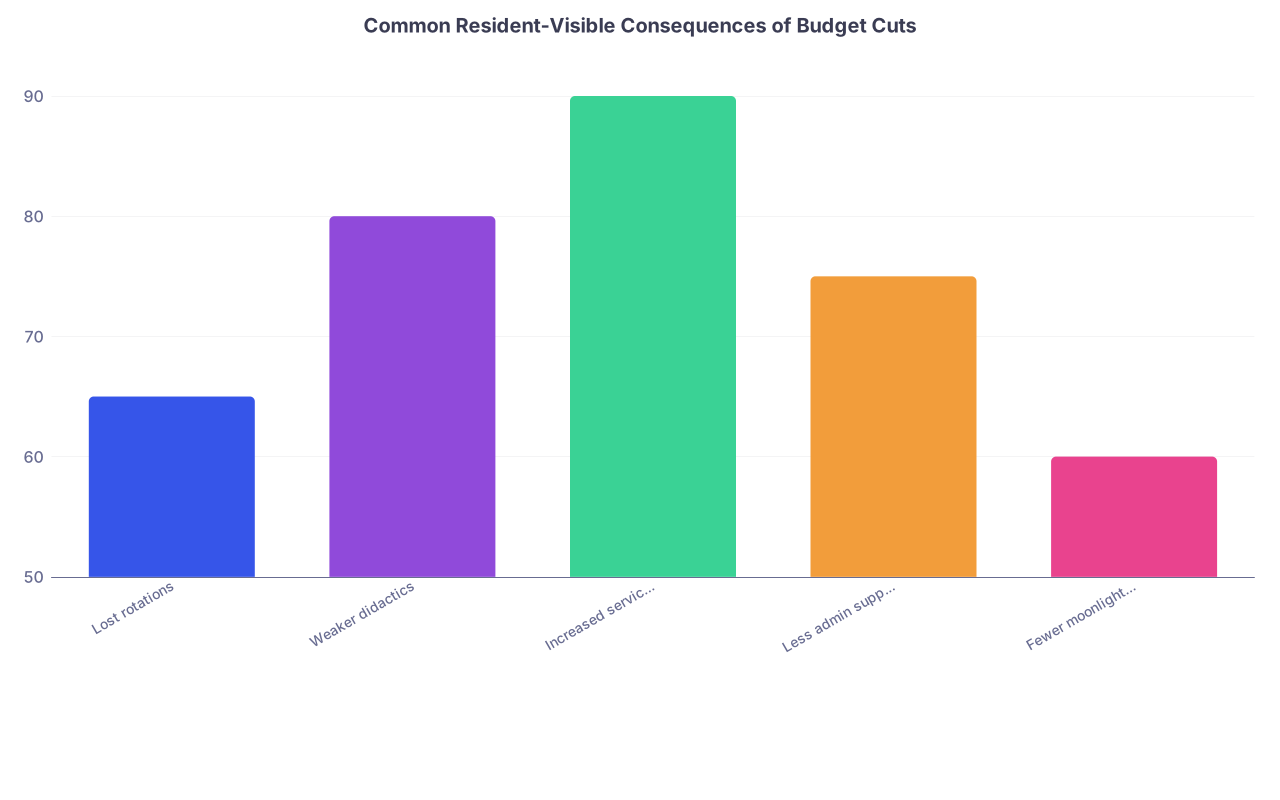
| Category | Value |
|---|---|
| Lost rotations | 65 |
| Weaker didactics | 80 |
| Increased service load | 90 |
| Less admin support | 75 |
| Fewer moonlighting options | 60 |
What You Should Actually Do With This Information
You can’t fix hospital finances. You can’t force a program to hire more faculty. But you can make smarter choices.
Here’s the strategy the savvy applicants use—quietly:
They treat every interview and virtual event as reconnaissance on one core question:
“Is this place investing in its residents, or using them?”
So they:
- Ask seniors pointed, specific questions about what’s been lost and what’s been added.
- Listen for “on hold,” “used to,” “planning to,” and “hoping to” as code for underfunded initiatives.
- Walk the wards with their eyes open: equipment, space, staffing. You don’t need to be an MBA to sense scarcity.
- Compare what the PD says with what the residents say. Budget cuts create inconsistencies; people spin in different directions.
Where you train shapes the rest of your career. Not just because of prestige or fellowship options, but because a starved program will grind you down. Burnout, chaotic schedules, poor mentorship—those are not random. They’re often the downstream mess of a system that decided your education wasn’t worth the money.
You deserve to see that coming.
The next step after you understand this pattern is learning how to decode resident responses in real time—who’s being honest, who’s loyal-spinning, and how to read silence when you ask a hard question. That, however, is its own art. And that story is for another day.