
Most applicants are asking the wrong question about ACGME citations. The number matters way less than the pattern and type of citations.
Let me be blunt: a program with 1 serious, unresolved systems citation can be far more dangerous than a program with 8 old, fixed, picky citations from five years ago.
You’re not trying to avoid “any citations.” You’re trying to avoid programs that are ignoring the same problems year after year, especially in supervision, duty hours, education, and patient safety.
Here’s how to actually judge whether ACGME citations are a red flag or just normal program “wear and tear.”
The One-Sentence Answer
If you want a threshold, here it is:
If a program has more than 3–4 recent (last 2–3 years), unresolved citations in core areas like supervision, duty hours, or educational content, you should treat it as a serious red flag and dig very, very hard.
But the real answer is more nuanced. Let’s unpack it.
First: What ACGME Citations Really Mean (Not the Myth)
Programs love to hand-wave this on interview day: “Oh, everyone has citations.” That’s only half true.
An ACGME “citation” is basically the accrediting body saying:
“We found a problem significant enough that you must fix it, and we’re going to track whether you actually do.”
Key points:
- Citations are not the same as minor comments or suggestions in a site visit report.
- Citations go into the official program record and get brought up on future reviews.
- Multiple persisting citations can push a program toward warning, probation, or worse.
There’s a spectrum:
- A few old, fully resolved citations → Fine. That’s normal.
- Repeated citations for the same issue over multiple review cycles → Not fine.
- Citations in core safety/education domains that are still open → Big problem.
So don’t freak out because a program had “3 citations” in 2019. Freak out if they were about supervision and duty hours and you hear “we’re still working on it” in 2026.
The Numbers Question: How Many Is “Too Many”?
You wanted an actual number, so here’s a practical framework by program type and stage.
| Situation / Program Type | Citation Pattern That Should Worry You |
|---|---|
| Established program (>10 years) | ≥3 recent, unresolved core citations |
| Newer program (<5 years) | ≥2 core citations in first review |
| Any program with repeat visits | Same citation persisting >1 cycle |
| Any program nearing warning/probation | Multiple core and systems-level citations |
| Your personal “hard no” threshold | Any active citation in supervision or safety |
Now, my opinion, based on what I’ve seen and heard from residents across multiple specialties:
0–2 citations (mostly administrative or niche issues)
Very common. Not inherently concerning.3–5 citations
Yellow flag. You need to know:- How recent?
- What domain?
- Are they actually fixed or just “addressed on paper”?
>5 citations
This is rare in a well-functioning, stable program. For this to be OK, you’d need:- Most citations to be older and officially resolved
- Strong resident satisfaction
- No repetition of the same problem
If a PD says “We had 7 citations last cycle,” your next sentence should be:
“Can you walk me through what those were and what’s been done since then?”
If they can’t do that in clear, concrete terms, that’s your answer.
Not All Citations Are Equal: Which Ones Should Scare You?
The content of the citation matters a lot more than the count.
Here’s the stuff that should make you think twice.
High-Risk Citation Categories
These are the ones that, in my book, are “one citation can be too many” if not clearly fixed.
Supervision and Patient Safety
- Residents being left alone beyond their level of training
- Lack of attending backup or in-house coverage
- Poor escalation pathways for unsafe conditions
Duty Hours and Fatigue Mitigation
- Repeated 28+ hour stretches with no real plan to change
- Pressure to under-report or falsify hours
- No system to address resident fatigue or schedule abuse
Bullying / Harassment / Unprofessional Environment
- Culture of intimidation (especially from leadership)
- Retaliation against residents reporting concerns
- Systemic discrimination issues
Inadequate Clinical Volume or Case Mix
- Residents not meeting minimum procedure numbers
- Too few patient encounters to be competent at graduation
Major Curriculum Gaps
- Required rotations missing or not meeting minimum standards
- Simulation, didactics, or evaluation systems essentially non-functional
If you see citations in those areas that are either:
- Repeated over time, or
- “Partially addressed” but everyone you talk to still complains
That’s when you should treat even 1–2 citations as a big deal.
Lower-Risk Citation Categories (Usually Fixable Noise)
These are often paperwork or infrastructure headaches, not existential threats:
- Documentation issues with evaluation forms
- Faculty development tracking not robust enough
- Minor noncompliance with conference attendance documentation
- Outdated written policies that don’t match current practice
- Some QI/project tracking details missing
Are these annoying? Yes. Are they a reason to avoid a place entirely? Usually no.
How to Actually Evaluate a Program’s Citations (Step by Step)
You rarely get a clean, public list of current ACGME citations. So you have to be smart and a little nosy.
1. Ask Directly on Interview Day
To the Program Director or APD, ask:
- “Has your program had any ACGME citations in the last review cycle?”
- “What were the main themes, and what changes have you made in response?”
- “Have any issues persisted over more than one review?”
You’re not looking for perfection.
You’re looking for:
- Specific examples (“We had a citation for X, so we did Y and Z…”)
- Ownership, not defensiveness
- Evidence that residents were involved in the fix
If the answer is vague (“We’re in good standing, nothing major, all fine now”) and they dodge basic follow-up questions, assume there’s more smoke than they want to admit.
2. Cross-Check with Residents (Privately)
Residents are usually brutally honest when PDs aren’t in the room.
Ask upper-levels:
- “Did you feel the last ACGME review accurately reflected the problems here?”
- “Have you seen real changes after the last site visit?”
- “Are there issues that keep coming up again and again?”
- “Do you feel safe escalating concerns without retaliation?”
If residents roll their eyes when you mention “ACGME review” or say, “We told them the same thing 3 years ago,” that’s a red flag for repeated, unresolved citations—whether or not you ever see them in writing.
3. Look for Indirect Evidence of Trouble
You can’t see the actual ACGME file, but you can use signals:
- Frequent changes in program director over a short time
- Rapid turnover of faculty in key rotations
- Recent change from “continued accreditation” to “warning” or “probation”
- Abrupt reduction in residency class size
- Residents suddenly leaving mid-year or lots of transfers out
These aren’t always caused by citations, but they often travel together.
Red Flag Patterns That Matter More Than the Raw Count
Let’s talk patterns. This is where people either get fooled or protected.
Pattern 1: Repeated Citations in the Same Area
Example:
2018 – Citation for duty hours non-compliance
2021 – Same citation, plus poor fatigue mitigation
2024 – Still complaints about “unofficial pressure” not to log hours accurately
I don’t care if that’s “only 3 citations.” That’s a culture problem, not a paperwork problem.
Pattern 2: Citation + Resident Rumbling + Leadership Spin
You hear:
- PD: “We had some minor compliance issues; all fixed now.”
- Residents: “They fixed it on paper. Day-to-day? Nothing’s changed.”
When those two stories clash, believe the residents. Every time.
Pattern 3: Citations + Instability
Combine:
- Lots of leadership turnover
- Chaotic schedules
- Confused responses during your questions about accreditation
Result: even a modest number of citations becomes a bigger deal, because the system clearly isn’t stable enough to fix them.
How to Use ACGME Citations in Your Rank List Strategy
Here’s how I’d integrate this into actual decisions.
Programs I’d Still Rank Confidently (Despite Citations)
- 1–3 citations total, mostly administrative or older clinical issues
- Clear, specific description by leadership of what was fixed
- Residents independently back up, “Yeah, it used to be bad, now it’s actually much better”
- No patterns of repetition in the same area
These are “normal human programs” that have grown and improved.
Programs I’d Rank Lower, or Only as Safeties
- 3–5 citations with at least 1 in a core area (duty hours, supervision, safety)
- Leadership says they’re fixed; residents say “sort of”
- Some turnover, some instability, but not full chaos
These might be okay if you don’t have better options, but I’d want strong positives in other dimensions (case volume, fellowship match, location) to compensate.
Programs I’d Strongly Consider Leaving Off the List
- Any repeated citation in supervision, duty hours, or resident mistreatment
4–5 recent citations, multiple in core domains
- Vague or defensive answers, plus residents sounding burned out or hopeless
- Recent warning/probation status without a very clear rebound story
You’re signing up for 3–7 years of training. You do not need to rescue a sinking ship.
Quick Decision Flow: Is This Program’s Citation History a Dealbreaker?

| Step | Description |
|---|---|
| Step 1 | Ask about recent ACGME citations |
| Step 2 | Low concern - focus on other factors |
| Step 3 | Ask about number and type |
| Step 4 | Likely manageable - verify with residents |
| Step 5 | High concern - check for repetition |
| Step 6 | Medium concern - look for real changes |
| Step 7 | Red flag - strongly consider ranking lower or skipping |
| Step 8 | Any in last 2-3 years? |
| Step 9 | Core areas affected? |
| Step 10 | Same issue >1 cycle? |
Visual: What Kind of Citation Mix Is Reasonable?
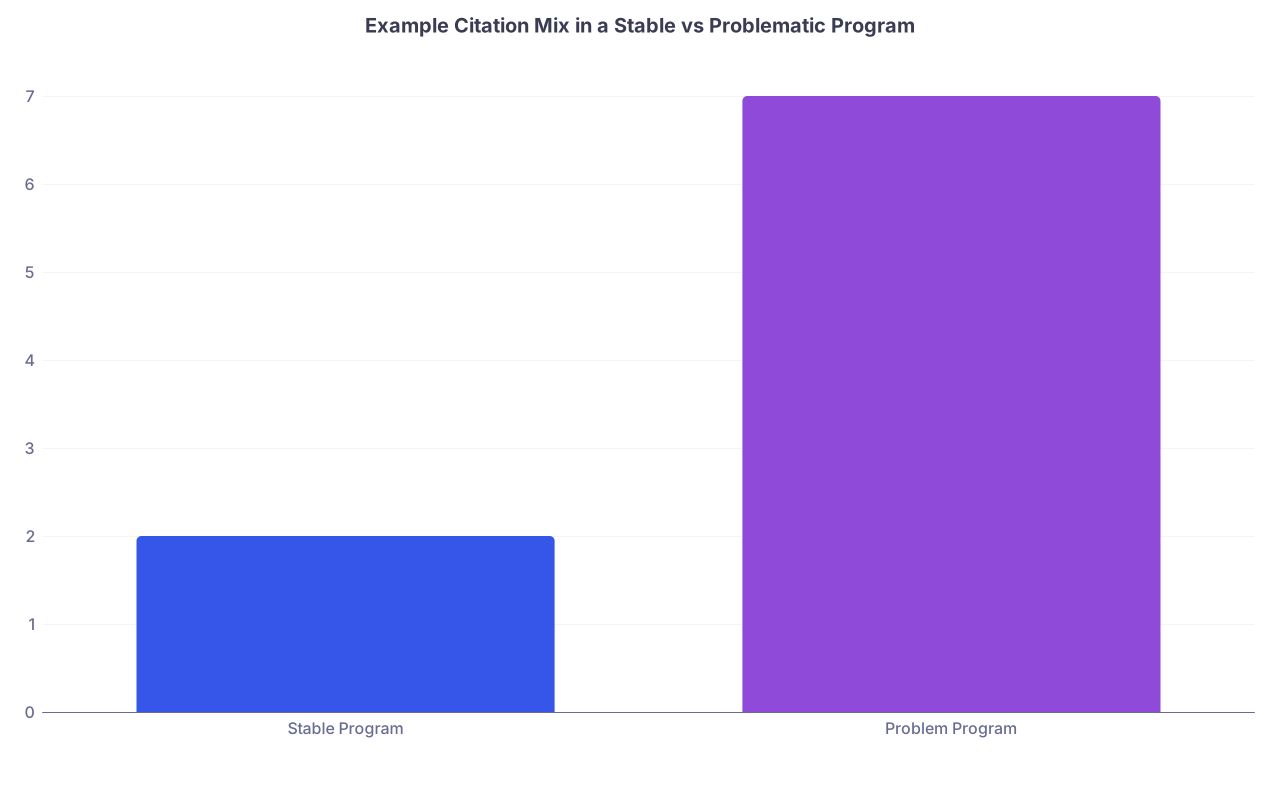
| Category | Value |
|---|---|
| Stable Program | 2 |
| Problem Program | 7 |
Imagine this:
- Stable program: 2 total citations in last cycle, both administrative/compliance. Clear fixes. Residents happy.
- Problem program: 7 citations, including 3 duty hours, 2 supervision, 2 curriculum gaps. Ongoing grumbling from residents.
You don’t need to be an accreditation expert to know which one is safer.
FAQs About ACGME Citations and Residency Red Flags
1. Are ACGME citations public? How can I actually see them?
No, the detailed citation list isn’t posted publicly. You can’t just Google “ACGME citations for XYZ program” and get the real file. What you can see is the program’s accreditation status (continued accreditation, warning, probation, etc.). For specifics, you have to rely on:
- What leadership discloses
- What residents tell you
- Indirect signs of trouble (turnover, culture, instability)
2. Is one ACGME citation a dealbreaker?
Usually not. One citation, especially if it’s old and clearly fixed, is completely normal. I’d only treat a single citation as a major red flag if it’s recent, in a core safety/education domain, and there’s no convincing evidence that anything actually changed on the ground.
3. Should I directly ask, “How many citations do you have?”
You can, but it’s smarter to ask what and how they responded rather than just the count. A better way to phrase it: “What were the main findings of your last ACGME review, and what changes came out of that?” That forces more honest discussion about content instead of just minimizing a number.
4. How do I tell if a cited issue is actually fixed?
Look for alignment between three things:
- Leadership’s description of changes (specific, concrete, not vague)
- Residents’ lived experience (“yes, we actually see this day to day”)
- Evidence in the schedule, workflow, or curriculum that you can see or verify
If two of the three don’t line up, assume the fix is mostly on paper.
5. Does a program on “warning” or “probation” mean run away?
Warning: not necessarily, but it should trigger deep questioning. Sometimes warning status happens during transitions and then programs recover strongly. Probation: much higher risk. I’d only touch a probation program if:
- The cause is crystal clear and now resolved
- They’ve documented a strong turnaround
- Residents actively say, “It used to be a mess, now it’s significantly better”
Most applicants don’t need to take that gamble.
6. Are community programs more likely to have citations than university programs?
Not automatically. I’ve seen pristine community programs and messy university ones. What changes is the type of risk: community programs may struggle with volume or subspecialty exposure; university programs may struggle with duty hours, service creep, or toxic hierarchies. ACGME citations can show up anywhere. Don’t assume “big name = safe.”
7. Bottom line: what’s the simplest rule I can use on interview day?
Use this:
If a program has more than 3–4 recent citations in core areas, or if the same issues keep coming back, and residents sound frustrated or hopeless about change—treat that program as unsafe until proven otherwise.
You’re not trying to find a perfect, citation-free unicorn. You’re trying to avoid places that ignore the same serious problems year after year.
Key takeaways:
- The type and persistence of ACGME citations matter more than the raw number.
- Any repeated or unresolved citations in supervision, duty hours, safety, or mistreatment are major red flags.
- Use interview day to cross-check leadership’s story with resident reality; when they don’t match, trust the residents.