
The idea that “fellows steal all the procedures” is wildly overstated—and also sometimes absolutely true.
You’re trying to answer one question: will having fellows around cripple your hands‑on experience, or actually make you better? Here’s how to tell the difference before you sign a contract.
The Core Truth: Fellows Are Not The Problem. Bad Program Design Is.
Blaming “fellow presence” is lazy. I’ve seen residents in heavy-fellowship programs finish with superb procedural and clinical autonomy. I’ve also seen residents in barely-subspecialized community hospitals graduate barely comfortable putting in a central line.
The real issue isn’t “Are there fellows?” but:
- Who owns the bread‑and‑butter work—residents or fellows?
- How is teaching vs service divided?
- When there’s competition, who wins by policy, not personality?
If you remember that framing, you’ll ask way better questions and see red flags much earlier.
Step 1: Look at Concrete Data, Not Vibes
Stop starting with, “Do you like having fellows?” Everyone will smile and say how “great the learning environment” is. Useless.
Instead, you want hard numbers and specifics.
Ask for their actual procedure and exposure data
Program leadership should be able to show you something like:
| Area / Procedure Type | Healthy Range by Graduation (Internal Medicine example) |
|---|---|
| Central lines | 30–50+ |
| Arterial lines | 20–40+ |
| Intubations (ward/ICU) | 20–40+ (varies by program) |
| Paracentesis | 20–30+ |
| Thoracentesis | 15–25+ |
| Lumbar punctures | 10–20+ |
If the PD or chief cannot provide any aggregate data (“we don’t really track that”), that’s your first red flag. Programs that care about resident hands‑on experience track it. Period.
Then ask residents:
“How many central lines have you personally done so far?”
Don’t ask near-graduating procedural superstars only—ask average residents.
Interpret numbers in context of fellows
When they say, for example:
- “We average 15–20 intubations per IM resident by graduation, but anesthesia fellows do most of them”
That tells you: resident airway experience is probably limited by design, not chance.
Or:
- “We have pulm/crit fellows, but residents place all ward central lines and most ICU lines before midnight. Fellows usually do complex access or lines during off hours when we’re swamped.”
That sounds balanced. Fellows are complementing, not cannibalizing.
Step 2: Map Out Who Owns What (Service Ownership Patterns)
Fellow presence becomes a problem when they systematically own the procedures or decision-making domains you care about. So you want to understand ownership.
Here’s the key question to ask on interview day or during a second look:
“On a typical day, who actually does X?”
Be annoyingly specific.
Common ownership patterns that limit residents
Some big warning structures:
ICU where fellows run the show, residents write notes.
Example pattern: Pulm/crit or anesthesia fellows:- Lead rounds
- Do most intubations and lines
- Talk to families about big decisions
- Present at multidisciplinary huddles
Residents: “We pre-round and place orders, then present to the fellow, who presents to the attending.”
Translation: You’re scribes with MD badges.
Subspecialty consult services where residents only do scut.
Cardiology, GI, Heme/Onc, etc. If the day looks like:- Fellow sees consults
- Resident “helps with notes and discharge summaries”
- Resident rarely leads on consult plans or procedures
That’s a bad sign. You want to hear, “Resident sees consult first and presents to fellow/attending.”
Emergency department with heavy EM fellows and minimal resident procedural priority.
If EM fellows get first dibs on lines, airways, cardioversions, and residents “can help if it’s slow,” that will crush your volume.
Ownership patterns that help residents
On the other hand, some structures are actually ideal:
- “Residents are primary operators for ward procedures; fellows do complex cases, supervise, or step in when busy.”
- “Residents put in all MICU lines on day shift; fellows handle nights or specialized access like dialysis catheters.”
- “For consults, residents see first, staff with fellow, then fellow staffs with attending. Residents lead the plan at the bedside.”
The pattern is clear: fellows are an added layer of teaching, not the default operator.
Step 3: Ask These Exact Questions on Interview Day
You don’t need to invent perfect wording. Use this list.
For residents (private conversations only)
- “In the ICU, who usually does lines and intubations—residents, fellows, or a mix? Be honest.”
- “On subspecialty services (cards, GI, pulm, etc.), do you feel like you’re truly functioning as a doctor, or more like a note‑writer?”
- “What are you currently short on experience‑wise because of fellows—anything?”
- “If you want to do a procedure and a fellow also wants it, what actually happens?”
- “Do seniors feel comfortable with independent cross‑cover decisions at night, or do fellows always need to be involved?”
For program leadership
Ask these straight to the PD, APD, or ICU director:
- “How do you balance procedure opportunities between residents and fellows? Who has priority for core procedures?”
- “Do you track resident procedure volumes? Can you share recent averages?”
- “What changed when you added [X] fellowship? How did you protect resident experience?”
- “On ICU rotations, who leads rounds—resident, fellow, or attending?”
- “Do residents ever graduate feeling underprepared in any area because fellows dominated certain experiences?”
Watch for evasive, generic answers like “We’re very resident‑focused” with no specifics. That’s spin.
Step 4: Learn to Hear Red Flag Language
Residents will tell you everything if you listen for certain phrases. Over the years, I’ve learned to translate.
Here’s the cheat sheet:
| What you hear from residents | What it often means in practice |
|---|---|
| “Fellows are great teachers” (and then they stop) | Fellows do most of the real work and procedures |
| “You can get procedures if you’re aggressive” | There is actual competition you may lose |
| “It depends on the fellow” | No clear system; your experience is luck‑based |
| “We mostly do ward stuff; fellows handle the tough cases” | Residents are shielded from complexity |
| “We don’t really care about numbers” | You may graduate with gaps no one is tracking |
Better language to hear:
- “Residents own the routine procedures; fellows help with complexity.”
- “Honestly, fellows make us better—we still get our volume, just with more backup.”
- “Even on fellowship-heavy rotations, our seniors still make the first call on plans.”
Step 5: Look at Where Graduates Actually Match
This is a huge indirect marker of resident autonomy and case ownership when fellows are present.
If a program has multiple subspecialty fellowships and also consistently matches its own residents (and others) into those fellowships and competitive external ones, that usually means:
- Residents are taken seriously by faculty.
- Residents get enough depth to function as near‑fellows in that area.
- Fellows aren’t gatekeeping all the good pathology.
If, instead, you see:
- Tons of in‑house fellowships
- Few residents matching into them
- Graduates mainly going into hospitalist or community jobs even when they say they want fellowship
That can mean residents are permanently “secondary” on those services—under the fellow layer, not trained to that next level.
Step 6: Distinguish Three Types of Fellow-Heavy Programs
You’re basically deciding which of these you’re looking at:
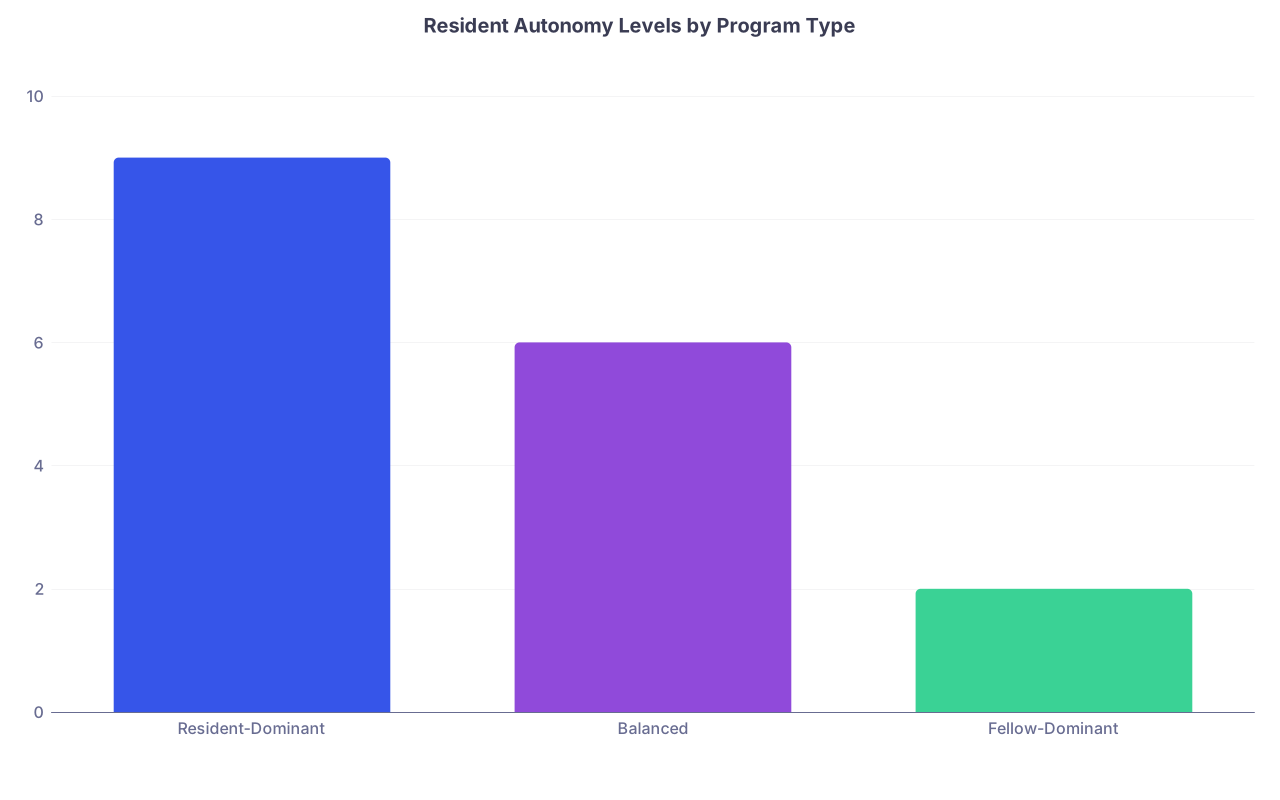
| Category | Value |
|---|---|
| Resident-Dominant | 9 |
| Balanced | 6 |
| Fellow-Dominant | 2 |
Resident‑Dominant with Fellows as Add‑Ons
Think strong academic centers that are very protective of core residency education:- Residents are primary operators for bread‑and‑butter
- Fellows manage the subspecialty nuance and complex cases
- Residents still run codes, present plans, and do routine procedures
Balanced Programs
These can be excellent:- Certain domains are fellow‑first (e.g., TEE, complex EP), others are resident‑first (lines, LPs, bread‑and‑butter consults)
- Clear policies on who gets what
- Residents know exactly where they’ll get their numbers and where they’re observing more
Fellow‑Dominant Programs (Red Flag)
- Fellows present on rounds, residents fill in orders and notes
- Procedures default to fellows unless explicitly “given” to residents
- Residents feel like they’re shadowing someone else’s training
You’re trying to avoid the third bucket. Completely.
Step 7: ICU and ED – The Two Big Danger Zones
If there’s anywhere fellow presence can wreck your hands‑on growth, it’s ICU and emergency/acute care.
ICU checkpoints
Ask:
- “Who runs the code cart and intubations on the floor—residents, ICU fellows, anesthesia?”
- “Who writes the ICU admission H&P and initial orders?”
- “Do residents ever write the first draft of the vent or pressor plan, or is that mostly fellows?”
Strong answer looks like:
“Residents run the codes and do the initial ABCs. Fellows are backup and step in for tough airways or when things are crashing.”
Bad answer sounds like:
“Fellows are always there for airways and usually manage lines. Residents get to see a lot, though.”
You don’t want to just “see a lot.” You want to do a lot.
ED checkpoints
If you rotate in an ED with EM residents and EM fellows, ask:
- “How are procedures divided between EM residents and off‑service residents?”
- “If I’m the admitting resident, do I ever get to do the line or LP in the ED, or is that all EM/EM fellows?”
Some places let admitting residents do procedures on their own patients in the ED. Others wall that off entirely. That matters.
Step 8: Use the “What Happens at 2 a.m.?” Test
This is my favorite simple litmus test.
Ask residents:
“At 2 a.m., with a crashing patient and a procedure needed, who gets called and who does it?”
If the universal answer is:
- “Fellow first. Then attending. Residents help.”
you have a clear picture: low autonomy, low procedural priority.
If the answer is:
- “Senior resident first. Fellow is backup or for complex stuff.”
that’s a healthier culture. It shows trust in residents as actual physicians, even with fellows present.
Step 9: Watch Rounds and Hierarchy During a Second Look
If you do a second look or shadowing day, do not just stare at the shiny new SIM center. Stand on rounds and observe:

| Step | Description |
|---|---|
| Step 1 | Resident presents case |
| Step 2 | Fellow refines plan |
| Step 3 | Attending final decision |
| Step 4 | Resident enters orders |
You want to literally see:
- Who speaks first?
- Does the resident present directly to the attending, or always through the fellow?
- Who the attending questions most deeply—resident or fellow?
- When a decision is made, who turns that into orders and communicates to the team?
If residents are consistently bypassed while fellows and attendings hash out the real plan, that’s not a training environment, it’s an audience seat.
Step 10: Know When Fellow Presence Is Actually An Asset
I’ll say this clearly: programs with thoughtful use of fellows often graduate stronger residents than fellow‑free programs.
Fellows can:
- Give near‑peer, practical teaching
- Let you see subspecialty‑level reasoning daily
- Create research and mentorship pathways
- Help you match into competitive fellowships
When fellows are used well, your day looks like this:
- You see the patient first
- You make an initial plan
- You present to the fellow, refine the plan with feedback
- You and the fellow together present to the attending as a team
- You still do the procedure, with the fellow coaching instead of replacing you
That structure is gold. If that’s what you’re hearing from multiple residents, evenly across years, fellow presence is not a problem. It’s a selling point.
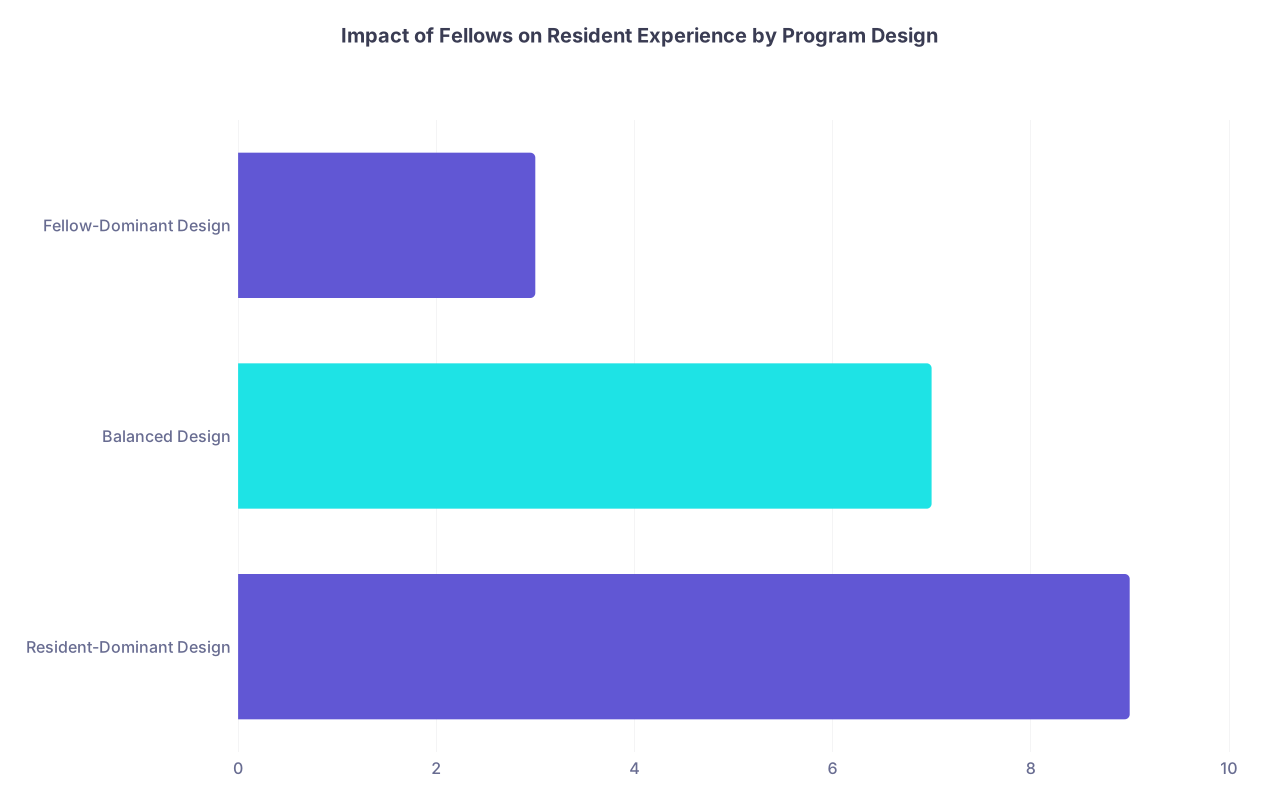
| Category | Value |
|---|---|
| Resident-Dominant Design | 9 |
| Balanced Design | 7 |
| Fellow-Dominant Design | 3 |
Quick Recap: How To Tell If Fellows Will Limit You
If you remember nothing else:
- Do not ask “Are fellows a problem?” Ask, “Who actually does the work—on an average Tuesday?”
- Get specific numbers (procedures, ICU autonomy, consult ownership). Vague reassurance is useless.
- Listen for code words like “depends on the fellow” and “you can get experience if you’re aggressive”—those signal competition, not structure.
FAQ (Exactly 5 Questions)
1. Is it always bad if fellows do more procedures than residents?
No. It depends which procedures. It’s fine if EP fellows do complex ablations or interventional fellows own high‑risk caths. That’s their lane. The problem is when fellows dominate bread‑and‑butter stuff residents need for competence—central lines, basic intubations, paracenteses, LPs, and common subspecialty consult management. Fellows owning the cutting‑edge 5% is fine. Them owning the core 95% is not.
2. Are community programs without fellows always better for hands‑on experience?
Not always. Some community programs are fantastic for procedures and autonomy. Others are glorified service jobs with poor supervision, chaotic teaching, and minimal complex pathology. I’ve seen academic programs with lots of fellows give residents more structured, high‑yield hands‑on experience than some small community places. You judge by structure and culture, not labels.
3. How many procedures is “enough” before graduation?
There’s no single magic number, but ranges exist. For internal medicine, 30–50+ central lines, 20–40+ arterial lines, 20–40 intubations (depending on your future path), and consistent experience with LPs, paracenteses, and thoracenteses are reasonable targets. More important than the raw number: do you feel independently comfortable doing them without someone holding your hand?
4. What if residents I talk to give totally different answers about fellows?
That’s a sign of inconsistency. If a PGY‑3 says fellows are “great, no problem,” and a PGY‑1 says, “We never get procedures because of fellows,” something’s off. It might be rotation‑dependent, or it might mean expectations aren’t clear and personality contests determine who gets opportunities. You want consistency: residents across classes describing the same basic structure.
5. Should I avoid programs that recently added new fellowships?
Not automatically, but you should scrutinize them harder. Ask, “What specific changes did you make to protect resident experience when the fellowship started?” If they can describe changed call structure, resident‑first procedure policies, or dedicated resident procedure services, that’s encouraging. If you hear, “We’re still figuring it out,” or “It hasn’t really changed things,” and residents quietly disagree—treat that as a serious red flag.