
The belief that a shiny fellowship match list cancels out serious residency red flags is dangerous—and usually wrong.
If you remember nothing else, remember this: great fellowship outcomes can coexist with a toxic or dysfunctional residency program. Both can be true. And you will feel the dysfunction every single day; you will only see the match list once a year.
Let’s walk through how to judge this correctly.
Short answer: No, a great fellowship match list does not erase major red flags
You can absolutely have:
- A malignant culture and a killer match list
- Unsafe staffing and a strong subspecialty pipeline
- Chronic call schedule abuse and several people matching derm, GI, or cards every year
So the real question is not: “Does this program place people into elite fellowships?”
The real question is:
“Given what I see about culture, workload, and support, what price are residents paying to achieve those matches—and is that a price I am willing to pay?”
In practice, here is how I rank things:
- Non‑negotiable floor: basic safety, humane culture, ACGME compliance
- Training quality: case volume, teaching, supervision, autonomy
- Career outcomes: fellowship match, job placement, mentorship quality
A great fellowship match list only lives at level 3. Serious program red flags usually live at levels 1 and 2. You do not trade level 1 for level 3. That’s how people burn out, quit, or worse.
What actually drives fellowship match success? (Hint: not just the program name)
Before you let a match slide deck hypnotize you, understand why a program’s fellowship outcomes look good.
Here are the real drivers I’ve seen over and over:
Resident quality and self‑selection
Highly competitive residents often cluster at certain programs. They would likely match well almost anywhere that is decent. The program then takes credit.Home fellowship programs
If a large academic center has strong in‑house fellowships (cards, GI, heme/onc, etc.), many residents will stay. That inflates the “prestige” of the match list even when the process is less competitive for home candidates.National reputation in one niche
Example: a place that’s “the” transplant center or “the” ECMO referral center. That can open doors for specific fellowships, even if other aspects of the residency are average or bad.Strong letter writers and networking
One or two nationally known attendings who pick a handful of residents to champion can drive big match wins—while the rest of the class quietly struggles.Fellowship market conditions
Some cycles are easier or harder. A single “good year” of matches can be random noise. You want to see a pattern across 5+ years, and even then, you must control for how many people applied and to what.
So when you see “5 matched at top‑20 cards fellowships,” you should be thinking:
- How many applied?
- How many did not match or scrambled elsewhere?
- How many stayed at home programs?
- Who actually had to grind for those spots vs. getting carried by home‑institution familiarity?
Common serious red flags—and whether strong fellowship outcomes change the calculus
Let me go through the red flags that actually matter and tell you bluntly whether a match list changes my recommendation.
1. Malignancy and toxic culture
Examples:
- Residents openly describe bullying, shaming, or retaliation
- PD or chiefs are described as punitive, non‑responsive, or playing favorites
- You hear “we don’t complain here, we just get it done” said with a nervous laugh
Can a strong match list offset this? No.
You can survive a tough culture for a year. Maybe two. Three or more years in a malignant environment? That leaves real scars. I’ve seen residents stop applying for dream fellowships because they were too exhausted or depressed to care anymore.
High‑achievers sometimes tell themselves, “I can take it; I just need the name on my CV.” That’s how people end up needing therapy, LOA, or transferring.
2. Chronic duty hour violations and dangerous workload
Examples:
- Everyone jokes about working 100+ hour weeks
- Cross‑cover of absurd numbers of patients (e.g., 80+ on nights in IM)
- “If you report duty hours accurately, you’ll hurt the program”
- Persistent stories of near misses or actual harm from workload
Can a strong match list offset this? No, if it’s chronic.
Here’s the nuance:
Short bursts of intense service at a high‑acuity center? That can be “good tough” training. But systemic overwork that violates ACGME rules and feels unsafe is a different category.
You cannot learn well if you are constantly sleep‑deprived and terrified. You also cannot produce research, network, or polish fellowship applications if every day is survival mode.
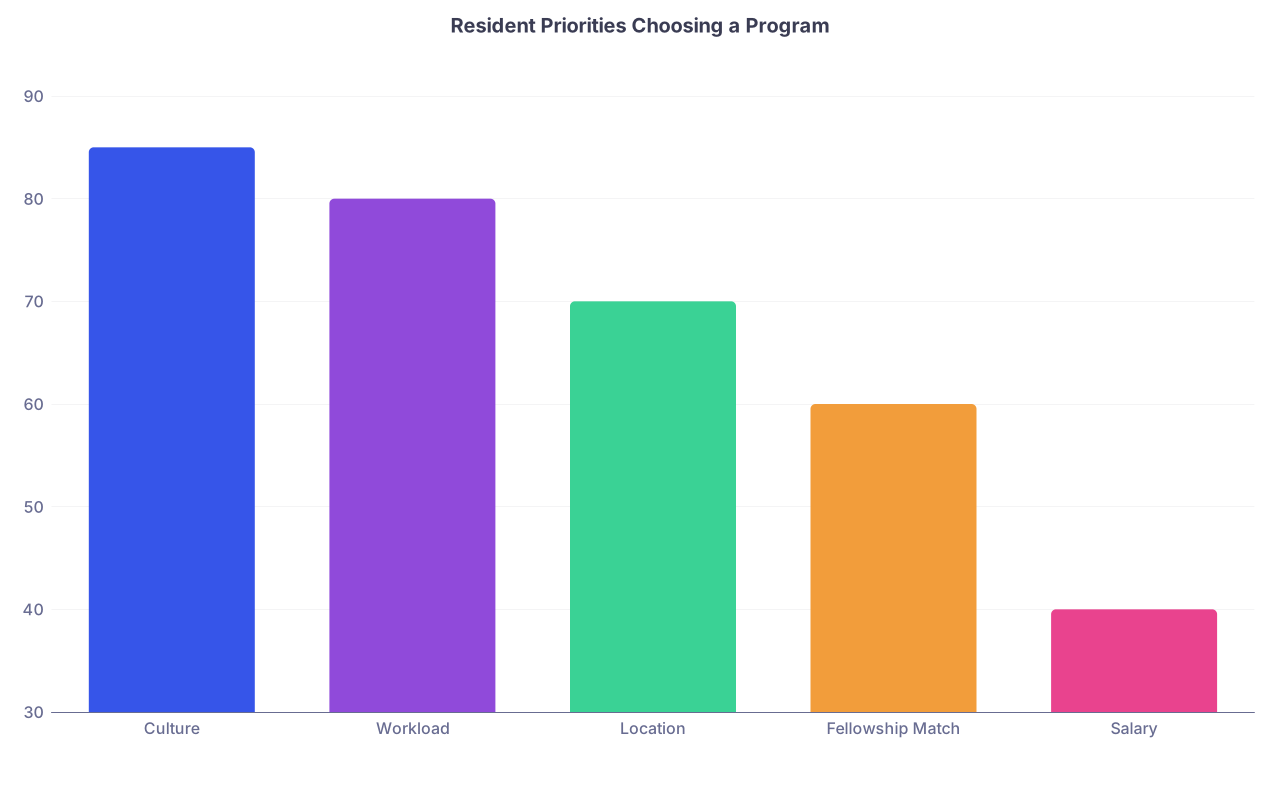
| Category | Value |
|---|---|
| Culture | 85 |
| Workload | 80 |
| Location | 70 |
| Fellowship Match | 60 |
| Salary | 40 |
3. Poor supervision and weak teaching
Examples:
- Seniors regularly feel unsafe with the degree of autonomy
- Attendings are absent, unapproachable, or uninterested in teaching
- New interns are thrown into high‑risk situations with minimal support
Match list impact? Very limited.
Fellowship PDs care whether you have:
- Strong letters describing sound clinical judgment
- Solid procedural and clinical skills
- Evidence you can handle responsibility and teach others
You do not get that from chaos. You get that from structured, thoughtful supervision that gradually hands you the reins.
If the program is just a work mill where note‑writing and scut dominate, the best residents will still carve out a path—but they will do it despite the program, not because of it.
4. Terrible support for wellness and remediation
Examples:
- Residents who struggle are labeled “problem residents” and isolated
- Mental health access is poor, stigmatized, or functionally unavailable
- Maternity/paternity leave is technically allowed but culturally punished
Can a strong match list offset this? No, especially if you have any known vulnerabilities.
Nobody plans to struggle. Yet many residents will have at least one rough patch: health issue, family crisis, step failure, sick parent, pregnancy, etc.
Programs that see you as disposable or a burden in those moments can derail even the most promising fellowship plans.
Here’s the hard truth: fellowship directors talk. If your program handles struggling residents by quietly pushing them out or tanking their letters, that follows you.
5. Dishonesty or data manipulation
Examples:
- Residents tell you “the program misreports our duty hours”
- Match lists are selectively edited—only showing “top” matches, hiding prelims, SOAP, or non‑matches
- During interview day, different leaders give conflicting answers about serious issues (closures, losing services, faculty turnover)
Match list impact? If they’re manipulating this, they’ll manipulate that too.
A program that lies to ACGME or applicants is not a place you should trust with your career. Period. A fancy slide of matches is useless if you cannot believe the people presenting it.
When can a strong fellowship match list partially offset lesser concerns?
Not every “red flag” is a true deal‑breaker. Some things are yellow or orange, and in those cases, fellowship outcomes matter more.
These are situations where I might say, “Yes, the match list honestly tips the scale.”
1. Rough around the edges, but clearly high‑quality training
Example profile:
- Culture: tough, direct feedback, not warm and fuzzy—but not abusive
- Workload: heavy but legal; high acuity, lots of responsibility
- Teaching: strong clinically, but not super structured or academic
- Outcomes: consistent record of competitive fellowship matches
Here, a great match list can be a legitimate plus. You’re trading a more intense, old‑school atmosphere for strong training and doors opened.
If you’re resilient, want a subspecialty, and can tolerate a “no hand‑holding” vibe, this can be a smart choice.
2. Mid‑tier hospital, stellar mentorship in your niche
Example:
- General IM program, nothing special overall
- But one or two nationally visible faculty in your target subspecialty who have a track record of mentoring residents into those fellowships
In that scenario, the specific fellowship track record under those mentors matters more than the global match list. You might reasonably accept some less‑than‑ideal aspects (location, less prestige) because you have a direct pipeline into what you want.
3. You value location/family highly, and the program is “good enough”
If your must‑haves are:
- Close to partner or kids
- Reasonable cost of living
- Near support system
And the program is:
- Safe, not malignant
- Solid training
- Decent but not amazing fellowship matches
Then a good match list nearby can be a tiebreaker compared to moving far away for a slightly weaker culture but marginally better training.
This is not about the match list erasing red flags. It’s about how you weight different trade‑offs in a mostly safe field of options.
How to evaluate a “great” fellowship match list like a grown‑up
Here’s the practical checklist I’d use when you’re staring at that glossy slide.
| Focus Area | Key Question |
|---|---|
| Consistency | How do matches look over 5+ years? |
| Denominator | How many applied vs matched? |
| Home Bias | How many stayed in-house? |
| Spread | Are matches broad or just 1–2 specialties? |
| Support | How do average residents (not stars) fare? |
And then, on interview day or during second looks, ask:
- “How many residents applied to fellowship last year, and how many matched?”
- “Where do average residents tend to match, not just the top 1–2?”
- “How often do residents change their minds about fellowship vs general practice?”
- “Can you show us the full, unedited match list—including people who did not match or went non‑trad paths?”
Then cross‑check with residents without faculty around. Ask:
- “Do you feel supported during fellowship application season?”
- “Who actually writes your letters? Are they invested or just signing forms?”
- “Did anyone not match last year? How was that handled?”
The vibe of those conversations tells you more than whatever is on the slide.
A simple decision framework: when to walk, when to accept, when to be cautious
Use this as a quick mental flow:

| Step | Description |
|---|---|
| Step 1 | See great fellowship match list |
| Step 2 | Do not rank highly |
| Step 3 | Prefer safer balanced program |
| Step 4 | Consider ranking mid-high with eyes open |
| Step 5 | Match list may be resident-driven, be cautious |
| Step 6 | Serious red flags? |
| Step 7 | Strong fit for your goals? |
| Step 8 | Robust mentorship in your interest? |
Rule of thumb:
- If the red flag is about safety, abuse, or systemic dishonesty → do not rationalize it with match data.
- If the “red flag” is mostly about personality fit, style, or intensity → then the match list can legitimately influence your choice.
The future: why this question is getting more important, not less
As fellowships get more competitive, programs are leaning harder into branding their “match success” as a selling point. I’ve already seen:
- Carefully curated, incomplete match slides excluding non‑matches
- Heavy emphasis on the 1–2 derm/rads/ortho matches, minimal mention of the rest of the class
- Programs subtly implying, “If you want subspecialty X, you must come to a place like ours”
You will see more of this.
At the same time, resident burnout, mental health crises, and early exits from training are increasing. Choosing a program that treats you as a human, not just a fellowship statistic, is not a luxury. It’s survival strategy.

Bottom line
A strong fellowship match list is a useful data point. It tells you that at least some combination of:
- Resident quality
- Institutional name recognition
- Niche reputation
- Mentorship and networking
is working well for fellowship placement.
But it does not:
- Make a malignant program non‑malignant
- Turn unsafe staffing into safe staffing
- Fix poor supervision or teaching
- Erase the personal cost of chronic burnout
So your hierarchy should be:
- Safety and culture first – if these are rotten, walk away, no matter the matches.
- Training quality second – will you be a competent, confident attending?
- Fellowship match list third – as a tie‑breaker among otherwise acceptable programs.
If you are currently making your rank list, here is your next step:
Pull up your top 5 programs and, for each one, write down one sentence on (1) culture, (2) workload, and (3) fellowship outcomes. If the only clear “pro” for a program is the match list and the culture/workload sentence makes you uneasy, move it down. Or off.
FAQ (Exactly 5 Questions)
1. If I’m 100% sure I want a competitive fellowship, should I prioritize programs with the best match lists?
Prioritize programs that are both safe/humane and have a solid fellowship track record. Between two equally safe options, yes, choose the one with better fellowship outcomes in your target field. But do not sacrifice your mental health or basic safety just to chase a brand name. Fellowship PDs would rather have a well‑trained, sane resident from a “lesser” program than a burnt‑out shell from a big‑name sweatshop.
2. How many years of match data should I look at to judge a program?
Aim for at least 3–5 years. A single “excellent” year can be a fluke driven by a particularly strong class or unusual fellowship market. You want to see that residents, year after year, are matching into a mix of solid academic and community positions that align with their goals, not just that one golden cohort crushed it.
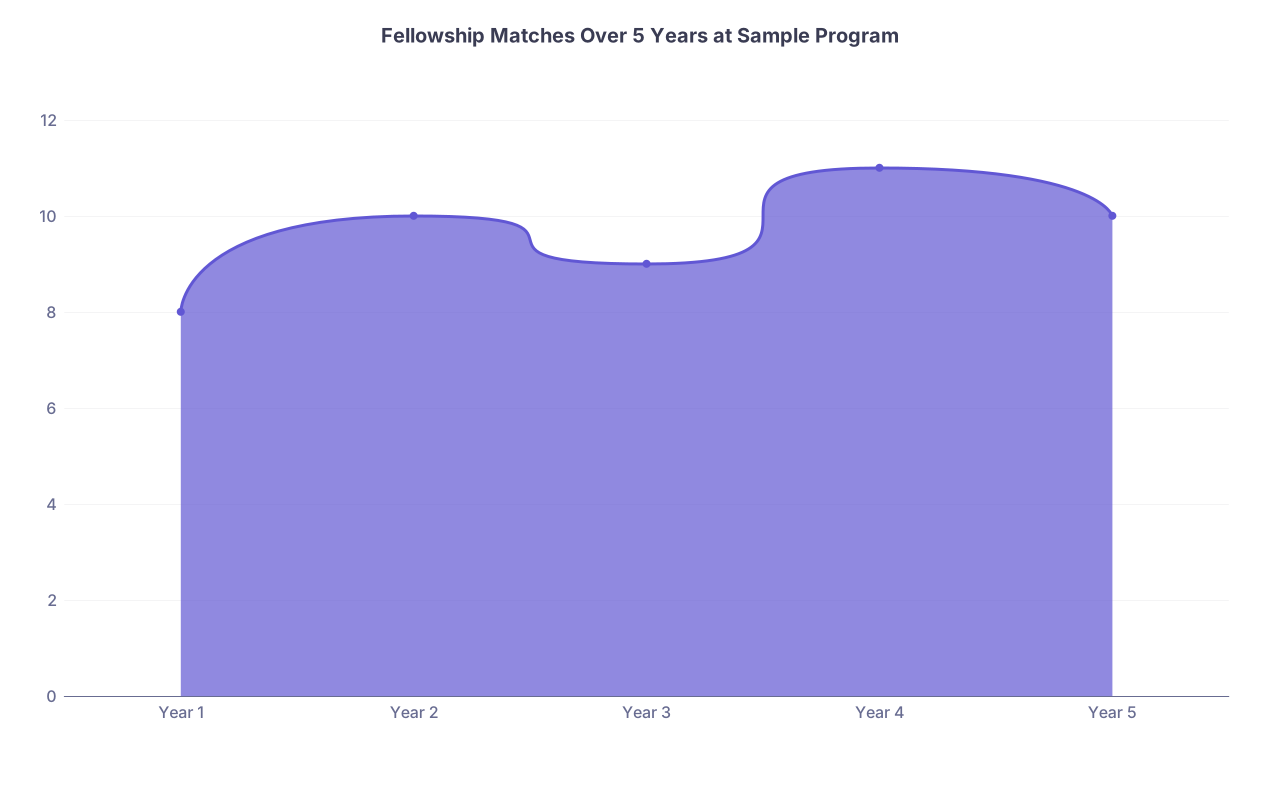
| Category | Value |
|---|---|
| Year 1 | 8 |
| Year 2 | 10 |
| Year 3 | 9 |
| Year 4 | 11 |
| Year 5 | 10 |
3. What if residents seem happy but the match list is mediocre for my desired fellowship?
That’s actually a good “problem” to have. A stable, supportive environment gives you the bandwidth to hustle: do research, attend conferences, network, and get strong letters. In that setting, you can often outperform the program’s average fellowship outcomes. One option is to ask specifically: “Has anyone from here matched into [your field] in the last 5–10 years? What did they do to get there?” If the answer is yes and they can describe a path, it’s workable.
4. Are there red flags specifically about how a program talks about its match list?
Yes. Red flags include: refusing to show full lists, only showing “top” matches, hand‑waving when you ask about non‑matches, or obviously inflating outcomes (e.g., counting one‑year research jobs as fellowships). Another warning sign is when they hype the match slide constantly but residents themselves seem lukewarm or exhausted when you ask about support for applications.
5. Can networking and away rotations compensate for being at a weaker program?
Sometimes. If you’re at a solid but not powerhouse program with decent support, strategic away rotations, research, and mentorship can absolutely put you in the running for competitive fellowships. But if your home program is chaotic, malignant, or unsupportive, you’ll struggle to even set up those opportunities. That’s why I’d always choose a “good, supportive B‑tier” program over a “toxic A‑tier” one, even for competitive subspecialties.