
The honest answer: choosing prestige over obvious culture red flags is almost never “smart.” Sometimes it’s survivable. Occasionally it’s strategically acceptable if you know exactly what you’re buying and what it will cost you. But “smart”? Not really.
Let me walk you through what people actually trade when they do this, what’s fantasy vs reality, and when—if ever—it might make sense to tolerate red flags for the sake of name brand.
First: What You’re Really Asking
You’re not asking, “Is prestige good?” You already know the answer. Big-name programs can open doors: fellowships, academics, niche careers.
You’re really asking:
“Is it worth sacrificing my well-being, training environment, and sanity for that name on my badge?”
Or more bluntly: “Can I eat three years of misery for a theoretically better career?”
Here’s the problem: people dramatically overestimate the upside of prestige and dramatically underestimate the downside of a toxic culture.
What Counts as a Real Culture Red Flag?
Let’s separate “this might be a little intense” from “this is going to wreck you.”
Real red flags look like this:
- Residents openly tell you, “Do not come here if you have other options.”
- PD/APD or faculty mock residents, applicants, or other specialties in front of you.
- Programs brag about “malignant but we produce the best clinicians.”
- No one smiles. During an interview day. That is supposed to be their best face.
- Residents are terrified to talk honestly unless they’re off campus or texting from personal phones.
- Consistent stories of:
- Bullying or retaliation for speaking up.
- Punitive responses to illness, pregnancy, mental health.
- Unsafe workloads, chronic 80+ hour weeks, or blatant duty hour fraud.
- Massive resident turnover, people switching out of the program or leaving medicine entirely.
- “We don’t tolerate weakness” used as a virtue line.
Not “we work hard.” Not “we have a rigorous ICU.” That’s normal. I’m talking systematic disrespect and fear.
Those are not quirks. Those are system features. You will not be the exception.
What Prestige Actually Buys You (And What It Doesn’t)
Let’s stop myth-making and put some structure on this.
| Area | Prestige Often Helps | Prestige Usually Does Not Fix |
|---|---|---|
| Competitive fellowships | Yes, modestly | Awful interview skills |
| Research-heavy careers | Yes, strongly | No publications at all |
| Community jobs | Barely | Major professionalism issues |
| Long-term happiness | No | Toxic culture |
| Core clinical skills | Variable | Systemic understaffing |
At a high level:
Prestige helps most if:
- You want a hyper-competitive fellowship (e.g., Derm, Ortho, GI, Cards, Heme/Onc).
- You want a heavily academic or research career.
- You want to be on a specific elite track (physician-scientist, policy at a national level, high-level leadership early).
It matters less or not at all if:
- You want to be a strong community clinician.
- You care more about lifestyle, teaching, and team cohesion.
- You want to stay in a region where local/regional programs are already well-respected.
I’ve watched residents from mid-tier, healthy IM programs match Cards and GI because:
- They had strong mentors.
- They were not burned out to the core.
- They actually had time/energy to produce solid research and show up well in interviews.
Contrast that with residents at famous-name programs who were so demoralized they barely scraped together a fellowship application.
Prestige is an amplifier. It boosts people who are already doing well. It doesn’t compensate for a system that crushes you.
The Real Cost of Ignoring Culture Red Flags
This is the part people hand-wave away on Interview Day when they’re high on flattery and catered lunch.
Here’s what ignoring culture red flags can actually cost you:
1. Mental and physical health
Burnout is not “I’m tired.” Burnout is:
- You stop caring if you make mistakes.
- You fantasize about quitting medicine entirely.
- You stop trusting yourself clinically.
- Your sleep, relationships, and personality erode.
In malignant programs, that’s not rare. That’s baseline.
And no, you are not “too tough” or “too resilient” to be affected. I’ve seen absolute workhorses break in bad environments. Crying in call rooms, panic attacks between pages, weight loss, hypertension in their 20s. The system always wins.
2. Your actual training
Toxic cultures don’t just make you miserable. They often make you worse clinically:
- Residents avoid asking for help because they’re scared of being humiliated.
- Shortcuts get normalized to survive workload.
- Teaching becomes performative and punitive versus formative.
- Senior residents are too overwhelmed to supervise well.
You might leave with a big-name diploma but shaky fundamentals and patched-together confidence. That’s a horrible combination.
3. Your future optionality
Ironically, the “prestige to keep doors open” argument often backfires.
Red flag programs can:
- Tank your evaluations if you’re not a favorite.
- Limit research opportunities because faculty are too busy, burned out, or disengaged.
- Give you weak or lukewarm letters because attendings barely know you.
- Make you so drained you cannot imagine an additional 3 years of fellowship.
I’ve watched people who picked “the name” decide in PGY-2 they cannot physically or emotionally do more training. That “prestige boost” for fellowship is suddenly irrelevant.
When Might It Be Reasonable to Tolerate Some Red Flags?
Notice I said “some red flags,” not “clear, flashing warning signs that everyone is miserable.”
There are rare, narrow cases when choosing a tougher culture for prestige might be a calculated risk—not a good time, but a conscious gambit.
Reasonable only if most or all of these are true:
You have a very specific, competitive end goal where pedigree strongly helps
Example: you’re aiming for interventional cardiology or transplant surgery and the program has:- A track record of placing multiple residents into those fellowships.
- Deep subspecialty exposure.
- Big-name mentors who actually meet with residents.
The “red flags” are intensity, not abuse
Intensity = high workload, sicker patients, lots of night float. Culture is direct and demanding but:- Residents still support each other.
- Program leadership is responsive.
- People are tired but not terrified.
Residents say, “It’s hard but fair” instead of “Run”
The exact phrasing matters. When I hear:- “We work really hard here, but I’d choose it again.”
- “Leadership will push you, but they have your back.” I listen. That’s not the same as, “Honestly, I’d go elsewhere if I could.”
You have a strong support system and good mental health baseline
Not the Instagram kind. Real support:- Partner/family/friends who understand what a bad call month feels like.
- Some history of using therapy, coaching, or other support when needed.
- No currently uncontrolled anxiety, depression, or PTSD.
There is a clear escape hatch if it’s worse than you expected
You understand:- How transfer/switching specialties works.
- Who at your med school or program you could talk to.
- That switching is possible but painful—and you’re prepared to do it if needed.
That scenario is not “this malignancy will make me strong.” It’s: “This will be brutal but high-yield, and I have enough internal and external resources to survive it.”
That’s as generous as I’m willing to be.
Decision Framework: How To Choose When One Program Is Prestigious and Red-Flaggy, and the Other Is “Just Solid”
Use this. Seriously. Don’t just vibe it out.

| Step | Description |
|---|---|
| Step 1 | Two Programs In Contention |
| Step 2 | Rank by Fit and Goals |
| Step 3 | Choose Other Program |
| Step 4 | Prestige Program Is Reasonable Risk |
| Step 5 | Any Serious Red Flags? |
| Step 6 | Residents Warn You Away? |
| Step 7 | Need Extreme Prestige For Specific Goal? |
| Step 8 | Confident You Can Tolerate Culture? |
Ask yourself, in order:
Are there serious red flags (abuse, fear, unsafe workloads, retaliation)?
If yes → program goes low on your list or off your list. Full stop.If the “red flags” are more like “tough but not toxic,” do you genuinely need that program’s specific advantages for your career plan?
Not “it would be nice.” Need.If you went to the less-prestigious but healthier program, could you still realistically reach your goal with:
- Good mentorship,
- Research,
- Solid evaluations?
Most of the time, the answer is yes. And then the rational move is: choose the healthier environment.
The Hidden Factor: How Often Prestige Is Just Ego
Nobody says this out loud, but let’s be honest.
A lot of the pull toward prestige is not actually about career outcomes. It’s about:
- Proving something to yourself, your classmates, your family.
- Fear of judgment: “What will people think if I turn down Big Name U?”
- That quiet, gross little voice: “Will they think I wasn’t competitive enough?”
I have heard residents say, “I knew I’d be miserable at [famous program], but I couldn’t bring myself to rank the smaller place higher. It just felt… less.”
That’s not strategy. That’s ego and fear driving a 3–7 year decision.
You’re allowed to have ego. You’re human. But call it what it is so you don’t dress it up as “career planning.”
Data Reality Check: Culture vs Prestige Over a Career
Here’s how the tradeoff often plays out across 10–20 years:
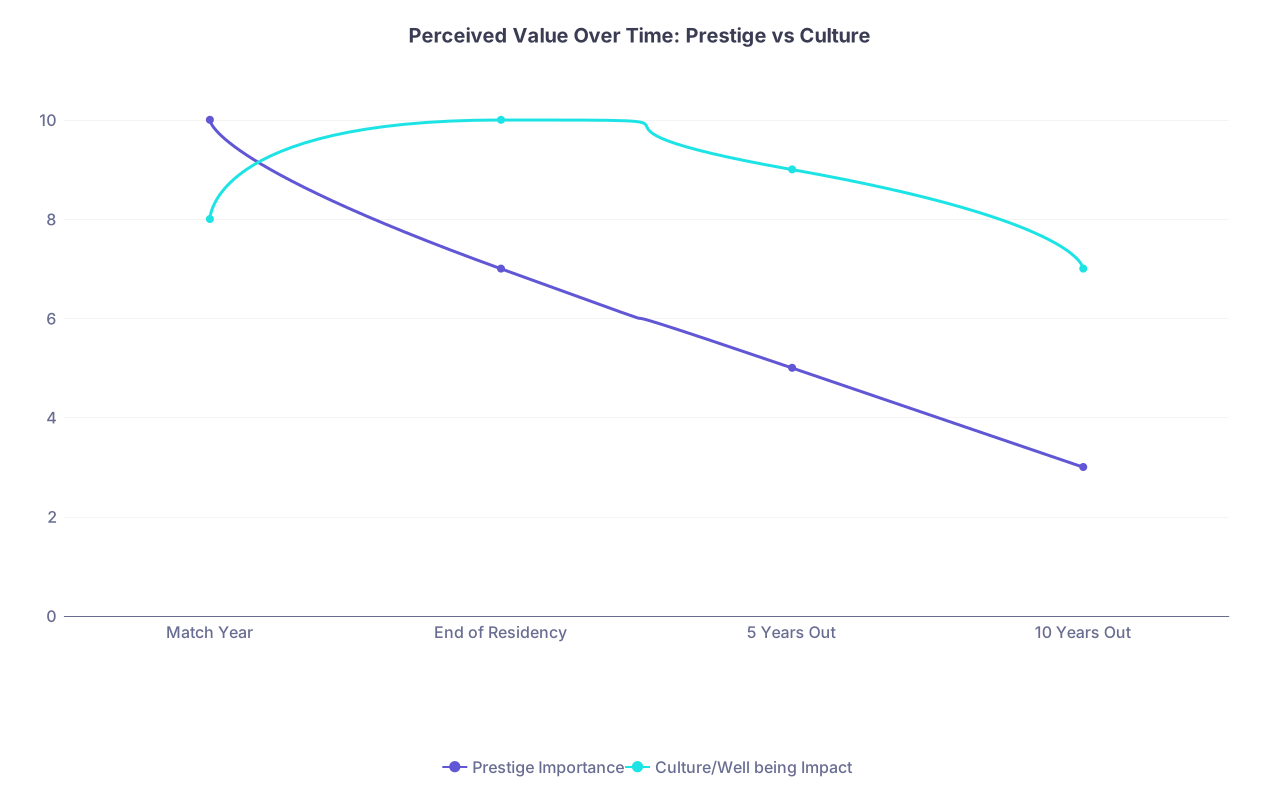
| Category | Prestige Importance | Culture/Well being Impact |
|---|---|---|
| Match Year | 10 | 8 |
| End of Residency | 7 | 10 |
| 5 Years Out | 5 | 9 |
| 10 Years Out | 3 | 7 |
- At Match: prestige feels like everything.
- End of residency: you care more about how broken or intact you feel.
- Five years out: your skills, reputation, and network matter far more than what your badge said at 28.
- Ten years out: hardly anyone cares where you did residency unless you’re in a very narrow lane of academic medicine.
Culture damage, on the other hand, doesn’t just evaporate. The habits, trauma, and burnout trajectory can follow you.
Clear Answer: Is It Ever Smart to Choose Prestige Over Clear Culture Red Flags?
If by “clear culture red flags” you mean the real ones—fear, bullying, unsafe workloads, lack of support—then no, it’s almost never smart.
You might still do it. You might survive. But you are not making a savvy, high-EV strategic play. You’re gambling your health and your future engagement with medicine for something that usually matters less than you think.
The only semi-defensible case is:
- The red flags are more “hard but not malignant.”
- You have a very specific, truly prestige-sensitive goal.
- There are demonstrable, concrete advantages at that program for that goal.
- You have unusual resilience and robust support.
Even then, I’d ask you one final question:
If a close friend described this program and this concern to you, would you tell them to go there?
If your honest gut answer is “absolutely not,” believe yourself.
What You Should Do Today
Right now, grab the list of programs you’re considering or ranking. For each prestige-heavy one, write down two columns:
- Left: 3 concrete, verifiable benefits that program gives you for your actual career goals (not ego, not vibes).
- Right: 3 specific culture concerns or red flags you heard or sensed.
Then ask yourself: would I trade three years of my daily life for the stuff in the left column, given the cost in the right column?
If your hand hesitates even a little, that’s your answer.