
What level of residency dysfunction is so bad that you should actually walk away from a matched spot and risk having no residency at all?
Let me be direct: that bar is high. Much higher than Reddit threads and panicked group chats make it sound. But there are real situations where leaving the Match spot is the lesser evil.
This is about those situations. Where the red flags are not just “this sucks,” but “this is unsafe, abusive, or career‑destroying.”
First: How “Bad” Does It Have To Be To Justify Walking Away?
You do not leave a Match spot because:
- The call schedule is brutal
- You liked another program more
- The city is depressing
- The program has some malignant seniors
- You’re “not sure” about the specialty after 2 rough rotations
Those are common. Painful. But survivable.
You start to think seriously about leaving when you’re facing one or more of the following:
- Credible, repeated patient safety violations that are normalized, not corrected.
- Systemic abuse or harassment with no functioning reporting path.
- Serious misrepresentation of program features that directly threaten your training or board eligibility.
- Legal/ethical issues that put you at risk of being reported, sued, or sanctioned.
- Severe and worsening health risk to you that the program will not accommodate (physical or mental) despite good‑faith attempts.
Anything short of that? You probably try to fix, transfer, or endure with a plan. Not torch the spot.
The Major Red Flags That May Justify Leaving
Let’s get specific. I’m going to call out patterns I’ve seen where I did advise people to consider leaving, and others where I told them bluntly: “You hate this, but you finish it.”
1. Patient Safety Hazards That Are Baked Into the System
Every program has a wild night or a dangerously understaffed stretch. That alone is not a reason to leave. I’m talking about persistent, normalized danger.
Patterns like:
- You’re routinely left holding services far beyond your training level with no accessible attending or senior.
- Supervision is functionally absent. Attendings willingly sign notes and procedures they never reviewed, every day.
- You’re pressured to falsify documentation (back‑dating H&Ps, writing that you examined someone you never saw, entering vitals you didn’t check).
- You report safety issues multiple times and get “this is just how it is” or outright retaliation.
Example:
A PGY‑1 in surgery covering 40–60 inpatients on nights, managing septic shock, acute abdomen, and airway calls alone with an attending who “doesn’t want to be called unless someone is literally dying.” That’s not “tough training.” That’s unsafe.
When this is persistent, documented, and uncorrected after escalation, you aren’t just in a bad job. You’re in a liability trap.
2. True Malignancy: Abuse, Harassment, Retaliation
“Malignant program” is overused. A hard program that yells a bit and has scut? Not malignant. Ugly, but not disqualifying.
Real malignancy looks more like:
- Targeted humiliation, screaming, threats as a norm, not an occasional blow‑up.
- Sexual harassment or discrimination (comments, touching, propositions, pregnancy discrimination) with no safe path to report.
- Retaliation after you raise legitimate concerns:
- Suddenly “unprofessional” in evaluations
- Blocked from electives
- Threats toward your future job/visa/letters
- Identity‑based abuse: racist remarks, mocking accents, attacking religious dress.
If you’ve tried internal routes (PD, DIO, GME, ombuds, HR) and either:
a) Nothing changes
b) Retaliation escalates
You may be justified in saying: “Staying here will break me or destroy my career.”
3. Program Dishonesty That Threatens Your Training or Certification
Programs sometimes oversell themselves. Annoying but common. What crosses a line is serious misrepresentation that threatens the core reason you’re there: to be trained and board eligible.
Red flags:
- You’re told on interview: “We’re fully accredited,” then find they’re on probation with ACGME and actively at risk of closure.
- Required rotations promised for board eligibility (e.g., certain months of ICU, outpatient clinic, pediatric exposure) simply do not exist.
- Procedure numbers or case logs are so low that graduating residents struggle to meet board requirements—and leadership shrugs.
| Type | Serious Red Flag | Annoying But Not Fatal |
|---|---|---|
| Accreditation | On ACGME probation, not disclosed | Recently had a citation, now fixed |
| Case Volume | Consistently below board minimums | Less volume than top programs |
| Required Rotations | Missing board-mandated rotations | Rotation sites rearranged |
| Faculty Stability | Key specialty faculty all left abruptly | Some recent turnover |
If staying risks you finishing residency but not being board eligible—or training in such a substandard way that you’ll struggle to practice safely—that’s a serious discussion.
4. Legal & Ethical Exposure You Cannot Avoid
You can’t control everything a hospital does. But there are situations where simply “being part of the team” puts you at risk:
- They push you to bill for services you didn’t perform or supervise.
- You’re told to back‑date notes to “make the chart consistent.”
- They want you to sign off on things above your credentialing (sedation, procedures, independent reads) as if you are an attending.
- You’re explicitly warned not to “put that in writing” about complications or mistakes.
This is how people end up on the wrong side of state boards and lawsuits. Once you’ve flagged it internally and seen no change, staying becomes less “suck it up” and more “accept personal legal risk.”
Don’t Ignore Your Own Health: When the Job Is Breaking You
There’s a difference between tired and destroyed.
You start thinking about leaving, for your own health, when:
- You have active suicidal ideation, self‑harm, or new substance misuse tied to residency.
- You’ve been diagnosed with a serious mental health condition and the program refuses reasonable accommodations (schedule adjustments, leave, treatment time).
- A physical health condition (e.g., new cardiac issue, pregnancy complications, autoimmune flare) cannot be managed safely with the program’s demands, and they refuse good‑faith accommodation discussions.
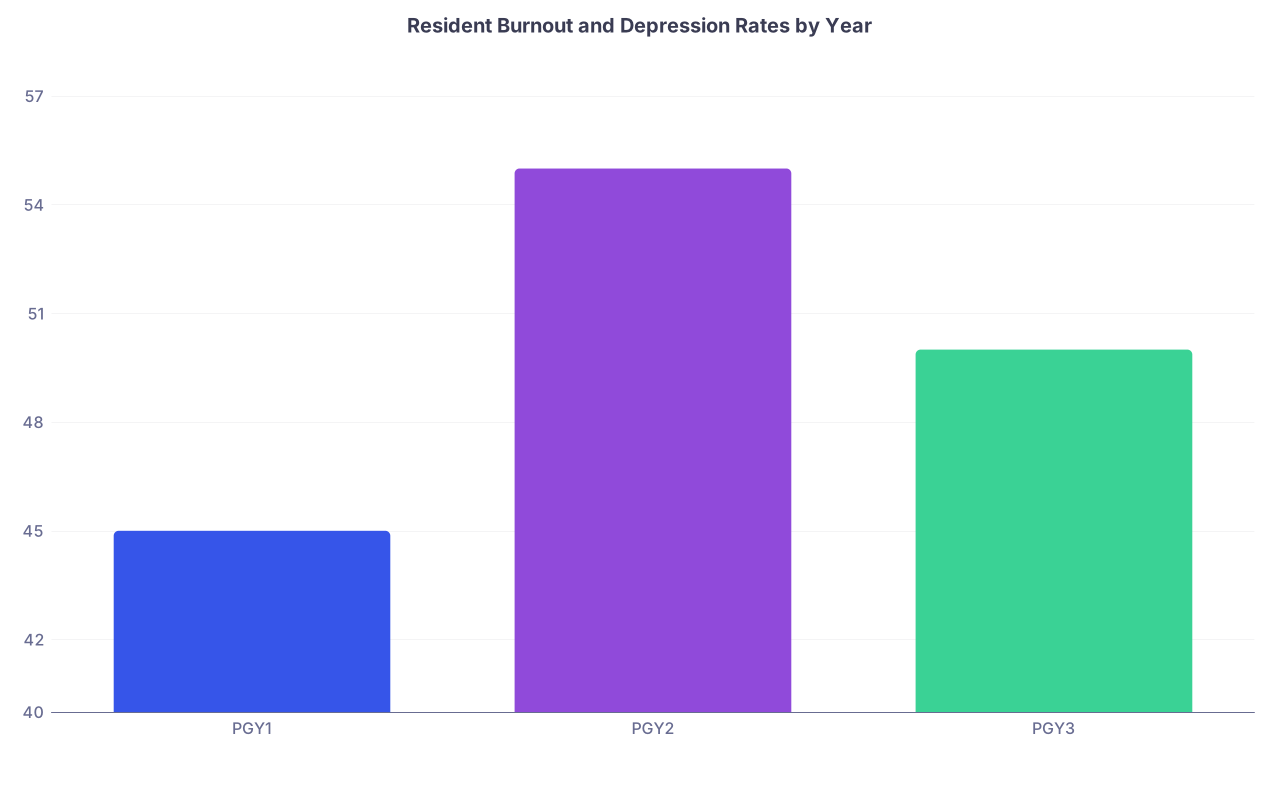
| Category | Value |
|---|---|
| PGY1 | 45 |
| PGY2 | 55 |
| PGY3 | 50 |
I’ve seen residents try to “be tough” through panic attacks daily, cutting, or drinking half a bottle of liquor after every call night. That’s not toughness. That’s losing yourself.
If continuing puts you at clear medical risk—and you’ve tried to get help, including from GME/PD—and you’re still being pushed past safe limits, leaving is not weak. It’s self‑preservation.
Before You Walk: What You Have To Do First
Leaving a Match spot is serious. It can follow you. So before you send any dramatic email, do this.
1. Get Outside Eyes On Your Situation
Talk confidentially with:
- A trusted attending outside your program
- Your medical school dean / student affairs or alumni office
- Specialty organization helpline or mentorship program
- A therapist or physician health program
- If needed: an attorney familiar with employment/medical training
You want at least one person who can say, “Yes, this is beyond normal misery,” or “No, this is awful but fixable.”
2. Document Everything
Not for drama. For protection.
- Keep a log: dates, times, who was present, what happened.
- Save emails, schedules, duty hour violations, texts (screenshots).
- Keep evaluations, formal feedback, any written threats.
If you ever need to explain to another PD, GME, or even a board why you left, this paper trail turns “complainer” into “person who faced a clearly unsafe/abusive situation.”
3. Use Internal Channels—Strategically
You don’t start with an ACGME complaint on day one. You escalate:

| Step | Description |
|---|---|
| Step 1 | Identify Serious Issue |
| Step 2 | Talk to Chief or Mentor |
| Step 3 | Program Director Meeting |
| Step 4 | Document Concerns in Writing |
| Step 5 | GME Office or DIO |
| Step 6 | Formal Complaint - ACGME or HR |
| Step 7 | Consider Transfer or Leaving |
If you skip all of this and just bail, you’ll have a harder time convincing the next program that you left for legitimate reasons.
4. Explore Transfer or Leave Options
There are more middle paths than “stay forever” vs “quit medicine.”
Options:
- Transfer to another program in the same specialty (often off‑cycle spots, SOAP‑filled programs, or when a resident leaves).
- Transfer to a different specialty that’s a better fit or has an opening.
- Take an official leave of absence for health reasons while you figure out next steps.
- Negotiate a mutual separation with honest reference language (“left program in good standing for personal/health reasons”).
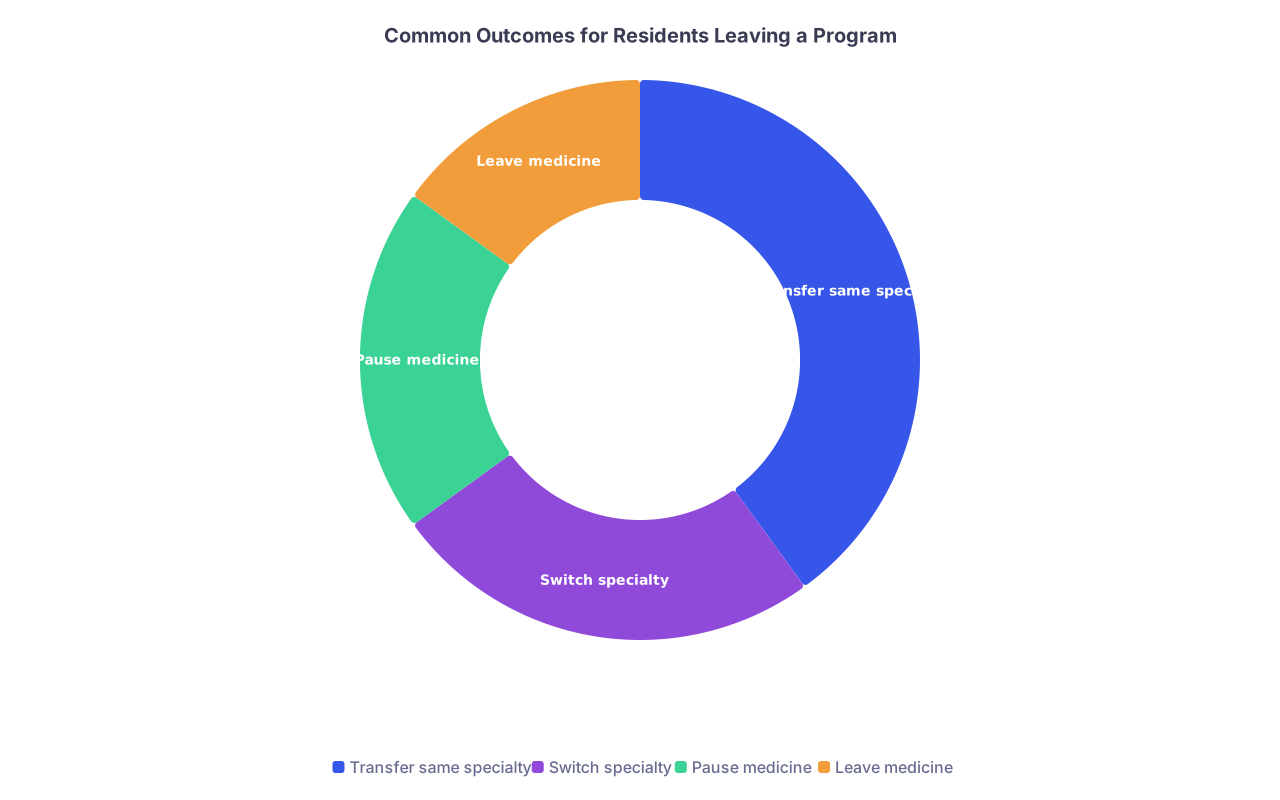
| Category | Value |
|---|---|
| Transfer same specialty | 40 |
| Switch specialty | 25 |
| Pause medicine | 20 |
| Leave medicine | 15 |
Do not assume leaving equals “I can never practice medicine.” People transfer. People re‑enter. It’s not easy, but it’s possible.
How Program Directors Will View You If You Leave
You need to understand the optics. PDs are skeptical by default. They’ve all seen residents who:
- Blame “malignancy” when really they were chronically late, unsafe, or unprofessional
- Bounce programs repeatedly
- Cannot articulate what happened beyond vague “toxic culture” claims
You change that narrative by:
- Having clear, specific, non‑emotional descriptions of what happened
- Showing you tried to resolve it internally
- Having at least one supportive letter from faculty who will vouch for your clinical performance
- Owning your part: “Here’s what I learned, here’s how I’d approach it differently next time”
If all you have is, “They were mean, schedule sucked, I was burned out,” you’ll struggle. If you can calmly describe a pattern of unsafe practice, abuse, or deception, backed by documentation and a dean/mentor, people listen.
A Simple Decision Framework: Stay, Transfer, or Leave
Use this as a gut check.
Ask yourself:
Is this primarily about discomfort… or danger?
- If it’s schedule, city, personality conflicts: lean toward staying or transferring, not quitting.
Have I exhausted reasonable internal options?
- If you’ve never spoken to your PD, GME, or a dean: you’re not ready to walk.
Is my own health at real risk?
- If mental/physical health is crashing despite treatment and attempts to adjust, that moves the needle.
Do I have at least a rough path forward if I leave?
- Potential transfer leads, leave of absence plan, financial backup, legal advice if needed.
If the answer is:
- Mostly discomfort, limited attempts to fix things → Stay for now, seek support, consider transfer.
- Clear danger/abuse, documented attempts to fix, worsening health → Leaving may be justified and wise.

How the Future Might Change This Calculation
Residency isn’t going to magically become humane in five years, but there are shifts:
- More oversight: ACGME and large health systems are more sensitive (and liable) to abuse, duty hour violations, and harassment claims than they were a decade ago. Paper trails matter more.
- Better mental health norms: Mature programs now have formal wellness resources, protected time, and more openness around leave. The dead‑eyed “never show weakness” culture is slowly aging out.
- Alternative career paths: Hospitalist tracks, telemedicine, hybrid clinical/industry roles—more ways to use partial training than before.
That said, the system still defaults to: “Just push through.” So you have to be the one to say, “No, this arrangement is unacceptable,” when it truly crosses the line.

Key Takeaways
- Leaving a Match spot is justified only in serious situations: persistent unsafe care, systemic abuse, major misrepresentation, or genuine health risk, after attempts to fix things.
- Before you walk, document everything, use internal channels, get outside advice, and explore transfer/leave options.
- You can leave and still have a future in medicine, but only if you handle the exit strategically, calmly, and with evidence, not in a blaze of rage.
FAQ: Residency Red Flags & Leaving the Match Spot
1. Is it career suicide to leave a residency after matching?
No, but it’s high‑risk. Some residents successfully transfer to other programs or specialties, especially if they have strong evaluations, clear documentation of serious issues, and support from mentors. If you leave impulsively without documentation or references, you make it much harder.
2. What if my program is just miserable but not clearly unsafe?
Then you probably stay—or you look quietly for a transfer, but you don’t nuke your spot. Miserable culture, rough call, and grumpy attendings are extremely common. That’s not enough to justify leaving with no backup plan.
3. When should I involve ACGME or an external body?
After you’ve tried internal mechanisms: chiefs, PD, GME, ombuds, HR. If you’re seeing persistent duty hour violations, unsafe care, harassment, or retaliation with no internal response, an ACGME complaint can be appropriate. Just know it’s serious, slow, and not always protective in real time.
4. Can I re‑enter the Match after leaving a program?
Sometimes. Some specialties and programs are more open than others. You usually need: a clear explanation, support from prior faculty, and ideally some time/experience that shows stability and growth (research, another training program, clinical work depending on your credentials).
5. How do I explain leaving in future interviews?
Be concise, specific, and unemotional: “There were persistent concerns about X (safety/harassment/misrepresentation). I raised them through A, B, and C. Things did not improve, and my health/career were being affected, so I stepped away. Here’s what I learned and why I’m confident I can thrive in a healthier environment.” No long rants. No character assassinations.
6. Should I talk to my PD before deciding to leave?
Usually yes—unless they’re the direct source of abuse and there’s a real risk of immediate retaliation. In most cases, a direct meeting with the PD, followed by contact with GME, is part of a professional exit strategy and often helps with future references or negotiated separation.
7. What if I’m not sure whether what I’m experiencing is “bad enough”?
Assume you’re too close to judge clearly. Talk confidentially with: a prior attending, your med school dean, a therapist, or a trusted senior resident outside your program. Lay out concrete examples, not just feelings. If multiple experienced people say, “This sounds like an extreme situation,” you take that seriously. If they say, “It’s awful but standard,” you lean more toward coping and planning rather than quitting outright.