
Found Concerning Board Pass Rates? Here Is Your Response Plan.
If a program cannot consistently get its residents past the boards, it is failing at its core job. Full stop.
You are not “overreacting” if you see a 60–70% board pass rate and feel uneasy. You are seeing a flashing red light. The question is not whether you should worry. The question is what you do next.
This is where most applicants and even current residents mess up:
- They panic but do nothing structured.
- They ask one vague question on interview day and accept a rehearsed answer.
- Or they ignore the data, assume “it will probably be fine,” and then end up as the next statistic.
You are going to do something different. You are going to treat concerning board pass rates like a clinical problem: gather data, assess severity, identify root causes, ask the hard questions, decide on a plan, and protect yourself with a backup.
Let me walk you step by step through that process.
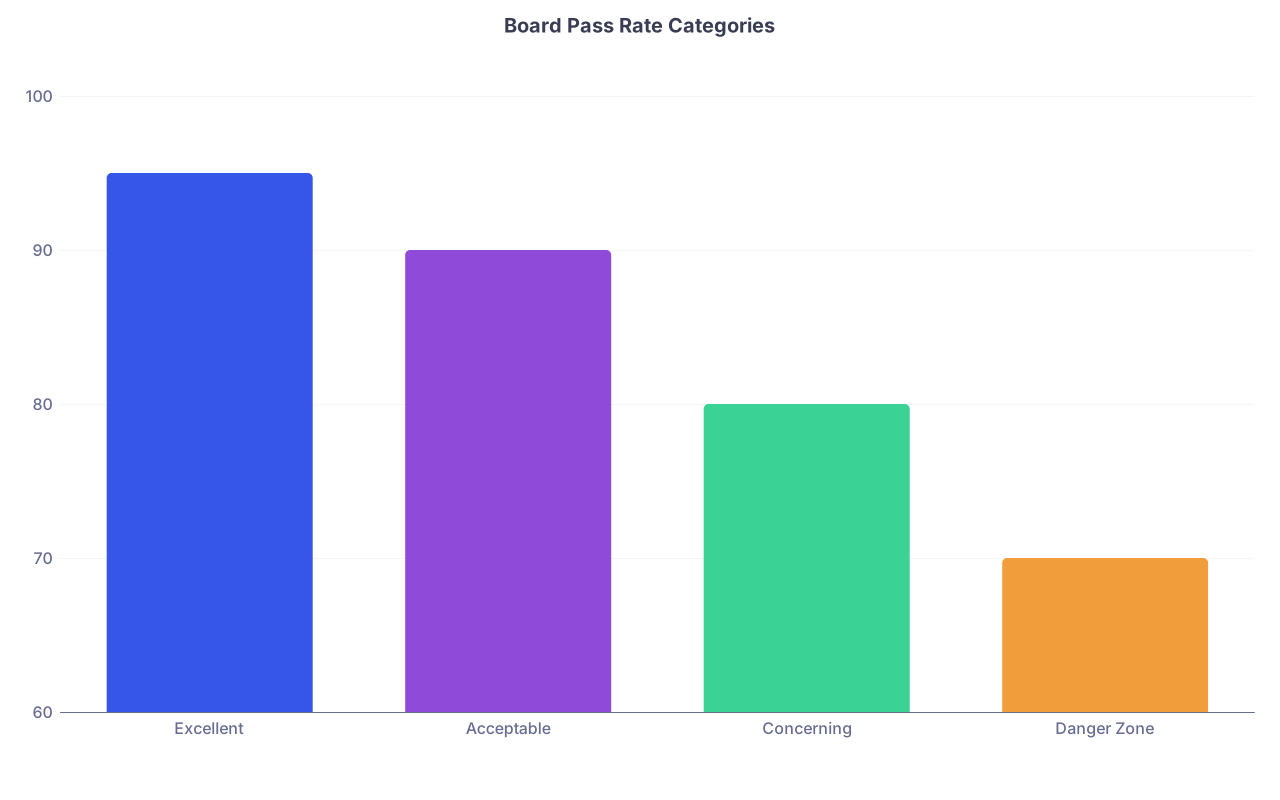
| Category | Value |
|---|---|
| Excellent | 95 |
| Acceptable | 90 |
| Concerning | 80 |
| Danger Zone | 70 |
Step 1: Get the Real Numbers (Not the Marketing Version)
Programs love vague language: “We generally do very well on boards.” That means nothing.
You want hard numbers, ideally:
- First-time board pass rate over the last 3–5 years.
- Overall pass rate (including retakes).
- How they compare to national averages.
Where to find the data
Program website
Some programs publish board pass rates directly on their site. If they do not, that is already mildly suspicious in 2026, especially in competitive fields.ACGME / Specialty Boards
- ACGME annual program reports often include “board certification rate.” It is not always public, but some specialty organizations summarize it.
- Many ABMS boards (e.g., ABIM, ABFM, ABS) publish pass rates by examinee type but not always by program. Still useful:
FREIDA / Specialty Society Resources
- FREIDA sometimes has board data or at least language like “meets ABIM pass rate standard.”
- Specialty societies sometimes release benchmarks or “minimum acceptable” thresholds.
Current or recent residents (most reliable) You ask:
- “In your class of X residents, how many passed boards on the first attempt?”
- “How many from the last graduating class are still not board certified?”
If no one can give you a number after a reasonable attempt, assume the number is bad.
How to interpret the numbers
Use this as a rough framework:
| Category | First-Time Pass Rate | Interpretation |
|---|---|---|
| Excellent | ≥ 95% | Strong exam culture |
| Acceptable | 90–94% | Solid but not elite |
| Concerning | 80–89% | Needs explanation & plan |
| Danger Zone | < 80% | Serious red flag |
If a program is consistently under 90%, you need answers. If it dips under 80% more than once without a credible fix, you should strongly consider walking away, unless there is a very specific, very convincing explanation that affects only a tiny number of residents in very specific circumstances.
Step 2: Determine the Pattern – One Bad Year vs. Systemic Problem
Not all low pass rates mean “bad program.” You are looking for pattern and direction.
Look for:
Trend over time
- Was it:
- 97%, 96%, 94%, 93% → fine.
- 95%, 85%, 82%, 78% → that is a program in trouble.
- 95%, 90%, 60%, 92% → something major happened 1 year. You need the story.
- Was it:
Single bad cohort vs. chronic issue Ask residents:
- “Was there one class that did poorly or has this been an ongoing problem?”
- “What changed in the years when rates dropped?”
Subgroup issues You might hear:
- “The people who delayed taking Step 3 during fellowship had more trouble.”
- “International grads struggled more because support was not tailored.” That is still a program responsibility, but it may be fixable.
What a reasonable explanation sounds like
A credible program director might say something like:
“Three years ago we had a change in call structure that backfired. Residents had less protected study time and our pass rate dropped to 78%. We reversed that change, created a mandatory board review curriculum, and the last two years we are back to 94% and 96%. Every resident who initially failed has since passed on retake.”
This is believable:
- Admits the problem.
- Names a specific cause.
- Shows concrete changes.
- Has improved numbers after the fix.
What is not credible:
“Yeah, we had a few bad years, but we are working on it.”
That means they do not have a handle on it.

| Step | Description |
|---|---|
| Step 1 | See concerning pass rate |
| Step 2 | Proceed but verify supports |
| Step 3 | High risk red flag |
| Step 4 | Ask residents specific questions |
| Step 5 | Consider ranking with caution |
| Step 6 | Lower or remove from rank list |
| Step 7 | Trend or 1 year? |
| Step 8 | PD explanation convincing? |
Step 3: Separate Program Failure from Individual Behavior
You want to know this: are residents failing because of:
- Lack of teaching and structure? → Program problem.
- High toxicity and burnout? → Program problem.
- One or two residents with serious personal / academic issues? → Might be individual, but the program still owns some of it.
Here is how you tease that out.
Targeted questions to residents
Do not ask: “Is there good board support?” Everyone will say yes.
Ask things like:
- “How many formal didactics hours per week are truly protected?”
- “Are people actually excused from pages during lectures, or is it interrupted constantly?”
- “What resources are provided and paid for by the program? (Question banks, board review courses, printed materials, etc.)”
- “Does anyone fail the in-training exam repeatedly and still get no structured remediation?”
- “If someone is falling behind, what actually happens? Not theoretically. What have you seen?”
You are listening for patterns:
- Green flags: “We have dedicated board review sessions, faculty-led question reviews, paid Qbanks, and a clear remediation plan.”
- Yellow flags: “Some services are so busy you just skip didactics regularly.”
- Red flags: “If you fail, they blame you. No one sits down and makes a plan with you.”
Ask about in-training exam (ITE) culture
ITE is your early warning system. Good programs use it aggressively to prevent board failures.
Ask:
- “What happens if you score low on the in-training exam?”
- “Are there structured, required steps if you are below a percentile cutoff?”
What you want to hear:
- “Below the 30th percentile? You meet with the PD, get a study plan, and are given extra Qbank access and protected time.”
What you do not want:
- “They send out the scores and say, ‘Try to do better next year.’ That is it.”
Step 4: Directly Confront the Issue with the Program Director
This is the part applicants are scared to do. You should do it anyway. Respectfully, but directly.
During an interview day or a follow-up call/email, you can say:
“I noticed your board pass rates in 2022 and 2023 were lower than national averages. Can you walk me through what happened and what specific changes you have made?”
Then stop talking. Let them answer.
How to judge their answer
You want:
- Specific data (“In 2022 we had 4 of 16 fail the first attempt.”)
- Honest cause analysis (“We identified weak didactic structure and poor use of ITE data.”)
- Action plan (“We increased protected didactic time, purchased X board review resource for everyone, and started mandatory remediation for ITE low performers.”)
- Follow-up metrics (“Since then, the last class had a 94% first-time pass rate.”)
You should be worried if you hear:
- “Our residents are just not good test takers.”
- “It was just one bad class” with no explanation why.
- “We expect our residents to take ownership of studying; we do not spoon-feed them.”
That last one is code for “We provide very little support and blame you if you fail.”

Step 5: Evaluate the Program’s Actual Board Prep Infrastructure
Do not just ask “Do you support board prep?” Ask what the infrastructure looks like.
Core components of a serious board-supportive program
You are looking for concrete elements like:
Protected didactics
- At least 3–5 hours per week.
- Pages covered by a jeopardy or float system.
- Attendance tracked and valued, not “come if you can.”
Integrated board-style teaching
- Case-based sessions with board-style questions.
- Regular Qbank review as a group.
- Faculty who actually know the exam blueprint.
Paid resources
- Qbank subscriptions (e.g., UWorld, Rosh, TrueLearn, NEJM Knowledge+ depending on specialty).
- Access to review courses or conferences.
- Printed or digital board-review books if relevant.
Data-driven remediation
- ITE tracking with clear thresholds.
- Individual meetings for low scorers.
- Adjustments to rotations or call schedules when needed.
Senior resident and recent grad feedback
- They can tell you: “Yes, what they did was enough,” or “We passed in spite of the program, not because of it.”
If a program has concerning board pass rates and cannot show you a robust system like this, they are gambling with residents’ careers.
Step 6: Adjust Your Risk Assessment and Rank List
Now you have actual data and not vibes. Time to decide how much risk you are willing to accept.
Make a cold, clinical risk assessment
Ask yourself:
How bad are the numbers?
- 1 year at 85% with recovery to >95% since → Possibly tolerable.
- Multiple years in the low 80s or worse → Structural issue.
How convincing is their remediation story?
- Clear cause, concrete changes, improved results → Reasonable.
- Vague hand-waving → Not good enough.
How strong are other aspects of the program?
- Does it compensate with elite clinical training, reputation, or fellowship placement? Be careful here. Reputation does not override the need for certification.
Your own risk tolerance
- If you are already a strong standardized-test taker with high Step/COMLEX scores and strong study habits, you might tolerate slightly more risk.
- If you have always struggled with exams, you should be ruthless about avoiding low-pass-rate environments.
Practical rank list adjustments
Category A: Excellent board outcomes
Programs you trust: rank them freely according to fit, location, and career goals.Category B: Mildly concerning but improved
Rank them lower than similar programs with better track records.
Acceptable as mid-to-lower choices if you have multiple safer options above them.Category C: Persistent poor board rates with weak explanations
Strongly consider removing them entirely, unless your alternative is not matching at all and you are in a very constrained situation. And even then, think long and hard.
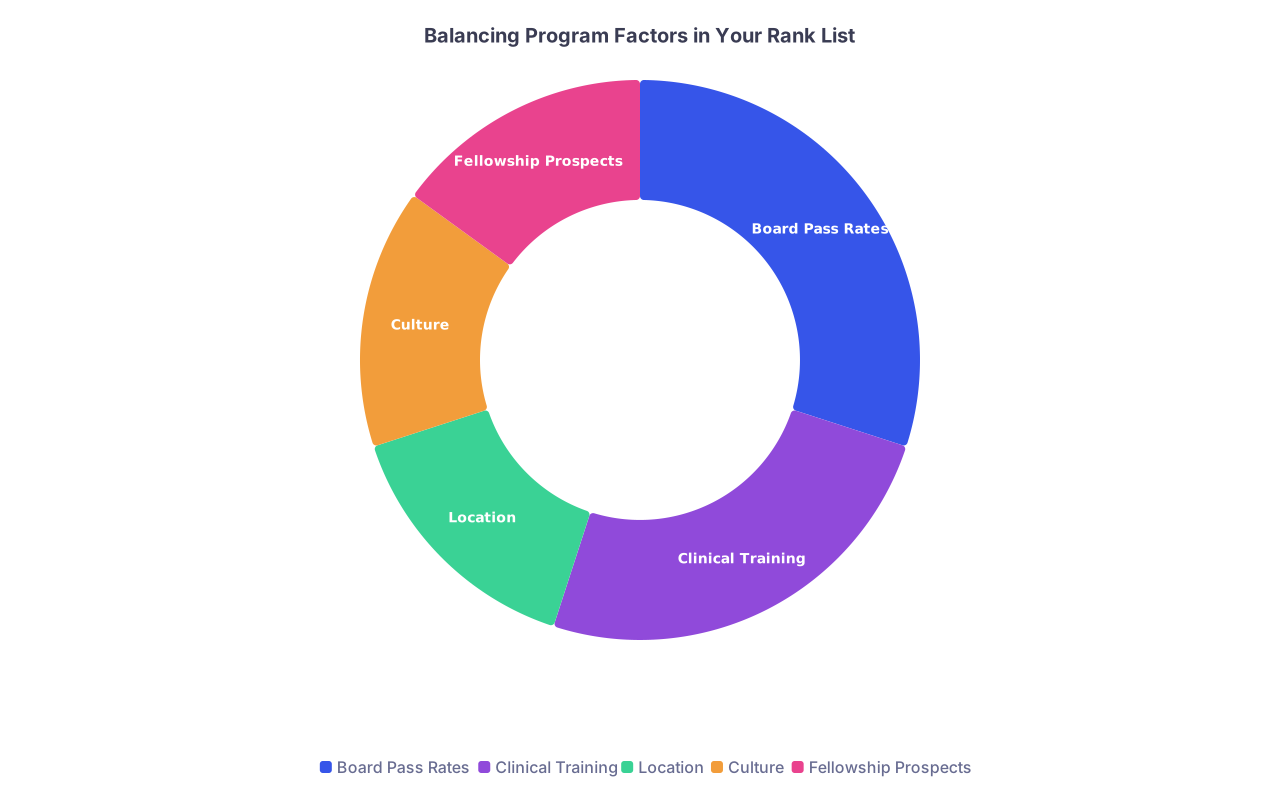
| Category | Value |
|---|---|
| Board Pass Rates | 30 |
| Clinical Training | 25 |
| Location | 15 |
| Culture | 15 |
| Fellowship Prospects | 15 |
Step 7: If You Are Already in the Program – Emergency Personal Plan
If you are a current resident and just discovered your program has awful board pass rates, you do not have the luxury of simply un-ranking them. You need a damage-control plan for yourself.
Phase 1: Reality check and baseline
Get your program’s exact pass data
- Ask the PD or chief resident directly.
- Phrase it as: “I want to make sure I am doing everything possible to pass the boards. Can you share our recent board performance data so I can understand where we stand?”
Analyze your own risk
- Past exam performance (Step 1/2/3, COMLEX, ITE).
- Your workload and rotations.
- Any personal circumstances that could impact studying.
Phase 2: Build a personal board-prep structure
If your program is weak, you must create your own system. Minimum components:
Dedicated schedule
- 1–2 hours per day on most weekdays.
- 4–6 hours on at least one weekend day.
- Block it in your calendar like a clinic session.
Core resources
- One primary Qbank (specialty-appropriate).
- One concise review text or video series.
- A schedule that covers the board blueprint at least once, ideally 1.5–2 times.
Data feedback
- Weekly Qbank performance review.
- Monthly “mock exam” blocks to monitor your progress.
Peer accountability
- Study buddy or small group (2–4 people).
- Weekly check-in with question review.
Phase 3: Demand what you reasonably can from the program
You should advocate for yourself, strategically.
Ask for:
- A formal review of ITE results with your PD and a written plan.
- Coverage for a high-yield board resource if they do not already provide one.
- Adjustments to your schedule in your final 3–6 months to protect study time (fewer nights, avoiding the most brutal rotations right before boards).
How you phrase it matters:
“I am concerned about board performance nationally and in our program’s recent years. I want to be proactive and ensure I am well-prepared. Could we work together to adjust my schedule slightly around the exam and consider support for [resource] to maximize my chances of passing the first time?”
Reasonable. Professional. Harder to dismiss.

Step 8: Decide When the Risk Is Too High – And Consider Exiting
There are rare but real cases where a program’s board pass rates and culture are so bad that staying is a direct threat to your career.
You should start thinking exit when you see:
- Multiple consecutive years with very low pass rates (<80%).
- Zero meaningful changes in response.
- A culture of blame toward residents who fail.
- No willingness to adjust schedules or support structure even when asked.
Options (none of them easy, but very real):
Lateral transfer to another residency
- Requires:
- Open position elsewhere.
- PD support letters (this is the hard part if the relationship is bad).
- More feasible in larger, less competitive specialties.
- Requires:
Finish training but hyper-invest in personal board prep
- Treat the program as a place to get your clinical numbers while you run your own independent “exam prep fellowship” on the side.
- Brutal, but I have seen residents do this successfully.
In extreme cases, legal / regulatory escalation
- If the program is clearly failing in its educational obligations and residents are repeatedly unable to become board certified, you may consider:
- Anonymous reporting to ACGME.
- Consulting GME office / ombuds.
- This is a nuclear option and has consequences; do not step into it lightly. But pretending things are fine when they are not helps no one.
- If the program is clearly failing in its educational obligations and residents are repeatedly unable to become board certified, you may consider:
Step 9: Factor in the Future of Boards and Specialty Trends
Board exams are shifting. Some have gone pass/fail, blueprints are evolving, and subspecialty certifications are changing. You should still care deeply about pass rates.
Why?
- Board certification remains a gatekeeper for:
- Hospital privileges.
- Insurance paneling.
- Many jobs, especially in competitive markets.
Watch for:
- Programs that claim: “Boards are becoming less important so we do not focus on them.” Wrong. Lazy.
- Programs that frame board prep as “self-study only” while other programs are actively modernizing their curricula.
Better programs are:
- Aligning curricula tightly with updated blueprints.
- Using modern educational tools (adaptive learning, analytics on Qbank performance).
- Tracking outcomes transparently and iterating quickly.
You want to train where people are paying attention to these shifts, not where leadership is pretending nothing is changing.

| Step | Description |
|---|---|
| Step 1 | Start PGY2 or PGY3 |
| Step 2 | Baseline self assessment |
| Step 3 | Select Qbank and resources |
| Step 4 | Build weekly study schedule |
| Step 5 | Monitor ITE and Qbank scores |
| Step 6 | Maintain schedule |
| Step 7 | Intensify study and seek support |
| Step 8 | Request schedule adjustment |
| Step 9 | On track? |
Step 10: A Simple Step‑by‑Step Checklist You Can Actually Use
If you want the bare-bones protocol, here it is. Use it when you see a concerning board pass rate for any residency program.
Get the numbers
- 3–5 years of first-time board pass rates.
- Compare to national averages.
Assess the pattern
- One off-year or chronic underperformance?
- Upward, stable, or downward trend?
Ask residents specific, concrete questions
- How many in their class actually passed.
- What real board prep support they received.
- What happens after a failed ITE or board exam.
Ask the PD directly
- “What happened during the low-pass years?”
- “What specific changes did you make?”
- “What have the results been since then?”
Evaluate the infrastructure
- Protected didactics.
- Paid board resources.
- Formal remediation pathways.
- Culture that treats boards as a shared responsibility.
Decide on your risk tolerance
- Strong test taker vs. struggling one.
- Quality of your other options.
- Your specialty’s job market and certification expectations.
Adjust your rank list or personal plan
- Rank safer programs higher.
- If already in the program, build an aggressive personal study strategy and advocate for support.
- Consider transferring or escalating if the environment is truly unsafe for your future.
Final Takeaways
- Low board pass rates are not a “small concern.” They are a core performance metric for a residency program. Treat them that way.
- Do not accept vague reassurances. Demand specific data, concrete changes, and clear evidence of improvement.
- Whether you are an applicant or a current resident, you need a structured, proactive plan. Protect your ability to become board certified. No one will care about that more than you.