How to Use Post‑Interview Emails to Investigate Potential Red Flags
Most applicants waste post‑interview emails on flattery instead of using them to expose problems that will shape their next 3–7 years.
You are not sending “thank you notes.” You are running a quiet investigation.
If you felt something off in a residency interview—odd body language, evasive answers about work hours, residents looking exhausted—that is not something you ignore. You test it. Systematically. And one of the safest, lowest‑risk tools you have is the post‑interview email.
Let me walk through how to do this like a professional, not a desperate applicant.
Step 1: Decide What You Are Actually Investigating
Do not send generic “thank you so much, I loved your program” emails if you have even a whiff of concern. You are not networking. You are gathering data.
Common red flag domains you should clarify:
- Toxic or unstable culture
- Hidden workload and call expectations
- Poor educational environment (service > education)
- Weak fellowship or job placement
- Program instability (leadership churn, accreditation issues)
- Resident burnout, mistreatment, or safety concerns
- Lack of support for parents / visas / couples match
You will get very different information depending on who you email and how you phrase questions.
Think like this:
- “I’m not sure if this place is malignant” → too vague
- “Are residents ever yelled at?” → no one will answer honestly
- “Can you tell me more about how feedback and conflict are handled between faculty and residents?” → answerable, revealing, professional
You need to convert vague discomfort into 2–4 specific, testable questions.
Translate your gut feeling into targeted probes
Examples:
You noticed every resident looked exhausted and mentioned “a lot of call.”
- Investigative questions:
- “Could you share what a typical inpatient week looks like in terms of hours and number of admissions?”
- “How often do residents end up staying past their scheduled times, and what usually drives that?”
- Investigative questions:
Faculty visibly dodged questions about fellowship placement.
- Investigative questions:
- “Would you mind sharing where recent graduates have gone for fellowship or practice in the last few years?”
- “How are residents supported when applying for competitive fellowships?”
- Investigative questions:
Residents warned you “you need a thick skin here.”
- Investigative questions:
- “How does the program handle unprofessional behavior by faculty or staff, if it occurs?”
- “What structures are in place for residents to report concerns safely?”
- Investigative questions:
You only get a limited number of meaningful follow‑ups before you look anxious or high‑maintenance. So be precise.
Step 2: Choose the Right Target for Each Question
Who you email matters as much as what you ask. Different people have different incentives.
General rule:
- For culture, safety, and workload questions → prioritize residents, especially senior or chief residents.
- For curriculum, policies, metrics, and institutional support → faculty leadership or program coordinator.
- For edge‑case or vulnerable topics (pregnancy, leaves, visas, accommodations) → ideally someone who explicitly invited those questions (PD, APD, or chief).
Use each role strategically:
| Concern Type | Best Primary Contact |
|---|---|
| Call schedule, hours | Senior / Chief Resident |
| Fellowship match data | PD / APD |
| Culture, mistreatment | Residents (off the record) |
| Schedule logistics, clinics | Program Coordinator |
| Parental leave, visas | PD / GME Office |
Who to avoid for certain issues
- Program Coordinator for culture/toxicity questions → they might know, but are unlikely to put anything sensitive in writing.
- PD for “is your program malignant?”-type vibes → you will only get a defensive, polished answer.
- Interns for structural issues → they usually have incomplete information and bias from being new and overwhelmed.
Aim for:
- 1–2 residents (ideally one you connected with + maybe a chief)
- 1 faculty leader (PD/APD) for big‑picture questions
- Coordinator only for process/logistical clarifications
Step 3: Structure Your Email So You Do Not Sound Accusatory
You want three things at once:
- Professional tone
- A specific, answerable question
- Enough cover that it does not look like you are “calling them out”
Basic structure:
- Subject line
- Brief appreciation + reminder who you are
- One or two sentences of context
- Your focused question(s)
- Polite closing with no pressure for a long response
Subject line examples
- “Follow‑up question from interview day – [Your Name]”
- “Thank you and brief clarification – [Your Name]”
- “Post‑interview follow up – [Your Name], [Med School]”
Skip cutesy subject lines. You are not writing a newsletter.
For residents – culture/workload example
Subject: Follow‑up question from interview day – [Your Name]
Dear Dr. [Last Name] / Hi [First Name] (if they invited that),
Thank you again for speaking with me during the [Program Name] interview day. I appreciated your candor about the resident experience and the inpatient rotations.
I had one follow‑up question I was hoping you could clarify.
During the interview day, a couple of residents mentioned that the workload can be heavy at times. Would you be comfortable sharing what a typical inpatient week looks like for a PGY‑2 in terms of approximate hours and number of admissions, and how often you find yourselves staying significantly past the scheduled end of the day?
Any additional context would be very helpful as I think through my rank list. Thank you again for your time and honesty.
Best regards,
[Name]
[Med school, expected graduation year]
Notice what this does:
- References their wording (“workload can be heavy”) rather than your accusation.
- Asks for concrete patterns (“approximate hours,” “how often”).
- Signals you are serious and thoughtful, not whiny.
For PD/APD – structure and support example
Subject: Thank you and brief clarification – [Your Name]
Dear Dr. [Last Name],
Thank you again for the opportunity to interview at [Program Name] and for your time during our conversation. I appreciated your discussion about balancing service and education.
I had a brief follow‑up question regarding resident support and feedback.
On interview day, we heard that the program emphasizes high clinical volume. Could you share how the program ensures that this volume does not compromise education (for example, protected didactic time, caps on admissions, or backup systems when the service gets unusually busy)?
I remain very interested in [Program Name] and want to fully understand how residents are supported during more demanding rotations.
Sincerely,
[Name]
[Med school, expected graduation year]
You are not accusing them. You are asking them to explain their system. If they cannot do this coherently, that is your answer.
Step 4: Use Post‑Interview Emails to Test Specific Red Flags
Here is where it becomes tactical. You can design your questions like stress tests.
Red flag: Residents look burned out and vaguely warned you
Signals you may have seen:
- Residents saying “we survive” with a half‑laugh.
- Comments like “you need a thick skin” or “you learn to cope.”
- Everyone looks sleep‑deprived, no one denies heavy workload.
Post‑interview email to a senior resident:
Hi [Name],
Thank you again for talking with me during the pre‑interview resident meet. I especially appreciated your honesty about the demands of the program.
I had one follow‑up question.
You mentioned that certain rotations are particularly intense. How does the program handle situations where the clinical volume becomes unsustainable for residents (for example, is there a backup system, are caps enforced, or do attendings step in)? And do you feel leadership is responsive when residents bring up concerns about workload or burnout?
I really valued your perspective and would appreciate any additional context you are comfortable sharing.
Best,
[Your Name]
How to interpret answers:
- Greenish: Concrete description of backup systems, explicit times leadership intervened, examples of positive change after resident feedback.
- Yellow: “We just help each other out,” “We manage,” with no specific systems. Culture might carry some of it; structure does not.
- Red: “That is just intern year,” “Everyone works hard in residency,” “If you are looking for easy, this is not it” without addressing safety or support.
Red flag: Evasive answers about mistreatment or faculty behavior
If, on interview day, someone dodged questions about unprofessional behavior, you probe the process, not “who is toxic.”
Email to chief resident:
Dear Dr. [Last Name],
Thank you for leading the resident Q&A during the [Program Name] interview day. I appreciated your openness about the strengths and challenges of the program.
I had one follow‑up question regarding resident support.
If a resident ever feels they are being treated unprofessionally by faculty or staff, what are the usual pathways to address that, and have you found that concerns are taken seriously and acted upon?
I understand these situations are complex, but I would appreciate any insight you are able to share.
Best regards,
[Your Name]
You are asking: is there a channel, and does it work?
If they say:
- “We talk to our chiefs, who escalate to the PD. The PD has removed residents from certain teams or addressed specific faculty directly when there were concerns.” → That is what you want to hear.
- “We usually just talk among ourselves and handle it” or “Luckily that almost never comes up” with zero detail → they either have no system, or they do not trust it.
Red flag: Weak or secretive fellowship/job placement
If their website has not been updated since 2018 or they gave vague answers in person, this is exactly what post‑interview email is for.
Email to PD or APD:
Dear Dr. [Last Name],
Thank you again for the opportunity to interview at [Program Name]. I enjoyed hearing about how graduates are prepared for both community practice and fellowship.
I realized after the interview day that I did not see a recent list of fellowship or job placements on the website. Would you be able to share where recent graduates (for example, from the last 3–5 classes) have gone for fellowship or their first positions?
I am particularly interested in [subspecialty or type of practice], but would appreciate a general overview as well.
Sincerely,
[Your Name]
Watch for:
- Strong program: They send a list, or at least a solid summary (e.g., “2–3 cardiology, 1–2 GI, etc. each year at [named institutions]”).
- Problem: “Our residents can do whatever they want,” with no specifics, or a defensive tone like, “We are a community program, not a fellowship mill,” when they previously implied robust fellowship support.
Step 5: Compare Programs Using a Simple Evidence Grid
You are collecting data across multiple emails and programs. If you leave it all in your head, you will bias toward whatever replied most recently or wrote the longest email.
Build a quick comparison grid for your top 5–10 programs.
| Program | Workload Transparency | Culture Signals | Response Quality | Overall Risk |
|---|---|---|---|---|
| A | Clear, specific | Supportive | Fast, detailed | Low |
| B | Vague | Mixed | Polished only | Medium |
| C | Defensive | Concerning | Slow or none | High |
Rate based on actual email content:
- Workload Transparency: Did they give numbers, patterns, specific systems?
- Culture Signals: Did they acknowledge challenges and describe how they address them?
- Response Quality:
- Turnaround time
- Level of detail
- Consistency between resident and faculty answers
You are not trying to be “objective.” You are trying to prevent yourself from ignoring glaring patterns because the social event was fun or the hospital lobby looked nice.
Step 6: Read Between the Lines (What Their Response Actually Tells You)
The words matter, but the manner often tells you more.
Watch for:
Tone
- Calm, matter‑of‑fact, and specific → usually good sign, even if they admit problems.
- Overly defensive (“all residencies are hard,” “no program is perfect”) when you asked a neutral question → they are used to being on the defensive for a reason.
Consistency
- Residents and PD say different things about the same issue.
- One resident is glowing, another is cautious or negative on the same topic.
- The website says “no 24‑hour call,” but residents quietly describe something very close to it.
Level of detail
- “We have backup” vs.
“We have a night float system. If the cap is exceeded, the attending and APP help with admissions. We also redistribute patients the next day.” - Vague answers often mean there is no real structure.
- “We have backup” vs.
Willingness to name problems
- A strong program will admit, “Our ICU month used to be brutal; we changed X, Y, and Z last year based on resident feedback.”
- A fragile or toxic program needs you to believe everything is fine.
If you get no answer:
- One email not returned → could be timing. People get busy.
- Multiple selective non‑answers to sensitive topics across several people → treat that as data. They are either discouraged from answering honestly or uncomfortable with the truth.
Step 7: Use Post‑Interview Emails Without Hurting Your Rank Position
Everyone worries: “If I ask about problems, will they tank my rank?” Reality:
- Reasonable, focused questions asked once are not a problem.
- Aggressive, accusatory, or repeated follow‑ups on the same issue can be.
Practical rules to protect yourself:
- Limit yourself to 1 email per person. If they do not respond, do not chase unless it is a logistical issue.
- Avoid leading or emotionally‑charged language.
Not: “I heard your program is malignant, is that true?”
Instead: “Could you describe how feedback and concerns are handled between residents and faculty?” - Do not contradict in writing what you told them in interviews. If you claimed you “love high‑volume environments” then complain about hours in email, it looks inconsistent.
- Avoid anything that sounds like threats. Never imply “this answer determines how I rank you” or similar.
Remember: any program that would punish a reasonable, professional question about resident well‑being is already a place you should rank lower.
Step 8: Topics Where You Should Use Email, Even If It Feels Awkward
There are a few sensitive areas where email follow‑up is actually the mature move, not a liability.
Pregnancy, parental leave, and family planning
You do not need to disclose your plans. You can ask policy questions neutral to your status.
To PD/APD:
Dear Dr. [Last Name],
Thank you again for the interview day. I realized I did not ask about how the program structures parental leave or coverage for residents who need extended time away (for example, for medical or family reasons).
Would you be able to describe how leave is typically handled, whether residents have been able to take parental leave in recent years, and how their schedules or training time were adjusted?
Best regards,
[Your Name]
You are asking about process, not confessing anything.
Visa support
If you are an IMG or need visa sponsorship, clarity matters.
Dear [Coordinator or PD],
Thank you again for the interview. I wanted to clarify the program’s current policy on visa sponsorship. Does the program sponsor [J‑1/H‑1B], and have there been any recent changes or anticipated changes to this?
Sincerely,
[Your Name]
If they cannot answer clearly about something this basic, you should not gamble your match on them.
Safety and location concerns
If current residents hinted at safety issues off‑hand, you can ask indirectly.
Dear [Resident],
During the interview day, a few people mentioned that certain areas near the hospital are less safe late at night. How do residents usually manage safety when leaving the hospital after evening or night shifts, and has the hospital taken any specific measures (escorts, parking policies, etc.) to address this?
Thank you again for your honesty and time.
Best,
[Your Name]
If the answer is, “We park on the street and hope for the best,” that is not a small thing.
Step 9: Timing – When to Send These Emails
Do not wait until the week rank lists are due to start. You will not get thoughtful responses.
Use a simple timeline:
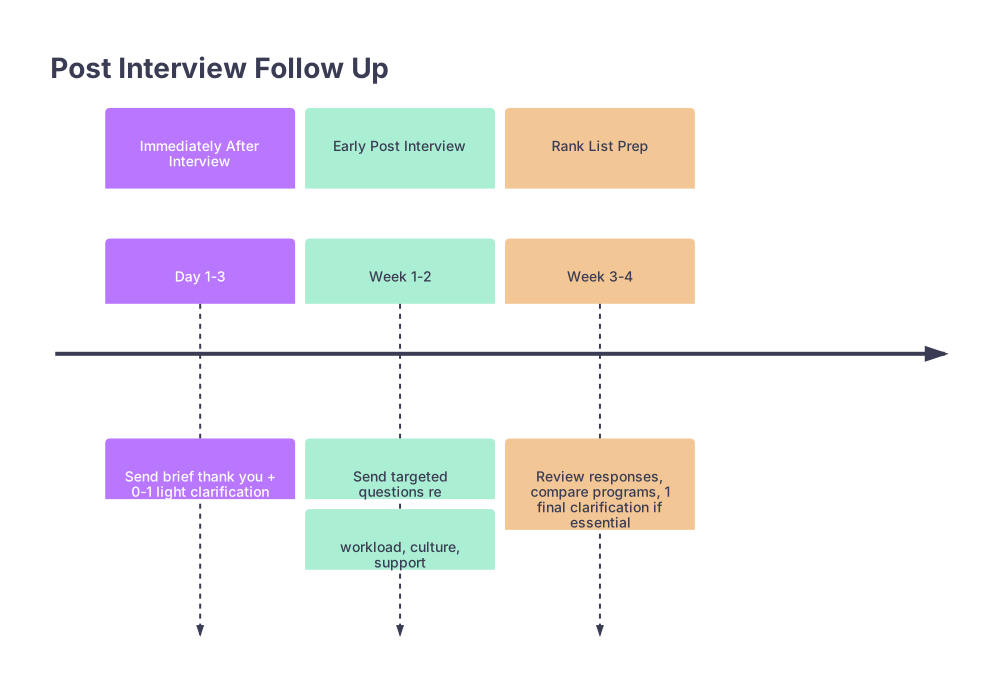
| Period | Event |
|---|---|
| Immediately After Interview - Day 1-3 | Send brief thank you + 0-1 light clarification |
| Early Post Interview - Week 1-2 | Send targeted questions re |
| Rank List Prep - Week 3-4 | Review responses, compare programs, 1 final clarification if essential |
Practical points:
- Send initial thank‑you within 24–72 hours.
- Bundle your “investigative” questions into one email per person, usually 1–2 weeks out, when you have had time to reflect.
- After that, focus on synthesis, not endless clarification.
Step 10: Use Data, Not Vibes, to Adjust Your Rank List
Here is the whole point of this exercise: converting “I got a weird feeling” into something rank‑list‑relevant.
After your responses come in, ask yourself:
- Did this email exchange reduce, confirm, or introduce concern?
- How does this concern compare to others? (e.g., location, prestige, fellowship goals.)
- Would I regret choosing this program if the worst‑case interpretation of their answers were true?
It sometimes helps to visualize how each program “scores” across dimensions.
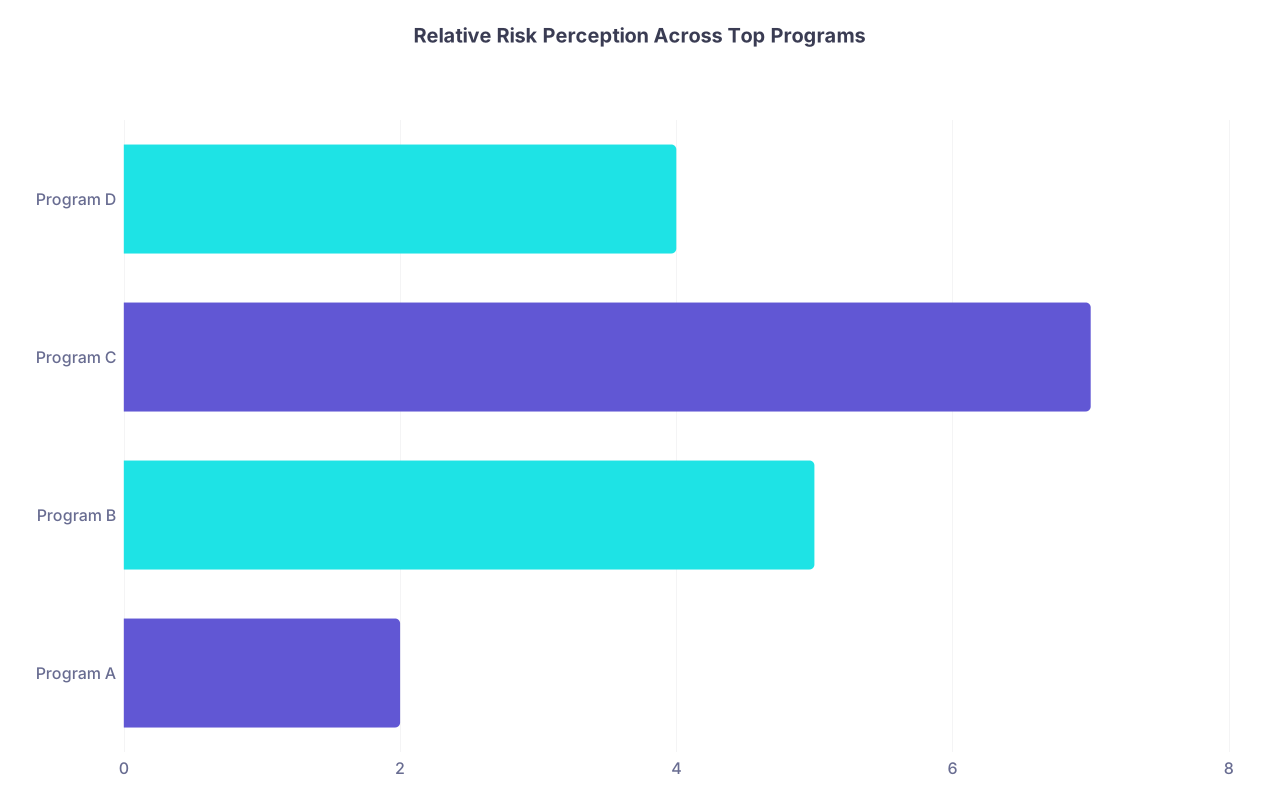
| Category | Value |
|---|---|
| Program A | 2 |
| Program B | 5 |
| Program C | 7 |
| Program D | 4 |
(Where 1 = minimal concern, 10 = serious concern based on emails, interview day, and other intel.)
You are not aiming for the perfect program. You are aiming to avoid a bad one that looked shiny on interview day but cannot answer straight questions about how they treat their residents.
The 3 Takeaways You Actually Need
Post‑interview emails are not just thank‑yous; they are diagnostic tools. Use them to test specific red flags about workload, culture, and support by asking focused, neutral questions to the right people.
The way programs answer is as important as what they say. Look for specificity, consistency between residents and leadership, and a willingness to acknowledge and address problems rather than reflex defensiveness.
Use the answers to protect your rank list from wishful thinking. Track responses across programs, treat non‑answers and vague replies as data, and be willing to downgrade programs that cannot give a straight, concrete answer about how they keep residents safe, educated, and supported.