
It is late January. You are staring at your ERAS spreadsheet and NRMP rank list.
There are three programs you interviewed at that did not feel right. Something was off.
The chief resident dodged your question about fellowship matches.
The PD made a weird comment about “we don’t believe in 80 hours, this is a surgical mindset” — but you were interviewing for internal medicine.
Residents seemed… tired. And quiet. Too quiet.
Now you are stuck:
Do you rank them low? Not rank them at all? Are you overreacting?
Or about to walk into three years of regret?
Here is the fix: you need a system, not vibes.
What follows is exactly that — a step‑by‑step framework I have seen residents use to sort out “questionable” programs without losing their minds or getting seduced by a fancy name and a good PowerPoint.
Step 1: Lock In Your Non‑Negotiables Before You Overthink
You cannot evaluate red flags if you do not know what actually matters to you.
Sit down once. Do this on paper or in a simple doc. No endless “pros and cons” rambling.
Make two short lists:
- Hard Non‑Negotiables (dealbreakers)
- Strong Preferences (nice but not fatal)
You are allowed 3–5 in each. If you have 15, you have none.
Examples of hard non‑negotiables:
- Consistent duty hour violations or “we do not track hours here”
- Residents routinely covering without supervision they should have
- Persistent culture of disrespect / harassment / racism / sexism that leadership minimizes
- Systemic dishonesty (misrepresenting board pass rates, fellowship match, call frequency)
- Unsafe patient volumes with no support (e.g., 25+ new admissions alone as an intern)
- Program obviously in free fall (mass resignations, lots of unfilled spots, toxic leadership)
Examples of strong preferences (important but not absolute):
- Geographic location close to family or partner
- Strong fellowship match in your specific subspecialty
- Strong didactics and protected education time actually protected
- Reasonable call/night schedule
- Good benefits and pay relative to area cost of living
Write them like this, clearly:
- “I will not rank programs where residents consistently work 90+ hours and leadership jokes about ACGME.”
- “I will not rank programs where multiple residents independently warn me about harassment or retaliation from leadership.”
Then stop. Those are your anchors.
Because later, when you are tempted to rank the toxic Big Name #4 because “it might help fellowship,” you will have something to check yourself against.
Step 2: Score Every Program Using One Simple Grid
You want to compare programs, not just stew in vague impressions.
Create a simple 0–3 scoring system across critical domains. You can do this in Excel, Notion, or on a sheet of paper.
Use something like this:
| Domain | 0 = Major Red Flag | 1 = Concerning | 2 = Acceptable | 3 = Strong/Excellent |
|---|---|---|---|---|
| Resident Culture | Toxic/fearful | Mixed/guarded | Generally OK | Supportive/collegial |
| Workload & Hours | Unsafe, chronic 80+ | Heavy/unclear | Busy but fair | Reasonable/sustainable |
| Education & Supervision | Weak, unsafe, no teaching | Spotty | Adequate | Strong, prioritized |
| Leadership Transparency | Dishonest/defensive | Vague/spin | Reasonably open | Very honest, owns problems |
| Outcomes (Boards/Jobs) | Hidden or obviously poor | Mediocre | Acceptable | Strong track record |
For each questionable program, go row by row and score them based on:
- What residents actually said
- How they looked and behaved
- What faculty and PDs admitted (or avoided)
- What you can find publicly (ACGME, Doximity, word of mouth)
Do not overcomplicate the scoring. Use your first honest impression.
Later, your decision rule can be something like:
- Any program with two or more domains = 0 → serious concern
- Any program with average below 1.5 → think hard before ranking
- Any program with 0 in Resident Culture or Workload → likely not rank
You are creating structure to counteract both FOMO and anxiety.
Step 3: Decode Resident Behavior — The Biggest Truth Source
Residents are your best data. But you have to know how to read them.
On interview day you probably saw at least three versions:
- The super enthusiastic PGY‑2 who loves everything
- The PGY‑3 who looked like they had not slept in a week
- The intern who carefully said… nothing
Go back and review your scribbled notes, emails to yourself, or memory, focusing just on residents.
Look for these patterns.
Strong positive signs
- They joke about being tired but still joke. Morale is tired but intact.
- Multiple residents independently describe the PD/APD as “protective,” “has our back,” “actually listens.”
- When someone criticizes the program, it is specific and realistic, not vague dread.
- They share concrete improvements that leadership actually implemented: “We used to have 7+ calls per month. Now it is capped at 4 because we complained.”
- When you asked about worst parts, people actually answered, not just laughed nervously.
Yellow flags
- Residents “seem fine” but everything they say is vague: “Oh, yeah, it is busy but you learn a lot” with no examples.
- Everyone uses the same weird buzzwords — “it is a family,” “we are gritty,” “we push the limits” — but no one can tell you what is being done about burnout or hours.
- Nobody can (or will) say their board pass rate or where people matched recently.
- When you ask, “Would you choose this program again?” they pause. Even briefly.
Red flags
These are not theoretical. I have heard all of these:
- Resident whispering during social: “Apply out if you can.”
- Multiple residents warn you off one attending or chief and say there have been no consequences despite multiple issues.
- Someone tells you, “Do not put that in an email” when you ask about hours or culture.
- Residents look burned out to the point of flat affect, and the senior says, “We do not complain here. You just push through.”
- Different residents give completely different answers about call schedule or clinic — suggests either chaos or dishonesty.
Now, force yourself to write one sentence per program:
- “Residents looked exhausted, repeatedly referenced ‘survival’ and ‘we just push through,’ and dodged specifics on hours.”
- “Residents tired but openly praised PD, gave actual numbers, and were honest about cons.”
That single sentence is often more predictive of how your life will feel there than any prestige metric.
Step 4: Triangulate Hours, Workload, and Safety
Programs lie about workload. Some by omission. Some by spin.
You cannot know precise numbers, but you can get close enough.
Here is a practical way to do it.
A. Compare what you were told vs what you observed
Take these elements:
- Stated: “We are compliant with duty hours. You will average 60–70 hours per week.”
- Observed: Residents on Zoom at 8 pm from work rooms. PD joking, “Sometimes we fudge the hours a bit.”
If you saw any of the following, your “hours” score should drop:
- Residents left the social early because they had to sign out late admissions.
- They casually mention, “Yeah, I have not had a real day off in a couple weeks, but it is fine.”
- They tell you they “submit 80” but actually work more, and leadership knows.
B. Use pointed, non‑accusatory follow‑up questions
If you still have contact with residents (email or text), ask specific questions:
Bad: “How are the hours really?”
Better:
- “On your hardest inpatient month, realistically, what are your typical start and end times on weekdays?”
- “How often do you leave after 8 pm on those rotations?”
- “How often do you genuinely get a full golden weekend off?”
You are trying to translate “it’s busy but manageable” into:
“Average day 6 am to 6:30 pm, 1–2 late stays per week, full weekend off q4” vs “Daily 5:30 am to 8 pm, post‑call you still stay to 3 pm, true days off rare.”
C. Check the “safety” component
Sometimes long hours are survivable; unsafe is not.
Red‑flag answers:
- “I routinely carry 18–22 patients as an intern with no mid‑level or senior doing direct notes or orders.”
- “Night float is one intern covering floor, step‑down, and admissions alone.”
- “Rapid responses feel chaotic, and no one really runs them well.”
If a program is both long hours AND unsafe, you are looking at a strong candidate for “do not rank” regardless of prestige.
Step 5: Assess Leadership: Honest Problem‑Solvers or Spin Artists
Leadership makes or breaks how problems are handled. And every program has problems.
You are not looking for perfection. You are looking for honest and responsive vs defensive and performative.
Think back to the PD/APD sessions:
When someone asked about past ACGME citations, did they:
- Say, “We did not have any,” and move on suspiciously fast?
- Or say, “We had a citation for X, here is exactly what we changed”?
When asked about resident burnout:
- Did they hand‑wave: “Residency is hard; we all went through it”?
- Or did they talk about specific schedule changes, mental health resources, backup call?
When you asked tough questions (match list transparency, fellows leaving, residents transferring), did they:
- Change the subject.
- Give generic PR lines.
- Or give a specific, if uncomfortable, answer?
A simple heuristic I use:
- If a PD can not admit one concrete weakness and what they are doing about it, they are either delusional or hiding something. Both are bad.
Write one more sentence per program:
- “PD openly discussed prior citation for duty hours and described current safeguards.”
- “Leadership refused to share board pass rates and deflected multiple questions about resident turnover.”
That sentence alone will nudge your ranking in the right direction.
Step 6: Verify Outcomes Instead of Trusting the Slide Deck
Every program has a 15‑slide deck with cherry‑picked match lists, board pass rates, and happy alumni.
Treat it like a marketing brochure, not data.
You want three things:
- Board pass rate (last 3–5 years)
- Fellowship match / job placement patterns
- Resident retention and transfers
Board pass rates
For many specialties, you can find at least some of this via:
- ABIM / ABFM / ABS or relevant boards (not always program‑specific, but sometimes)
- Word of mouth from upperclassmen and recent alumni
- Direct resident answers: “We have had a couple failures but overall almost everyone passes on first try.”
Red flags:
- PD refuses to quote any number.
- Residents change subject or say “we had some troubles a few years back” but cannot explain current situation.
Fellowship / job outcomes
When you are screening “questionable” programs, you need recent, detailed outcomes, not historical legends.
Ask or recall:
- “Where did your last 3–5 residents in my intended specialty match?”
- “What do most graduates do — community jobs vs academics vs fellowship?”
If the match list looks like:
- Mostly unfilled, SOAPed positions in weaker fellowships despite residents having strong letters and scores → something is wrong with mentorship or reputation.
- Or residents say: “We do okay, but we struggle to get into top‑tier fellowships unless people do research outside,” and they have no research support.
Again, does not have to be perfect. But if outcomes are consistently poor and leadership spins it, mark that as a real red flag.
Resident retention
Ask residents privately:
- “Have any residents left or transferred out in the last few years? Why?”
1–2 leaving over several years = normal.
A pattern of people fleeing after intern year = smoke and fire.
Step 7: Cross‑Check Your Gut With External Signals (Without Getting Lost in Gossip)
You are not the first person to have doubts about these programs. Use that.
But be smart. Online forums are noisy and often outdated.
Here is how to use external info correctly.
A. Use targeted, not generic, questions
Talk to:
- Alumni from your med school in that program
- Upperclassmen who interviewed there but did not rank
- Trusted attendings with regional knowledge
Do not ask: “What do you think of X program?”
Ask:
- “Have you heard anything specific about resident culture there?”
- “Any concerns about leadership, safety, or people leaving recently?”
- “Would you advise a student to rank that program highly or cautiously?”
You are fishing for concrete stories, not vibes.
B. Map what you hear onto your grid
If multiple people independently say:
- “They work like animals, but they come out sharp and match well” → high workload, but maybe not toxic.
- “I have heard multiple residents left due to bullying from leadership” → major culture/leadership red flag.
The external input should adjust your scores, not replace your direct observations.
Step 8: Apply a Clear Decision Rule: Rank, Tank, or Drop
Now you have:
- Your non‑negotiables
- A scored grid
- Resident culture notes
- Leadership honesty notes
- Outcome data and word of mouth
You still need to do the hardest part: decide.
Here is a straightforward framework that works for most people.
Category 1: Do Not Rank (DNR)
Programs that meet any of these:
- Violate one of your hard non‑negotiables, especially:
- Unsafe staffing
- Chronic serious duty hour abuse that is normalized
- Widespread harassment, racism, or retaliation with no real response
- Score 0 in Resident Culture AND 0 or 1 in Leadership Transparency
- Multiple independent sources warn you off the program for serious reasons (“people leave, leadership is vindictive, unsafe environment”)
These go off your list. Yes, even in a competitive specialty. Matching into a nightmare can be worse than not matching.
Category 2: Rank Low With Caution
Programs that:
- Have 1 major concern but not in your hard non‑negotiables
- Or average score around 1.5–2 with clear strengths and clear weaknesses
- Residents are mixed: some happy, some miserable, but leadership seems at least partially responsive
These are your “acceptable if necessary” programs. Rank them below all places that meet your non‑negotiables and feel safe, but they can stay on the list if you truly prefer matching there over not matching.
Be brutally honest:
- “Would I rather reapply or scramble into a prelim year than spend 3–7 years here?”
If your answer is “I would honestly rather reapply” → move it to Do Not Rank.
Category 3: Rank With Eyes Open
Questionable programs that, after this process, turn out to be:
- Intense, maybe under‑resourced, but not dishonest or unsafe
- Busy county or safety‑net hospitals where residents work hard, but culture is strong and leadership is clearly fighting for them
- Programs in less desirable locations or with heavy service load that still:
- Respect duty hours reasonably
- Have decent board pass and fellowship outcomes
- Have residents who, tired as they are, say, “I would choose this again”
These may move surprisingly higher than you initially thought, especially if your other options have hidden problems.
Use one final gut check:
“Can I picture myself walking into this hospital at 5:45 am as an intern in July and not regretting it every day?”
If yes, it can be on your ranked list.
Step 9: Put It All Together — Practical Workflow
Let me condense this into a simple, actionable protocol you can actually do in an evening.
1. List your questionable programs
Write them down: Program A, B, C.
2. Pull notes and memories
- Look at:
- Your interview day notes
- Any emails or texts from residents
- Program brochures (only as reference)
3. Score each program on the 5‑domain grid
Resident Culture, Workload, Education/Supervision, Leadership, Outcomes.
4. Write 3 sentences per program
- Resident vibe in one sentence
- Leadership honesty in one sentence
- Outcome/retention in one sentence
Do not sanitize. Be blunt.
5. Pass each through your non‑negotiables
Ask:
- “Did this program clearly violate any of my declared dealbreakers?”
- If yes → move to Do Not Rank pile.
6. Sanity‑check with one outside opinion
For any program still confusing:
- Call or message one trusted person (alum, attending, senior)
- Ask 1–2 specific questions
- Adjust scores if needed.
7. Place them on your rank list in 3 bands
Top band: Programs you genuinely like or trust → order by preference.
Middle band: “Acceptable if necessary” — questionable but not disastrous.
Bottom: Do Not Rank → off the list.
To help with the banding, you can visualize how your list might shake out numerically:
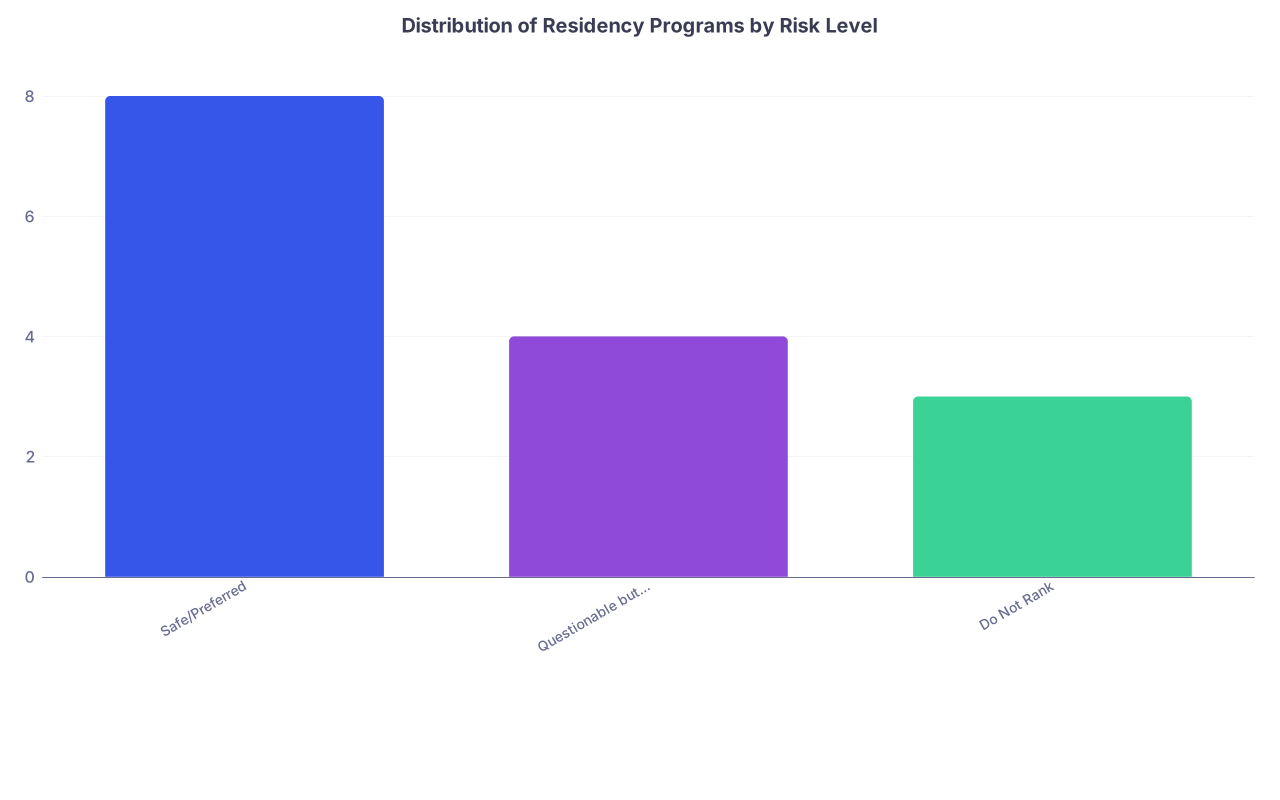
| Category | Value |
|---|---|
| Safe/Preferred | 8 |
| Questionable but Acceptable | 4 |
| Do Not Rank | 3 |
Step 10: Watch for These 5 High‑Yield Red Flag Combinations
To close the loop, here are the combos that, in my experience, almost always spell trouble. If you see two or more in the same program, you should be very cautious about ranking it at all.

Silent social + over‑polished PD
- Residents quiet, guarded, no real jokes.
- PD speaks in slogans, cannot name a single weakness.
“We never violate duty hours” + residents clearly chronically exhausted
- Everyone looks wrecked.
- But official line is “we are always 80 compliant.” That gap is a problem.
High resident attrition + vague explanations
- “Yeah, a few people left, but it was just not the right fit.”
- No one can say where they went or why.
No board / fellowship outcome details + defensiveness
- You ask about stats, PD says, “Our graduates do fine” and changes topic.
- Residents shrug and say, “We are okay, not amazing,” but cannot be specific.
Reported harassment / discrimination + no clear corrective actions
- Residents casually mention problematic faculty.
- When asked about what was done, answer is “we filed things, but nothing changed” or “we do not talk about that.”
If you hit two or more of these in one place, I would put that program in serious jeopardy on your list.
Quick Visual: Your Decision Flow
Here is a simple mental model of the decision process:

| Step | Description |
|---|---|
| Step 1 | Questionable Program |
| Step 2 | Do Not Rank |
| Step 3 | Score Grid 0 to 3 |
| Step 4 | Strongly consider Do Not Rank |
| Step 5 | Rank with eyes open |
| Step 6 | Rank low or drop after outside opinion |
| Step 7 | Violates any non negotiable |
| Step 8 | Resident culture 0 or unsafe workload |
| Step 9 | Average score >= 2 |
A Note About Fear and FOMO
Let me be blunt.
You will feel pressure to keep questionable programs on your list “just in case.” Especially if your specialty is competitive or your Step scores are not perfect.
That fear is real. But so is the reality of:
- Residents reapplying after hellish PGY‑1 years
- Burnout so severe people leave medicine entirely
- Being trapped for 3–7 years in a place that destroys your health and confidence
Matching is not the only metric. Your sanity matters.
If your honest, systematic review says a program is unsafe, dishonest, or toxic, believe that. Even if it is big‑name, university‑affiliated, or your dean likes it.
Final Check: Balancing Risk and Reality
You are not trying to build a fantasy list. You are weighing risk against your actual options.
Use this last small tool if you are stuck:
| Preference vs Risk | Low Risk Program | Moderate Risk Program | High Risk Program |
|---|---|---|---|
| High Personal Preference | Rank in top tier | Rank mid tier | Think very hard before ranking |
| Medium Personal Preference | Rank mid tier | Rank low tier | Usually do not rank |
| Low Personal Preference | Rank low or not at all | Usually do not rank | Do not rank |
Combine your preference with your risk assessment. Then place it.
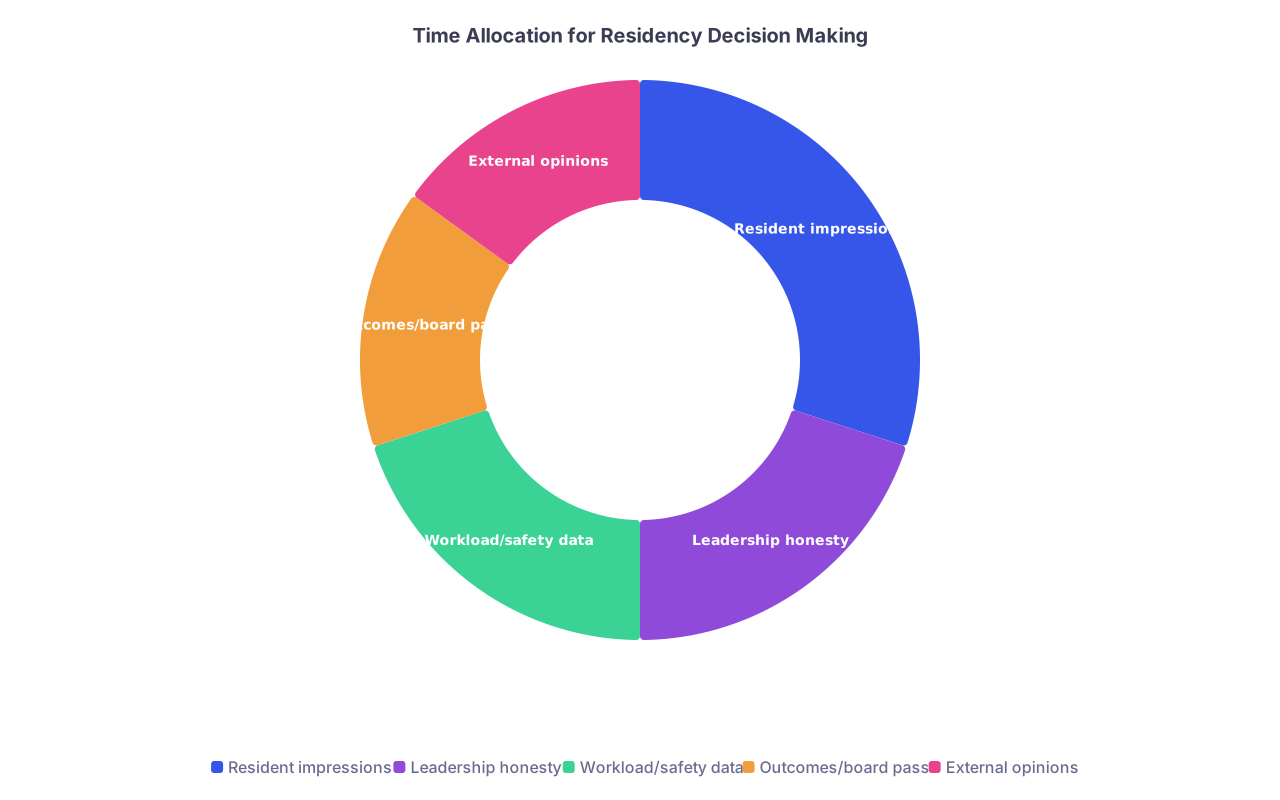
| Category | Value |
|---|---|
| Resident impressions | 30 |
| Leadership honesty | 20 |
| Workload/safety data | 20 |
| Outcomes/board pass | 15 |
| External opinions | 15 |
Key Takeaways
- Replace vague vibes with a structured grid: score resident culture, workload, education, leadership honesty, and outcomes from 0–3 for each program.
- Define and respect your non‑negotiables; any program that clearly violates them goes in the Do Not Rank pile, regardless of prestige.
- Give extra weight to resident behavior and leadership transparency; when those two are bad together, the program is almost never a place you want to spend the next several years.