The worst way to evaluate a residency program is to believe the loudest anonymous review you read at 2 a.m.
You are not powerless here. There is a systematic way to verify scary online reviews so you do not tank a good program—or walk blindly into a toxic one—based on one bitter post.
Let me walk you through it like I would with a stressed MS4 in my office the week before rank lists are due.
Step 1: Classify the Review Before You React
First rule: do not treat every online review as equal. Some are gold. Some are junk. Most are emotional data points that need context.
When you hit a scary review, pause and classify it quickly:
What type of review is it?
- Specific and concrete: “On medicine, interns carry 10–14 patients, q4 call, average 80+ hours, weekend sign-out is unsafe, we had X sentinel event.”
- Vague and emotional: “This place is toxic. Worst decision of my life.”
- Personal beef: “PD hates IMG FMGs, favorites only, ruined my career.”
- Cultural mismatch: “Too much autonomy, not enough hand-holding” vs “You are treated like a workhorse.”
What is the tone?
- Descriptive: Reports facts, examples, dates.
- Vindictive: Blaming individuals by name, sweeping statements (“everyone,” “always,” “never”).
- Exhausted: Sounds like someone writing post-call, not totally wrong, but filtered through fatigue.
What is the time frame?
- Dated (5+ years ago): Leadership may have changed, ACGME citations may be resolved.
- Mid-range (2–4 years): Some things change slowly; still relevant but not definitive.
- Recent (0–2 years): High signal, especially for structural issues (hours, staffing, fairness).
Write this down in your notes. Literally:
- “Review 1 – specific, angry, from 2020, heavy on workload, light on evidence.”
This small discipline keeps you from reacting purely to emotion.
Step 2: Look for Pattern, Not Drama
One terrible review is a story. Multiple similar reviews are a pattern.
You want to know: is this a one-off explosion or consistent smoke over time?
Do this:
Scan across multiple sites:
- Reddit (r/medicalschool, r/residency, specialty subs)
- SDN (Student Doctor Network) forums
- Doximity residency reviews
- Google reviews (for the hospital—watch for nurse / tech / patient comments referencing residents)
- Specialty-specific forums or listservs if you have access
Track the themes in a simple grid. Example:
| Source | Year | Theme: Hours | Theme: Culture | Theme: Education | Theme: Safety |
|---|---|---|---|---|---|
| Reddit 1 | 2021 | 80–90+ | Malignant | Weak didactics | Unsafe labs |
| SDN 1 | 2019 | 70–80 | Mixed | Okay | Not mentioned |
| Dox 1 | 2023 | 75–80 | Supportive | Strong | Safe |
You are looking for:
- The same complaint showing up in different years, by different apparent people.
- Or the same strengths contradicting a single scary review.
If only one anonymous comment screams “this program is malignant” but everything else for five years is neutral or positive, that review still matters—but it is not gospel. Flag it. Do not let it dominate.
On the other hand, if for 5 consecutive classes you see:
- “Program leadership does not listen.”
- “Moonlighting is banned because of prior duty hour violations.”
- “Residency review committee put us on warning.”
That is not drama. That is data.
Step 3: Cross-Check Against Hard Data (ACGME, Board Pass, Attrition)
Online opinions are soft. You must slam them against hard numbers.
Here is what you can realistically check:
ACGME accreditation status
- Go to the ACGME public site.
- Check:
- Accreditation status (continued, warning, probation, withdrawn).
- Length of the current accreditation cycle.
- Any recent “Warning” or “Probation” absolutely deserves attention. Combine that with scary reviews, and the risk is real.
Board pass rates
- Many programs publish board pass rates on:
- Their website
- FREIDA
- Doximity or specialty society directories
- You want:
- 3–5 year rolling pass rates.
- Ideally >90% in most specialties.
- If reviews say “no teaching, we are just scut” and their boards are 60–70% over several years—that review probably has teeth.
- Many programs publish board pass rates on:
Attrition and extension
- Look at resident lists on program websites for multiple years (Wayback Machine if needed).
- Red flags:
- Many PGY-1s disappearing by PGY-3 without transferring list.
- Frequently replaced mid-year residents.
- Lots of “chief residents” who are not graduating in 3 expected years (indicating extensions, though some are voluntary).
Duty hour violations
- Some programs will have had ACGME citations for duty hours. Not all are public, but:
- Ask on interview day or second look (tactfully).
- “Have you had any recent ACGME citations? How were they addressed?”
- If residents’ reviews scream “duty hours are a joke here” and leadership refuses to even acknowledge prior citations, assume the review is probably accurate.
- Some programs will have had ACGME citations for duty hours. Not all are public, but:
Tie this together. If the scary review is about “unsafe workload and zero education,” then compare:
- Duty hours: Are they boasting “we work hard” with a weird grin?
- Board pass rates: Weak?
- Accreditation cycle: Shortened or with prior warnings?
That is correlation you should not ignore.
Step 4: Use Interviews Like a Cross-Examination (Without Making It Awkward)
You are not a passive invitee on interview day. Use it like reconnaissance.
But there is a right way to probe scary online reviews without looking like a walking lawsuit.
How to ask about red flags without burning bridges
Take the theme from the review and turn it into a neutral, open question.
If the review says: “This program violates duty hours constantly.”
Ask residents:
- “What does a typical week look like on your busiest rotation?”
- “How often do you come close to or exceed duty hours? How is that handled?”
- “When you feel overwhelmed with workload, who actually helps?”
Ask leadership:
- “How do you track and respond to duty hour concerns from residents?”
- “Have there been any systematic changes over the past few years around workload?”
You are looking for:
- Consistency between what residents and leadership say.
- Nonverbal cues: hesitation, side glances, nervous laughter, “off the record” comments later.
If the review says: “Toxic culture; retaliation when people speak up.”
Ask residents:
- “When residents have concerns, how do they usually raise them? Does that feel safe in practice?”
- “Has anyone ever faced backlash for giving feedback or asking for help?”
Ask leadership:
- “How do you gather anonymous feedback from residents? Can you give an example of a change you made because of resident feedback?”
Red flag answer from leadership: “Our door is always open; no one has ever had any issues here.” That is not how real programs talk. Healthy programs will admit problems and describe fixes.
If the review says: “No teaching, you are just service.”
Ask:
- “What are your protected didactic times? Are pages held?”
- “How often do didactics actually get canceled?”
- “Can you tell me about a recent quality improvement or M&M conference and what changed afterward?”
You want specifics, not vague “We value education” slogans.
Step 5: Validate with Current and Recent Residents (The Right Way)
The single most powerful way to verify scary reviews: a 15–20 minute honest conversation with a current or very recent resident who is not carefully supervised by their PD.
You should not randomly cold-DM every resident. Be strategic and respectful.
Who to contact
Prioritize:
- Current PGY-2 or PGY-3 (they have enough experience but are not yet checked out).
- Recent grads (within 1–3 years) listed on:
- Program website
- Specialty society membership list
Avoid:
- Only talking to chiefs. They are usually more politically constrained.
- Only talking to the one resident who wrote a viral rant.
How to reach out
Short, direct message (email, LinkedIn, or professional Facebook group):
Hi Dr. X,
I am an applicant who interviewed at [Program] this season and am strongly considering ranking it. I have seen mixed information online about the resident experience and wanted to ask if you would be willing to share your perspective for 10–15 minutes by phone or Zoom.
I am particularly interested in workload, culture, and how leadership responds to feedback.
I understand you are busy and I appreciate any time you are willing to offer.
You are not asking them to trash the program. You are asking for clarity.
What to ask them
Have 5–7 high-yield questions, not a 30-question interrogation:
- “If you had to decide again, would you still choose this program? Why or why not?”
- “What surprised you most after starting here—good or bad?”
- “How often do people actually leave or get pushed out, and why?”
- “What happens when a resident complains or asks for help? Do they get support or punished indirectly?”
- “Do you feel you are being prepared for the jobs/fellowships you wanted?”
- “The kind of things I have seen online mention X (e.g., unsafe hours / toxicity). In your experience, is that accurate, exaggerated, or outdated?”
Listen for:
- Hesitations before answering controversial topics.
- Phrases like “It depends who you ask,” “Some people have had issues,” “I would not say malignant, but…”.
- The ratio of positives to negatives. One or two negatives are normal. A 10-minute rant is not.
Step 6: Decode Reddit Posts and Doximity Comments Like an Adult
Reddit and Doximity reviews are useful if you know how to read them.
How to filter Reddit posts
Look at:
User history (if not anonymous):
- Is this person always bitter about everything?
- Or do they give detailed, balanced advice elsewhere?
Level of detail:
- Specific details like “On MICU, we have 1 resident and 1 intern covering 20 ventilated patients overnight” are more credible.
- Non-specific: “It sucks here, do not come” with zero examples is lower value.
Other users’ responses:
- Are others confirming or pushing back?
- “I am here now; things have changed a lot in the last two years” matters.
How to interpret Doximity
Doximity residency reviews are biased, but not useless.
Use them to spot:
- Trend of comments about:
- “Strong operative experience, but culture is rough.”
- “Great fellowship match, but hours are heavy.”
- Whether multiple years of residents echo the same points:
- If three cohorts say “leadership does not listen,” that is real.
Do not:
- Rank programs solely based on Doximity ranking. That method is garbage for culture and red flags.
Step 7: Separate “Hard Program” From “Bad Program”
A lot of applicants confuse “this was hard” with “this was malignant.”
Those are not the same.
Here is the distinction:
| Feature | Hard Program | Bad Program |
|---|---|---|
| Hours | 65–80, usually within rules | Repeated violations, 90+ unreported |
| Culture | Direct, demanding, but respectful | Shaming, yelling, retaliation |
| Teaching | Strong but squeezed by workload | Minimal; residents left alone without backup |
| Leadership | Admits issues, tries to fix | Denies problems, blames residents |
| Outcomes | Good boards, good jobs | Poor boards, frequent burnout/attrition |
Many scary online reviews are from residents in hard but decent programs who are exhausted and venting. That is understandable. You just cannot let that be your only data.
If multiple independent sources show:
- Systemic disrespect (name-calling, public humiliation, retaliatory scheduling).
- Chronic safety issues (unsafe patient loads, “we fudge duty hours,” covering two services at once).
- Lack of improvement over time (same complaints for years, no structural changes).
That is not just “hard.” That is a bad program. Believe those reviews.
Step 8: Use Objective Career Outcomes as a Reality Check
Residents can be miserable and still match great fellowships. Or they can feel “happy” but be poorly trained.
Look at where grads end up:
Fellowship match lists:
- Do they publish them?
- Are graduates getting into the tiers they aim for (community vs academic vs top-20)?
- Are there sudden drops in match quality over a few consecutive years? That sometimes tracks with leadership/culture collapses.
Job placement:
- Do grads find jobs easily in their desired settings (hospital-employed, academics, private practice)?
- Alumni LinkedIn profiles tell you a lot if you bother to look.
Scary review says “No one cares about your career here”:
- If match lists and jobs look strong and consistent, the problem may be more about mentorship style than actual outcomes.
- If their outcomes are flat or worsening and residents online report lack of mentorship, that fits.
Step 9: Protect Against Your Own Bias and Panic
Your brain loves negativity. The sharp, angry review hits harder than ten boring “It is fine” comments.
You need a simple decision framework so you do not spiral.
Build a quick-risk scoring for yourself
Take each program and score 0–2 on these:
Culture red flags (toxicity, retaliation)
0 = none credible
1 = some concern, mixed signals
2 = multiple consistent reportsWorkload/safety concerns
0 = demanding but safe
1 = heavy, borderline
2 = frequently unsafe patternsLeadership accountability
0 = transparent, responsive
1 = unclear, mixed
2 = evasive, defensiveObjective data (ACGME, board pass, attrition)
0 = solid
1 = mild concerns
2 = major concerns
Total: 0–8.
Then roughly:
- 0–2: Fine. Scary reviews likely outliers or old.
- 3–5: Caution. Acceptable if you love other aspects and understand trade-offs.
- 6–8: Do not rank highly unless you have extremely strong reasons and eyes wide open.
This keeps you from overreacting to one dramatic story.
Step 10: What to Do When the Red Flag Is Confirmed
Sometimes the scary review is dead on. You verify it with:
- ACGME warning.
- Multiple residents quietly confirming.
- Board pass struggles.
- Leadership dodging every question.
Then what?
Do not try to “fix” the program as a resident.
You will not. You will be busy surviving. Choose training, not a crusade.Adjust your rank list accordingly.
- If there are plenty of safer options you would be content with, drop the problematic program or move it way down.
- Only keep it higher if:
- It is the only program in a region you absolutely must be in for family reasons.
- You have a realistic backup plan (switch specialty, reapply, transfer later).
If you have already matched there (or are likely to, based on couples match strategy):
- Start mentally preparing risk mitigation:
- Identify early allies (APDs, senior residents who seem humane).
- Document serious issues neutrally (for your own protection).
- Learn your institution’s GME and ombudsman structure before you arrive.
- Start mentally preparing risk mitigation:
You are not helpless. But you must stop pretending a clearly bad program will magically become great in July.
A Simple Reality Check Flow
To make this painfully clear, here is the mental flow when you see a scary review:

| Step | Description |
|---|---|
| Step 1 | Read scary review |
| Step 2 | Classify tone and detail |
| Step 3 | Scan multiple sources for same theme |
| Step 4 | Check ACGME, boards, attrition |
| Step 5 | Ask targeted questions on interview |
| Step 6 | Talk to current and recent residents |
| Step 7 | Consider review as anecdote, lower weight |
| Step 8 | Lower rank or remove program |
| Step 9 | Red flag confirmed? |
You are running a basic investigation, not doomscrolling.
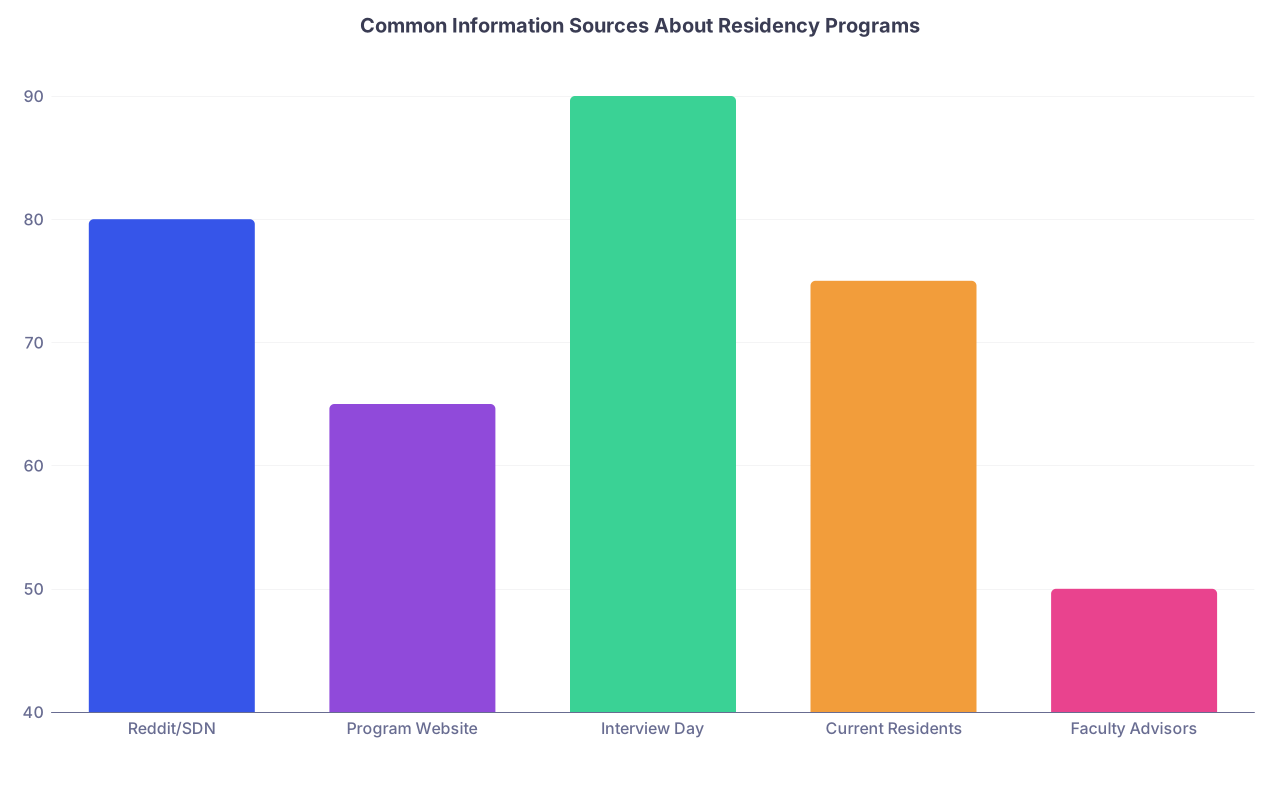
Quick Visual: Where Students Actually Get Their Info
Just so you see why you need structure, not vibes:
| Category | Value |
|---|---|
| Reddit/SDN | 80 |
| Program Website | 65 |
| Interview Day | 90 |
| Current Residents | 75 |
| Faculty Advisors | 50 |
Most applicants lean heavily on Reddit and interview day impressions. Those are exactly the two most distortion-prone sources. You fix that by systematically checking the rest.
A Concrete Example Walkthrough
Let me make this real.
You are applying to Internal Medicine. You read:
“Do not come to X University IM. We are abused. 90-hour weeks. Attendings yell at us in front of patients. Leadership does not care. Half my class wants to quit.”
You:
- Classify: Angry tone, some specifics (90-hour weeks, public shaming).
- Scan multiple places:
- Reddit: Two more posts from different years mentioning “heavy work, some mean attendings, but good fellowship match.”
- Doximity: Mixed—culture 3.2/5, education 4.2/5, workload “heavy.”
- Check hard data:
- ACGME: Full accreditation, no warnings.
- Boards: 3-year pass rate 96%.
- Resident roster: Stable; no obvious mass attrition.
- Interview day:
- Residents admit “It is busy. MICU can be brutal. But PD is responsive; we just added another night float.”
- Leadership openly says, “We know workload is high and we are recruiting more hospitalists to shift some burden.”
- Call a recent grad:
- Says, “It was hard as hell but I felt incredibly trained. Some attendings are old-school and harsh; culture varies by service. I would choose it again for the training and match outcomes, but it is not for everyone.”
What do you do?
- This is a hard program, not necessarily a malignant one.
- If you want high-powered fellowship and can tolerate intensity, you may rank it high.
- If you prioritize lifestyle and support, you should not.
The scary review was partially true—but incomplete.
One More Example: When You Should Actually Run
Different program, General Surgery:
- Reddit: Multiple posts over 4 years: “Malignant,” “Residents crying in stairwells,” “Retaliation if you report anything.”
- Doximity: Culture 1.8/5, residents mention bullying.
- ACGME: Prior warning two years ago, shortened accreditation cycle.
- Board pass: 3-year rate 75%.
- Interview:
- Residents look exhausted; one quietly says, “Feel free to email me later if you have questions,” with a loaded look.
- PD dodges every culture question: “We are a busy surgical program; if you want coddling, this is not for you.”
You speak with a recent grad who says, “I am glad I finished; I would never do it here again.”
That one scary review just got backed by reality from multiple directions. You believe it. You rank accordingly.
Your Next Move (Do This Today)
Pull up your current list of residency programs.
- Pick the one program that worries you most based on something you read online.
- Open a blank document and do this right now:
- Write the scary review’s main claims as 2–3 bullet points.
- Underneath, create four headings:
- “Other Online Sources”
- “Objective Data (ACGME/Boards/Attrition)”
- “Resident Conversations”
- “Interview Impressions”
- Spend 20–30 minutes filling in whatever you can today from publicly available info.
- Highlight in red any area where the scary review appears confirmed by two or more independent sources.
If that document stays mostly blank, the review is not “verified.” It is just noise.
If it fills up with red, you have your answer.
Stop letting one late-night anonymous post dictate your career. Run your own investigation, then decide like a professional.