
The match algorithm is not your problem. Panic after ranking the wrong program is.
You submitted your rank list. You slept on it. Then something clicked. A story you heard about a malignant attending. A resident who quietly said, “I would not come back here.” A patient safety incident you brushed off during interview day. Suddenly you are staring at your top-ranked program thinking: I made a mistake.
Here is the blunt truth: once the deadline passes, you cannot change your rank list. But you are not powerless. You still have moves—before Match Day, on Match Day, and after you start—if you handle this like an adult and not like a panicked MS4.
This is your playbook.
1. First: Get Clear On What the “Red Flag” Actually Is
Do not act on vague dread. Name it.
Ask yourself, very specifically, what changed after submission:
- New information you learned (resident texted you, Reddit thread, recent ACGME citation).
- Old information you finally took seriously (offhand resident comment you minimized).
- Your own priorities shifting (you suddenly realize you care way more about call schedule or location).
Write it down. Literally.
Break it into:
Type of red flag
- Patient safety / ethics
- Resident mistreatment / malignant culture
- Training quality / board pass rates
- Work-hour violations / duty-hour lying
- Program instability (new PD, recent mass exodus)
- Personal fit / life circumstances
Severity
- Annoying but tolerable
- Concerning but possibly manageable
- “I would rather not match than go there” level
If it is not at least a “concerning but possibly manageable,” you are probably catastrophizing. Anxiety after ranking is almost universal. I have watched multiple students spin themselves out over nothing more than “the residents seemed tired.”
Concrete example of a real red flag:
- “Two separate residents told me they regularly work 90+ hours a week and are told to under-report hours. One said the PD threatened them about reporting to the GME office.”
Vague anxiety:
- “The hospital felt kind of gloomy and I did not vibe with the intern I met.”
You respond very differently to those two.
2. Understand What You Can and Cannot Change (Reality Check)
Before you start emailing program directors at midnight, understand the rules.
You cannot:
- Change your rank list after the official deadline.
- Ask NRMP to delete a program from your list.
- Call a program and say “Please do not rank me” after the deadline and expect it to matter.
- Back out of a matched position without serious consequences (possible NRMP violation and being barred from future matches for a period).
You can:
- Decide, before Match Day, what you will do if you match there.
- Prepare backup plans (SOAP strategy, research year, prelim year, reapply).
- Refuse to sign an employment contract if there is a separate institutional contract (with consequences, but it is an option).
- Transfer later, if justified and feasible.
- Protect yourself if you end up there (documentation, GME reporting, wellness strategies, searching for mentors).
So the question shifts from “How do I undo my rank list?” to “How do I reduce damage if this goes bad?”
That is the grown-up question.
3. Triage: How Bad Is This Really?
Let us stratify your situation, and I will tell you what to do in each case.
| Level | Description | Primary Strategy |
|---|---|---|
| Mild | Fit doubts, location regrets, minor culture worries | Accept, adjust expectations, plan support |
| Moderate | Work hours, weak education, disorganized leadership | Contingency plan, skill-building, early monitoring |
| Severe | Abuse, retaliation, safety issues, accreditation risk | Aggressive backup planning, possible exit strategy |
Level 1: Mild – You Just “Don’t Feel Great” Anymore
Examples:
- You liked another program better in hindsight.
- You are suddenly worried about being far from family.
- You heard “they work hard there” but nothing specific.
What to do:
- Do nothing structural. You ride this out. The match is binding, and this level of concern is not worth burning bridges or derailing your career.
- Write a short reality-check note to yourself: Why you ranked them where you did. What you liked (case volume, fellowship match, city, research). You will need this on Match Day when your brain freaks out again.
- Start thinking support system: If you match there, who will be your lifelines (friends, family, therapist, co-residents).
You do not need a grand plan. You need emotional regulation.
Level 2: Moderate – Real Concerns, But Not Obviously Unsafe
Examples:
- Rumors of poor board pass rates.
- Heavy scut with weak teaching.
- Chaotic scheduling, disorganized leadership, constant PD turnover.
- Residents seem burned out, but not abused.
What to do:
- Gather better information (quietly):
- Reach out to one trusted resident you met. One, not ten.
- Ask focused questions: “How comfortable are you with your preparation for boards?” “Do you feel PD has your back?” Not “Is this program terrible?”
- Map your outcomes: Will this place:
- Graduate you board-eligible?
- Let you be competitive enough for your career goals? (General IM vs Derm fellowship are not the same bar.)
- Create a development plan for yourself:
- If teaching is weak, you will need:
- Extra question banks.
- External courses.
- Self-structured study plans during residency.
- If teaching is weak, you will need:
- Identify your line in the sand:
- Decide now: At what point would you consider transferring, or stepping out for a research year, or re-matching?
You do not blow up your life over a moderate red flag. You prepare to compensate.
Level 3: Severe – True Red Flag Territory
Examples:
- Documented or credible reports of:
- Systematic hours falsification.
- Intimidation or retaliation for reporting issues.
- Racist, sexist, or abusive behavior by leadership that goes unaddressed.
- ACGME probation related to resident mistreatment or education.
- Residents leaving mid-year in significant numbers.
Now we treat this like a real threat.
4. If It Is Severe: Build a Serious Contingency Plan
You feel trapped. You are not. It is expensive, stressful, and ugly to change course, but you absolutely still have options.
Step 1: Decide Your “If I Match There” Threshold
Ask yourself bluntly:
If I open that envelope and see this program, do I:
- Accept and plan to survive 3+ years, or
- Believe I would rather delay my training than go there?
If you are in the second camp, own it. That will guide all your moves.
Step 2: Sketch Your Backup Paths
Realistic options if you cannot stomach starting or staying:
SOAP (if you go unmatched)
This only applies if you ranked them low enough that you may not match. If you are terrified and they are #1, SOAP will not save you.Research year or non-clinical year
- Join a research group in your desired specialty.
- Strengthen your application.
- Re-enter the match later.
Preliminary year + reapply
- If your specialty allows it, one year of prelim IM or surgery plus a reapplication can be viable.
- You must perform well clinically and secure strong letters.
Transfer after PGY-1
- Harder than people think, but it happens every year.
- Requires:
- Strong evaluations.
- No professionalism issues.
- A program willing to release you and another willing to take you.
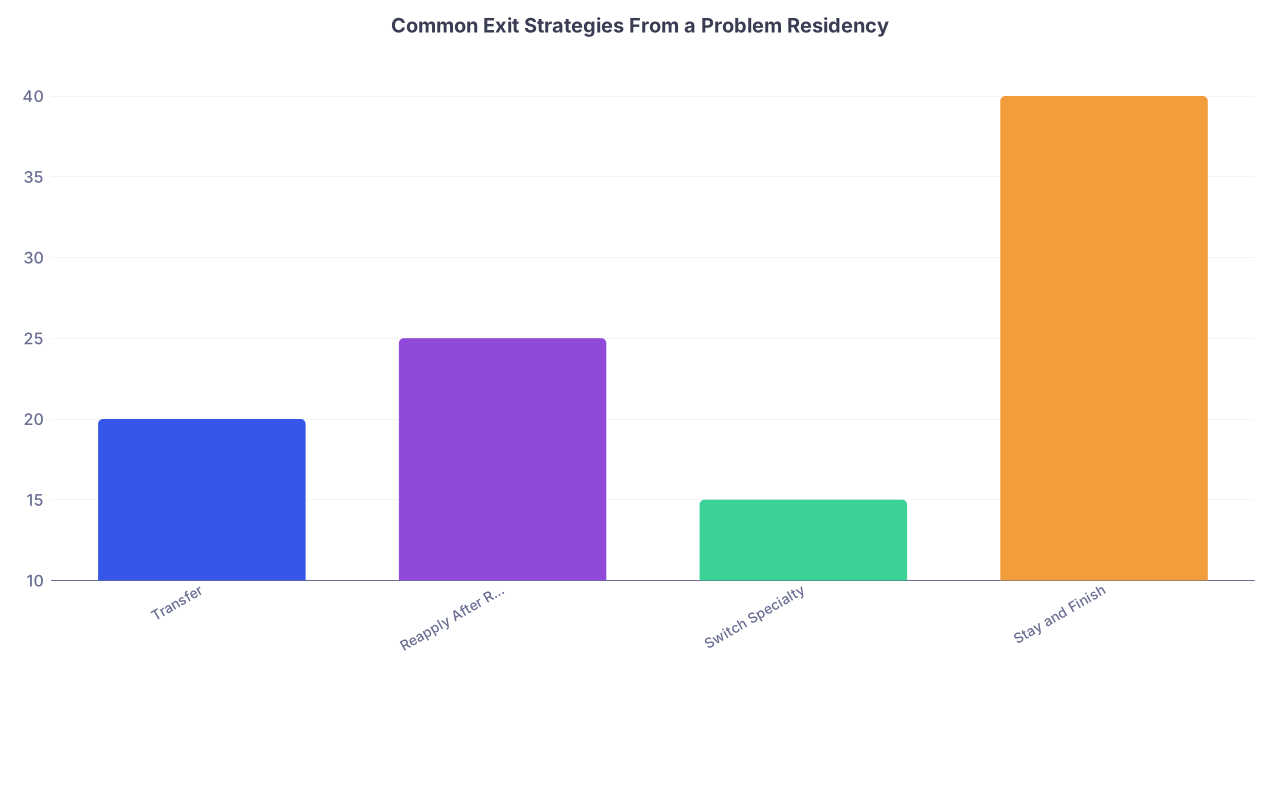
| Category | Value |
|---|---|
| Transfer | 20 |
| Reapply After Research | 25 |
| Switch Specialty | 15 |
| Stay and Finish | 40 |
Numbers here are illustrative, but the pattern is real: most people stay and finish, some move successfully, a minority change paths completely.
Step 3: Quiet Pre-Match Day Prep
Before Match Week:
Update mentors (carefully, not dramatically):
“I have some concerns about one of the programs I ranked highly and I may want to explore alternate paths next year depending on how things shake out. Could I touch base with you after Match Day if needed?”Prepare a basic CV and personal statement draft for:
- Research positions.
- Potential off-cycle PGY-1 openings.
- Future applications.
Mentally rehearse both outcomes:
- You do not match there.
- You match there and must decide how to respond.
No emails to programs. No “please do not rank me” calls. That ship has sailed.
5. Match Week and Match Day: What to Actually Do
Let us walk through the key moments.
Monday of Match Week: You Learn If You Matched
Two possibilities:
You did not match.
Honestly, for someone terrified of a top program, this can be a relief.Action plan:
- Go all-in on SOAP, strategically:
- Target programs with solid reputations, even if not “prestige” locations.
- Talk to your dean’s office immediately; tell them your concerns from before so they do not push you toward a known-bad program again.
- If SOAP fails, implement your backup:
- Research year planning.
- Gap year with structured clinical work.
- Go all-in on SOAP, strategically:
You matched.
You do not know where yet. Anxiety spikes but nothing to do today. Do not contact programs. Do not start emailing NRMP.
Use this time to:
- Sit with your written severity assessment and contingency plan.
- Book time with:
- A trusted dean / advisor.
- A therapist or counselor if you have one.
- Decide in advance: if it is Program X, what is your threshold for staying vs planning rapid exit?
Match Day: You See the Name
This is where people make emotional, irreversible mistakes.
If you open the envelope and it is the program you fear:
Do nothing publicly.
Smile, take the photo if you can stomach it, leave the room if you cannot. You do not announce “this program is malignant” on stage. You need your dean’s office on your side later.Decompress for 24–48 hours.
You will not make a rational decision in the first hour. Do not email the PD. Do not blast the program on social media. Do not post on Reddit beyond anonymous venting.Book a meeting with your dean / student affairs ASAP.
Say something like:
“I have serious concerns about the program I matched at. Some of this information came after I certified my list. I need to discuss what my realistic options are if I decide it is not safe or suitable to train there long-term.”
They have seen this before. Not often, but enough.
6. If You Decide To Go: How To Protect Yourself and Your Training
Most people, even with serious doubts, will still go. Because they want to start residency, get trained, and move on. If that is you, then your job shifts from “escape” to “survive and still become excellent.”
Here is how.
Step 1: Hit the Ground With Your Eyes Open
During orientation and the first few months:
- Watch for confirmation or disconfirmation of your fears.
- Are residents openly altered on duty hours reporting?
- Do attendings berate residents publicly?
- Is there any functional mechanism for feedback (house staff council, ombudsperson)?
- Document patterns, not one-off annoyances.
- Keep a private, dated log of worrying events.
- Stick to facts: times, people involved, what was said/done.
Step 2: Build Your Own Support Network Immediately
You are not going to fix the culture as an intern. But you can buffer yourself.
- Identify:
- At least one senior resident who seems balanced and trustworthy.
- At least one faculty member outside your immediate program (e.g., in another department or GME) to be a sounding board.
- Use institutional supports:
- Resident wellness office.
- GME ombudsperson.
- Confidential counseling.
You are not weak for using these. You are smart.
Step 3: Protect Your Education
In programs with weaker formal teaching:
- Structure your own learning:
- Use question banks daily (e.g., UWorld, Rosh Review, TrueLearn).
- Create a year-long board study schedule in month 1, then adapt as needed.
- Be aggressive in seeking procedures and cases:
- Show up early for interesting cases.
- Verbally express interest: “I would like to gain more central line experience. Could I scrub on the next few?”
- Track your progress:
- Board-style scores.
- Procedure logs.
- Concrete skills checklist for your specialty.
You are building an exit portfolio, whether you stay or not.
Step 4: If Things Are Truly Toxic, Use the System—Carefully
Signs it is beyond “rough” and into “unacceptable”:
- Systematic pressure to lie on duty hours or clinical documentation.
- Retaliation after raising patient safety concerns.
- Repeated racist / sexist / harassing comments from leadership with no consequence.
- Residents being threatened about contacting ACGME or GME.
What to do, in order:
Informal channels first:
- Trusted senior or chief resident.
- Trusted faculty advisor.
- Ask: “Is this just how it is here, or is this considered out-of-bounds?”
Then formal internal channels:
- Program leadership if safe (sometimes it is not).
- GME office.
- Anonymous reporting tools.
Last resort: external bodies (ACGME, state medical board)
- Only after you:
- Attempt internal processes.
- Document heavily.
- Talk to your institution’s legal or ombuds resources if available.
- Only after you:
You want to fix conditions or protect others, but you also must protect yourself. No martyrdom.
7. If You Decide You Cannot Stay: Planning an Exit Without Blowing Yourself Up
Leaving a residency is a big move, but sometimes it is the right one. The mistake is doing it impulsively.
Step 1: Clarify Your Goal
You must know which of these you are aiming for:
- Transfer to another program in the same specialty.
- Switch specialties.
- Step out for research with the intention to re-enter later.
- Leave clinical medicine entirely (rare, but it happens).
Each path has different timing and documentation needs.
Step 2: Timing Your Move
Realistic windows:
- End of PGY-1: Most common transfer point.
- After PGY-2: Harder, but possible in some specialties.
- Off-cycle positions: Openings when someone else leaves or a program expands unexpectedly.
You will need:
- Program letter documenting your completed training time.
- Summative evaluations.
- Proof you are not leaving because of your own misconduct or incompetence.
Step 3: Managing the Conversation With Your PD
This is delicate.
You do not walk in and say, “This place is malignant. I am out.” That guarantees bad letters and closed doors.
Instead, something like:
“I appreciate the opportunities here, but I am realizing this program is not the right fit for my long-term goals, and some aspects of the training environment are not aligning with what I need. I would like to explore transfer options and I hope to do that collaboratively, so my career can move forward and you can have someone who is a better fit for the program.”
You are aiming for:
- A neutral or mildly supportive letter.
- An accurate but not incendiary program completion document.
Meanwhile, you quietly:
- Reach out to other PDs (often via mentors, not cold).
- Monitor FREIDA and specialty listservs for openings.
- Use your dean’s office and med school network—this is where it actually helps that they liked you.
8. How To Not End Up Here Again (Future You)
If you are an M3/M4 reading this before rank list certification, use this as a warning shot.
Things You Ignored the First Time That You Should Not Ignore Later
During interviews and second looks, aggressively pay attention to:
- How residents talk when leadership is not in the room:
- “We get crushed, but you learn a ton” is fine.
- “We are constantly scared of the PD” is not.
- Turnover:
- Constant PD changes, multiple residents leaving mid-year.
- How they handle questions about wellness and duty hours:
- Specific, measured answers = better.
- Vague, deflective nonsense = bad.

| Step | Description |
|---|---|
| Step 1 | Interview Day |
| Step 2 | Talk to Residents Alone |
| Step 3 | Likely Safe |
| Step 4 | Ask Follow Up |
| Step 5 | Move Program Down List |
| Step 6 | Consider Neutral Factors |
| Step 7 | Consistent Positives? |
| Step 8 | Serious Concerns? |
When you do your next rank list—for fellowship or another match—remember this feeling. The pit in your stomach right now is data.
FAQs
1. Can I ask NRMP to change or delete a program on my rank list after the deadline because I found out something serious?
No. NRMP does not alter rank lists after the deadline, even for new information or alleged red flags. What you can do is prepare contingency plans (SOAP if you go unmatched, alternate training paths if you match there) and, if you end up at that program, use institutional and external mechanisms to address serious issues or plan a transfer later.
2. If I match at a program with serious red flags, can I just refuse to start and re-enter the match next year?
You can refuse to start, but you risk being cited for an NRMP violation if you back out of a matched position without a mutually agreed release, which can affect your ability to participate in future matches for a period. Before considering that route, you must talk with your dean’s office and understand the contractual, NRMP, and career consequences in your specific situation. There are often better strategies: structured exit after some training, a research year plus reapplication, or a carefully negotiated transfer.
Open your rank list confirmation email or screenshot right now and write, in 3–5 sentences, what specifically worries you about each high-risk program. Name the problem, then decide: mild, moderate, or severe. Your next move depends on that clarity.