
You are in a cramped conference room on interview day. Lunch is half-eaten, the chief resident just finished their slide deck, and someone asks, “So… how many residents leave the program?”
The room goes silent for half a second too long. The coordinator shifts in their seat. The PD gives a vague, “Like any program, we’ve had some transitions over the years.”
That is the moment you are trying to avoid.
You want real information about attrition. You want to know whether residents are supported or quietly pushed out. You want to spot residency program red flags before you sign three to seven years of your life away.
But you also do not want to sound accusatory, naive, or like you read one too many SDN horror threads at 2 a.m.
So here is the fix: a scripted, structured way to ask about attrition that:
- Gets you honest, specific answers.
- Keeps the tone neutral and professional.
- Signals that you are thoughtful, not hostile.
- Lets you compare programs on something they rarely advertise.
Let me walk you through exactly what to say, when to say it, and how to read the answers.
Step 1: Know What You Actually Need to Find Out
If you just ask, “What is your attrition rate?” you will get either:
- A useless percentage with no context, or
- A deflection.
You are not just chasing a number. You are trying to answer these questions:
How often do people leave?
- Resignations, dismissals, transfers, non-renewals.
Why do people leave?
- Burnout? Toxic culture? Personal issues? Career change? Performance?
What happens when someone struggles?
- Support first? Or punishment first?
How transparent and self-aware is the program?
- Do they own their history, or do they spin?
What has changed if there were problems?
- Concrete interventions or hand-waving?
Those five areas drive how you phrase your questions. You are not interrogating them. You are trying to understand their system.
Step 2: Timing – When To Ask About Attrition
You can absolutely ask about attrition. The trick is timing and target.
Best times to ask
Resident-only sessions
More candid, less scripted. Residents will often tell you what actually happened to people who left.End of a PD or APD interview
After you have built some rapport and asked about educational philosophy, wellness, and evaluation.Second looks or follow-up emails
Especially if you did not get a clean answer on interview day.
Who to ask what
Use different angles with different people.
Program Director / APD
Ask about systems: policies, numbers, formal processes, what they have changed.Chief residents / senior residents
Ask about real-life examples: how struggling residents were handled, how departures affected the team.Junior residents (PGY-1/2)
Ask about vibes: do they feel safe to ask for help, have they seen anyone “disappear,” do they know people who left.
Step 3: Framework – How To Sound Curious, Not Accusatory
The way you ask matters as much as the words.
Key principles:
Lead with curiosity, not suspicion.
“I am interested in understanding…” beats “Why did people leave?”Normalize attrition.
Make it clear you know every program has some.Invite specificity.
Ask for “in the last 5–10 years,” “in a typical class,” or “recent years” rather than “ever.”Pair numbers with processes.
Ask not only how many, but what happens when someone is struggling.Use neutral language.
Avoid “fired,” “toxic,” “unsafe.” Use “transitioned,” “left the program,” “non-renewal,” “performance concerns.”
Now, let’s move into scripts you can use almost verbatim.
Step 4: Scripts for the Program Director / APD
You will not use all of these. You pick 1–3 that fit the flow of your conversation.
Script 1: Global, non-confrontational opener
Use this with the PD or APD.
“I know every residency has some amount of turnover over the years. To help me understand how residents tend to do here, could you share how often residents have left the program before completion in, say, the last 5–10 years, and what the typical reasons have been?”
Why this works:
- You explicitly acknowledge that attrition exists everywhere.
- “To help me understand how residents tend to do here” frames it as learning, not accusation.
- “Typical reasons” invites them to categorize (fellowship change, family reasons, performance, etc.).
Script 2: Getting more specific on numbers
If they stay vague, you tighten it slightly:
“To put that in context, out of a typical categorical class of [X], how many residents would you say do not finish here each year or over a full training cycle?”
or
“So in, for example, the last 5 graduating classes, about how many residents started but did not complete training here?”
You are not demanding an exact spreadsheet. You are pushing them into a range that is actually interpretable.
Script 3: Process when residents struggle
This one tells you if they are punitive or supportive:
“If a resident is struggling—whether clinically, academically, or with wellness—how do you typically approach that as a program? What formal supports or remediation processes are in place before considering someone leaving the program?”
Listen for:
- Structured remediation plans.
- Clear communication.
- Use of GME resources, mentoring, reduced load, coaching.
- Or, on the flip side, vague “we address it” with no specifics.
Script 4: How they talk about past attrition
If they admit residents have left, follow with:
“For the residents who have left in the last several years, how has the program reflected on those situations? Were there any changes you made to support trainees differently after that?”
Good programs will say things like:
- “We realized our night float schedule was crushing, so we changed X.”
- “We improved mentorship and adjusted how we give feedback.”
- “We now identify residents at risk earlier with formal check-ins.”
Bad ones will:
- Blame the residents entirely.
- Get defensive.
- Claim nothing needed to change.
You are not asking them to self-flagellate. You just want evidence of introspection and improvement.
Step 5: Scripts for Residents (Where You Get the Real Story)
Residents will give you a different kind of data. You need a slightly different tone. More peer-to-peer.
Script 5: Soft, open-ended entry
Use this in a resident-only lunch or social:
“Big-picture, how well do people tend to do here? Do most residents finish the program, or have there been a number of people who left or switched out in the last few years?”
This is casual, non-threatening, and gives them permission to say, “Actually, we had a few…”
Script 6: Follow-up if they mention departures
If they say “Yeah, a couple of people have left,” follow with:
“Got it. Would you be comfortable sharing, in general terms, what kinds of situations those were? I am trying to understand if it was more personal-life stuff, career-change, or people feeling unsupported.”
You are giving them buckets. Most residents will happily sort stories into those buckets.
Script 7: How they respond to struggling co-residents
This one is extremely revealing:
“For residents who have a tough time at some point—whether that is clinical performance, step scores, or life events—how has the program responded? Have you seen someone really struggling actually get supported and end up doing well?”
Gold-standard answer: a specific, anonymized story of someone who struggled and was supported into success.
Red flag answer: “If you cannot keep up, they just let you go,” said with a shrug.
Script 8: The “vanished resident” check
You ask this only if you sense something off, or you have heard rumors.
“Sometimes you hear stories where a resident just kind of disappears from the schedule and people are not sure what happened. Has anything like that happened here in recent years?”
If they all exchange looks or freeze, pay attention. If they say, “Once, years ago, and it was handled badly, but now…” you drill into what “now” looks like.
Step 6: Interpreting the Answers – What Is Normal vs Red Flag
You are not looking for a program with zero attrition. That often just means they never dismiss anyone no matter how unsafe, which is its own problem. Or they are lying.
You are looking for healthy patterns + honest explanations.
Here is a quick comparison.
| Aspect | Healthy Program Response | Red Flag Response |
|---|---|---|
| Acknowledging attrition | Openly admits some residents left, with reasons | Claims “no one ever leaves” or “I cannot recall” |
| Reasons for leaving | Mix of personal, career-change, rare performance | Vague “it just was not a fit” with no examples |
| Process for strugglers | Clear remediation, mentorship, documented steps | “We expect residents to figure it out” |
| Tone about past residents | Respectful, reflective, balanced | Blaming, mocking, or dismissive |
| Changes over time | Specific schedule/structural changes after issues | “We did not need to change anything” or hand-waving |
And do not ignore non-verbal cues:
- Long pauses before answering.
- Eye contact between leadership before they speak.
- Residents dodging the question or changing the subject.
- Inconsistency between what PD and residents say.
When PD says, “We have had minimal attrition—just one or two over a decade,” and residents later casually mention three people leaving in the last three years? That mismatch matters more than the raw number.
Step 7: Email Scripts – When You Need to Ask After Interview Day
Sometimes you do not get a clean shot to ask these questions in person. Or you walk away with vague answers that bother you.
You can absolutely follow up by email. Here is a professional template.
Script 9: Email to program leadership
Subject line example:
“Follow-up question regarding resident outcomes – [Your Name], [Interview Date]”
Body:
Dear Dr. [Last Name],
Thank you again for the opportunity to interview with your program on [date]. I appreciated our conversation about [brief reference to something you discussed].
As I am reviewing programs and trying to understand where residents tend to thrive, I had a follow-up question I did not get to ask during the interview day.
Over approximately the last 5–10 years, how often have residents left the program prior to completion, and in general terms, what have been the most common reasons (for example, personal circumstances, change in career goals, or performance-related issues)?
Additionally, for residents who encounter significant difficulties during training, I am interested in how your program typically supports them before considering a transition out of the program.
I appreciate any context you are able to share.
Sincerely,
[Your Name]
Polite, direct, and very hard to misinterpret as hostile.
Script 10: Email to residents you connected with
More informal, but still professional.
Hi [Name],
Thanks again for taking the time to talk with us on interview day – I really appreciated your honesty about the program.
As I am putting together my rank list, I am trying to understand how residents generally do in the programs I am considering. If you are comfortable sharing, over the last several years have most residents finished the program, or have there been a number of people who left or switched out? And when that has happened, has it felt more like personal-life or career-change decisions, or more like people feeling unsupported?
Completely understand if there are details you cannot share, but any general sense would be helpful.
Best,
[Your Name]
If they never reply or answer with something very evasive, that is also data.
Step 8: Advanced Tactics – Cross-Checking Attrition Signals
If you want to go one step further (and you should for any program near the top of your list), you cross-check what you hear.
1. Look at past resident lists
Many programs list their current and past residents on their website, often with their med school and where they matched for fellowship.
Scan:
- Did a PGY-3 suddenly drop off?
- Are there “research years” that look odd (someone vanishing into “research” and never reappearing)?
- Does a class size shrink as you go up in years?
Not always definitive, but patterns pop out.
2. Ask about class size changes directly
Another subtle script:
“I noticed on your website that the current PGY-1 and PGY-2 classes have [X] residents, but the senior classes have [Y]. Has the program expanded recently, or were there residents who transitioned out?”
If they say, “We expanded the program recently,” fine. If they stumble, you push a bit:
“Understood. For the residents who did transition out, were those mainly for personal or career reasons, or performance concerns?”
Again—you are not accusing. You are categorizing.
3. Use GME office or institutional data when available
Some institutions publish overall GME metrics. You might see:
- Average time to graduation.
- Dismissal or non-renewal rates by specialty.
- Exit survey comments (occasionally summarized).
If you are doing a second look or there is a GME town hall, your script is:
“At the institutional level, how does GME monitor and review resident attrition across programs, and has [specialty] had any particular patterns over recent years?”
That is a more advanced move, but it tells you how seriously the hospital takes training outcomes.
Step 9: Reading Between the Lines – Tone, Language, and Evasions
Sometimes what is not said is the loudest information you get.
Here is what I have seen repeatedly.
Green flags in how they answer
Specific time frames
“In the last 7 years, we have had 3 residents leave: one for family relocation, one to change specialties, one who was not progressing despite remediation.”Balanced ownership
“We had a situation where we should have recognized burnout earlier. We learned from that and now have scheduled wellness check-ins.”Respectful language about departed residents
No eye-rolling. No gossip. No “they just could not hack it.”Consistency across people
PD, APD, and residents tell the same story with similar numbers.
Red flags in how they answer
Total denial
“No one has ever left our program.”
Translation: either they are lying or they have never had the courage to dismiss someone obviously unsafe.Blame-heavy narratives
“They were just lazy.”
“That person was never cut out for this.”
Zero reflection on whether the system contributed.Vagueness plus discomfort
“We have had… people leave… for various reasons.”
When you ask for categories, they still stay vague.All about weeding out
“If you are not strong enough, you just will not survive here.” Said like this is a selling point.
If multiple of those red flags line up, you should treat that as a major residency program red flag, not just a “quirk.”
Step 10: Integrate Attrition Into Your Rank List – Without Overweighting It
Do not swing to the other extreme and make attrition the only thing that matters. There are high-intensity, high-expectation programs with some attrition that still train excellent, supported physicians. There are “chill” programs with hidden dysfunction.
So you pull attrition into a broader framework. Quick mental checklist:
- Schedule / workload: Does it match their attrition story?
- Culture: Do residents seem scared or supported?
- Feedback / remediation structure: Clear and humane, or ad hoc and punitive?
- Leadership style: Approachable, or authoritarian?
- Actual outcomes: Board pass rates, fellowship matches, resident satisfaction.
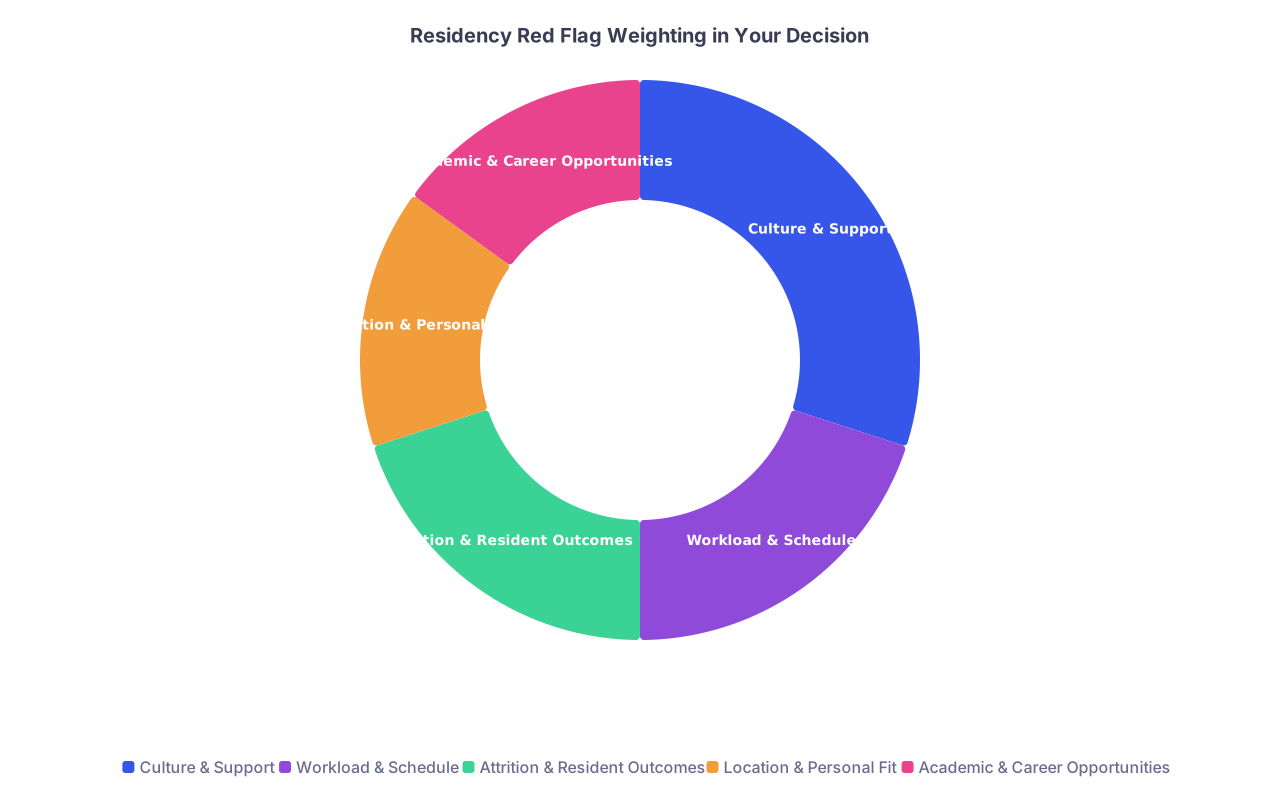
| Category | Value |
|---|---|
| Culture & Support | 30 |
| Workload & Schedule | 20 |
| Attrition & Resident Outcomes | 20 |
| Location & Personal Fit | 15 |
| Academic & Career Opportunities | 15 |
If a program looks great except for serious, unexplained attrition issues with defensive leadership, that should drop it down your list. If attrition is low and well-explained, that is a strong plus—but still not the whole story.
Step 11: Practice Out Loud Before You Walk In
Last piece. Do not wait until you are sitting across from the PD to “see what comes out.” That is how people blurt, “So, why are residents leaving? Is this a malignant program?”
You want muscle memory.
- Pick 2–3 scripts from this article that feel natural to you.
- Say them out loud. Not in your head. Out loud.
- Trim or tweak phrases so they sound like you, not like a memo.
- Practice once or twice the night before each interview.
If you want a simple “baseline package,” use this set:
For PD/APD:
“Every program has some turnover over time. To help me understand how residents tend to do here, could you share how often residents have left the program before completion in the last 5–10 years, and what the typical reasons have been?”
“If a resident is struggling, how do you typically approach that as a program? What kinds of supports or remediation are in place before a transition out is considered?”
For residents:
“Big-picture, how well do people tend to do here? Do most people finish, or have there been several residents leaving or switching in recent years?”
“For residents who have had a rough patch, have you seen people actually get supported and come out the other side doing well?”
Say those out loud now. If you stumble on a phrase, simplify it.
Your Next Step Today
Open a note on your phone or laptop and write down three attrition questions you will use on your next interview day:
1–2 for leadership.
1–2 for residents.
Phrase them in your own words, using the structures above. Then read them out loud once.
If they sound calm, neutral, and curious, you are ready. If they sound like you are cross-examining them on the witness stand, soften the lead-in and try again.
Do that today, and the next time you walk into a residency interview, you will not be wondering if you can ask about attrition. You will have a script in your back pocket and a clear plan to spot red flags before they become your reality.