
Resident morale is not a throwaway detail. It is a live preview of your next three to seven years.
If you walked out of a tour thinking, “I really like this program, but the residents look beaten down,” you are not overreacting. You are also not done. This is fixable—if you approach it methodically.
Here is the problem: most applicants either ignore the bad vibes or overcorrect and run away. Both are lazy responses. You can do better. You can figure out whether you are seeing:
- A fixable, transitional low point, or
- A structurally toxic system that will grind you down.
I am going to show you how to tell the difference and exactly what to do, step by step.
Step 1: Diagnose the Type of “Low Morale” You’re Seeing
“Low morale” is vague. You need to turn vibes into data.
On interview day, you probably saw a mix of this:
- People who look exhausted, short, or disengaged
- Residents making dark jokes about work hours, documentation, or administration
- Awkward pauses when someone asks, “Do you feel supported?”
- A chief or PD jumping in to answer questions clearly meant for residents
You cannot fix what you do not define. Start by categorizing what you saw.
A. Separate Burnout from Toxic Culture
They overlap but they are not the same.
Burnout pattern (potentially fixable):
- Residents are tired, but still:
- Help each other out
- Speak respectfully about each other and nurses
- Make self-deprecating jokes, not hostile ones
- Complaints are about:
- EMR clicks
- High volume
- Staffing shortages
- “We’re just slammed this month”
- They still talk about:
- Good teaching from certain attendings
- Strong fellowship matches
- Feeling close with co-residents
Toxic culture pattern (huge red flag):
- Residents undermine or roll their eyes at each other in front of you
- They complain about:
- Being shamed in public
- Attendings yelling or belittling them
- Retaliation for speaking up
- They warn you indirectly:
- “You just have to keep your head down here”
- “Do not ever call out sick, it will follow you”
- You see cliques, visible tension, or fear around leadership
If what you saw was mostly burnout with some camaraderie still alive, the program might still be a good fit. If you saw fear, disrespect, or chronic bitterness, that is not “low morale.” That is structural dysfunction.
Step 2: Get More Data—Quietly and Systematically
Your impression from one afternoon is unreliable. You need more inputs.
Do not just “trust your gut.” Train your gut with real information.
A. Reconstruct What You Already Saw and Heard
Right after your interview (or now, if you remember enough), write down:
- Exact quotes residents used that stuck with you
- Who said them (PGY level if you recall)
- The context (pre-round, noon conference, pre-dinner, social event)
- Nonverbal stuff:
- Were people interrupting each other?
- Did they laugh off complaints or let them land heavy?
- Did anyone defend the program when others complained?
Patterns matter more than single comments. Four different residents joking about “no days off” is not random.
B. Reach Out to Current Residents (But Ask Smart Questions)
You need off-script answers. Not the polished party line.
Target:
- A mix of PGY-1, PGY-2, PGY-3
- If applicable: a chief resident and at least one prelim or TY if they exist
- If you are interested in a subspecialty, at least one resident going into that field
When you email or message them, be respectful of their time.
Template opener:
Hi Dr. [Last Name],
I interviewed at [Program] on [date] and really liked [specific aspect: e.g., curriculum structure, patient population, specific track]. I got the sense that residents are stretched pretty thin right now, and I want to understand more honestly what day-to-day life feels like before I rank programs.
If you have 10–15 minutes, I would really appreciate your perspective on a few specific questions.
Avoid “So… is morale low?” That is vague and easy to dodge. Ask questions that force concrete answers.
Ask:
“How have things changed over the last 1–2 years?”
- Listen for:
- New leadership
- Major EMR changes
- Hospital mergers
- COVID/RSV/flu surges
- You want to see if low morale is:
- A new, recognized problem under active repair
- Or “just how it has always been”
- Listen for:
“What are the top 2–3 things residents complain about most?”
- If they say:
- Documentation burden
- Boarding in ED
- Admissions volume
That is common, not ideal but common.
- If they say:
- “Retaliation if you raise concerns”
- “We are constantly covering unsafe numbers of patients”
- “Administration does not care if we violate duty hours”
That is different.
- If they say:
“When residents bring concerns to leadership, what actually happens?”
- Good sign:
- “We brought up X, and within 3–6 months they adjusted Y”
- Bad sign:
- “We bring things up, they say they will look into it, nothing changes”
- “We stopped bringing things up. It just makes your life harder.”
- Good sign:
“What do you wish you had known before ranking this program?”
- This pulls out the uncomfortable truths they never put on a brochure.
“On a 1–10 scale, how likely would you be to choose this program again, and why?”
- The number matters less than the explanation behind it.
You are trying to see whether residents are:
- Frustrated yet still hopeful and engaged, or
- Detached, resigned, and just trying to survive
Those are very different realities.
Step 3: Look for Whether Leadership Is Fixing or Ignoring the Problem
This is the pivot point. Low morale by itself does not kill a program. Indifference from leadership does.
A. Re-Examine What the PD and Chiefs Actually Said
Review your notes or memory from PD/chief Q&A:
- Did anyone mention:
- Work-hour monitoring?
- Wellness initiatives beyond pizza and yoga?
- Structural changes to lighten burden (new night float, more NPs/PAs, scribes)?
You want specific, unforced statements like:
- “We had serious burnout two years ago. We cut ICU caps, hired 3 additional hospitalists, and changed how nights work. Things are better, but we are still watching it closely.”
- “Feedback from our residents changed how we do X/Y/Z. We meet with residents monthly for open forum discussion, and we actually act on it.”
You do not want exclusively vague hand-waving:
- “We take resident wellness very seriously.”
- “We are like a family here.”
- “Our residents are resilient and handle a lot.”
Those lines are cheap. They prove nothing.
B. Ask Directly About Morale (If You Have a Second Look or Email Access)
If you still have the PD or APD’s email, you can ask a respectful but blunt question.
Example:
I really appreciated the chance to interview at [Program]. I noticed that several residents mentioned feeling stretched thin, especially on [specific service].
I am very interested in [Program] and want to understand how the program is approaching resident workload and morale. What changes (recent or upcoming) are being made to address resident burnout or low morale?
You are watching for:
- Concrete interventions (schedule restructuring, ancillary support, caps, expansion of residency class, call redesign)
- Timeframes (already implemented vs “sometime in the future”)
- Acknowledgment instead of deflection
A PD who says, “You are right, we are in a tough stretch and here is exactly what we are doing about it” is far better than one who pretends everything is fantastic.
Step 4: Use Objective Data to Back Up Your Impression
You are not the first to notice low morale. It leaves a paper trail.
A. Check for Turnover, Attrition, and Transfers
Red flags to look for:
- Multiple PGY-2/PGY-3 residents “transferred for personal reasons”
- Sudden expansion or contraction of class size without clear justification
- Residents who leave medicine entirely, not just the program
You can spot some of this from:
- Program website: missing bios, residents who vanish between years
- Word of mouth from residents at neighboring programs
- Alumni LinkedIn pages or specialty-specific forums
B. Compare Duty Hours and Service Structure with Peers
Use a simple comparison frame:
| Factor | Healthy Range |
|---|---|
| Cap on ward patients | 8–12 per resident (IM example) |
| Typical weekly hours | 55–70, with real post-call days |
| Night float length | 1–2 weeks, not months |
| ICU coverage | Reasonable caps and supervision |
| Cross-cover load | Not routinely unsafe numbers |
If residents consistently talk about:
- 80+ hours “on paper we log 70”
- No true post-call days (always “just round and dispo”)
- Chronic cross-cover of 30–40+ patients
Then you are not just dealing with “low morale.” You are dealing with structural abuse.
C. Use Board Pass Rates and Fellowship Matches as Secondary Clues
They are not perfect, but they tell you if training is still intact despite the strain.
- If morale looks poor but:
- Board pass rates are consistently high
- Fellowship matches are solid
It suggests a high-intensity but educationally sound environment.
- If morale is low and:
- Board pass rates have dipped
- Match outcomes look weaker recently
You may be seeing a program in decline.
Step 5: Decide What You Can Tolerate (And What You Cannot)
Here is the part most applicants skip: aligning program reality with your own limits.
A. Be Honest About Your Personality and Needs
Some people can tolerate:
- Heavy workload
- Blunt feedback
- Chaotic systems
If they get: - Strong training
- Great fellowship opportunities
- Autonomy and respect
Others will be crushed by that same environment. Only you know which one you are.
Ask yourself:
- How did I handle my hardest clerkship or sub-I?
- Did I thrive in busy, high-acuity settings or crumble?
- Do I need a supportive culture more than a “brand name” program?
If you need a program where people visibly like coming to work, do not convince yourself you will “tough it out” in a chronically miserable place. That is how you become the PGY-2 warning MS4s at noon conference not to come.
B. Identify Which Red Flags Are Deal-Breakers
Non-negotiables (in my view, and I have seen this play out badly when ignored):
- Repeated stories of retaliation for speaking up
- Routine duty-hour violations with pressure to under-report
- Public shaming, humiliation, or abusive behavior from attendings tolerated by leadership
- Multiple residents transferring out within a short time frame
Maybe you are willing to tolerate:
- A rough ICU rotation with high acuity but great teaching
- Some unfixable hospital-level issues (ED boarding, EMR pain)
- A few “old-school” attendings in an otherwise decent culture
But you should not tolerate a program that breaks people and then blames them.
Step 6: Adjust Your Rank List with a Clear Framework
You like the program. You also see or suspect low morale. The question is not “rank or not rank.” It is usually “rank high, middle, low, or leave off entirely?”
Use a simple ranking framework.
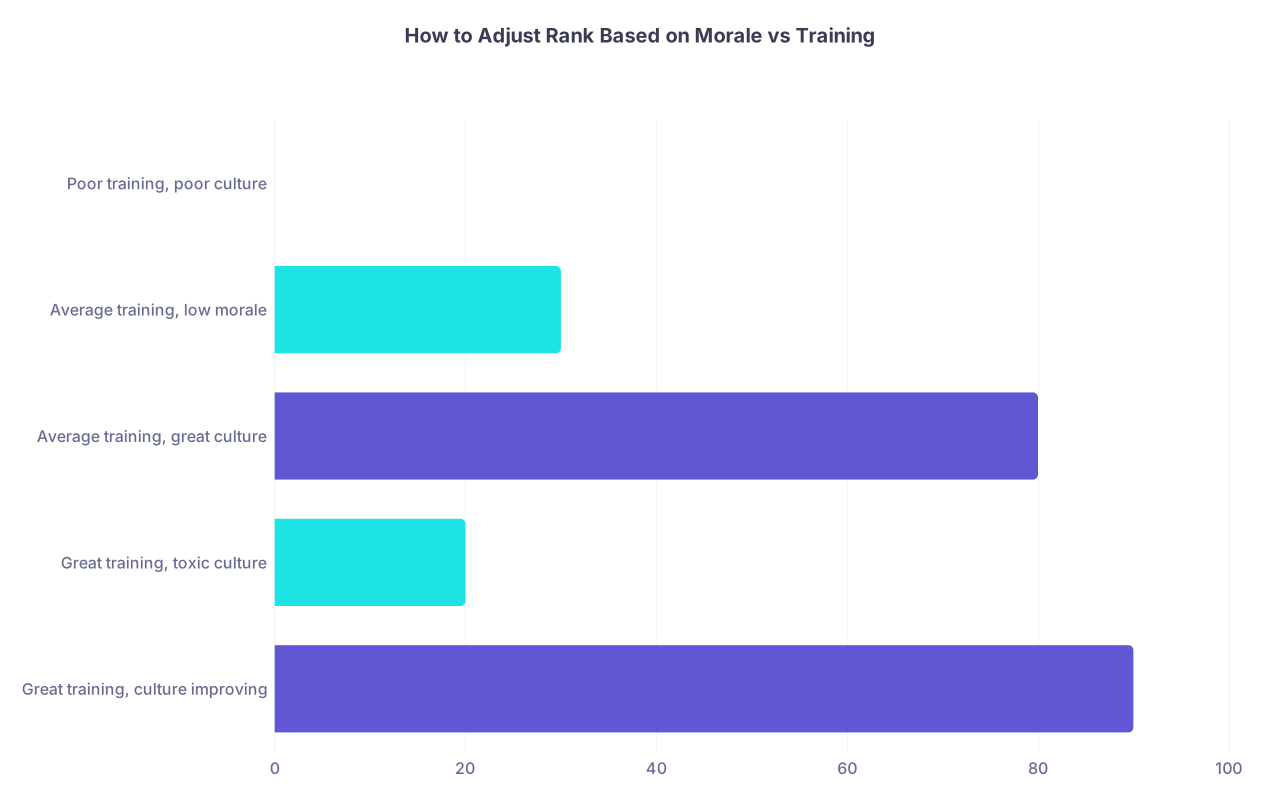
| Category | Value |
|---|---|
| Great training, culture improving | 90 |
| Great training, toxic culture | 20 |
| Average training, great culture | 80 |
| Average training, low morale | 30 |
| Poor training, poor culture | 0 |
Interpretation:
Great training + culture improving, leadership engaged
- Rank: High
- You will work hard, but it will probably get better while you are there.
Great training + clearly toxic culture, leadership defensive
- Rank: Low or remove
- Name brand will not compensate for being miserable and unsupported.
Average training + great culture, people genuinely like each other
- Rank: Middle to high, depending on your career plans
- Especially good if you value day-to-day life, generalist practice, or community ties.
Average training + low morale, no clear fixes in place
- Rank: Middle or low
- Only keep if geographic needs or other personal constraints demand it.
Poor training + poor culture
- Remove. There is no scenario where this is a rational choice.
If you are truly torn between two programs, ask one final question:
“Where am I more likely to become the kind of physician I want to be and remain a functioning human being?”
Not just in PGY-1. In PGY-3+ when the novelty is gone.
Step 7: Prepare Contingency Plans If You Match There
Sometimes you will still rank and match at a place where morale is shaky, because:
- Location is critical (family, partner, visa, etc.)
- The program’s name or fellowship pipeline matters for your goals
- You believe the culture is in transition and improving
Fine. But do not go in blind. Go in with a plan.
A. Build Your Own Support System Early
Within the first 2–3 months:
- Identify 1–2 senior residents you trust
- People who are candid but not cynical
- Ask, “Can I come to you for advice if I hit rough patches?”
- Find at least one attending who:
- Remembers your name
- Genuinely teaches on rounds
- Treats staff respectfully
They become your buffer when the system is rough.
Outside the hospital:
- Lock in:
- Therapy or counseling if you are open to it
- At least one non-medical friend group or activity
- A regular physical routine (short, sustainable workouts)
Programs with low morale rarely protect your time. You have to protect it yourself.
B. Learn the Real Rules of Survival in That Program
Every program has formal rules and unwritten rules. You need both.
In your first month, ask trusted seniors:
- “What gets people into trouble here?”
- “What do interns do that makes their lives harder for no reason?”
- “What helps people succeed and stay sane here?”
You will hear things like:
- “Never suffer silently on night float. Call the senior early.”
- “If you are drowning on wards, this specific chief or NP will actually help.”
- “Avoid working continuously with Attending X until you are more comfortable—they are demanding but fair if you know how they operate.”
Use these to navigate around landmines.
C. Control What You Can: Efficiency, Boundaries, and Communication
You cannot fix staffing. You can fix your own approach.
Efficiency:
- Get fast at the EMR. Ask seniors for smart phrases, order sets, note templates.
- Batch tasks. Do not click the chart 20 times; do everything you can per patient at once.
- Pre-chart strategically. Half the note done before rounds is worth hours saved later.
Boundaries:
- When post-call, leave. Do not linger to “help out” unless the team is in true crisis.
- Use your days off. Stop “coming in just to check on my patients” regularly.
Communication:
- If you are drowning, say so early. “I am at capacity with X and Y; I need help with Z.”
- Ask for expectations upfront: “For this rotation, what does a strong intern look like to you?”
Programs with low morale often have terrible communication norms. You can correct some of that for yourself and sometimes your team.
Step 8: Know When to Cut Your Losses
Here is the nuclear option nobody likes to talk about: sometimes the answer is to leave.
You do not go into residency expecting to transfer. But you also do not chain yourself to a sinking ship out of pride.
If all of the following are true:
- Morale is worse than you expected once you start
- Leadership is unresponsive or punitive
- You are experiencing persistent dread, panic, or depression around work
- Your seniors and attendings say “Yeah, this place has always been like this”
Then you at least explore your options.
That means:
- Talking confidentially with:
- A trusted attending
- The DIO (Designated Institutional Official)
- Or GME office if available
- Contacting residents or PDs at other programs you know, to understand the transfer process
- Documenting:
- Duty-hour violations
- Instances of unsafe staffing
- Abusive interactions
You do not threaten or posture. You quietly gather information and only move if you find a better fit. I have watched residents stay and tough it out in objectively unsafe programs. Years later, they regret not leaving sooner.
Step 9: Use What You Learn Here for Future Decisions
Even if you never go near this program again, the way you dissected its morale issue is valuable.
You now know how to:
- Look past free food and shiny facilities
- Ask residents questions they cannot answer with fluff
- Watch leadership for evidence of action, not just words
On future electives, fellowships, or jobs, apply the same filters:
- Are people tired but united, or tired and isolated?
- Do leaders name problems honestly or hide them?
- When someone speaks up, does anything change?
Those three questions will tell you more about a place than any glossy brochure ever will.

| Step | Description |
|---|---|
| Step 1 | Like program but saw low morale |
| Step 2 | Gather more data from residents |
| Step 3 | Check if leadership is fixing issues |
| Step 4 | Lower rank or remove program |
| Step 5 | Rank in upper or middle tier |
| Step 6 | Rank lower or remove |
| Step 7 | Burnout or toxic culture |
| Step 8 | Leadership engaged and changing things |
Final Takeaways
- “Low morale” is not a vibe; it is a symptom. Turn it into data by probing residents, leadership, and objective metrics.
- Distinguish hard-but-functional programs from structurally toxic ones. Burnout with camaraderie and active fixes is survivable. Fear, retaliation, and neglect are not.
- If you still rank and match there, go in with your eyes open, your support system ready, and a clear sense of your boundaries—and be willing to leave if the place is truly breaking you.