
Only 17% of graduating residents in one multi-specialty survey reported feeling fully confident in their procedural volume by the end of training. That number should scare you more than any glossy brochure impresses you.
Programs love to say “you will be very busy here” or “you will see a wide variety of pathology.” The data often says something very different. Case logs, ACGME reports, OR board screenshots, clinic schedules — if you look closely, they tell you where the real red flags are.
You are not trying to be “busy.” You are trying to become competent. Competence is quantifiable. Case volume is one of the bluntest but most actionable tools you have to judge a residency.
The Baseline: What “Normal” Case Volume Actually Looks Like
The first step in spotting outliers is knowing the baseline. For almost every procedure-heavy specialty, the ACGME publishes case minimums and national averages. Program directors know those numbers. Good programs track them obsessively. Bad ones hand-wave.
Here is a rough sense of typical graduating resident volumes (recent ACGME and specialty board reports; ranges approximate):
| Specialty | Typical Total Cases | Key Procedural Benchmarks |
|---|---|---|
| General Surgery | 900–1,200 | 200+ major abdominal, 120+ endoscopy |
| Orthopedic Surgery | 1,500–2,000 | 200+ trauma, 200+ arthroplasty |
| OB/GYN | 1,000–1,500 | 200+ SVDs, 150+ C-sections |
| EM (procedures) | 200–400 | 30+ intubations, 20+ central lines |
| Anesthesiology | 1,500–2,000 | 200+ regional blocks, 50+ pediatrics |
Those are not “nice-to-have” numbers. They are minimums and medians that correlate with board pass rates and independent practice comfort.
If a program director tells you “our residents are very well trained” and then casually admits their graduating chiefs are at or barely above the ACGME minimums, that is a red flag. The data shows high-performing programs routinely exceed minimums by 20–40%.
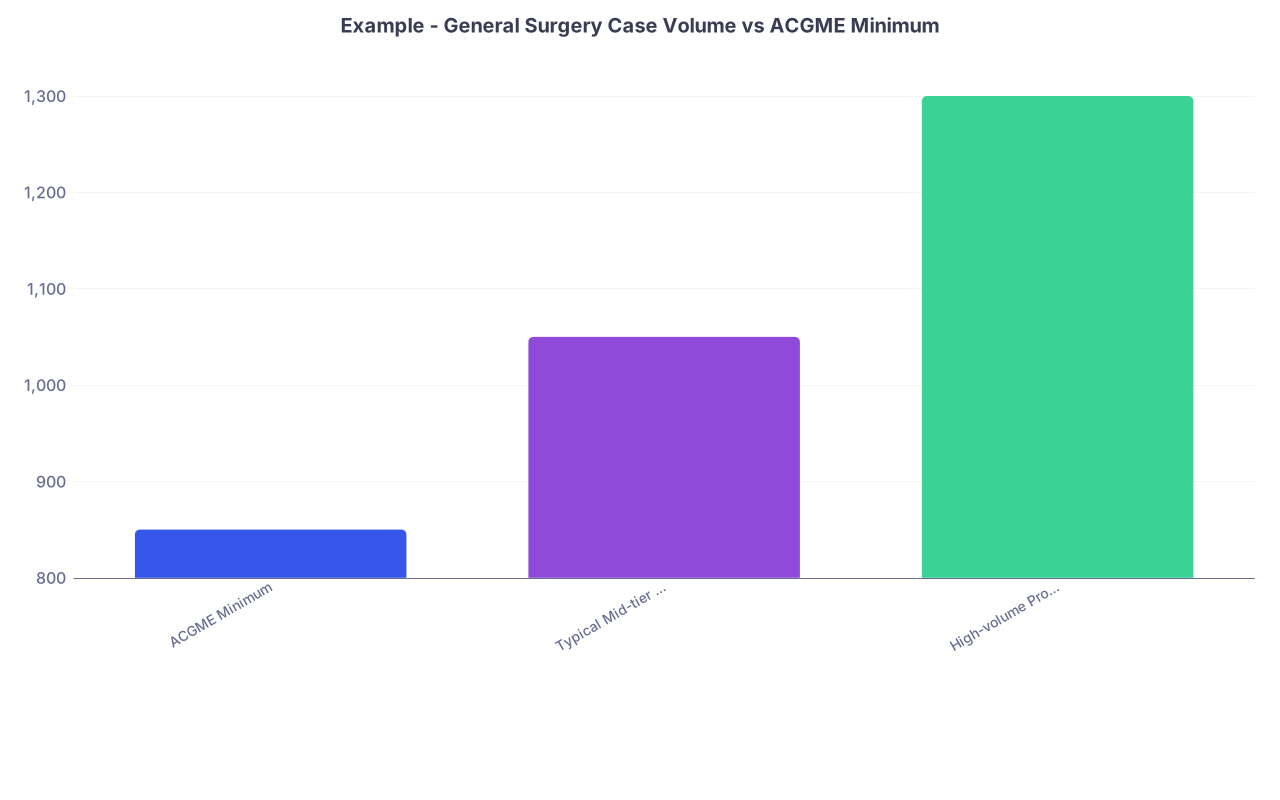
| Category | Value |
|---|---|
| ACGME Minimum | 850 |
| Typical Mid-tier Program | 1050 |
| High-volume Program | 1300 |
The outliers you care about sit on both tails:
- Extremely low volume: obvious danger.
- Extremely high, skewed volume in a narrow set of cases: also a problem, but more subtle.
Red Flag Pattern #1: Systematically Low Total Volume
The most straightforward red flag is low total cases, but you need to define “low” intelligently.
If the ACGME minimum for a graduating surgical resident is 850 major cases and the national mean is 1,050, then:
- Below minimum: catastrophic.
- 0–10% above minimum: weak.
- 10–25% above minimum: acceptable but not impressive.
- 25%+ above minimum: solid.
When I have reviewed de-identified case logs for applicants during advising, the danger pattern shows up as:
- PGY-5 residents finishing within 5–10% of minimums.
- Entire graduating classes bunched in that range, not just one outlier.
If someone tries to excuse this with “but we have excellent didactics,” that is spin. You cannot read your way to surgical skill.
You will rarely see official numbers on websites. So you have to triangulate:
- Ask residents directly: “What was your total case count at graduation? Roughly.”
- Ask: “Any grads in the last 3 years who had trouble meeting minimums?”
- Look at their board pass rates; low volume and weak boards often travel together.
If they dodge, change the subject, or say “we do not really focus on numbers,” assume the numbers are bad.
Red Flag Pattern #2: Skewed Distribution by PGY Year
Total volume might look fine. Distribution by year tells a different story.
Healthy pattern:
- Early years: high supervision, growing numbers, increasing complexity.
- Senior years: leadership cases, index procedures, less scut, more key portions.
Red flag pattern:
- PGY-1 and PGY-2 buried in floor work and clinic, doing almost no procedures.
- PGY-3 and PGY-4 suddenly trying to cram in huge case numbers.
- Seniors fighting for primary roles because juniors are being overprotected or midlevels are doing the work.
I have seen logs where PGY-2 surgical residents had fewer than 100 major cases for the entire year. That is not “protecting education.” That is wasting time.
If residents say things like:
- “Most of our operative experience actually comes in the last 6–9 months.”
- “You really become a surgeon here as a chief.”
- “The first two years are kind of service heavy.”
Translate that as: poor longitudinal volume distribution, likely unsafe rush at the end.
You want residents telling you: “I was operating from the beginning, just with more supervision and simpler cases early on.”
Red Flag Pattern #3: Case Mix That Looks Impressive on Paper but Is Hollow
Programs sometimes “game” volume by padding with low-value, repetitive cases while leaving gaps in critical, complex procedures.
Example in general surgery:
- 400+ endoscopies, 250+ lap choles, 200+ hernias.
- But only 20–30 colectomies and almost no complex foregut, HPB, or vascular exposure.
Numbers look big. Competence does not.
Similar pattern in OB/GYN:
- Tons of routine vaginal deliveries but very few operative vaginal deliveries, complicated C-sections, or gynecologic oncology cases.
You need to separate “case count” from “index case coverage.” Ask:
- “How many of your seniors feel comfortable doing [index procedure] independently?”
- “Do you track specific index procedures, not just totals?”
- “Any case types residents consistently feel light on by graduation?”
If more than one resident labels a major procedure category as “weak” or “we do a fellowship to really learn that,” that is an academic choice in some specialties, but often it is just a polite way of saying the residency did not deliver enough volume.
Red Flag Pattern #4: Volume Variability Between Residents in the Same Class
Here is a consistent warning signal I see in data:
Same-year residents with wildly different logs. One chief logging 1,300 major cases; another barely at 900 in the same program, same year.
That almost always means:
- Poor rotation fairness.
- Inequitable assignment of key cases.
- Or chaotic scheduling where whoever speaks loudest gets into the OR.
In a well-run program, variation between residents in the same graduating class should be modest. Not zero — interests differ — but not 40–50% swings.
What you want to hear:
- “We compare logs mid-year and adjust rotations.”
- “Chiefs are responsible for ensuring everyone meets benchmarks.”
- “Our class all graduated within about 10–15% of each other in total cases.”
If instead you hear:
- “You just have to advocate for yourself.”
- “Some people hustle more.”
- “If you are proactive you will be fine.”
That is code for structural inequity disguised as “initiative.” And yes, it shows up in the data.
Red Flag Pattern #5: Competition with Fellows and Midlevels
Fellows are not inherently bad. Some of the best training environments have strong fellowship programs. The question is simple: who is holding the knife and driving the scope?
Data from multiple institutions has shown that:
- When fellows are present in a small program with limited attending bandwidth, resident primary case volume often drops 15–30% in the overlapping case types, unless there are explicit protections.
- In contrast, large-volume centers with clear role separation sometimes show resident volume equal to or exceeding non-fellowship programs.
Similarly, aggressive expansion of advanced practice providers (NPs, PAs) can erode residents’ opportunities. Look at:
- Who first-assists in routine OR cases.
- Who does the procedures in ED or ICU (lines, intubations, chest tubes).
- Who staffs clinics and performs small procedures.
Red flags in language:
- “Our fellows do the more complex cases.”
- “The PAs help with central lines so residents are not overwhelmed.”
- “Midlevels run their own clinics; residents cover the floor.”
You want hard data-backed statements instead:
- “Our chiefs still average 40+ independent intubations.”
- “Fellows focus on niche procedures; residents get the bread-and-butter and plenty of advanced cases.”
Red Flag Pattern #6: Outpatient vs Inpatient Imbalance
The future of many specialties is shifting outpatient. That is not a slogan. The billing data shows it.
But residency case logs and schedules often lag 10 years behind practice patterns.
For surgical specialties:
- An orthopedic program with heavy inpatient trauma but minimal outpatient sports, arthroplasty, and hand clinic experience will produce residents who are technically strong in the OR and lost in real-world practice management.
- Conversely, a program with tons of clinic and injections but low operative fracture volume will leave you procedurally underpowered.
For internal medicine and EM:
- You should be seeing a solid mix of high-acuity inpatient and bread-and-butter outpatient continuity care.
- Programs that skew you almost entirely to inpatient wards, nocturnist-style shifts, or “admit and ship to somewhere else” undermine future outpatient competence.
Ask:
- “How many half-days of continuity clinic do you average per week, over the three years?”
- “How many ambulatory blocks?”
- “Are outpatient procedures (e.g., joint injections, skin biopsies, colposcopies) logged and tracked?”
If nobody can answer with numbers, they are not tracking the balance. That often means it is poor.
Red Flag Pattern #7: Rapid Recent Volume Declines
Case volume is not static. Service closures, referral pattern changes, new competing hospitals — they all hit trainee experience.
I have seen programs that were strong five years ago become mediocre purely due to system-level shifts:
- New private surgical center siphoning elective cases.
- Hospital leadership pushing more midlevel-based clinics.
- Level 1 trauma designation dropped.
Well-run programs respond to these shocks by:
- Rebalancing rotations.
- Building new affiliations.
- Importing cases in defined blocks (e.g., trauma rotations at a partner center).
Poorly run programs hand residents the bill: lower volumes, weaker logs, and a shrug.
Ask directly:
- “Have there been any major service changes in the last 3–5 years that impacted case volume?”
- “How have your average case numbers changed over that period?”
- “What structural adjustments did you make in response?”
A program that cannot show a plan or give numbers is a program that is hoping you will not look too closely at the trend line.
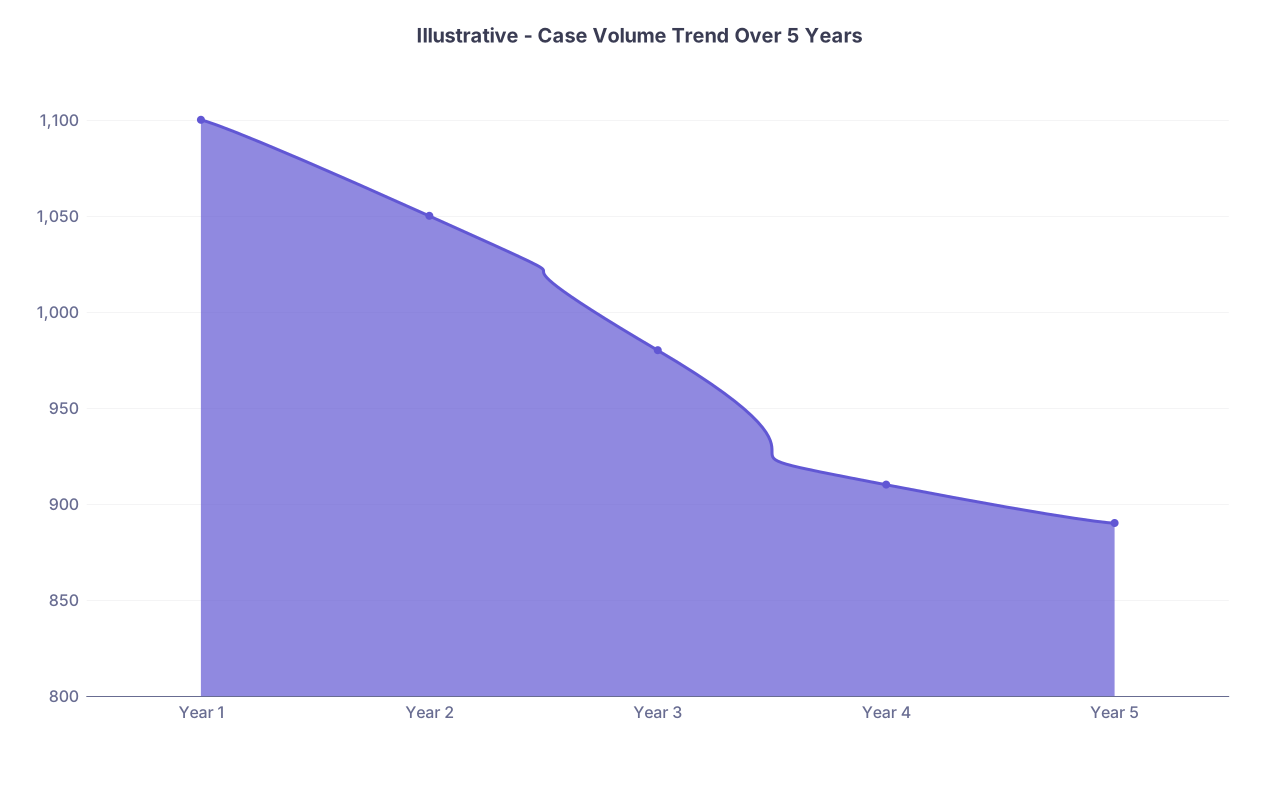
| Category | Value |
|---|---|
| Year 1 | 1100 |
| Year 2 | 1050 |
| Year 3 | 980 |
| Year 4 | 910 |
| Year 5 | 890 |
That type of downward slope without a clear correction plan should make you think very hard before ranking that program highly.
How to Extract Real Case Volume Data as an Applicant
Programs are not going to hand you a nicely formatted spreadsheet with every red flag highlighted. You have to ask targeted questions and listen carefully to how people answer.
Here is a practical approach that I have seen work repeatedly.
1. Ask Residents, Not Just Faculty
Faculty often give aspirational or outdated numbers. Residents live the reality.
Questions that generate real data:
- “What was your total case count last year?” (Ask 2–3 seniors independently. Numbers should be similar.)
- “Did anyone in the last few years struggle to meet ACGME minimums?”
- “Which procedures do people feel weak in when they graduate?”
- “Do you see any big differences in case volume between residents in your class?”
You are not looking for perfect precision. You are looking for order-of-magnitude answers and patterns.
2. Use Specific Benchmarks When You Ask
Generic questions get generic answers. Anchored questions force specifics.
For example, instead of “Do you get enough operative experience?”, ask:
- “Roughly how many major cases did you have by the end of PGY-3?”
- “Do most people graduate closer to 900 cases, 1,200, or 1,500?”
- “How many intubations do EM residents log by graduation? 20, 50, 100+?”
People can map to these ranges more easily than they can recall exact figures.
3. Watch for Denial or Overcompensation
There are two classic bad patterns in how programs talk about case volume:
Dismissive:
- “We do not obsess over numbers.”
- “Quality over quantity.”
Defensive overpromise:
- “Our residents get more cases than anywhere else.”
- “You will be operating constantly from day one.”
Strong programs tend to speak calmly and concretely:
- “Our grads average just over 1,100 major cases; nobody has been close to missing minimums in at least 5 years.”
- “Our EM residents log around 40–50 intubations; we track quarterly and move people to higher-yield rotations if they are behind.”
Calm, specific numbers beat hype every single time.
Integrating Case Volume with Other Red Flags
Case volume is not the only metric, but it interacts strongly with others.
Common combinations I see:
Low case volume + heavy scutwork complaints
→ You are busy, but not on the right things. Classic malignant or service-heavy environment.Decent case volume + poor teaching / supervision
→ You may get “numbers” but with sloppy technique and little feedback. You will spend fellowship or early practice unlearning bad habits.High case volume + terrible work-life balance + burnout
→ Some people still choose this trade-off, but you should be honest with yourself. Numbers do not fix exhaustion and morale collapse.
The sweet spot looks like:
- Case volume consistently 20–40% above ACGME minimums.
- Clear distribution of cases across years with increasing responsibility.
- Reasonable variation between residents within a class.
- Residents speaking confidently about both their logs and their comfort level.
That profile is what you are hunting.
The Future: Procedure Volume Will Matter Even More
As medicine moves toward more standardization, objective metrics are not going away. They are tightening.
Several predictable trends:
- Boards and credentialing bodies are increasingly interested in granular logs of specific index cases, not just totals.
- Hospitals are becoming more cautious about privileging new attendings without documented experience. Some already request procedure logs during hiring.
- Fellowship programs in procedural specialties quietly favor applicants from high-volume residencies. They do not always say this publicly, but the rank lists reflect it.
Meanwhile:
- Non-physician clinicians are taking on more procedural work.
- Outpatient and ambulatory centers are growing faster than traditional inpatient-heavy hospitals.
- Financial pressure is pushing efficiency, which can marginalize learners if programs are not intentional.
All of this means that weak case volume is going to hurt more, not less, over the next decade. You will be competing in a market where your actual, documented experience matters. A lot.
Quick Synthesis: How to Use Case Volume as a Red Flag Detector
If you want a compressed checklist, it is this:
- If graduates are near ACGME minimums rather than 20–40% above them → red flag.
- If volume is crammed into the last year or two instead of being progressively built → red flag.
- If big differences exist between residents in the same class → red flag.
- If fellows and midlevels clearly take substantial portions of core cases without structural protections → red flag.
- If recent service changes have dropped volume without a clear plan to fix it → major red flag.
The data shows that residents who train in high-volume, well-structured programs enter practice more confident, more employable, and safer. You cannot control the job market, hospital politics, or new regulations. You can control where you spend these crucial training years.
Choose the place where the numbers — not the marketing — say you will actually learn.
Key takeaways:
- Case volume outliers, especially low or skewed numbers, are reliable early warning signs of residency program weakness.
- Do not accept vague reassurances; insist on approximate numbers from residents and look for consistency across answers.
- Aim for programs where graduates clearly exceed minimums, distribution across years is rational, and residents share fairly in core cases.