
The most dangerous residency programs are not the ones that fail. They are the ones that grow faster than their infrastructure and quietly burn through residents to keep the lights on.
You are bombarded with “We are expanding!” on program websites and interview days. Admins call it “growth.” Residents often call it something else: “We added 6 new spots and zero new faculty,” or “We doubled the class but the call schedule did not change.”
The data tells you who is right.
This is an article about reading those numbers correctly—how to tell legitimate growth from unsafe overstretch—using the only language that does not lie over time: ratios, trends, and capacity constraints.
1. The Core Ratios That Separate Healthy Growth From Overstretch
Ignore the glossy marketing slides. Start with five ratios. If these look bad, nothing else redeems the expansion story.
1.1 Residents per Faculty FTE
The single best early-warning metric is residents per core faculty FTE (not just “faculty with titles,” but actual full‑time equivalent teaching effort).
Healthy internal medicine or pediatrics programs usually live somewhere around 1.5–2.5 residents per core faculty FTE. Surgical programs run tighter because of case complexity and direct supervision requirements.
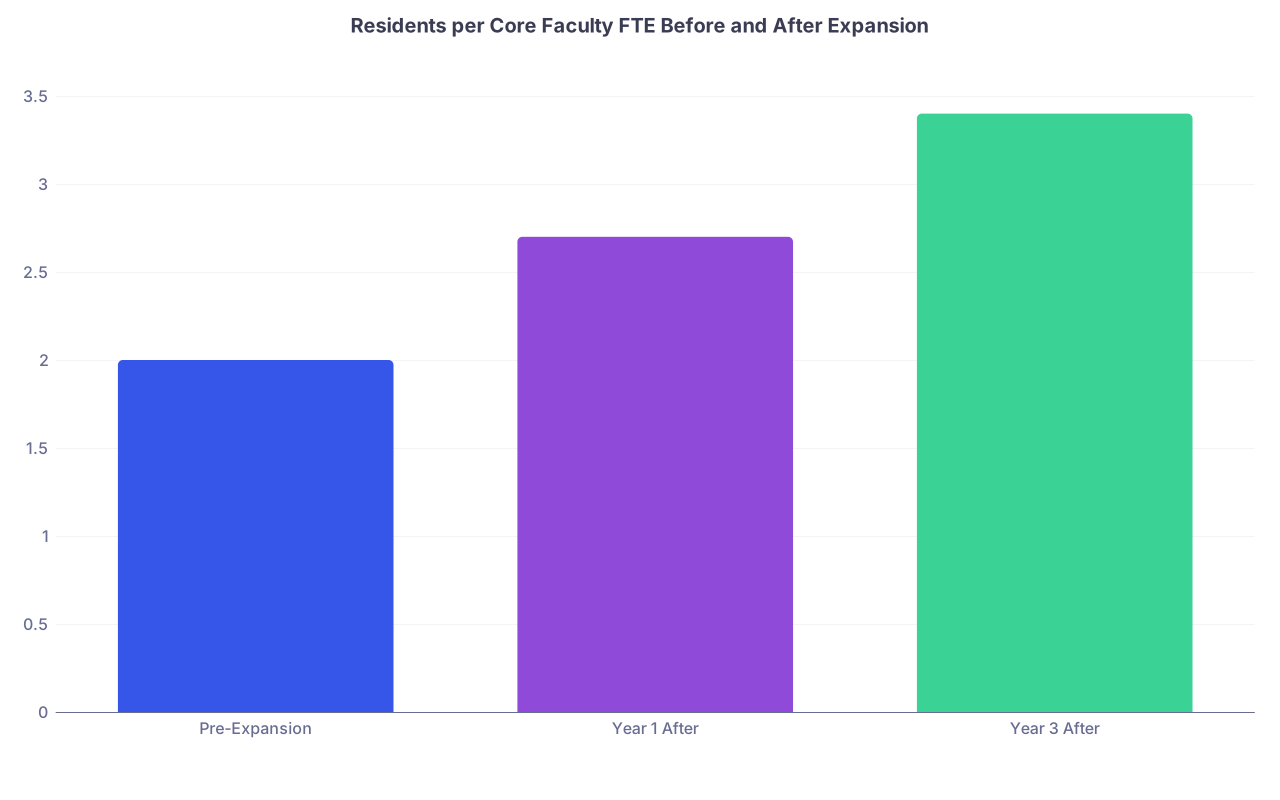
When programs “expand” by +6 residents per year class without adding faculty, this ratio spikes quickly.
| Category | Value |
|---|---|
| Pre-Expansion | 2 |
| Year 1 After | 2.7 |
| Year 3 After | 3.4 |
What that type of jump actually means:
- Pre‑expansion: 20 residents, 10 FTE core faculty → 2.0 residents per FTE
- 3 years after adding 4 per class with no new faculty: 32 residents, same 10 FTE → 3.2 residents per FTE
Once you cross ~3.0 residents per core faculty FTE in a broad‑based specialty, supervision quality and feedback time almost always suffer. I have seen it repeatedly:
- Less direct observation
- Fewer meaningful evaluations
- Faculty using copy‑paste evaluations because there is no time
If a program director says “We’re expanding by 50%” and cannot follow that with “and we hired X new full‑time clinician‑educators,” you should mentally downgrade the program.
1.2 Residents per Inpatient Volume
Next ratio: residents per 1,000 annual inpatient discharges (or equivalent patient‑care units).
Too low volume relative to residents → poor case mix, weak procedural numbers.
Too high volume relative to residents → chronic overwork, duty hours violations, missed education.
For big‑city IM programs, a rough “reasonable zone” you see in stable, non-toxic programs can be:
- 25–40 residents per 10,000 adult discharges across all teaching sites
An expansion turns toxic when the denominator does not grow.
Example I have seen in actual data:
- Before expansion: 28 residents, 18,000 discharges → 15.6 residents per 10k discharges
- After expansion: 42 residents, 18,500 discharges → 22.7 residents per 10k discharges (40% more residents for 3% more patients)
The residents feel this instantly: more bodies fighting for procedures, more residents on each team for the same total census, people “competing” for sick patients instead of learning collaboratively.
Healthy growth usually means:
- Parallel increase in discharges or complexity (e.g., new ICU, transplant line)
- Rational redesign of teams so each resident’s patient load stays stable or even decreases
If the program tells you: “We added 12 residents but our hospital census is mostly flat,” that is not training capacity growth. That is call coverage optimization for the hospital.
2. Stepwise Growth vs. Sudden Expansion – The Time Axis Matters
Volume is not the only variable. Time is the second dimension. Strong programs grow in deliberate steps. Red‑flag programs grow like a hockey stick.
2.1 Watch the 5‑Year Trend, Not the Single-Year Spike
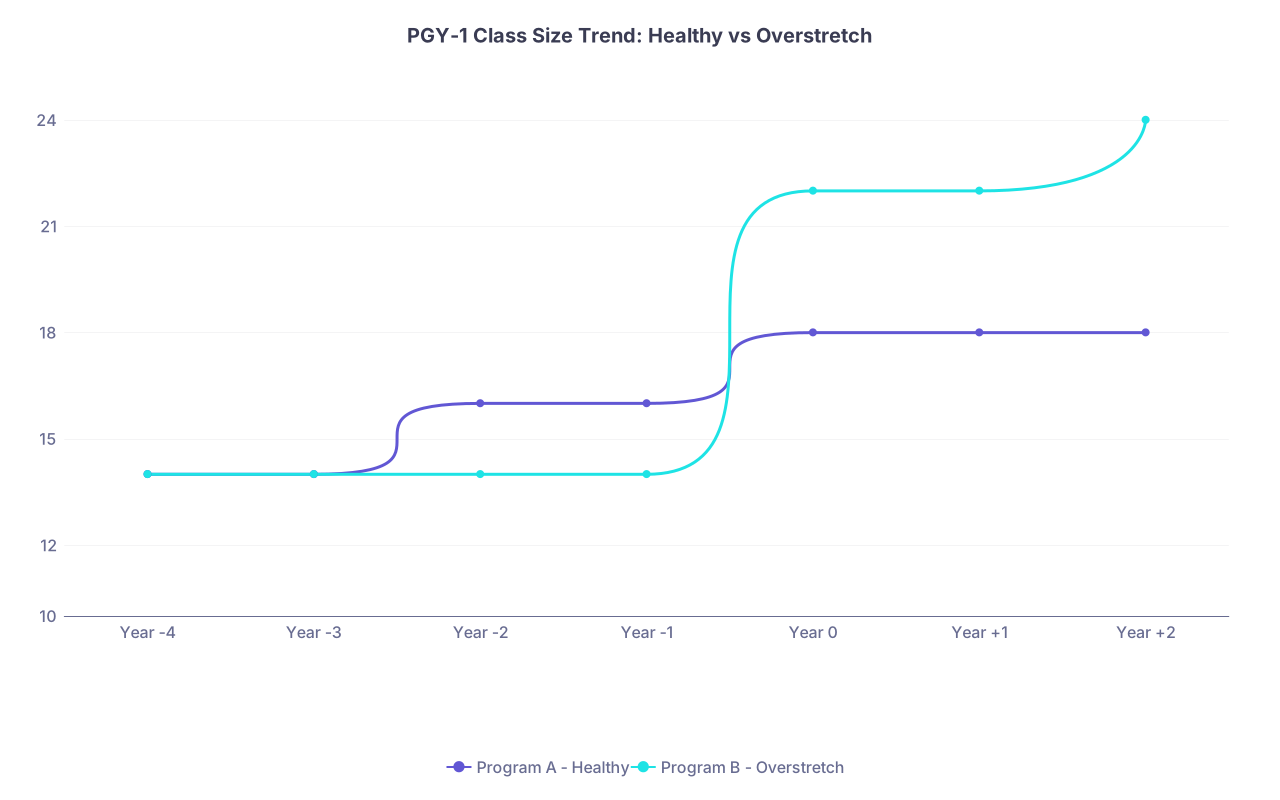
You want to see a modest, staircase‑like increase, with visible capacity changes at each step.
| Category | Program A - Healthy | Program B - Overstretch |
|---|---|---|
| Year -4 | 14 | 14 |
| Year -3 | 14 | 14 |
| Year -2 | 16 | 14 |
| Year -1 | 16 | 14 |
| Year 0 | 18 | 22 |
| Year +1 | 18 | 22 |
| Year +2 | 18 | 24 |
Program A: adds 2 spots every 2 years. Reports new faculty hires and new rotation sites. Residents describe incremental change.
Program B: static for years, then jumps from 14 to 22 PGY‑1s in one shot.
Nine times out of ten, the sudden‑jump pattern is:
- Loss of outside hospital coverage by private groups → residents backfill
- Hospital opening a new tower or service line, faster than it can recruit attendings
- Financial squeeze → system realizes residents are cheaper than hiring nocturnists or midlevels
You are not being brought in because they “love teaching.” You are being brought in to plug a revenue hole.
2.2 ACGME Citations Lag Behind Reality
Many applicants trust ACGME accreditation status way too much. They see “Continued Accreditation” and assume the program is safe.
The data says otherwise on timing:
- Expansion year 0: PGY‑1 class suddenly increases
- Year 1–2: Residents begin complaining, duty hours get tight, education time shrinks
- Year 3–4: ACGME site visit or review catches up → citations about faculty supervision, didactics, resident case logs
- Year 5: Major changes or warning/conditional status appear on public reports
You are interviewing in real time, not 5 years after the problem started. So you must detect issues before the formal citations catch up.
If residents on the trail say, “We just grew from 8 to 14 interns,” your mental model should be: the ACGME has not fully reacted yet. You are the canary in the coal mine.
3. How to Quantify “Overstretch” From What You Can Actually See
You do not have access to every spreadsheet the DIO keeps. But you can reconstruct 80% of the story with some careful questions and basic math.
3.1 The Key Data Points to Pull on Interview Day
You want hard numbers, not vibes. Focus on quantifiable answers:
- Current PGY‑1 class size, and what it was 3–5 years ago
- Number of core faculty and a rough count of hospitalists who teach regularly
- Number of primary training hospitals and ICUs
- Typical team structure (interns + seniors + attending, max census)
- Typical weekly duty hours on ward months now, vs “a few years back”
Then convert that to ratios.
| Metric | 5 Years Ago | Current |
|---|---|---|
| PGY-1 Class Size | 12 | 20 |
| Total Residents (All Years) | 36 | 60 |
| Core Faculty FTE | 14 | 17 |
| Annual Adult Discharges | 16,000 | 17,000 |
| Teaching Hospitals | 1 | 1 |
Now compute:
- Residents per faculty FTE: from 36/14=2.6 → 60/17≈3.5 (35% worse)
- Residents per 10k discharges: from 36/1.6=22.5 → 60/1.7≈35.3 (≈57% more residents per patient volume)
You do not need differential equations. Simple ratios tell you this program is using “expansion” as resident multiplication without meaningful infrastructure increase. That is overstretch.
3.2 Red‑Flag Growth Patterns in Resident Descriptions
Residents often encode the truth in throwaway remarks. Listen for time‑anchored changes.
Bad patterns:
- “We used to have X; now we have to…”
- “They added nights to cover the new tower, so now we’re on Q3 for a few blocks.”
- “They say more people means better work‑life balance, but honestly the work just expanded to match.”
Good patterns:
- “When they added 4 spots, they also opened a new community hospital with high autonomy, and hired 3 more clinician‑educators.”
- “The new subspecialty services actually took patients off general medicine, so ward caps dropped from 16 to 12.”
You are looking for numerical cause‑and‑effect, not generic reassurance.
4. When Growth is Actually Good: The Positive Data Patterns
Not all expansion is bad. Some programs use growth to create better schedules, more electives, and deeper exposure. The numbers look different.
4.1 Volume‑Driven, Well‑Resourced Expansion
The cleanest story is: more complex patients + more faculty + slightly more residents → higher quality training with slightly less individual grind.
Concrete example:
- New cardiac ICU opens, with 600 high‑acuity admissions per year
- Two new intensivists + one cardiology faculty hired
- Program adds 2 residents per class plus one extra CCU rotation per year
Ratios:
- Residents per ICU admission stays stable or improves
- Residents per intensivist FTE stays <3
- Duty hours stay near 55–60/week for heavy rotations, not creeping toward 80
This is what legitimate growth looks like: a clear clinical justification, backed by faculty and infrastructure, with explicit design to protect education time.
4.2 Expansion that Reduces Burnout Metrics
Occasionally, you see a program that expands for a reason that is actually resident‑centric: redesigning the call and night‑float structure.
I have seen:
- Program goes from 12 to 16 residents per class
- They add a dedicated night‑float team, eliminate 28‑hour calls, and cut number of hard call months per resident from 6 to 3
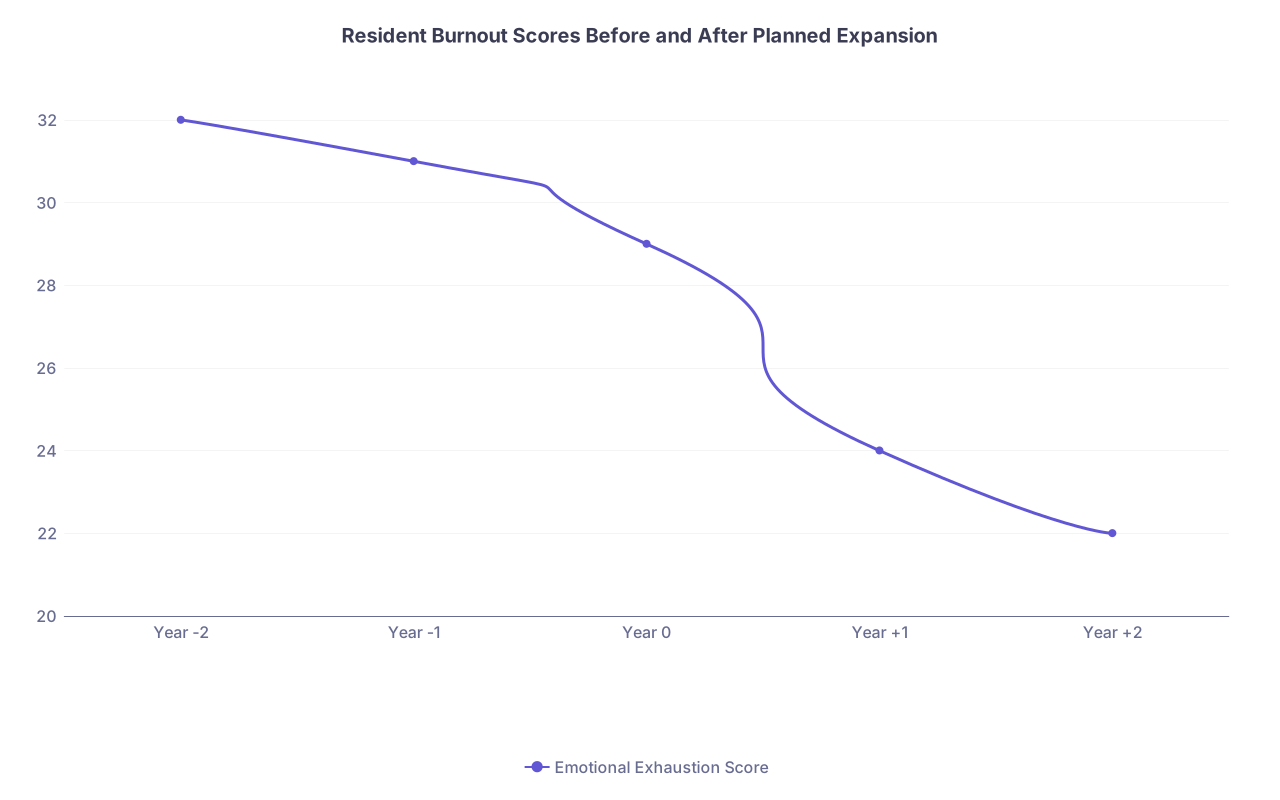
- They track Maslach Burnout scores or local well‑being surveys and see a tangible drop in emotional exhaustion scores over 3 years
| Category | Emotional Exhaustion Score |
|---|---|
| Year -2 | 32 |
| Year -1 | 31 |
| Year 0 | 29 |
| Year +1 | 24 |
| Year +2 | 22 |
When a PD can show that type of data and talk through the design logic, you are not looking at a red flag. You are looking at rare competent leadership.
If all you hear is: “With more residents, call will be more spread out,” and no one can give you numbers on how call frequency or average hours have changed, assume the benefit exists more in their imagination than in reality.
5. System‑Driven Expansion: Following the Money
The hard truth: most rapid expansions are not education‑driven. They are finance‑driven.
Healthcare systems see residents as:
- Inexpensive labor relative to NPs, PAs, or hospitalists
- Sources of GME payments (direct and indirect) from Medicare
- A recruiting funnel into their attending workforce
So they run a simple equation: Can we fund 6 more residency slots and avoid hiring 4 nocturnists? Often, yes.
5.1 How to Spot a System‑Driven, Risky Expansion
A few institutional patterns correlate strongly with unsafe overstretch:
- Sharp expansion across multiple programs simultaneously (e.g., IM + Surgery + EM all add 4–6 residents per class within 2 years)
- Significant bed expansion (new tower, new ED) with resident numbers ramping faster than faculty hires
- Heavy reliance on residents to staff off‑hour services where previously hospitalists or fellows covered
You can see some of this in public data. Check the program complement changes on ACGME or institutional GME annual reports. If three different departments have 40–60% more residents than 5 years ago, but the hospital’s overall discharges are only up 5–10%, you are staring at a system that is using trainees to solve an economic problem.
5.2 Hidden Expansion: New Rotations Without New Support
There is another, more subtle variant: they do not increase class size, but they increase resident‑dependent services.
Signs:
- New off‑site rotations added at community hospitals with minimal faculty presence
- “We now cover the oncology step‑down unit” but the total number of ward teams is unchanged
- Extra clinics or specialty blocks where residents are functionally unsupervised because attendings are double‑booked
This is pseudo‑expansion. The headcount is stable, but the responsibility per resident balloons. The math is worse: instead of distributing work to more people, the same number of residents gets stretched thinner in space and function.
6. Concrete Benchmarks: When To Walk Away
Let me give you some numerical tripwires. They are not absolute rules, but when you see several together, the risk of unsafe overstretch climbs fast.
6.1 Quantitative Red Flags
If a program:
- Increased its PGY‑1 class size by ≥50% within the last 3 years
- Did not add at least 1 new core faculty FTE for every 3–4 additional residents overall
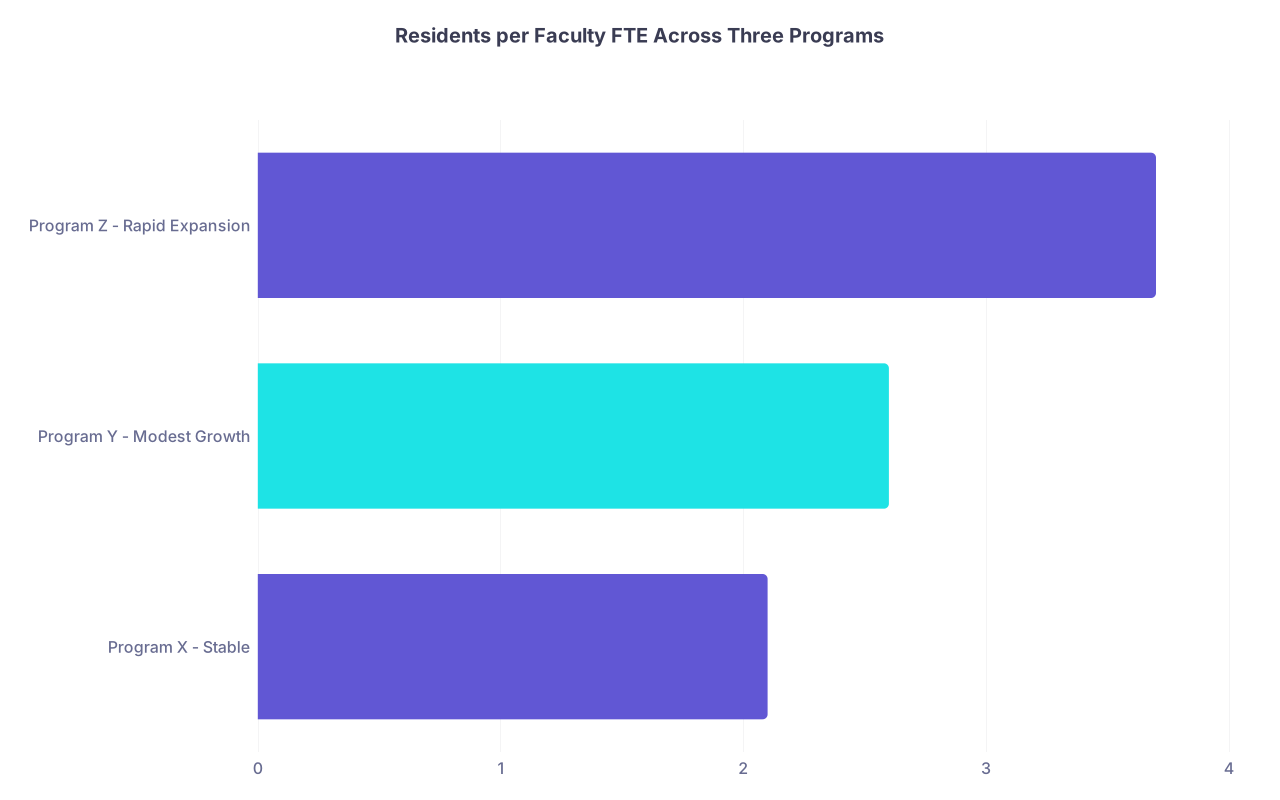
- Has residents per core faculty FTE >3.2 in a comprehensive specialty (IM, Peds, FM)
- Added a new major service (ICU, oncology ward, ED coverage) with residents taking primary call in the first 1–2 years of that service
- Has total residents per 10,000 discharges above the 75th percentile for comparable programs
…you are likely looking at overstretch, not healthy growth.
| Category | Value |
|---|---|
| Program X - Stable | 2.1 |
| Program Y - Modest Growth | 2.6 |
| Program Z - Rapid Expansion | 3.7 |
Program Z is where you start to see late‑note documentation at midnight, attendings signing out to each other while residents still round, and residents saying, “We never see our PD on the wards anymore.”
6.2 Qualitative Corroborators
Overlay the numbers with observed behavior:
- Residents cannot agree on how many people are in their class (“I think we have 21? Or 22? They just added two prelims.”) → chaotic growth
- Faculty look surprised or a bit defensive when asked about expansion (“Administration wanted more coverage… we are still adjusting.”)
- PDs label growth as an “opportunity” but cannot show you a restructured curriculum or new educational offerings that came with it
If the quantitative story and the qualitative story do not match, trust the numbers and the lived experience of current residents, not the talking points.
7. How To Interrogate Expansion Without Sounding Confrontational
You do not need to go full auditor on interview day. But you should ask targeted, data‑oriented questions.
Examples that reveal a lot:
- “How has the class size changed in the last 5 years, and what came with that change in terms of faculty and rotations?”
- “With the new expansion, what has happened to typical ward census per intern?”
- “Have duty hours or the number of call / night blocks changed with the increased class size?”
- “How many core teaching faculty are there now, and what was that number 3 years ago?”
- “What specific educational opportunities became possible because of the expansion?”
Good programs can answer with numbers and structure: “We went from 10 to 14 interns, added 3 clinician‑educators and a community hospital site, dropped max intern census from 14 to 10.”
Weak programs answer with vibes: “More residents means more flexibility. We are still figuring out the details.”
You know which answer you want.
8. The Future: Expansion Will Continue. Your Screening Has To Get Smarter.
Here is the uncomfortable macro‑trend: the pressure to expand GME will increase, not decrease.
- Physician shortages in multiple specialties
- Hospital systems consolidating and seeking cheaper labor
- Political pushes to fund more residency slots, often without strict guardrails on educational quality
So you will see more programs advertising “growth.” Many will be genuine opportunities. Too many will be thinly disguised coverage fixes.
Your edge will not come from memorizing every red‑flag list on the internet. It will come from doing what most applicants never do: thinking like an analyst.
Take their numbers. Compute the ratios. Match those against what residents actually say about workload, supervision, and burnout. Separate marketing narratives from capacity realities.
Programs can claim anything they like. The data shows what is sustainable.
Once you train yourself to see that, you will not just pick a residency that “sounds good.” You will pick one where growth means better training, not being the extra cog in an overstretched machine.
With that lens in place, you are ready for the next step: not just identifying red flags, but comparing “good” programs quantitatively to find the best fit for how you learn and live. That, however, is a different analysis entirely.