
The most dangerous residency programs do not look dangerous on paper—until you run the numbers on resident‑to‑faculty ratios.
Why Resident‑to‑Faculty Ratios Matter More Than Brochure Buzzwords
Every residency website promises “strong clinical volume” and “robust teaching.” That language is meaningless without numbers. The single metric that often exposes whether those claims are believable is the resident‑to‑faculty ratio.
I am not talking about the glossy “we have 150 faculty” line you see on slide decks. I am talking about:
- How many core faculty are actually responsible for resident education and supervision.
- How many residents those faculty have to cover, across clinics, wards, ORs, and call.
- Whether those ratios are remotely consistent with safety and the capacity for real teaching.
The data from large specialties tells a clear story: when programs push resident‑to‑faculty ratios beyond certain thresholds, you reliably see the same pattern—thinner supervision, more service work, and weaker outcomes.
Let’s quantify that.
What The Data Shows Across Major Specialties
Public, standardized numbers are imperfect, but there is enough data from ACGME reports, NRMP program characteristics, and specialty organizations to sketch reasonable ranges.
Below is a synthesized snapshot of typical resident‑to‑core‑faculty ratios for medium‑to‑large programs in common specialties. These are ballpark aggregates, not values for a specific institution.
| Specialty | Residents per Core Faculty (Typical Range) | Red-Flag Zone (Residents per Core Faculty) |
|---|---|---|
| Internal Medicine | 1.5 – 2.5 | > 3.0 |
| General Surgery | 1.0 – 1.8 | > 2.2 |
| Pediatrics | 1.5 – 2.3 | > 3.0 |
| Emergency Medicine | 1.8 – 2.8 | > 3.2 |
| Anesthesiology | 1.2 – 2.0 | > 2.5 |
Programs that sit at or slightly above these ranges can still be fine if they are well organized and have strong advanced practice support. But once you cross into the “red‑flag zone,” the same problems start appearing with remarkable consistency.
To visualize relative intensity across specialties:
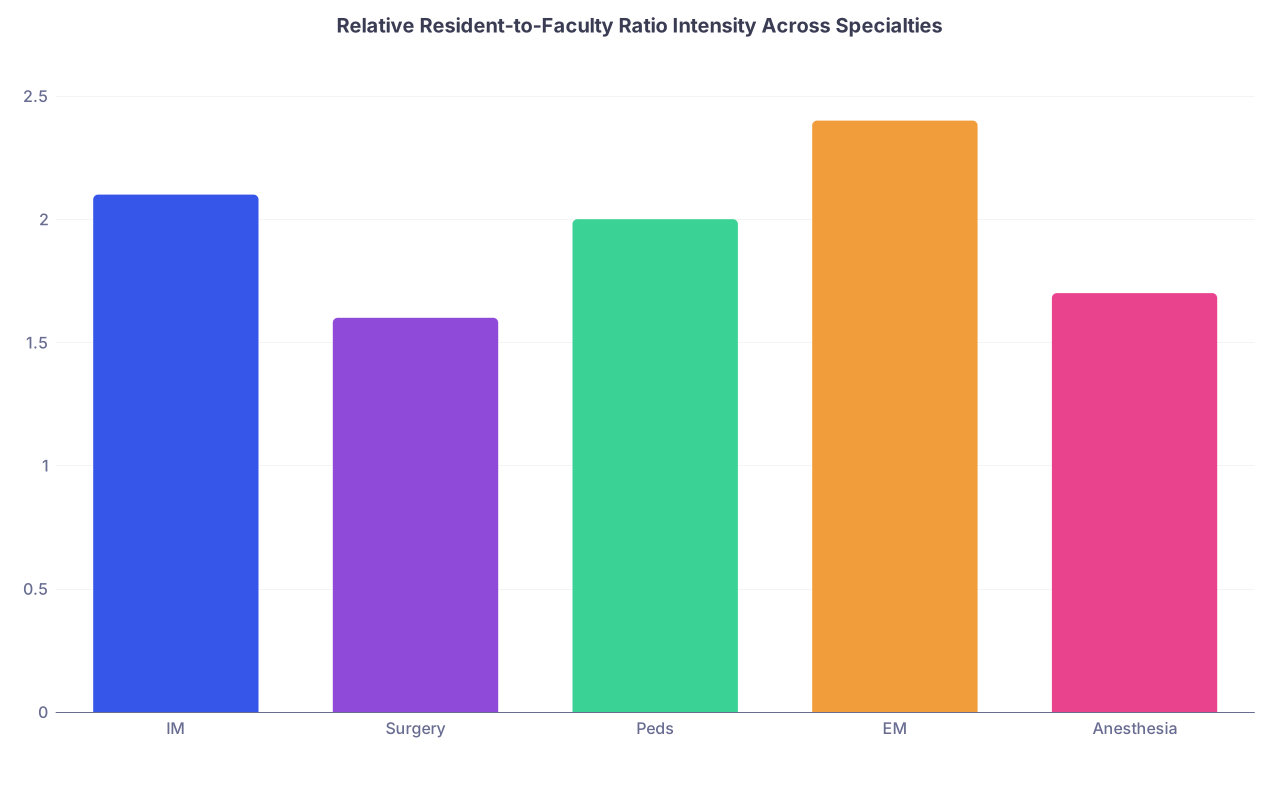
| Category | Value |
|---|---|
| IM | 2.1 |
| Surgery | 1.6 |
| Peds | 2 |
| EM | 2.4 |
| Anesthesia | 1.7 |
Internal medicine and emergency medicine typically run the highest ratios because of scale and coverage needs. General surgery and anesthesiology tend to keep ratios tighter because of procedure‑driven supervision requirements.
The key takeaway: a 2.4–2.6 ratio means very different things in EM versus in surgery. You cannot read the raw number without context.
How To Actually Calculate The Ratio (And Not Get Fooled)
Most applicants calculate this wrong. They divide “total residents in program” by “total faculty listed on website.” That is garbage data.
You need three clarifications:
Count core faculty, not everyone with a title.
Many institutions list research‑only PhDs, part‑time volunteer faculty, or people peripherally involved. They do not supervise your night float.Use program‑level numbers, not department‑wide.
Example: Department of Medicine may have 200 “faculty,” but only 35 are truly core IM residency faculty across inpatient and continuity clinic.Normalize to FTE (full‑time equivalent) when possible.
A 0.2 FTE clinician‑educator should not be counted the same as a full‑time ward attending.
The simplified formula that still gives you useful signal:
Resident‑to‑Faculty Ratio ≈ Total Residents in Program ÷ Number of Core Clinical Faculty
If you can get FTE data (often hinted at in ACGME reports, sometimes in program slides), use:
Adjusted Ratio ≈ Total Residents ÷ (Sum of Faculty FTE for Clinical + Teaching)
Let me make this concrete with a scenario I have actually seen in interview season:
- 60 IM residents (20 per year)
- Website claims “over 80 faculty.”
- Detailed slide deck lists 26 “core faculty” for inpatient/clinic; the rest are research or affiliate preceptors.
Your naive ratio: 60 / 80 = 0.75 (looks amazing, right?).
Your real ratio: 60 / 26 ≈ 2.3 (very average, nothing special).
That is the kind of numerical mirage you are up against.
Where Ratios Start To Look Unsafe
There is no universal hard cutoff, but pattern recognition across programs is blunt: once you push above certain thresholds, supervision and education degrade.
Here is a practical rule‑of‑thumb framework, using internal medicine as an anchor and adjusting by specialty.
Internal Medicine (categorical IM)
1.5–2.0 residents per core faculty:
Comfortable. You typically see attendings who know residents by name, sustainable team caps, and actual bedside teaching.2.1–2.8:
Heavy but manageable. Residents work. Teaching depends heavily on culture and schedule design.≥ 3.0:
High risk. The probability that residents are functioning as largely unsupervised service workers goes up sharply.
General Surgery
Because of case‑based education and procedural oversight requirements, safe ratios are lower.
1.0–1.5:
Strong. 1:1 or 2:1 resident‑attending environments in the OR are common.1.6–2.2:
Pushing it. Usually manageable only if there is an army of fellows and mid‑levels smoothing the workflow.2.2:
Big red flag. This often shows up as residents stacking cases with limited attending presence, or a single attending trying to staff too many rooms.
Emergency Medicine
Coverage and volume drive higher ratios, but there is a ceiling.
1.8–2.4:
Normal for busy EM programs.2.5–3.0:
High but sometimes necessary in high‑volume shops with strong ancillary support.3.2:
Concerning, especially if combined with multiple “off‑service” shifts and thin faculty presence overnight.
To anchor the threshold visually:
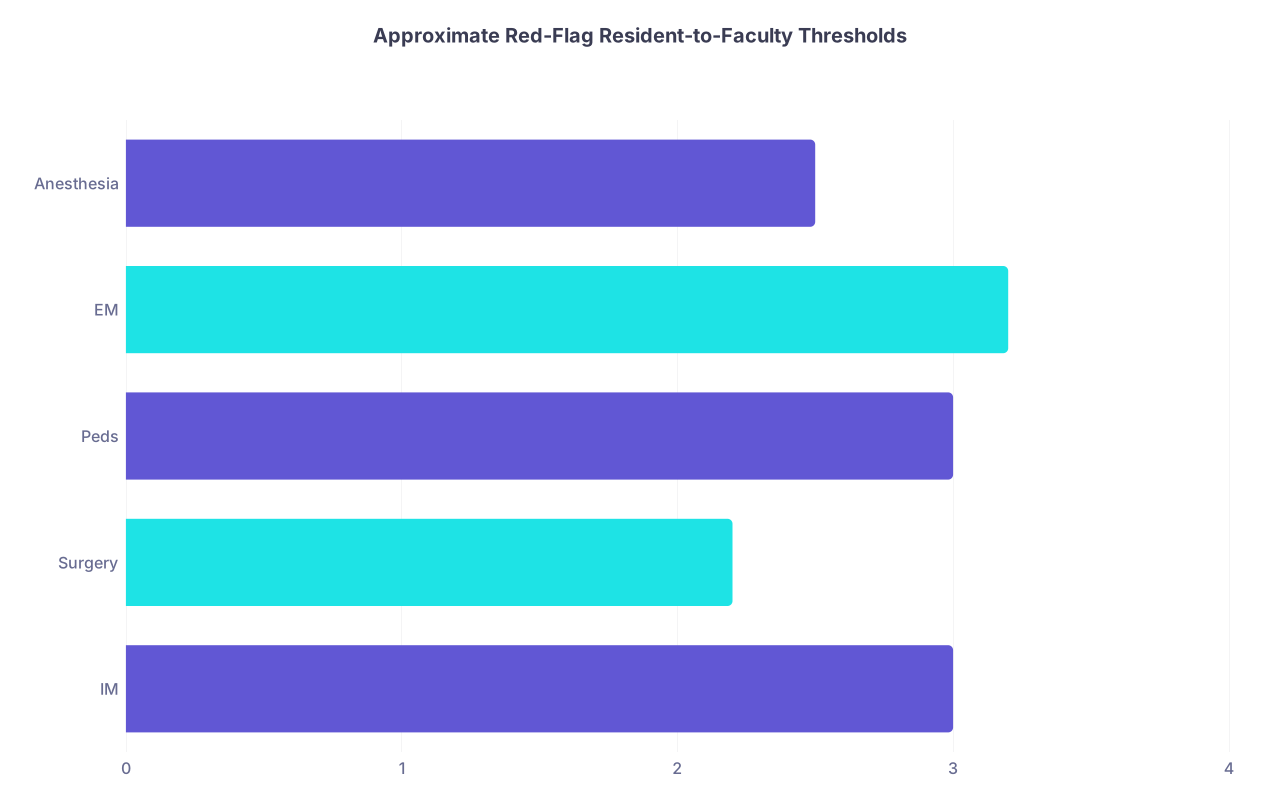
| Category | Value |
|---|---|
| IM | 3 |
| Surgery | 2.2 |
| Peds | 3 |
| EM | 3.2 |
| Anesthesia | 2.5 |
Once a program’s ratio passes its specialty‑specific red‑flag threshold, you should be demanding explanations.
Ratios, Supervision, And Safety: The Causal Chain
The ratio itself does not harm patients. The downstream effects do.
At high resident‑to‑faculty ratios, three predictable shifts occur:
Indirect supervision increases.
Attendings cover more patients and more teams, so more decisions are made without real‑time attending input. On paper, supervision might meet ACGME minimums. In practice, it can be paper‑thin.Teaching time per resident collapses.
There are only so many teaching minutes in a day. If a faculty member has to precept 10 residents in clinic instead of 4, the average feedback per resident plummets. You feel this as “no feedback” and “I am just churning notes.”Residents absorb system inefficiencies.
When faculty cannot pick up slack, residents become the pressure release valve: boarding patients, chasing consults, doing clerical work, covering phantom FTE gaps.
I have watched this play out in a midsize community IM program that expanded residents from 36 to 60 over a few years without a proportional faculty increase. The numbers shifted from about 1.7 to 2.8 residents per core faculty. On the ground, residents started reporting:
- Attendings covering two inpatient teams instead of one.
- “Teaching” rounds converted to rapid dispo rounds.
- Continuity clinic precepting where attendings saw notes more than they saw patients.
None of that showed up on the website. The ratio told you it was coming.
When “Big Program” Starts To Mean “Bad Ratio”
Large programs are not inherently bad. But they are structurally prone to ratio creep.
Let’s do some quick math.
Say an internal medicine program has:
- 30 residents per year → 90 total.
- 35 core faculty FTE covering wards, ICU, night float, and clinic.
Ratio: 90 / 35 ≈ 2.6. High but maybe defensible if the program is well run.
Now the hospital wants more cheap labor and GME revenue. They expand to 36 per year (108 total) without solid faculty growth:
- 108 residents / 37 core faculty ≈ 2.9.
That 10–15% shift in ratio is not abstract. It means:
- Each attending now precepts more clinic sessions or more residents per session.
- Coverage models stretch (e.g., one attending for two busy services at night).
- Marginal cases for calling the attending or for double‑checking a plan may not get the attention they deserve.
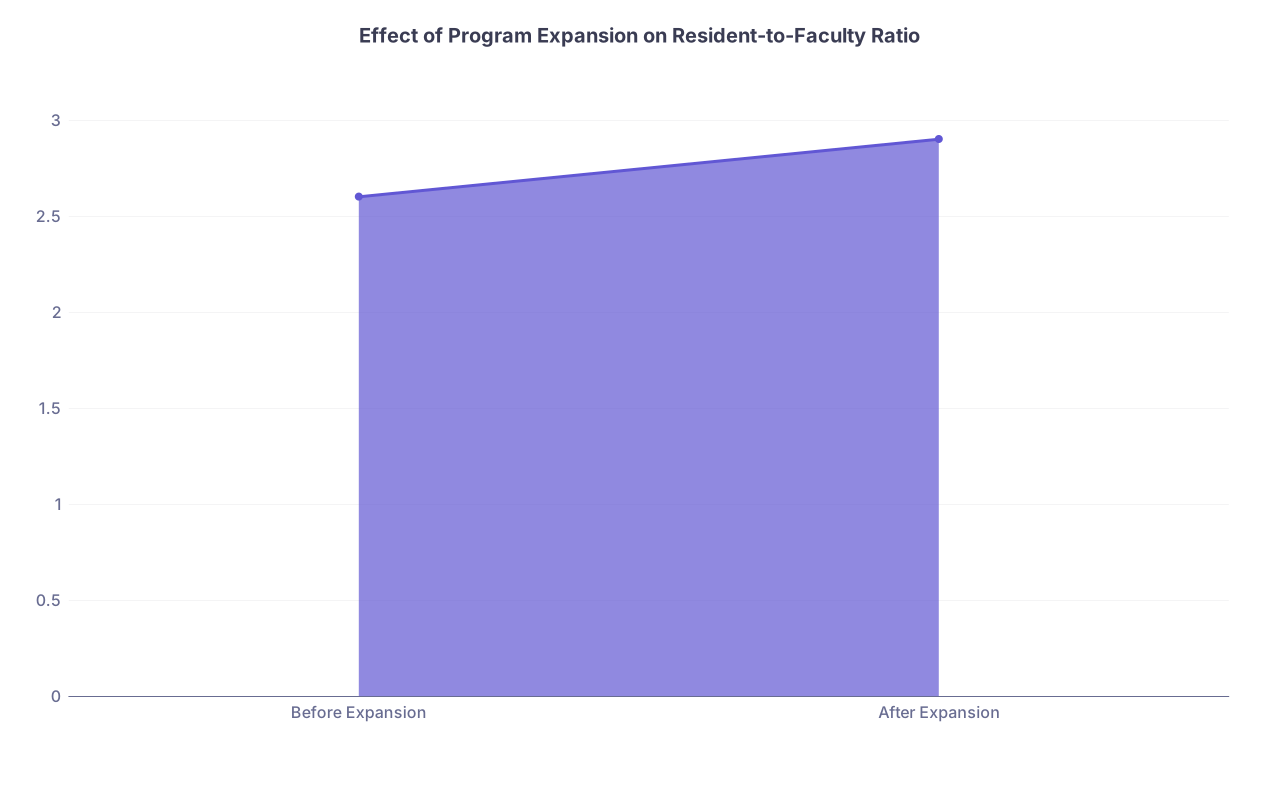
| Category | Value |
|---|---|
| Before Expansion | 2.6 |
| After Expansion | 2.9 |
The graph is simple. The lived effect is not.
If a program is expanding aggressively and you do not hear:
- Detailed plans for new faculty hiring, and
- Clear redesign of rotations to avoid overloading existing attendings,
assume the ratio is about to tilt in the wrong direction.
Hidden Complicating Factors The Ratio Does Not Capture
The number alone is not everything. Some programs “earn” a slightly higher ratio; others fail even with decent numbers. You have to adjust for at least five factors.
1. Fellows And Advanced Practice Providers
Fellows can cut both ways. They:
- Provide another layer of supervision and procedural guidance.
- But can also crowd residents out of cases.
From a pure workload lens, a strong fellow presence can partially offset a high ratio because residents are not alone in the trenches. From an educational lens, it depends on how fellows are integrated.
Nurse practitioners and PAs are similar: they can either:
- Absorb non‑educational scut and stabilize teams, or
- Be used to replace resident ownership while residents run the leftovers.
2. Case Mix And Acuity
A 2.5 ratio in a low‑acuity, high‑throughput community clinic‑heavy program is not the same as 2.5 in a quaternary referral ICU‑heavy program.
Higher acuity amplifies the cost of thin supervision. You need attendings heavily engaged in decision‑making, not just signing notes.
3. Schedule Architecture
The same ratio can feel brutal or manageable depending on schedule design:
- Night float vs 24‑hour calls.
- Number of simultaneous teams an attending covers.
- Use of caps vs open‑ended census.
Programs that are serious about safety usually have explicit caps and clear redistribution plans when caps are reached. If ratios are high and caps are vague, expect trouble.
4. Non‑Clinical Faculty Time
Faculty with protected time for teaching, curriculum development, and simulation contribute more to education than someone jammed with clinics.
Two programs can both list “30 faculty.” In one, 10 are true clinician‑educators at 0.6–0.8 clinical FTE. In the other, everyone is 1.0 clinical FTE and teaching is “whenever you can.”
The headcount is the same. The effective teaching capacity is not.
5. Culture Of Accessibility
There are programs with mediocre ratios that function safely because faculty are reachable, humble, and invested. Residents are encouraged to call. There is psychological safety around saying “I am not sure.”
And then there are programs boasting “we trust our residents to be autonomous” which is often code for “we are under‑staffed and you are on your own.”
Ratios tell you the structural risk. Culture tells you how often that risk turns into harm.
How To Extract Real Numbers On The Interview Trail
You have limited time and a lot of spin aimed at you. You need specific, data‑oriented questions.
Here is how you get closer to the truth without sounding like you are auditing them.
Ask the PD or chair:
- “How many core clinical faculty are dedicated to this residency (not counting pure research faculty)?”
- “Have resident numbers changed in the last 5 years? How has faculty FTE changed alongside that?”
- “For a typical inpatient block, how many residents is one attending supervising at a time?”
Then ask residents privately:
- “Do you feel attendings have time to teach on rounds, or is it mostly dispo and paperwork?”
- “How many patients are you personally managing on a heavy ward day?”
- “In clinic, how many residents share a single preceptor per half‑day?”
If you hear numbers like:
- One attending covering 16–20 resident‑managed patients across two teams.
- Clinic precepting ratios of 6–8 residents per preceptor regularly.
- Residents managing >14 complex inpatients consistently with minimal direct attending review.
You are seeing the downstream consequences of unfavorable ratios.
A very simple decision flow can help you categorize what you are hearing:

| Step | Description |
|---|---|
| Step 1 | Estimate residents per year |
| Step 2 | Ask about core faculty count |
| Step 3 | Compute rough ratio |
| Step 4 | Ratios likely acceptable |
| Step 5 | Probe residents on supervision and teaching |
| Step 6 | High risk program |
| Step 7 | Moderate concern but context dependent |
| Step 8 | Above specialty red flag? |
| Step 9 | Residents report thin coverage? |
You do not need exact decimal precision. Back‑of‑the‑envelope is enough to tell you whether you are in the safe band or in the danger zone.
Resident‑to‑Faculty Ratios And The Future Of Training
Here is the uncomfortable part. System pressures are pushing ratios in the wrong direction nationally.
Hospitals see:
- Residents as cost‑effective labor.
- Faculty as expensive fixed costs.
- GME expansion as politically popular.
Without strict enforcement, that combination pushes toward:
- More residents.
- Slower growth in core faculty.
- Higher ratios.
Over the next decade, I expect three trends unless regulators and accrediting bodies become more aggressive:
Continued expansion of residency positions without proportional faculty growth.
Especially in IM, FM, and EM, where “community need” and “workforce shortage” are used to justify trainee expansion.Increased reliance on fellows and APPs to backfill supervision gaps.
That will mask some ratio problems on paper while introducing new tensions over who gets the most educational cases.Greater variability across programs.
Top‑tier academic centers will maintain healthier ratios with protected educator tracks. Resource‑strained hospitals will quietly push ratios past safe thresholds.
There is an opportunity here for smarter regulation: explicit maximum resident‑to‑faculty ratios by specialty, adjusted for acuity and case mix, with real consequences for violations. ACGME has some guidance, but enforcement is often lagging and reliant on self‑report.
Until someone forces more transparency, applicants and residents have to run their own numbers.
Red Flags You Should Not Ignore
Let me condense this into actionable signals. You are looking for a pattern, not a single data point.
The numbers look unsafe when you see combinations like:
Resident‑to‑core‑faculty ratios above:
- ~3.0 in IM or pediatrics,
- ~2.2 in general surgery,
- ~3.2 in EM,
- ~2.5 in anesthesia.
Recent expansion of resident class size without explicit, quantified faculty additions.
Residents describing:
- Little to no attending teaching on rounds.
- Precepting ratios of 6+ residents per faculty in clinic.
- Attendings regularly covering multiple teams or OR rooms simultaneously.
Websites or PDs bragging about “massive clinical volume” and “autonomy” while being vague about how many faculty actually staff that volume.
If 2–3 of those are present, the safe interpretation is that the structural supervision capacity is being stretched.

The Bottom Line
Three points, no fluff:
Resident‑to‑faculty ratios are one of the clearest structural markers of whether a program can safely supervise and meaningfully teach its residents. Ignoring them is a mistake.
The raw faculty headcount on a website is almost always misleading. You care about core clinical faculty FTE relative to total residents, adjusted by specialty‑specific thresholds.
When ratios drift beyond those thresholds and you hear matching stories of thin supervision and minimal teaching, you are not looking at “autonomy.” You are looking at a red‑flag program betting your education and patient safety against its staffing ratios.