
The most dangerous residency red flag is not drama on Reddit. It is bad numbers on board exams.
If you ignore everything else in a program’s marketing, you should not ignore their board pass data. Because unlike vibes, logos, or tour-day hospitality, board outcomes are measurable, comparable, and tightly linked to your future earning power and subspecialty options.
Let me walk through what the data actually say, and where the hard quantitative thresholds sit between “healthy,” “concerning,” and “this program is gambling with your career.”
1. Why Board Pass Rates Are a Hard Red Flag
Programs can spin almost anything. “Growing program.” “New leadership.” “Curriculum in transition.” I have heard every euphemism. Board pass data are much harder to spin because:
- They are reported to accrediting bodies (ABIM, ABFM, ABS, ABEM, etc.).
- They are typically averaged over multiple years.
- They correlate with program culture, didactics quality, supervision, and how seriously leadership takes resident education.
From a numbers perspective, there are three reasons board pass rates matter:
- They are a leading indicator of whether residents are getting adequate teaching and exam prep.
- They are a proxy for overall program organization and stability. Disorganized, chaotic programs show it here.
- They directly affect fellowship competitiveness and sometimes even job opportunities in saturated markets.
The data pattern is very consistent: programs with chronically low board pass rates rarely have just that one problem. You usually see the same cluster:
- Poor in‑training exam performance.
- High resident burnout and attrition.
- Weak academic support (no protected board study time, minimal remediation).
So yes, this is a core red flag category, not a side detail.
2. Key Thresholds: What Percent Should Worry You?
You need numbers, not adjectives. Let’s define them.
Across major specialties, the national first‑time board pass rate for US allopathic graduates usually sits in the:
- 85–95% range for most core specialties.
- 90–98% range for some high-discipline fields (e.g., dermatology).
- 80–90% for a few notoriously difficult exams, depending on year and candidate mix.
Residency Review Committees (RRCs) and ABMS boards monitor programs’ 3‑year rolling first‑time pass rates, not just single-year noise. That is exactly how you should look at them as an applicant.
Here is a rough quantitative classification you can actually use.
| 3-Year First-Time Pass Rate | Interpretation | Risk Level |
|---|---|---|
| ≥ 95% | Strong performance | Low risk |
| 90–94% | Solid, at or above national | Acceptable |
| 85–89% | Below strong, watch closely | Mild concern |
| 80–84% | Consistently weak | Significant risk |
| < 80% | Likely under ACGME scrutiny | Major red flag |
Let me be blunt:
- A 3‑year first‑time pass rate under 85% is a yellow-to-red flag for most mainstream specialties.
- Under 80% is a structural problem, not bad luck. Programs living there either are already on probationary radar or will be.
You can adjust a few points up or down for very small programs (n=2–3 per year) where one failure swings the percentage massively. But once you are looking at ≥5–6 residents per year, the percentages start to mean what they say.
3. Specialty Differences: Context Matters, But Not That Much
You will hear this excuse: “Our exam is just harder this cycle.” Sometimes true. But relative to national means, the thresholds still hold.
Let’s map this with a simplified example for three core specialties.
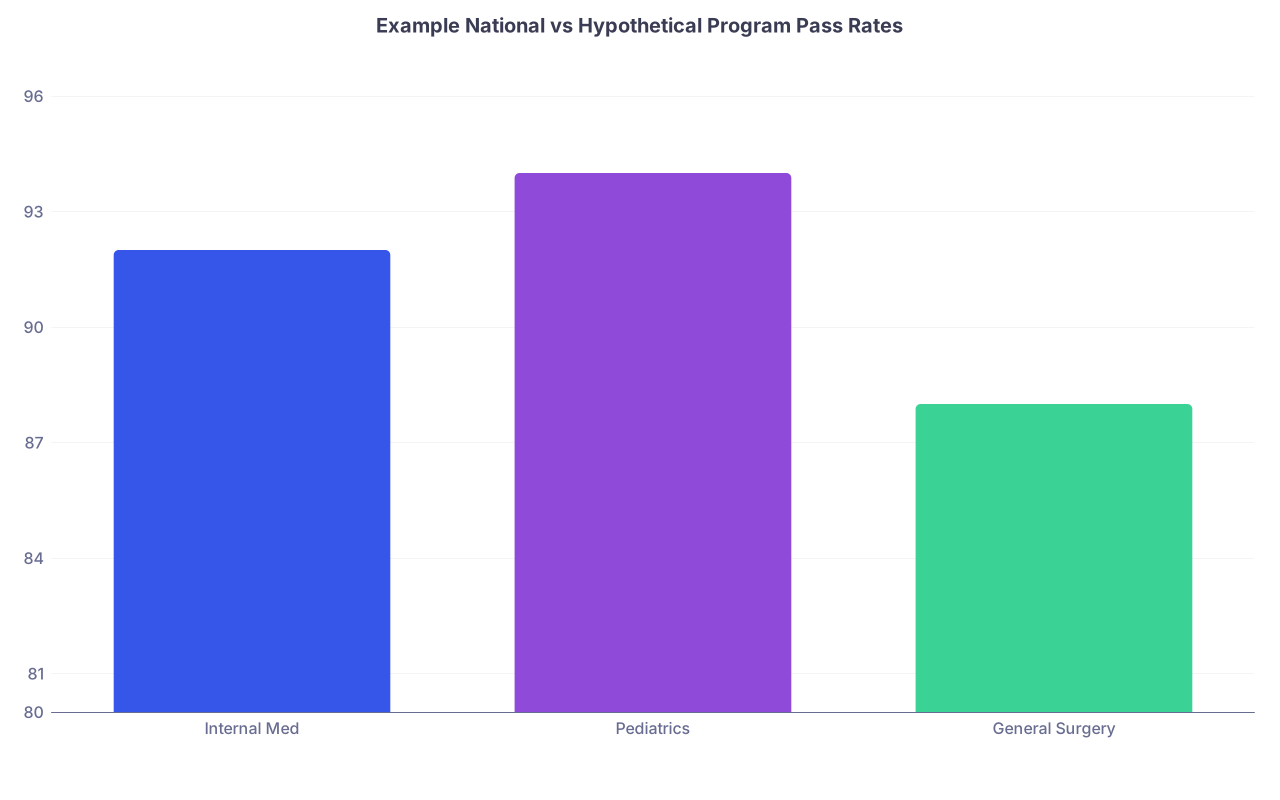
| Category | Value |
|---|---|
| Internal Med | 92 |
| Pediatrics | 94 |
| General Surgery | 88 |
Imagine:
- National 3‑year pass rates:
- Internal Medicine (ABIM): ~92%
- Pediatrics (ABP): ~94%
- General Surgery (ABS QE): ~88%
Now imagine a program with:
- IM pass rate: 82%
- Peds pass rate: 85%
- Surgery pass rate: 76%
Even after “our exam is hard this year” adjustment, those are materially below national means. You cannot explain a 10+ point deficit by test difficulty alone. That is curricular or cultural.
So yes, check the national baseline for the exact exam and year. But do not let anyone talk you into believing that a chronic 10–15 point gap vs national is “noise.”
4. The Time Dimension: One Bad Year vs Chronic Risk
The data show something important when you stretch the timeline out: programs do not suddenly go from stellar to terrible (or vice versa) in one exam cycle. Trends matter.
A healthy pattern looks like this:
- Year 1: 100%
- Year 2: 92%
- Year 3: 95%
- Year 4: 90%
- Year 5: 95%
A risky pattern:
- Year 1: 92%
- Year 2: 85%
- Year 3: 80%
- Year 4: 83%
- Year 5: 78%
If the program reports only “we’re at 90% over the last 5 years,” push for the year‑by‑year breakdown. They know it. They just are not volunteering it.
Here is what a stable vs deteriorating program trend roughly looks like.
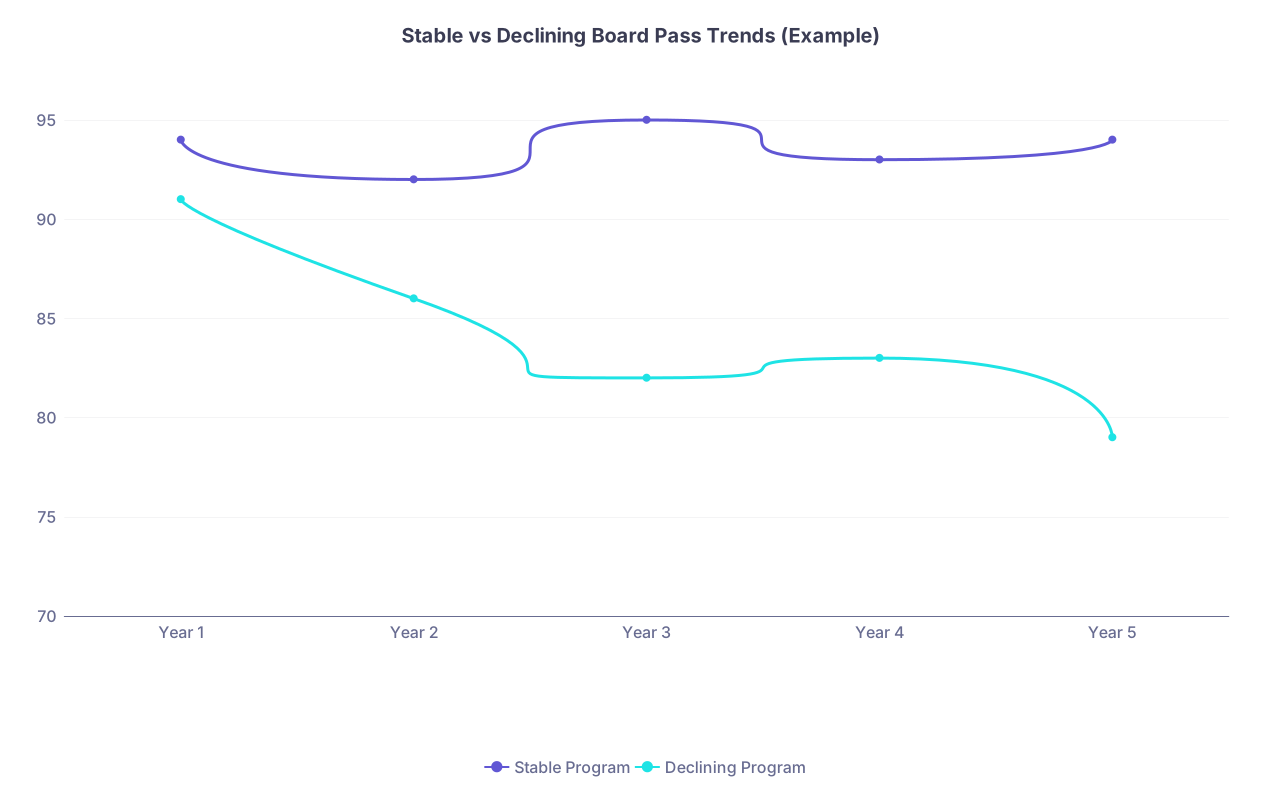
| Category | Stable Program | Declining Program |
|---|---|---|
| Year 1 | 94 | 91 |
| Year 2 | 92 | 86 |
| Year 3 | 95 | 82 |
| Year 4 | 93 | 83 |
| Year 5 | 94 | 79 |
If your interview day answer sounds like:
- “We had one rough year, but we implemented X, Y, Z and have been above national since.”
That is not a red flag. That is a program that reacted to data.
But if what you get is hand‑waving:
- “There were changes to the exam.”
- “Our residents are really clinically strong, they just don’t test well.”
Translated: the program does not own its outcomes. That cultural issue is just as bad as the raw numbers.
5. In‑Training Exam Data: The Canary in the Coal Mine
Most specialties have an in‑training exam (ITE) or annual in‑service:
- IM: ITE
- EM: ITE
- Surgery: ABSITE
- Anesthesiology: In‑Training Exam
- Pediatrics: In‑Training
These scores correlate reasonably with board outcomes. I have seen program dashboards where residents in the bottom 10–20th percentile on ITE had board failure rates 2–4 times higher than their peers.
Programs know this. Strong ones act on it. Weak ones shrug.
A few key quantitative signals:
- Is the median ITE percentile near or above the national median (50th)? Good.
- Are there multiple residents in the bottom decile with no clear remediation structure? That usually feeds straight into board failures.
- Is the program providing protected time to prepare for ITE and boards (e.g., 3–5 days of dedicated study time, structured reading schedule, question bank access)?
Some programs will show aggregated ITE data on interview day; many will not. You can still ask:
- “What is the typical ITE percentile range for your residents?”
- “For residents scoring below the 30th percentile, what structured support do you provide?”
If the response is vague or defensive, assume the data are not good.
6. Small Programs vs Large Programs: Interpreting Volatility
Sample size matters. A program graduating 3 residents per year is statistically noisy:
- 3/3 pass = 100%
- 2/3 pass = 67%
- 1/3 pass = 33%
That volatility does not mean the program is terrible. It means you cannot over‑interpret any single year. You need:
- A longer horizon (5–7 years).
- Context: leadership stability, didactics quality, ITE performance, resident narratives.
By contrast, a program graduating 12 residents per year:
- 1 failure = 92%
- 2 failures = 83%
- 3 failures = 75%
When you start seeing 80% or lower at that scale, the signal is robust. The likelihood that it is “just a bad cohort” drops sharply.
Here is a simple variance comparison.
| Class Size | 0 Failures | 1 Failure | 2 Failures |
|---|---|---|---|
| 3 | 100% | 67% | 33% |
| 6 | 100% | 83% | 67% |
| 12 | 100% | 92% | 83% |
| 20 | 100% | 95% | 90% |
So if a 3‑resident class had 2 failures one year, you should not panic based on that alone. But if the program hides behind “small size” after 5 consecutive years of sub‑85% performance, that is not statistics. That is mismanagement.
7. How to Fact‑Check Programs: Where the Numbers Live
You do not need to take anyone’s word for this. You can verify.
Sources vary by specialty and country, but for US programs common places include:
- Specialty board websites: Many list aggregate or even program‑level pass rates (e.g., ABIM has historically posted program data; some boards are more opaque).
- Program websites: They often cherry‑pick best years. That tells you something too—what they choose not to show.
- ACGME “ADS” data and RRC reports: Applicants do not have direct access, but persistent patterns (probation, withdrawal of accreditation) leak into the open via rumors, news, or NRMP lists.
- Word of mouth: Alumni and recent grads will bluntly tell you, “We had 3 people fail last cycle.”
On interview day or at a second look, you can ask explicitly:
- “What has your 3‑year rolling first‑time board pass rate been?”
- “How does that compare to the national average?”
- “What specific changes have you made in response to any dips?”
Be suspicious of any program that:
- Refuses to quote numbers.
- Throws out a single great year and ignores the prior bad years.
- Talks only in generalities (“strong,” “solid”) with no percentages.
Data‑driven programs are proud to show you their dashboards. Because they have nothing to hide.
8. Board Pass Rates and ACGME Risk: When It Gets Serious
Board performance is not just an internal metric. The ACGME and individual RRCs bake it into accreditation decisions. The details vary, but a common pattern looks like:
- Programs expected to meet or exceed national 3‑year first‑time pass rate OR maintain a defined minimum (often ~80% or similar).
- Failure to meet these benchmarks can trigger:
- Citations in accreditation letters.
- Requirements for action plans and progress reports.
- Probation or shortening of accreditation cycles for persistent non‑compliance.
Some RRCs have explicitly stated triggers like:
- “If the 3‑year rolling first‑time pass rate is below X% for Y consecutive years, the program may receive a citation or worse.”
You as an applicant may not see the RRC letter, but you will see the symptoms:
- Residents talking about “recent ACGME visits.”
- Leadership constantly referencing “working on our board performance.”
- Abrupt curriculum overhauls.
None of those are inherently bad if they are accompanied by improving numbers. The red flag is when you see constant churn with no measurable outcome shift.
9. The Resident‑Level Perspective: Your Personal Risk Calculation
Let’s make this personal. Assume you are a reasonably prepared US MD/DO student entering residency. Your individual baseline likelihood of passing boards on first try is already high.
Now compare two scenarios.
- Program A: 3‑year first‑time pass rate 95% (national is 92%).
- Program B: 3‑year first‑time pass rate 80% (national is 92%).
Rough interpretation:
In Program A, your failure risk is slightly lower than baseline, because:
- There is likely a strong culture of exam prep.
- Weak residents get early remediation.
- Didactics and ITE support are optimized.
In Program B, your failure risk is roughly double compared to national averages. Maybe more if you are not a natural test‑taker. You would be walking into:
- Less structured teaching.
- More service‑heavy, education‑light grind.
- Leadership that either cannot or will not fix the problem.
Failing boards is not a small inconvenience:
- It delays full licensure.
- It can limit jobs in competitive markets and block some fellowships.
- Some employers or groups will not touch non‑certified physicians.
So when you see a 3‑year 80% first‑time pass rate, do the mental math. You are trading a material increase in failure risk, often for marginal gains in other dimensions (location, perceived prestige, etc.). Sometimes that trade is worth it; often it is not.
10. Patterns that Often Co‑Travel with Bad Board Data
Board pass rates rarely exist in isolation. Statistically, they correlate with other program‑level variables.
From multi‑program datasets I have seen, low board pass programs often show:
- Higher resident attrition (people quitting or being non‑renewed).
- Lower scholarly output (few abstracts, weak QI culture).
- Poor ITE medians.
- Less protected didactic time (conferences constantly canceled for service needs).
Conceptually, you can think of it as a risk cluster.

| Step | Description |
|---|---|
| Step 1 | Low Board Pass Rate |
| Step 2 | Weak Didactics |
| Step 3 | Poor ITE Performance |
| Step 4 | High Service Load |
| Step 5 | Resident Burnout |
| Step 6 | Attrition and Remediation |
So when you pick up one red flag, look for the rest. If a program has:
- Board pass rates in the low 80s,
- Residents quietly complaining about no real teaching,
- And heavy service that eats all conference time—
You are not seeing three separate issues. You are seeing one integrated risk profile.
11. Applying a Simple Decision Framework as an Applicant
Let me give you a practical, numbers‑driven filter. It is not perfect, but it beats “I liked the free lunch.”
Start with the 3‑year first‑time board pass rate (if you can obtain it):
- ≥ 90%: No major concern by itself. Move on to other factors (fit, location, case mix).
- 85–89%: Ask pointed questions. Confirm trend direction. Not a dealbreaker, but this program has homework.
- 80–84%: This program is on your “caution” list. You need strong countervailing positives to justify ranking it highly.
- < 80%: Treat as a high‑risk choice. Rank only if you have very few alternatives or very strong personal reasons.
Then adjust slightly for:
- Program size (more leniency for tiny programs, but not infinite).
- Trend direction (is the curve going up or down?).
- Transparency and response when you ask about it.
You can mentally map your list like a risk chart.
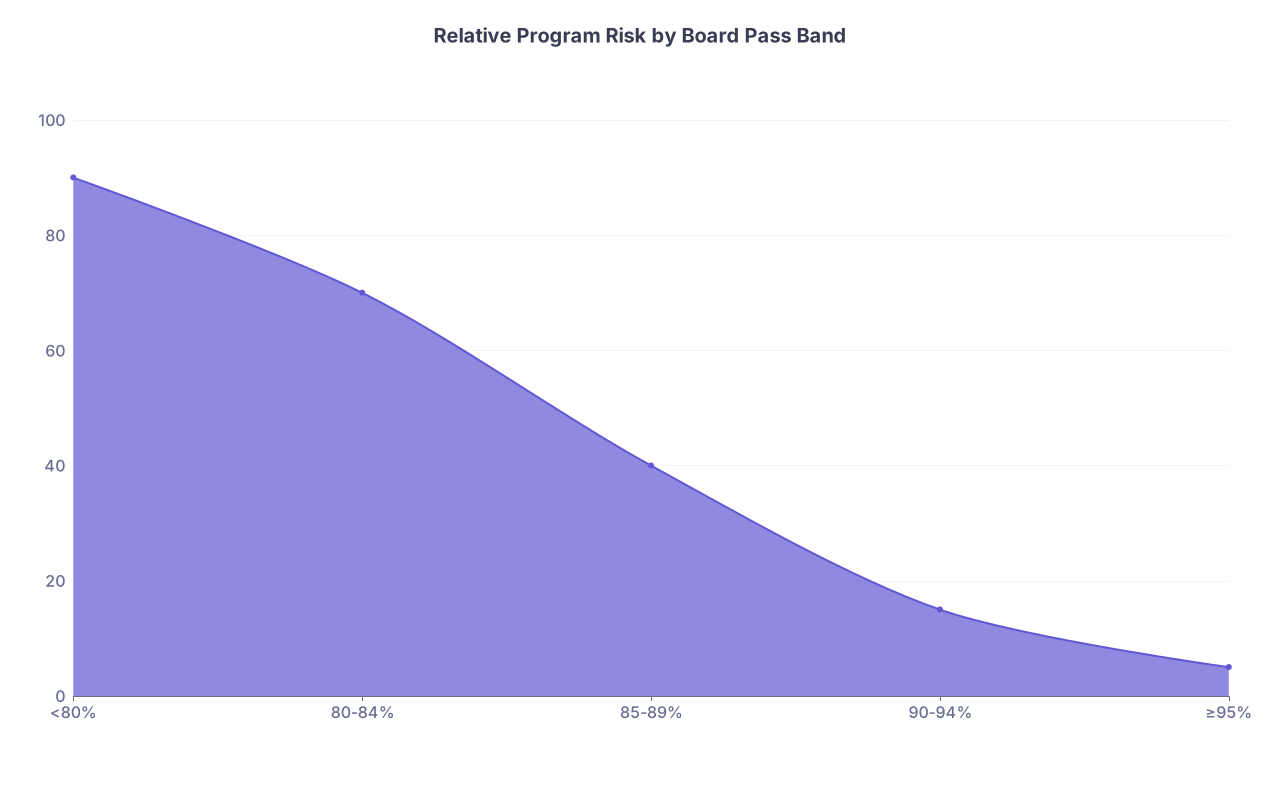
| Category | Value |
|---|---|
| <80% | 90 |
| 80-84% | 70 |
| 85-89% | 40 |
| 90-94% | 15 |
| ≥95% | 5 |
Interpretation: as you move from ≥95% to <80%, your relative risk of running into serious systemic issues (not just exam performance) escalates sharply.
12. The Future: How Board Data Will Shape Program Reputation
We are moving steadily into a more data‑transparent era.
Even if some boards still hide granular program outcomes, external pressure is rising:
- Applicants increasingly share pass rate rumors and screenshots on forums and social media.
- Some specialties are pushing for public reporting dashboards at the program level.
- Hospitals are more price‑sensitive; they want residents who will become certified attendings without costly delays.
My prediction: over the next decade, board performance will formally hard‑wire into:
- Program reputation scores that applicants actually use.
- Hospital system decisions about which programs to expand or shut down.
- Incentives for program directors tied partly to exam outcomes.
The programs that thrive will be the ones already behaving like data analysts: tracking their pass rates every year, stratifying by risk factors, and intervening early. The rest will keep saying “Our exam is just harder” right up until the ACGME arrives.
The Short Version
Three points you should carry into interview season:
- 3‑year first‑time board pass rates below ~85% are a real risk signal, not a rounding error. Below 80% is a major red flag unless you see clear, documented, sustained improvement.
- Trends and transparency matter almost as much as raw percentages. A program that owns a bad year and shows you its recovery plan is safer than a program that dodges questions with vague reassurances.
- Board data are a proxy for the entire educational ecosystem. Chronic underperformance usually means deeper issues in didactics, supervision, and culture. Ignore that at your own career’s expense.