
The programs that burn residents out the most rarely implode overnight. The data shows they unravel slowly over about five years—and the signals are sitting right in front of you if you know where to look.
Most applicants obsess over single-year stats: this year’s board pass rate, this year’s fill rate, this year’s Step cutoffs. That is a mistake. Any program can have a bad year. What exposes true program instability is trend analysis across a 5‑year window.
I am going to walk through the specific 5‑year changes that statistically correlate with “something is wrong here” at a residency. Not vibes. Not rumors. Numbers.
Why Five Years Is the Right Lens
Three years is often too short. Ten years is too long. Five years hits the sweet spot for residency programs:
- It captures at least one full cohort from intern to graduation.
- It spans multiple leadership cycles (PD, APD, chief residents).
- It smooths out random noise (a single bad board year, one unlucky match cycle).
Across specialties and programs, when you see a sustained negative direction over 5 years in multiple independent metrics, the odds of systemic problems go way up.
To make this more concrete, think of a program as a small ecosystem with inflows (applicants, funding, faculty) and outflows (graduates, attrition, reputation shifts). Healthy systems oscillate slightly around a baseline. Unstable ones show consistent directional drift.
We will focus on six key 5‑year trend domains:
- Match performance and applicant quality
- Board pass rates and exam performance
- Case volume, acuity, and clinical exposure
- Faculty stability and leadership turnover
- Resident outcomes: fellowship, jobs, and attrition
- Work environment signals: duty hours, remediation, and grievances
You do not need perfect data for all six. Three or more pointing south is usually enough to call it: this program is unstable.
1. Match Performance: The Canary in the Coal Mine
Programs can spin stories about “new leadership” or “restructuring.” The NRMP data is harder to spin.
There are three trend categories I look at over five cycles:
- Overall fill rate
- Proportion filled by US MD/DO seniors
- Proportion of applicants ranking the program highly (harder to get, but sometimes gleaned from program presentations or institutional brag slides)
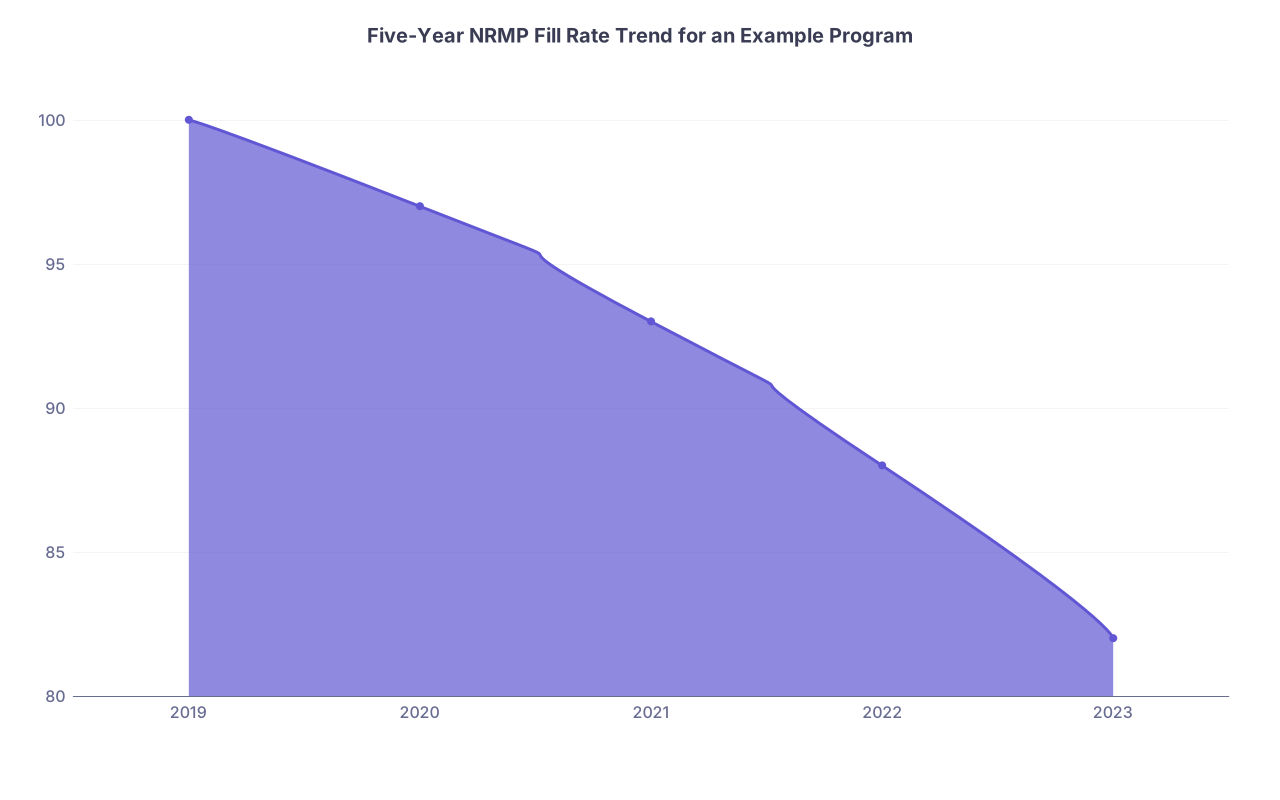
| Category | Value |
|---|---|
| 2019 | 100 |
| 2020 | 97 |
| 2021 | 93 |
| 2022 | 88 |
| 2023 | 82 |
A pattern like the chart above is not “random variation.” A drop from 100% to low‑80s fill, especially if coupled with a shift away from US seniors, strongly suggests the market is losing confidence in this program.
Red-flag thresholds over 5 years
When I evaluate match performance trends, these are my cutoffs:
- Drop in overall fill rate of ≥10–15 percentage points
- US MD/DO senior fill dropping from, say, 85–90% down to <60%
- Visible scramble/SOAP dependence in 2 or more of 5 years
If a previously solid program:
- used to be 95–100% filled with US seniors,
- now fills only 60–70% of spots with US seniors,
- and relies on SOAP or late matches for the rest,
the data is shouting that applicants with options are going elsewhere. That is not a fluke; that is revealed preference at scale.
How you detect this as an applicant
You are not going to get a perfect NRMP dataset for each program, but you can approximate:
- Program presentations that brag about “X% US seniors over the last five years.” If they stop showing these slides compared to older PDFs—why?
- Specialty-specific match data where some programs are repeatedly listed as SOAP-heavy.
- Alumni forums and Reddit posts that repeatedly mention “this program scrambled again.”
In a stable, respected program, the 5‑year line is flat or slightly up. If it is sloping down and accelerating, you are looking at program instability in action.
2. Board Pass Rates: Single-Year Dips vs Structural Decay
Every program gets the occasional small cohort that underperforms on boards. That is noise. The 5‑year pattern is signal.
You want to track:
- First-time pass rate each year
- Stability of performance relative to national mean
- Whether the program shows clear ownership and correction when a bad year occurs
Here is a simple comparison that comes up a lot.
| Pattern Type | Year 1 | Year 2 | Year 3 | Year 4 | Year 5 |
|---|---|---|---|---|---|
| Stable A | 100% | 95% | 100% | 95% | 100% |
| Declining B | 100% | 90% | 85% | 80% | 78% |
| Volatile C | 100% | 70% | 100% | 65% | 95% |
Pattern A is healthy. Some noise, but anchored near 95–100%.
Pattern B is structural decay. Consistently downward over multiple cohorts.
Pattern C is volatility, which is almost as concerning as a steady decline. It suggests chaos in teaching, evaluation, or resident selection.
Numerical red flags
I start to call a program unstable on boards when I see:
- ≥3 of 5 years below national average
- A drop of ≥15–20 percentage points from best to worst year with no clear recovery
- Multiple years with pass rates <80% without a coherent remediation plan
If a PD is hand-waving a 65–75% first-time pass rate as “just a bad year” but the trend shows they have had 3 “bad years” recently, that is not bad luck. That is a broken pipeline: didactics, supervision, study time, or selection criteria.
What to ask on interview day
You can uncover this without any fancy stats package:
- “What have your board pass rates been over the last 5 years?”
- “How do they compare to national averages?”
- “When you had a lower-performing year, what changes did you make, and did they work?”
Listen for specific numbers and specific interventions. If you are getting vague percentages (“we are usually in the 90s”) or zero concrete response to what they changed, the 5‑year trend is likely ugly.
3. Case Volume and Clinical Exposure: The Quiet Collapse
Clinical logs and case numbers tell you whether graduates will actually be competent. Over five years, declining volume is one of the most under-discussed red flags.
There are predictable causes:
- System mergers or service line closures
- Increased use of advanced practice providers taking resident cases
- Shifts in referral patterns (losing trauma designation, elective cases leaving, etc.)
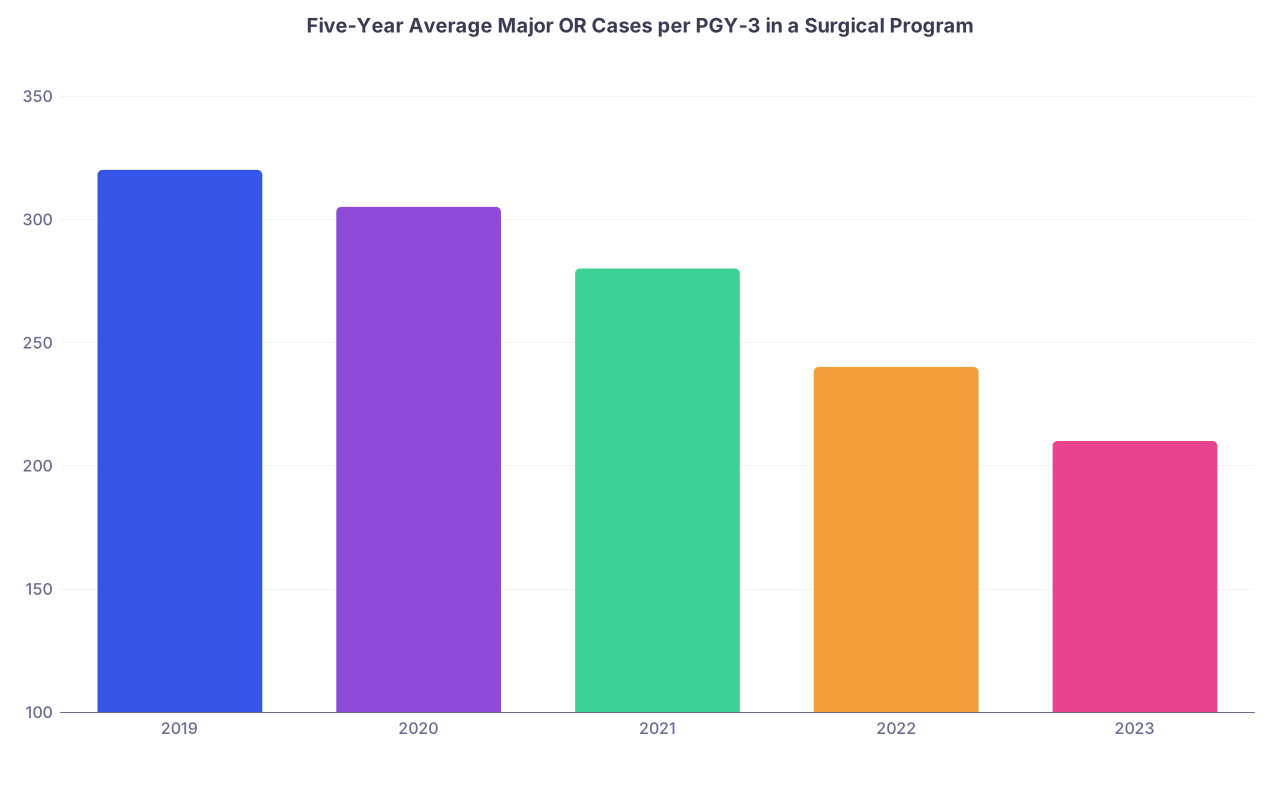
| Category | Value |
|---|---|
| 2019 | 320 |
| 2020 | 305 |
| 2021 | 280 |
| 2022 | 240 |
| 2023 | 210 |
A drop from ~320 to ~210 major cases per PGY-3 in five years is not minor. That is a 34% reduction in exposure.
Metrics that actually matter
For 5‑year trend analysis, focus on:
- Average total cases per resident per year in key categories
- Distribution—not just mean, but whether some residents are starved while a few get everything
- Changes in hospital designation: trauma level, transplant center status, volume of key services
Red flags over five years include:
- ≥20–25% sustained decline in core category volumes (e.g., endoscopy, deliveries, trauma cases)
- Residents reporting that “chiefs are fighting with fellows for basic cases now”
- New fellowship programs or APP expansion without clear resident case protection
When a program says, “We have introduced fellows in X,” your follow-up should be: “Can you show how resident case numbers have changed over the last 5 years since that started?” If they cannot, or dodge, assume the worst.
4. Faculty Stability and Leadership Turnover
You can think of faculty FTEs and leadership roles the way you think of stock volatility. Stable leadership = low variance. Instability = churn.
Two time series matter most:
- Number of core faculty over time
- Program leadership turnover: PDs, APDs, chiefs
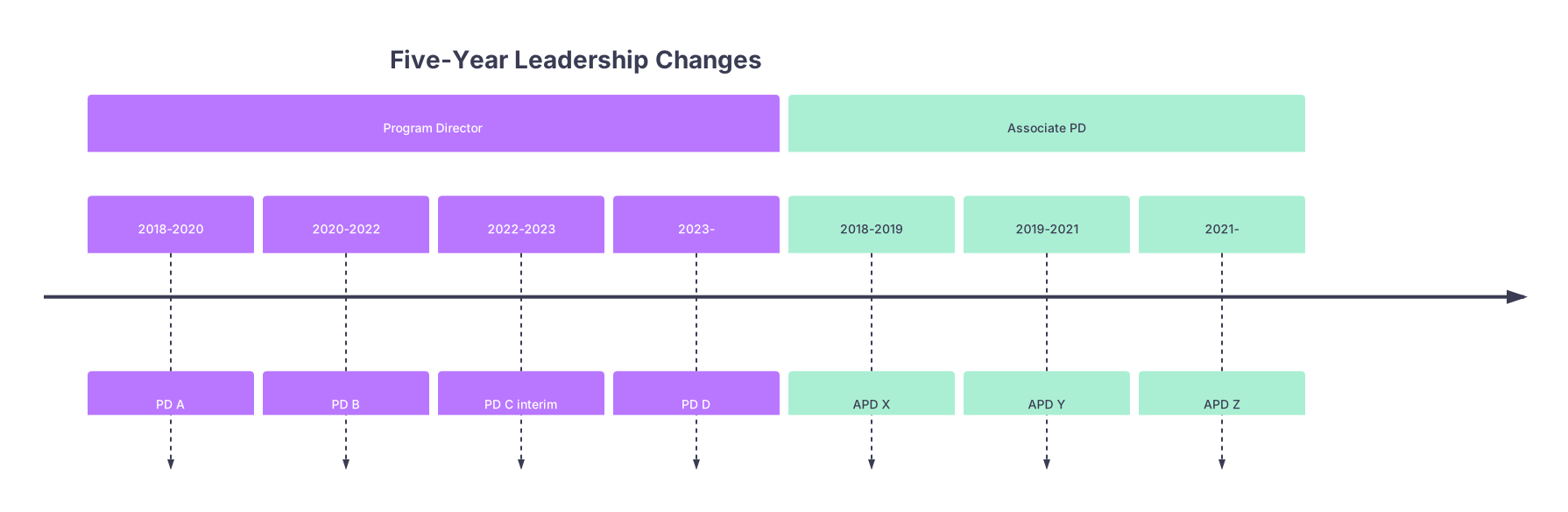
| Period | Event |
|---|---|
| Program Director - 2018-2020 | PD A |
| Program Director - 2020-2022 | PD B |
| Program Director - 2022-2023 | PD C interim |
| Program Director - 2023- | PD D |
| Associate PD - 2018-2019 | APD X |
| Associate PD - 2019-2021 | APD Y |
| Associate PD - 2021- | APD Z |
If you see a new PD every 1–2 years, that is not normal. That is chaos. Especially when paired with core faculty leaving and smaller teaching teams.
Quantifying the instability
Over five years, I get nervous when I see:
- ≥2 PD changes (with one being “interim”)
- ≥30–40% turnover in core faculty, particularly if senior educators leave
- Residents consistently referring to “new leadership” and “transition” every single year
Programs love to sell turnover as “fresh vision.” That excuse expires after the first PD change. When the third PD in five years is talking about “rebuilding culture,” you are walking into a rebuilding project, not a stable environment.
You can pick this up easily:
- Look at archived faculty lists on web caches (Wayback Machine) to quantify who has disappeared.
- Ask: “How long has the current PD been in role? How many PDs in the last 5–7 years?”
- Listen for the phrase “a lot of change recently” repeated by multiple residents.
The data pattern here is: frequent leadership changes + shrinking faculty count = program instability, nearly every time.
5. Resident Outcomes: Where Graduates End Up (And When They Do Not Finish)
Residents vote with their feet. Over five years, you want to see:
- Stable or improving fellowship match outcomes (for fellowships-heavy specialties)
- Strong job placements in desired geographic/clinical settings
- Low, stable attrition rates
When instability creeps in, the pattern shifts:
- Increasing proportion of graduates taking “whatever job they can find” instead of targeted positions
- Fellowship match lists that show a slide from top/mid-tier destinations to mostly low-visibility or unfilled plans
- Rising attrition: residents transferring out, switching specialties, or simply disappearing from lists
| Metric | Healthy 5-Year Pattern | Unstable 5-Year Pattern |
|---|---|---|
| Fellowship match rate | 80–90% and stable or improving | Dropping from 80% to 50–60% |
| Graduate job alignment | Majority in chosen setting | Many in “locum” or vague jobs |
| Attrition (any cause) | 0–1 resident every few years | 1–2 residents leaving almost yearly |
| Transfers out mid-training | Rare | Mentioned casually by multiple people |
If three cohorts in a row show unexplained missing names (“graduated 7 of 9”) or quiet departures, that is not bad luck. That is a pattern of residents deciding the pain is not worth it.
On interview day, ask very directly:
- “How many residents have left the program in the last 5 years, and for what reasons?”
- “Can I see a list of where your graduates have gone over the last several years?”
If they cannot produce lists, or they handwave that “a few people left for personal reasons” every year, the attrition trend is almost certainly non-trivial.
6. Work Environment: Duty Hour Violations, Grievances, and Remediation
You will rarely get clean numeric data for this bucket, but the trend still leaks out through language and anecdotes.
Signs of worsening environment over 5 years:
- Consistent mentions that “duty hour monitoring has gotten stricter” without any actual reduction in workload. Translation: more pressure to under-report.
- Multiple residents across different years referencing grievances, ombudsman, or GME involvement.
- A steady uptick in residents being placed on remediation or probation.
You can roughly model this as an unseen time series where you only observe the spikes (formal complaints, probation, resignations). If spikes are occurring every year or two instead of once a decade, that is a major red flag.
Here is the pattern I listen for comparing older vs newer residents:
- Seniors: “It used to be rough, but we had a good group and things felt manageable.”
- Interns/PGY-2s: “It is pretty bad now. We are working on fixing it. PD says change is coming.”
That contrast over just 3–4 years tells you the 5‑year trajectory.
Ask explicitly:
- “How frequently are duty hours violated? How has that changed over the last several years?”
- “How many residents have needed formal remediation over the last 5 years?”
If the answers are “never” and “almost none” but the residents look exhausted and guarded, assume under-reporting and institutional pressure. Your qualitative read is your substitute when the quantitative data is hidden.
Putting It Together: A Simple 5‑Year Instability Score
You do not need a PhD in biostatistics to synthesize this. You can build a mental scoring system.
For each category, rate the 5‑year trend as:
- 0 = Stable or improving
- 1 = Mild concern / unclear
- 2 = Clear negative trend
Categories:
- Match performance / fill pattern
- Board pass rates
- Case volume / clinical exposure
- Faculty and leadership stability
- Resident outcomes (fellowship/jobs/attrition)
- Work environment / duty hours / complaints
Total possible “instability score” = 12.
Here is how I interpret totals:
- 0–2: Likely stable. Normal noise.
- 3–5: Yellow flag. Needs deeper investigation and honest self-reflection about your risk tolerance.
- 6–8: High risk. Multiple independent data streams show slippage.
- 9–12: Program in active or impending crisis. You are gambling your training.
You will never have perfect data, but you will have enough partial data to know whether you are closer to 1 or 9. The point is not precision; it is direction.
How to Actually Collect Five Years of Data as an Applicant
This looks daunting, but the practical workflow is manageable.
Archive digging: Use the Wayback Machine to view old program websites and count:
- Faculty names by year
- Resident class sizes
- Published board pass rates or “100% for X years” claims that suddenly vanish
NRMP and specialty organizations:
- Look at SOAP numbers and fill charts year by year.
- Track which programs repeatedly show up on “scramble” lists or have unfilled positions.
Program materials:
- Ask for 5‑year board pass data in writing.
- Ask to see recent graduate placement lists since 2019.
Resident interviews:
- Ask older vs younger residents the same historical questions and compare narratives.
- Listen for changes: “It used to be…” vs “Now it’s…”
It takes maybe 30–60 minutes of focused work per program. For a place you are going to spend 3–7 years of your life, that payoff is enormous.
The Biggest Mistake: Ignoring the Slope
Most applicants focus on snapshot values:
- “The board pass rate last year was 88%. That is okay, right?”
- “They filled all their spots this year, so they must be fine.”
What matters more than the level is the slope.
A program going from 70% to 88% boards over 5 years with a new PD and documented education reforms is a good risk. A program drifting from 100% down to 88% with no clear explanation is a bad risk.
Same board number. Completely different five‑year story.
When you zoom out and look at five years, you stop being surprised by “sudden” program collapses. The data was screaming long before the reputation caught up.
Your leverage as an applicant is simple: go where the trends are aligned with your future self, not your fear of not matching. You are not just choosing a brand. You are choosing a trajectory.
With that quantitative lens in place, you are ready for the next step: combining these objective instability trends with your subjective fit and career goals. That synthesis—data plus gut—is where the best decisions get made. But that is a discussion for another day.