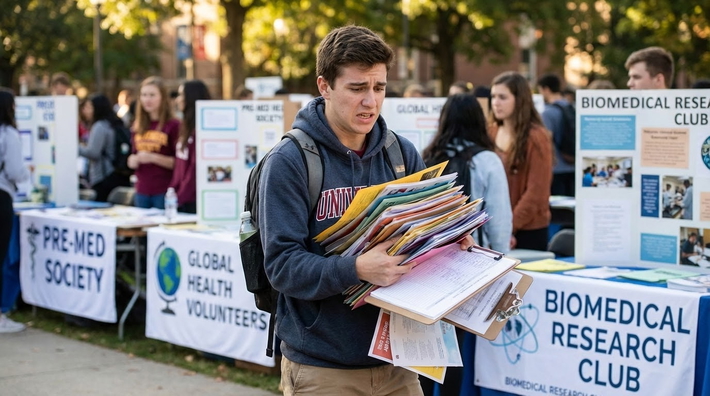
You went to the conference. You sat through panels. You collected emails, maybe a tote bag, maybe a few inspiring quotes. Then the cycle ended and nothing changed. No interviews. No acceptances. No stronger letters. No new research slot. No clinical role that actually moved your file forward.
That is what "no outcomes" means. Not vague disappointment. Measurable underperformance.
Operationally, I define "no outcomes" as one or more of the following: zero interview invitations attributable to stronger positioning, zero acceptances, no new letter writer with real substance, no documented research or clinical asset added to the application, no meaningful improvement in your personal statement or activity descriptions, and no closing of obvious gaps. If your attendance produced motivation but not proof, the data shows it produced very little.
Here is the hard truth. Event attendance is an input. Not an output.
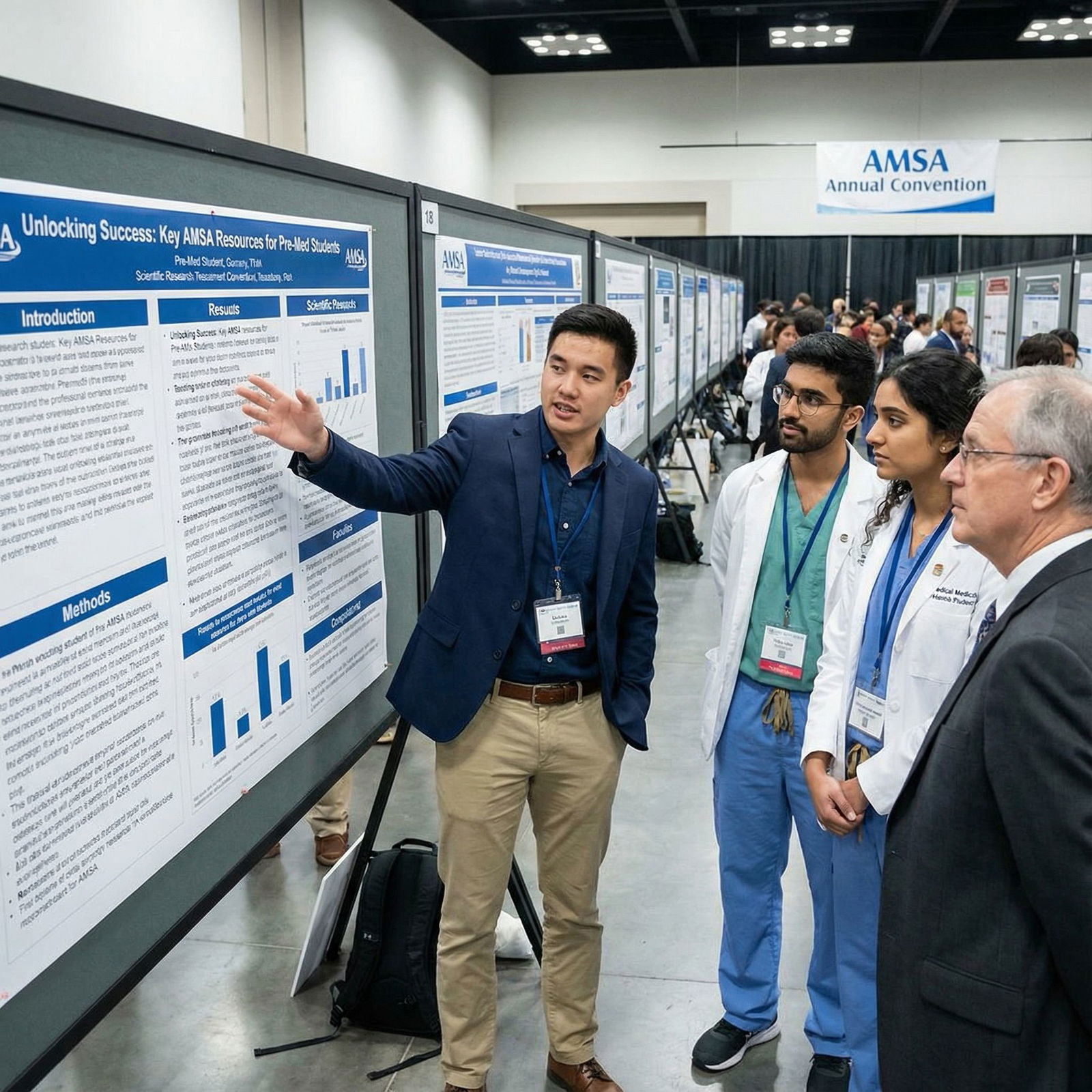
I have seen this repeatedly with premeds who attend AMSA, SNMA, AAMC-linked, or similar national and regional events and assume exposure itself has value. It does not. Not by itself. The denominator matters: how many sessions you attended, how many useful contacts you made, how many follow-ups you completed, how many of those became actual meetings, and how many meetings turned into assets. That is the funnel. Miss that, and you are just counting appearances.
The article's thesis is simple: outcomes come from conversion funnels, not attendance alone. The students who benefit are not the ones who merely show up. They are the ones who turn exposure into deliverables, documentation, letters, revisions, and interview-ready stories.
Problem Framing: Attending AMSA/SNMA/AAMC Events but Seeing No Outcomes
Students often describe attendance as if it is a credential. It is not. Admissions committees do not award points because you sat in Ballroom C at 2:15 p.m. and listened to a panel on holistic review. They care whether that event changed your application in a measurable way.
The data lens matters here. Attendance can correlate with ambition, curiosity, and access. But correlation is weak if nothing happens after the badge comes off. A student who attends four conferences and follows up with nobody will usually underperform a student who attends one local event and converts two contacts into recurring mentorship, one poster project, and a stronger committee letter. That is not theory. That is how conversion works in every pipeline.
Think of your application like a funnel:
- Top: event attendance
- Middle: follow-up contact
- Lower middle: meetings and deliverables
- Bottom: upgraded application components and interview invitations
Every stage has leakage. Usually a lot of it.
If 100 students attend an event, but only 60 send thoughtful follow-ups, 35 schedule a substantive next step, 25 generate a real asset, and 10 reach interview-strength gains, then "attendance" was never the story. Conversion was.
What the Data Typically Shows: Attendance Is Not a Substitute for Conversion
The first analytical mistake applicants make is confusing correlation with causation. Students who attend AMSA, SNMA, AAMC, or adjacent programming may already be more engaged than average. That baseline engagement can correlate with stronger outcomes. But the event itself is not the active ingredient. The downstream actions are.
The data shows that attendance alone is a weak predictor because attendee pools are mixed. At the same event, you will see:
- Highly prepared applicants polishing final details
- Mid-range applicants looking for one missing link
- Underprepared applicants hoping a conference will compensate for GPA, timing, or experience gaps
That creates a selection effect. Attendance means many different things for many different people. So if you ask, "Does going help?" the honest answer is: only if it changes what lands in the file.
A practical admissions funnel looks something like this:
Attend event Baseline: 100% of attendees
Submit follow-up contact Typical conversion: around 50% to 70% Most students fail here because they wait too long, send generic emails, or never ask for a next step.
Obtain mentorship or value-add action Typical conversion from attendance: around 25% to 40% This means a real meeting, project invitation, shadowing arrangement, essay review, committee role, or letter-building interaction.
Upgrade application components Typical conversion from attendance: around 15% to 30% This is where the event becomes useful: better activity entries, revised personal statement, stronger secondary examples, better narrative alignment, or documented hours.
Receive interview invitations Typical conversion from attendance: highly variable, often around 5% to 15% if the event was one among many inputs Not because the event "gave" the interview, but because the student translated it into file improvements.
Small drop-offs compound brutally. If you lose 40% at follow-up, then another 25% at mentorship, then another 10% at actual asset production, the bottom of the funnel gets thin fast. That is why so many students say, "I went to everything and got nothing." The numbers support that outcome if no one managed the middle stages.
And yes, I am blunt about this because I have seen the pattern. Students collect names, not relationships. They collect inspiration, not deliverables. They overvalue access and undervalue conversion. Bad trade.
Where Outcomes Fail: Mapping Common Failure Points in Student Organization Pathways
Most stalled applicants are not failing at attendance. They are failing at translation. Here are the five failure modes I see most often.
1. One-and-done attendance
This is the classic mistake. You attend, maybe ask a question, maybe post a photo, then move on. No shadowing request. No project ask. No scheduled second conversation. No documented output.
Exposure is not an asset. Research hours are. Clinical documentation is. A poster abstract is. A mentor who can write specifics is. If the event did not produce something you can point to six weeks later, its practical value was close to zero.
2. Weak output from relationships
A lot of students do get contacts. Then they waste them.
They have a promising conversation with a resident, faculty member, admissions dean, or student leader and never turn it into structure. No written plan. No accountability cadence. No deliverables. The relationship remains socially pleasant and professionally useless.
The strongest applicants do something different. They leave with specifics:
- a 20-minute follow-up on Tuesday
- a literature review task by next Friday
- two shadowing dates next month
- one revised personal statement sent for feedback
- one student leadership project with measurable scope
That is how relationships become file-strengthening signals.
3. Application components never get updated
This one is astonishingly common. Students attend events, learn a lot, feel clearer about their why-medicine story, and then never revise the application materials to reflect any of it.
So the event changed their thinking but not their file.
That means:
- personal statement remains generic
- activity descriptions remain duty-based instead of impact-based
- secondary answers remain shallow
- school list remains poorly matched
- resume or CV remains stale
If the event taught you something and your essays still read the same 30 days later, the learning did not convert.
4. Letter and credibility gap
Applicants often assume that meeting impressive people will somehow improve letters. No. Letter quality depends on observed performance and narrative fit.
A weak letter usually has one of three defects:
- the writer barely knows you
- the writer cannot quantify your contribution
- the letter does not reinforce your core application story
If your recommender writes that you were "pleasant, engaged, and interested," that is filler. If they write that you independently summarized 18 articles for a review project, improved clinic workflow, or showed unusual maturity in patient-facing situations, that is signal.
Good letters are evidence-rich. Bad letters are adjectives. The data shows committees respond to evidence.
5. Interview readiness mismatch
Even strong applicants lose outcomes at the final stage because their narrative is not interview-ready. They attended events, accumulated experiences, maybe even improved the file, but never practiced communicating the story.
No rehearsal. No targeted feedback. No calibration between what the written application says and how the candidate presents. That mismatch costs interviews and acceptances.
I have seen students with polished resumes crash because they could not explain why a research project mattered, what they learned from a service role, or how their clinical work shaped career direction. That is not bad luck. That is poor conversion discipline.
Measuring "Outcomes" Like an Analyst: KPIs Applicants Should Track After Attendance
If you do not track post-event performance, you cannot diagnose failure. You can only feel bad in a vague, inefficient way. That is useless.
Track five KPI categories over every 4-to-8-week cycle:
Contact conversion
- Number of meaningful people met
- Number of follow-up messages sent within 72 hours
- Number of responses received
- Number of meetings scheduled
Asset generation
- Research tasks completed
- Clinical shifts or shadowing blocks documented
- Leadership or committee deliverables completed
- New measurable achievements produced
Application strengthening
- Personal statement revisions completed
- Activity descriptions rewritten
- Secondary themes drafted
- School list adjustments made using better fit data
Timeline compliance
- Letter requests sent
- Letter packet completion status
- Draft deadlines met
- Submission readiness by target date
Performance indicators
- Mock interview sessions completed
- Feedback themes corrected
- Interview invites, waitlists, and movement tracked
A useful target range for one 4-to-8-week cycle after an event might look like this:
- 3 to 5 meaningful follow-up messages
- 2 scheduled mentorship or project meetings
- 1 concrete deliverable completed
- 1 to 2 application sections revised
- 1 letter writer advanced to "in progress"
- 1 interview prep session completed if in-cycle
Leading indicators matter more than vanity metrics. The number of sessions attended is a vanity metric. The number of unique, meaningful mentor conversations is a leading indicator. So is revision cadence. So is actual work product.
My recommendation is simple: use a spreadsheet like a lightweight CRM. Date, contact, next step, asset tied to the contact, deadline, status, outcome. Clean data. No wishful thinking. If you cannot diagnose where the pipeline broke, you will keep repeating the same bad cycle.
Make AMSA/SNMA/AAMC Attendance Produce Assets: A Practical, Data-Driven Action Plan
You do not need more events. You need a better post-event operating system.
Start with a 30/60/90-day plan.
By day 30
- Send follow-ups within 72 hours
- Schedule 2 to 3 substantive conversations
- Identify one missing application asset
- Ask for one specific opportunity: literature review, shadowing block, committee role, poster help, outreach project
By day 60
- Complete at least one documented deliverable
- Update activity bullets and personal narrative based on that work
- Advance one letter relationship with concrete evidence of contribution
- Store all notes, milestones, and outputs in one tracker
By day 90
- Have one polished artifact tied to your application story
- Have one recommender who can quantify your impact
- Have revised essays or activity descriptions reflecting the new evidence
- Be able to articulate the experience in interview language
Mentorship has to be operationalized. Do not ask, "Can you mentor me?" That is vague and lazy. Ask for a role with a timeline:
- "Could I assist with a two-week literature summary?"
- "Would it be possible to shadow two half-days this month?"
- "Could I help with poster preparation and draft methods slides by next Friday?"
- "Can I join this committee project and take ownership of one defined task?"
That is how networking becomes artifacts.
Every artifact should map somewhere in the application:
- one activity entry
- one essay example
- one interview story
- one letter talking point
And your letter strategy needs structure. Give writers a packet: CV, draft personal statement, key experiences, bullet points of quantified impact, deadline, and submission instructions. Immediately. Not "sometime later." Later is where applications go to die.
Cost of Inaction: Opportunity Loss, Timeline Penalties, and Applicant Burnout
The cost of poor conversion is not abstract. It is calendar math.
If you delay turning an event contact into a research task by 6 weeks, then the research output may be delayed another 4 to 8 weeks. If you delay letter requests, you compress revision time and risk late submission. If you delay essay updates, secondaries become rushed and generic. The pipeline backs up.
Path A is event attendance without conversion. Path B is attendance with monthly deliverables. The difference is usually 8 to 12 weeks of drift versus 2 to 4 weeks of controlled progress. That gap matters.
Burnout often follows strategy failure. Students get no outcomes, panic, then start random event hopping, adding more organizations, more webinars, more panels. More noise. Less signal. They feel busy but become less deliberate. I do not recommend that. Run a KPI audit before you add a single new activity.
Action-First Wrap-Up: What to Do This Week If You Have "No Outcomes"
Here is your 7-day sprint. No drama. Just execution.
- Day 1: Audit your KPIs. Who did you meet? Who did you follow up with? What asset came from it?
- Days 1-2: Send two high-quality follow-up messages with a specific ask and deadline.
- Days 2-3: Schedule at least one mentor, resident, faculty, or student leader meeting.
- Day 3: Choose one deliverable only. One. Literature review, shadowing block, activity revision, poster task, committee work.
- Days 4-5: Draft a letter packet for one recommender.
- Days 5-6: Update your narrative outline and activity bullets.
- Days 6-7: Build an interview rehearsal plan or essay revision plan, depending on your cycle stage.
Evidence standard: if you cannot prove an output with documented hours, milestones, drafts, or submissions, it does not count.
Define success by day 30:
- two letters in progress
- one deliverable completed
- revised activity descriptions
- at least two structured follow-up conversations finished
That is how you fix "no outcomes." Not with more attendance. With conversion.