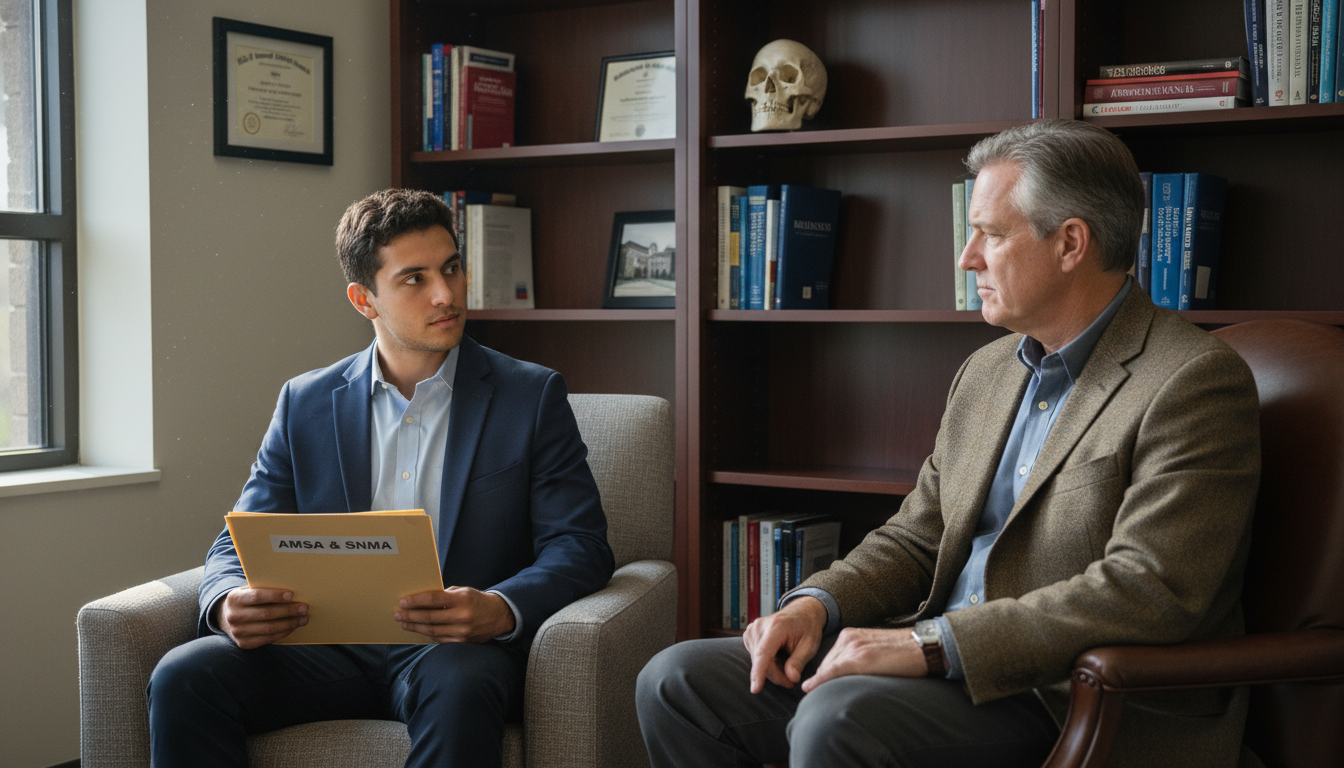
When Your Advisor Doesn’t Value Orgs: Advocating for Your AMSA and SNMA Work
What do you do when your advisor rolls their eyes at your AMSA or SNMA leadership and tells you to “stop wasting time on clubs” and “focus on what really matters for med school”?
If you are deeply involved in AMSA, SNMA, LMSA, or similar groups, you’ve probably heard some version of this:
- “Admissions committees do not care about these organizations.”
- “Leadership is overhyped. Your MCAT and GPA are what counts.”
- “You’re doing too much. Drop the org stuff.”
Here is the problem: your advisor might be partially right about numbers mattering. But they are often completely wrong about how (and how much) sustained, meaningful student organization involvement actually plays in admissions and later opportunities.
You are not just trying to “be involved.” You are trying to turn real advocacy, community work, and leadership into something that helps you grow and that admissions committees can recognize as serious.
Let’s walk through what to do if you are in this exact situation.
Step 1: Diagnose What Kind of Advisor You’re Dealing With
Before you try to “defend” your AMSA or SNMA work, you need to understand where your advisor is coming from. Different advisor types require different approaches.
Common Advisor Profiles
The Numbers-Only Advisor
- Background: Often faculty who’ve served on admissions or are research-heavy.
- Typical comments:
- “If your GPA isn’t above 3.7, nothing else matters.”
- “MCAT first, everything else second.”
- Risk: They see all non-GPA/MCAT things as distractions unless you are already “safe” numbers-wise.
The Old-School Advisor
- Background: Trained decades ago, may not fully grasp modern holistic review, diversity missions, and health equity work.
- Typical comments:
- “When I applied, we didn’t have all these organizations.”
- “Focus on research and shadowing. Advocacy is nice but not essential.”
The Burned-Out Advisor
- Background: Has watched too many students over-extend themselves and tank their grades.
- Typical comments:
- “Everyone thinks leadership will save them, but it won’t.”
- “Students hide from the MCAT in their orgs.”
- Risk: They assume you are doing the same, even if you’re actually managing well.
The Misinformed Advisor
- Background: Has limited recent interactions with top schools or doesn’t keep up with current admissions priorities.
- Typical comments:
- “I have never seen AMSA or SNMA make a real difference.”
- “These orgs are just social clubs.”
You are not going to change their core worldview in one meeting. So the goal is more targeted:
- Clarify your priorities
- Show you understand the tradeoffs
- Convert your advisor from “anti-org” to at least “neutral but informed”
Step 2: Get Clear on What Your Org Work Actually Is (Not Just the Title)
If you cannot clearly explain why your involvement matters, your advisor definitely will not see it.
Take AMSA and SNMA as concrete examples.
Typical weak explanations students give:
- “I’m president of AMSA; we host events.”
- “I’m active in SNMA; we do community outreach.”
Those sound fluffy, even to friendly advisors.
You need specifics like you would put on an application:
Scale:
- “We hosted 12 events this year, average attendance 40–60 students.”
- “We coordinate 5 recurring community clinics serving ~200 patients annually.”
Responsibility:
- “I managed a $3,000 yearly budget and applied for 2 grants.”
- “I supervised a team of 8 committee leads, each with their own projects.”
Outcomes:
- “We doubled underrepresented student participation in our mentorship program from 25 to 50.”
- “We increased flu vaccination rates at our outreach site by 30% compared to the previous year.”
Skills built:
- Leadership, conflict resolution, public speaking
- Working with administration, budgeting, data tracking
- Cultural humility, community partnership, advocacy
Do this for your own role before talking to your advisor:
Quick exercise (do it in writing):
- Write your role and org: “SNMA Chapter President,” “AMSA Advocacy Chair,” etc.
- Under it, list:
- 3 concrete responsibilities you held
- 3 quantifiable outcomes or changes you helped make
- 3 real skills you developed that would matter in residency or as a physician
You will use this language with your advisor and later in secondaries and interviews.
Step 3: Prepare for the Conversation Before You “Defend” Yourself
Do not walk into the advising meeting emotionally raw, ready to argue about values. Walk in prepared to show you have a plan.
Bring 3 things to the meeting
Your current stats and timeline
- Current GPA (overall and science)
- Planned MCAT date and practice score range (if available)
- Where you are in pre-reqs
- Target application cycle (year)
Your time map
- Rough weekly breakdown:
- Class/study time
- MCAT prep (if relevant)
- Clinical exposure
- Research (if any)
- AMSA/SNMA/other org hours
You want to show that your org involvement is not drowning out the fundamentals.
- Rough weekly breakdown:
A short “org impact” summary
- 1 page, bullet-style
- Highlight your leadership, responsibilities, major initiatives, and outcomes
- For SNMA, this might include pipeline programs, mentorship, community partnerships, premed advising work.
- For AMSA, it might include advocacy campaigns, national conferences, legislative visits, or health policy work.
This shifts the tone from “emotional disagreement” to “let’s evaluate a concrete plan.”
Step 4: How to Respond in Real Time When Your Advisor Dismisses Orgs
Let’s handle actual phrases you might hear and how to respond strategically.
Scenario 1: “Orgs don’t matter. Med schools don’t care about AMSA or SNMA.”
Response structure:
- Brief acknowledgment
- Reframe with evidence and specific goals
- Connect org work to admissions language
Example:
“I understand that GPA and MCAT are critical, and I’m not ignoring that. The reason I’ve stayed deeply involved in SNMA is that a lot of schools have missions around diversity, service, and health equity.
Through SNMA, I’ve led a mentorship program with 30+ premeds each year and organized monthly pipeline sessions with local high school students interested in medicine. I’d like help thinking about how to balance this with MCAT prep, not whether it ‘counts at all,’ because I know it will be one of my core activities on my application.”
You’re not asking for permission to care about SNMA. You are asking for strategy on balance.
Scenario 2: “Your GPA isn’t strong enough to be doing this much leadership.”
Here, you pivot to triage and practical planning, not argument.
Example:
“You’re right that my 3.4 science GPA is not where I want it to be. I’ve already adjusted by stepping back from one committee and cutting my hours. Right now, my AMSA role is about 4–5 hours per week except near major events.
I’d like your advice on a realistic limit. If I commit to ‘no more than X hours/week for AMSA’ and focus the rest of my time on grade repair and MCAT prep, does that sound acceptable? I do not want to quit entirely because this is my main leadership and health policy experience, but I’m willing to scale down.”
Now you are collaborating. And you are signaling that you know numbers matter.
Scenario 3: “Everyone has leadership. You’re not special because you were president.”
The subtext: Your advisor has seen a lot of paper leaders.
You respond with depth, not defensiveness.
Example:
“I agree that ‘president’ by itself doesn’t mean anything. What I think will matter is what I actually did in the role. For example, we:
- Built a tutoring pipeline between med students and premeds that now has 40 active pairs
- Started a quarterly community health workshop series with 60–80 attendees per event
- Secured $2,500 in new funding from the dean’s office for underrepresented student initiatives
I’m not relying on the title alone; I’m trying to build a track record of starting and sustaining programs. I want help framing that in a way that makes sense to committees.”
You just converted “club president” into “program builder with measurable outcomes.”
Step 5: Translate Your AMSA/SNMA Work Into Admissions Language
You cannot assume your advisor understands how modern admissions committees think. But you can gently connect the dots.
What committees are actually looking for that AMSA/SNMA can show
- Sustained commitment (multi-year involvement, increasing responsibility)
- Leadership and initiative (starting or revamping programs, not just inheriting roles)
- Impact on others (community, classmates, mentees)
- Fit with mission (diversity, health equity, underserved populations, advocacy)
- Professionalism (can you organize people, manage conflict, follow through)
Now tie your org work to specific competency language:
Sample reframes you can use with your advisor (and later in applications):
“Through SNMA, I’ve developed longitudinal mentorship experience and worked with pipeline programs that align with mission-driven schools like UCSF, Michigan, and Howard that emphasize diversity and community engagement.”
“My AMSA advocacy work—coordinating Hill Day visits and organizing a health policy journal club—has given me concrete experience understanding healthcare systems and working with multidisciplinary stakeholders, which many schools highlight in their core competencies.”
“Running our AMSA premed conference required budgeting, interdepartmental communication, marketing, and outcome tracking. That’s direct practice in project management and systems-based practice.”
When advisors hear language like “competencies,” “mission fit,” and “systems-based practice,” many shift from “this is just a club” to “okay, this might be relevant if balanced properly.”
Step 6: Decide If You Need to Adjust Your Involvement—For Real
Sometimes your advisor is wrong about the value of organizations but right about your bandwidth.
Ask yourself bluntly:
- Are your grades slipping because of org time, or because of poor study strategy and time management?
- Are you using org work to avoid MCAT prep because it feels more rewarding and less scary?
- Is your role still growth-promoting, or have you shifted into “I’m stuck doing logistics I don’t care about anymore”?
If your numbers are solid
Example:
- GPA: 3.7+
- MCAT practice scores tracking at or above your target
- You are getting consistent, solid grades in hard science courses
Then your org work is likely an asset, not a liability. Stay engaged, but:
- Protect non-negotiable MCAT study blocks like clinic shifts
- Favor high-impact, fewer projects over saying yes to everything
- Document what you do as you go (impact logs, attendance, outcomes)
If your numbers are shaky
Example:
- GPA: 3.3–3.5 science with some recent B-/C grades
- MCAT practice stagnant or low
- Chronic sleep deprivation or burnout
You may need to strategically downshift but not disappear:
Possible moves:
- Move from president to advisor/mentor role next term
- Shorten your involvement to one core project you truly care about
- Train a successor early so you can hand off day-to-day tasks
Frame this to your advisor as:
“I’ve recognized I need more academic bandwidth, so I’m transitioning from operational leadership to more of a mentorship and advisory role in SNMA over the next semester. That way I maintain continuity and impact, but free up 5–7 hours a week for MCAT and coursework.”
That sort of planning sounds professional, not flaky.
Step 7: If Your Advisor Still Doesn’t Get It—Build a Parallel Support System
You may not be able to convert your primary advisor. That’s fine. You just need enough support to move intelligently.
Where to find people who actually understand AMSA/SNMA work
Faculty or residents involved in diversity, equity, and inclusion
- Offices of Diversity & Inclusion
- Faculty advisors for SNMA, LMSA, APAMSA
- DEI committee members
National or regional org contacts
- AMSA national leaders or regional directors
- SNMA regional chairs or national officers
- They can share sample CVs, activity descriptions, and ways members have successfully framed their involvement to admissions.
Recent accepted students
- M1s or M2s who held leadership roles in your same org
- Ask how they wrote about it in secondaries/interviews
- Ask what concrete metrics or stories resonated in their experience
Premed advising offices at other institutions (if yours is weak)
- Some universities allow open info sessions or virtual Q&A for non-students
- Professional advisors who see a lot of successful applicants may give more up-to-date feedback
You are not betraying your advisor by doing this. You are building a more complete support network.
Step 8: Turn Your Org Work Into Strong Application Material
Assume your advisor never fully comes around. You still need to turn your AMSA/SNMA work into compelling entries.
Activity descriptions (AMCAS/AACOMAS)
Weak:
“President of SNMA. Organized meetings and community outreach events. Mentored premed students.”
Stronger:
“Led a 20-member SNMA executive board serving 130 chapter members. Expanded our high school pipeline program from 2 to 5 partner schools, increasing student participation from ~40 to 120 annually. Coordinated 10+ community health education events focused on hypertension and diabetes in predominantly Black neighborhoods, partnering with 2 local churches and a free clinic. Mentored 15 premed undergraduates through monthly check-ins and application workshops; 7 have since matriculated to medical school.”
You can show that to your advisor as an example of how this becomes concrete on an application.
Secondary essays & interviews
You will especially lean on AMSA/SNMA for prompts like:
- “Describe a leadership experience.”
- “Describe a challenge within a group and how you addressed it.”
- “How have you contributed to diversity or supported underrepresented groups?”
- “Describe a time you advocated for a change in your community.”
Your strategy conversation with your advisor then becomes:
“I understand that not all orgs are equal on paper. My goal is to use a small number of deep experiences—primarily through AMSA/SNMA—to answer leadership, advocacy, and diversity-related questions with real, specific stories. I’m asking for your help in making sure that doesn’t compromise my academic strength.”
Now even a skeptical advisor can participate productively.
Step 9: Protect Your Values While Playing the Long Game
Sometimes the underlying tension is values-based. You may care deeply about racial justice, health equity, or pipeline work. Your advisor may see those as “extra.”
Your job is not to convert them philosophically. Your job is to:
- Honor your values
- Maintain competitive metrics
- Build a portfolio of experiences that prepare you for the kind of physician you actually want to be
If an advisor suggests:
“SNMA is too niche” or “AMSA advocacy is too political,” you can calmly respond:
“My long-term goal is to work in [community health/academic medicine/health policy] with a focus on [underserved communities/systemic inequities]. SNMA/AMSA is where I’ve actually been doing that work on the ground. I’m not looking to abandon that; I’m looking to integrate it with strong academic performance so I can train at places that value those same commitments.”
You’re signaling: I’m not just chasing admission. I’m building toward a coherent career identity.
Your Action Step for Today
Open a blank document and create a one-page “Org Impact Sheet” for your AMSA or SNMA role:
- Top: Your role(s) and dates
- Then three sections:
- Responsibilities (What you actually do, weekly or monthly)
- Outcomes (Numbers, changes, programs started or expanded)
- Skills/Competencies (Leadership, advocacy, teaching, community engagement)
Once it is drafted, schedule a 30-minute meeting or email your advisor with:
“I’d like to review my academic plan and also show you how my org involvement fits into my overall preparation for medical school.”
Walk into that meeting with clarity, not defensiveness. Your job is not to prove your advisor wrong; it is to make your AMSA and SNMA work so concrete and integrated into your plan that even a skeptical advisor has something useful to help you with.