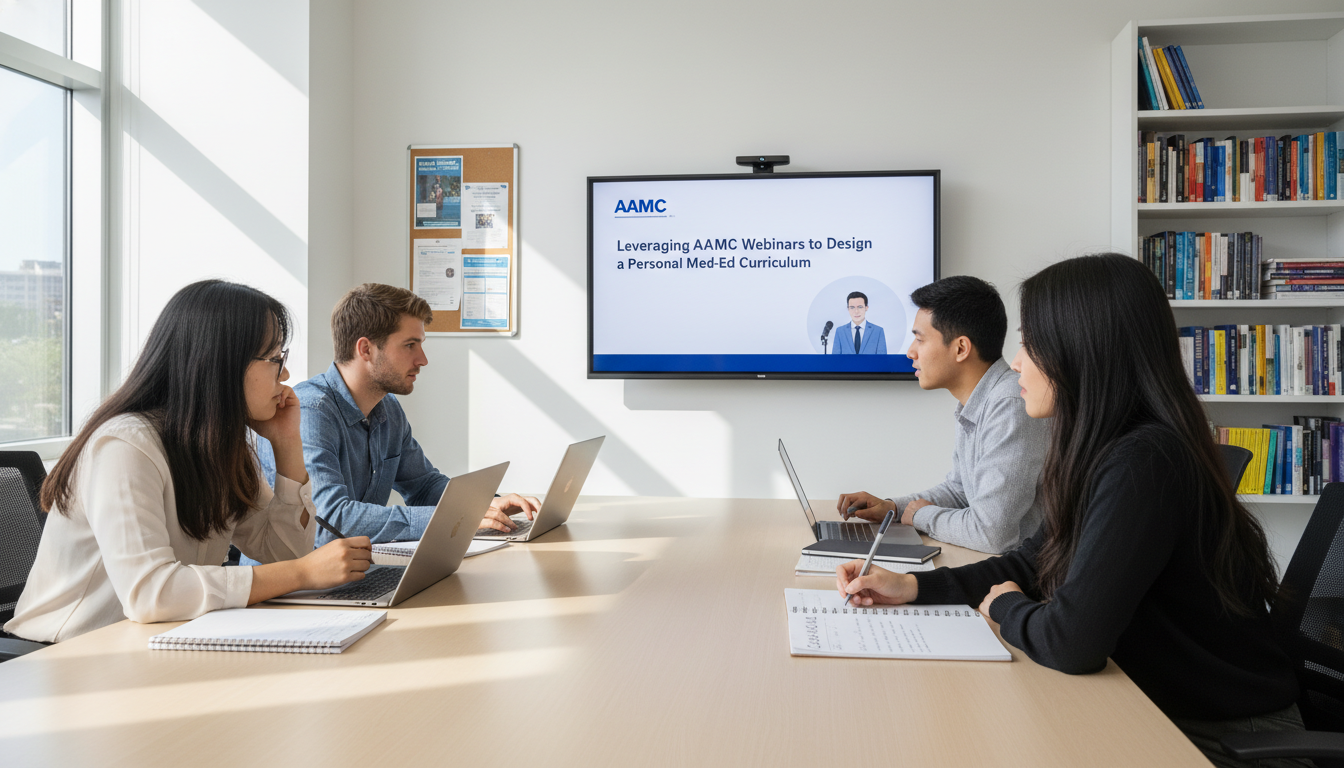
You are in your campus library at 8:30 p.m. Clubs are quieting down, your inbox is full of “new opportunity” emails, and you have ten tabs open:
- MCAT resources
- Shadowing database
- Volunteering sign-up
- AAMC events page with yet another webinar you are «supposed» to attend
You know you cannot go to everything. You also know that just passively “showing up” to webinars is not moving you meaningfully closer to being a strong medical school applicant or a prepared M1.
You do not need more noise. You need a system.
This is where AAMC webinars can stop being random events and start becoming the backbone of a deliberate, personal med‑ed curriculum that your student organization can build, track, and refine over time.
Below is a concrete, step‑by‑step way to turn AAMC webinars into a structured, cumulative learning program for premeds and early medical students.
Step 1: Treat AAMC Webinars as Curriculum Building Blocks, Not One‑Off Events
Before you start signing people up, change the mental model for yourself and your student organization.
Most students use AAMC webinars like this:
- See email or Instagram post
- Register if it sounds interesting
- Half‑listen while doing Anki
- Never review notes
- Repeat with no clear trajectory
Instead, think of each webinar as a modular lesson in a larger curriculum that spans:
- Awareness (exploring medicine, specialties, career paths)
- Preparation (MCAT, admissions, competencies)
- Readiness (transitioning to M1, professionalism, financial literacy)
Build a simple framework around 3 domains:
Career & Identity Development
- Exploring specialties
- Understanding diversity, equity, and inclusion in medicine
- Physician well‑being and resilience
- Professional identity formation
Academic & Admissions Strategy
- Pre‑req planning and academic performance
- MCAT strategy and planning
- Application logistics (AMCAS, letters, personal statement)
- Competencies and holistic review
Systems & Practical Realities
- Financial aid and debt
- GME and the residency pipeline
- Health systems science and policy basics
- Transition to medical school and clinical learning
Every AAMC webinar you see should be tagged by your organization into one (or two) of these domains. Over time, you build a map, not just a pile of links.
What to do this week
- Go to the AAMC events/webinars page.
- Export or list all recurring or upcoming premed‑relevant webinars.
- For each, tag it into one of the 3 domains above.
- Identify obvious gaps. Example:
- Many MCAT webinars? You are heavy in domain 2.
- Very few on debt, wellness, or career exploration? Domain 1 and 3 are weak.
That gap analysis is how you start designing an intentional curriculum instead of chasing random events.
Step 2: Build a 12‑Month “Personal Med‑Ed Track” for Your Organization
You cannot attend every webinar live, and your members will be at different phases (freshmen exploring vs. juniors applying). The fix is to build tracks anchored to a calendar.
2.1. Choose 3 Tracks Based on Phase
For a typical premed student organization, create three tracks:
Explore Track (Early Premeds: 0–30 credits)
- Goals:
- Understand what physicians actually do
- Learn about different specialties
- Build foundational professional competencies
- Webinar priority:
- AAMC “Careers in Medicine” type sessions
- Diversity pathways webinars
- Physician and student panel discussions
- Goals:
Prepare Track (Mid Premeds: 30–75 credits)
- Goals:
- Plan coursework toward competencies
- Structure MCAT timeline
- Learn how admissions really works
- Webinar priority:
- MCAT strategy and planning
- Competency‑based admissions and holistic review
- Experiences & activities: building a meaningful portfolio
- Goals:
Apply & Launch Track (Late Premeds & Accepted Students)
- Goals:
- Execute AMCAS strategically
- Understand financial aid and debt management
- Prepare for M1 transition and professional expectations
- Webinar priority:
- “How to Apply to Medical School” series
- Financial aid and repayment sessions
- Transition to medical school / wellness webinars
- Goals:

2.2. Layer the Calendar
Create a 12‑month view in a shared Google Calendar or Notion page for your organization.
For each month:
- Identify at most:
- 1–2 Explore Track webinars
- 1–2 Prepare Track webinars
- 1–2 Apply Track webinars
- Mark which ones you will:
- Attend live as a group watch
- Assign as “asynchronous viewing” with a follow‑up discussion
Your objective: no member attends more than 2–3 AAMC webinars per month. The rest of their time goes into actions generated from those webinars.
Resist the temptation to overload. Volume does not equal value.
Step 3: Turn Passive Viewing into Active Learning with a Fixed Protocol
The main failure point: students passively consume webinars, then forget almost everything.
You can fix that with a simple, consistent Before–During–After protocol for every AAMC webinar your organization engages with.
3.1. Before: Define One Target Outcome
24–48 hours before each selected webinar, send members a 1‑page prep document:
Template (copy this for your org)
- Webinar Title:
- AAMC Link:
- Domain (Career/Academic/Systems):
- Track (Explore/Prepare/Apply):
- Target Outcome for Our Org:
- Example: “By the end of this webinar, members will be able to outline a three‑semester MCAT prep timeline”
Ask members to write, in 1–2 sentences, what they personally want to gain. Collect a few examples, and share them at the start of the group watch.
3.2. During: Use a Structured Note‑Taking Template
Give everyone the same note‑taking structure for every AAMC webinar:
Webinar Notes Layout
- 3 Key Ideas
- Bullet list only
- 2 Actionable Steps I Can Take in the Next 2 Weeks
- Examples:
- Draft a preliminary MCAT study schedule
- Email our premed advisor about course sequencing
- Examples:
- 1 Concept I Need to Clarify
- Something to bring to a Q&A, advisor meeting, or peer discussion
Set the expectation that notes are required if you want this webinar to count toward your “track completion” (more on that later).
3.3. After: Convert Learning to Action in 7 Days
Within 7 days of the webinar, your organization should run a 15–30 minute debrief. This can be:
- A quick add‑on to your regular meeting
- A separate Zoom huddle
- An asynchronous discussion thread in Slack/GroupMe/Discord
Use this fixed agenda:
- Quick poll:
- “Who took at least 1 concrete action from the webinar?”
- Round‑robin:
- 2–3 members share their “2 Actionable Steps” and what they did
- Capture:
- One member updates a shared “Webinar to Action” log
The log should have:
- Webinar title & date
- Domain & Track
- 3–5 distilled takeaways from the group
- Specific recurring actions people took (e.g., “3 members scheduled advisor meetings about MCAT timing”)
Over time, this log becomes a resource bank for new members so they can benefit from webinars even if they never watched them.
Step 4: Embed AAMC Competencies into Your Personal Curriculum
AAMC offers not just webinars, but an entire competency framework for entering medical students. If you ignore this, you risk building a curriculum that feels impressive but is misaligned with what schools actually look for.
Focus on the Core Competencies for Entering Medical Students (pre‑professional, thinking & reasoning, science, and cross‑cutting).
4.1. Build a Simple Competency Matrix
Create a table with:
- Rows = the 15 AAMC core competencies
- Columns = the AAMC webinars you have selected for the year
For each webinar, mark which competencies it most clearly addresses. For example:
“Understanding Holistic Review in Admissions”
- Service Orientation
- Ethical Responsibility to Self and Others
- Capacity for Improvement
“MCAT Essentials and Planning”
- Critical Thinking
- Quantitative Reasoning
- Reliability and Dependability
“Financing Medical School 101”
- Resilience and Adaptability
- Capacity for Improvement
- Oral Communication (if interactive)
This does not need to be perfect. You are building directional alignment, not a grant report.
4.2. Use Competencies as Reflection Anchors
For each key webinar, prompt members to answer:
- “Which 1–2 AAMC core competencies did this session help me understand or develop?”
- “What evidence can I generate in the next month to demonstrate growth in those competencies?”
Examples of concrete evidence:
- After a webinar on resilience and wellness, a member:
- Implements a weekly schedule that protects study time and rest
- Journals for 4 weeks about stress management strategies
- Mentors a younger student using what they learned
These are the kinds of reflections that later feed directly into:
- Personal statements
- Activity descriptions
- Secondary essays about challenges, growth, or resilience
You are not just watching webinars. You are shaping your narrative around real frameworks admissions committees already use.

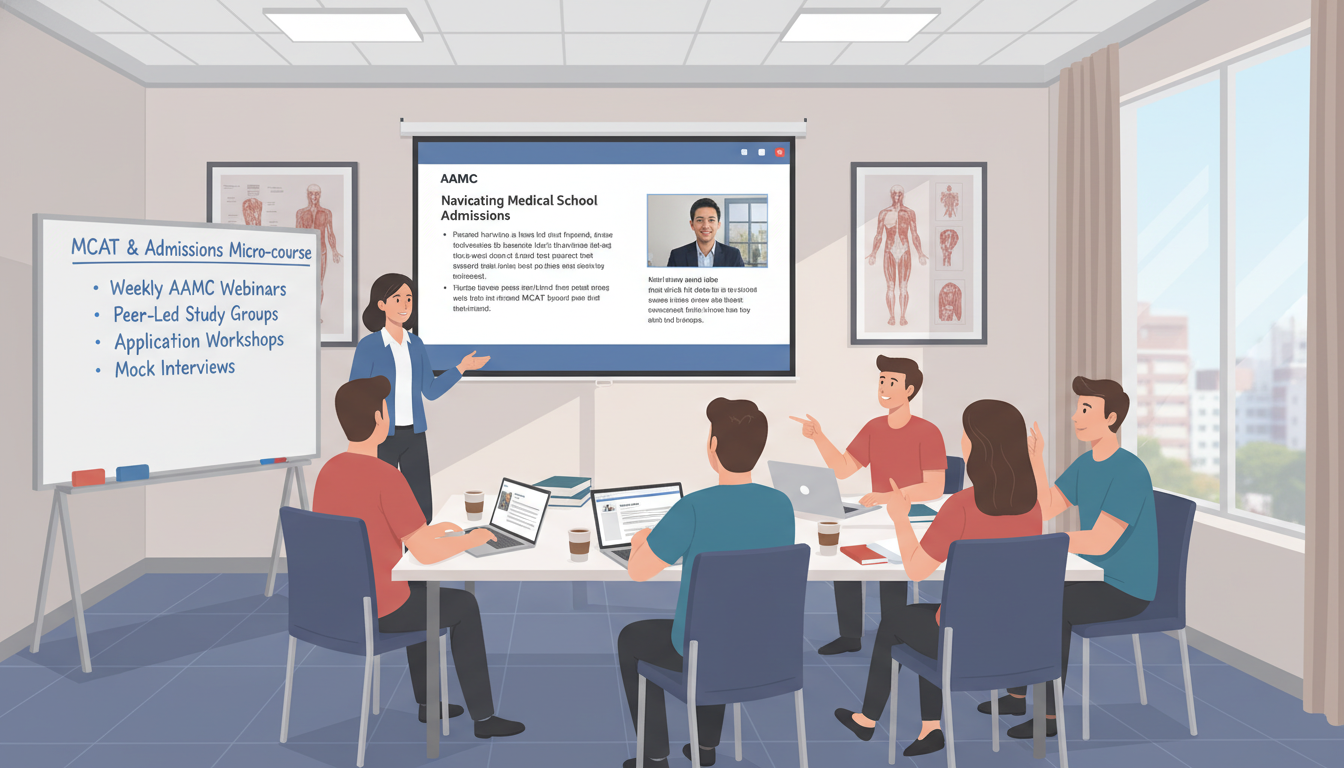
Step 5: Create “Micro‑Courses” from AAMC Webinar Series
Some AAMC topics recur: MCAT, holistic review, financing medical school, transition to med school. Instead of treating them as isolated events, convert them into micro‑courses for your organization.
5.1. Identify Clusters
Look for AAMC offerings that naturally cluster:
MCAT Readiness Micro‑Course
- MCAT Basics / What is Tested
- When to Take the MCAT & Timeline Planning
- Using AAMC Official Prep Materials Strategically
- Managing Test‑Day Anxiety
Admissions Strategy Micro‑Course
- Understanding Holistic Review
- Building Your Experiences Portfolio
- Letters of Evaluation: What Admissions Committees Want
- The AMCAS Application Walkthrough
Financial & Wellness Micro‑Course
- Financial Aid and Scholarships
- Debt Management 101
- Physician Burnout and Wellness
- Transition to Medical School & Maintaining Balance
Each micro‑course can be 3–5 webinars total.
5.2. Design a Standard 4‑Week Micro‑Course Format
For each micro‑course:
Week 1 – Orientation + First Webinar
- 20 min: Org leader introduces the course, its goals, and connection to AAMC competencies
- 40–60 min: Group watching of Webinar #1
- 15 min: Debrief using the “3–2–1” note protocol
Week 2 – Application Workshop
- Members bring specific questions or plans:
- MCAT timing chart
- Draft activity list
- Budget projection
- Use content from Webinar #1 to refine them
Week 3 – Second Webinar + Case Discussion
- Watch Webinar #2 (live or recorded)
- Use real or fictional student profiles and ask:
- “How does this webinar change what this student should do next?”
Week 4 – Synthesis & Output
- Members create 1 tangible product:
- MCAT 6‑month timeline
- Drafted “Most Meaningful Experience” paragraph
- Basic 4‑year financial projection
Alliance with reality is critical: there must be a visible output at the end of each micro‑course.
5.3. Document Micro‑Course Completion
When members finish a micro‑course, have them:
- Log their completion in a simple spreadsheet
- Save their outputs in a shared folder (with permission) as examples
- Write a 150–200 word reflection about:
- What changed in their planning
- What concrete decisions they made as a result
This reflection can directly feed into later application materials and advisor meetings (“Here is how I systematically prepared using AAMC resources”).
Step 6: Integrate Webinars into Student Organization Programming
If your org is like most, your semester calendar is packed: guest speakers, volunteer drives, exam weeks. AAMC webinars must be strategically woven into what you already do, not stapled on top.
6.1. Designate Roles: “Curriculum Coordinator”
Create a specific position within your organization:
- Title: AAMC Curriculum Coordinator (or Educational Programming Chair)
- Main responsibilities:
- Monitor AAMC event listings
- Tag webinars by domain and track
- Propose which ones integrate into your org calendar
- Maintain the Webinar‑to‑Action log and competency matrix
For small orgs, this can be a duty under your Vice President of Academics or Education.
6.2. Replace, Do Not Just Add
When you schedule an AAMC webinar group watch:
- Replace a regular meeting agenda item, rather than adding an extra burden
- Example:
- Instead of a generic “Q&A about MCAT,” co‑opt that time to watch an AAMC MCAT planning webinar, then spend 20 minutes translating it into your campus context
Remember: member burnout will ruin the best curriculum on paper. Less, done well, is better.
6.3. Align with University and Premed Office Resources
Coordinate with:
- Premed advisors
- Diversity pathway programs
- Honors programs
Propose:
- A joint AAMC micro‑course each semester
- Shared promotion of key webinars
- Possible recognition (certificate, digital badge) for students who complete a full track or micro‑course
This boosts engagement and external validation without adding much extra work.
Step 7: Use Webinars to Drive Advising and Mentoring Conversations
AAMC webinars often give generalized advice. Your reality is specific: your GPA trend, your school’s course offerings, your schedule.
Solve that disconnect by making webinars a starting point for personalized advising, not the end.
7.1. Pre‑Advising Assignment
Before meeting with a premed advisor or physician mentor, members should:
Watch the relevant AAMC webinar (e.g., MCAT timing, gap year decisions)
Fill out a short “Webinar to My Situation” worksheet:
- What does this webinar recommend in general?
- What parts clearly apply to me?
- Where does my situation differ?
- List 3 specific questions for my advisor/mentor.
This shifts the advising session from “What should I do?” to “Given that AAMC suggests X, and my situation includes Y and Z, how should I adjust?”
Advisors appreciate this level of preparation. It makes the conversation higher yield and more strategic.
7.2. Peer‑Mentoring Integration
If your organization runs a mentoring program:
- Require each pair to:
- Choose 1 webinar per month aligned with their mentee’s track
- Watch it either together or separately
- Send a 5–6 bullet follow‑up:
- 2–3 key points they discussed
- 1 decision they made or action they planned
This structure gives mentors easy “content” to talk about and prevents meetings from turning into vague check‑ins.
Step 8: Track Outcomes and Iterate Like a Real Curriculum
You are essentially functioning as a micro‑curriculum committee. Treat it that way.
At the end of each semester, ask:
- Which webinars or micro‑courses:
- Drove actual behavior change?
- Directly influenced MCAT planning, course choices, or application strategy?
- Where did interest drop off?
- Topic too broad?
- Too close to exams?
- What feedback did members give?
- “This was too basic for juniors.”
- “We needed more examples on non‑traditional paths.”
Use these data to:
- Swap out low‑yield webinars
- Adjust timing (e.g., move MCAT series earlier in the year)
- Balance domains so you are not only doing admissions and ignoring wellness or financial reality
Even a simple anonymous Google Form with 5 questions can guide your revisions.
How This Looks for One Actual Student
To make this more concrete, imagine a second‑year student, Lisa:
- Current status: 45 credits completed, strong in biology, anxious about MCAT and financial aid
- Org role: Active member, not an officer
Over 6 months, using your AAMC‑based curriculum:
- Lisa enrolls in the Prepare Track.
- She completes an MCAT Readiness Micro‑Course:
- Watches 3 AAMC MCAT webinars through group sessions
- Creates a 7‑month MCAT study plan as her final product
- Reflects on development of competencies: Critical Thinking, Capacity for Improvement
- She joins one Financial & Wellness Micro‑Course:
- Attends a “Financing Medical School” webinar
- Uses the follow‑up workshop to build a basic debt projection and scholarship search plan
- She leverages these outputs in advising:
- Brings her MCAT timeline and financial plan to her campus premed advisor
- They refine it together based on her GPA trend and course demands
Six months later, Lisa is not just “someone who watched a lot of webinars.” She is a student who can say:
- “Here is how I systematically used AAMC resources to design my MCAT timing and financial strategy, and here are the competencies I developed along the way.”
That is narrative gold in interviews and essays.
Key Takeaways
Do not treat AAMC webinars as background noise. Tag them into domains and tracks, and use them as structured building blocks for a 12‑month curriculum in your organization.
Use fixed protocols. Before–During–After structures, micro‑courses, and competency reflections turn passive watching into concrete planning and documented growth.
Integrate, track, and iterate. Embed webinars into org programming, connect them to advising and mentoring, then adjust each semester based on what actually changed members’ behavior and outcomes.