The biggest mistake isolated pre‑meds make is trying to “figure it out alone” instead of plugging into the two networks built specifically to help them: AMSA and SNMA.
If you are a first‑gen student, have no physicians in your family, or feel completely lost about how to get from Gen Chem to an actual acceptance letter, this is fixable. Not someday. This semester.
AMSA (American Medical Student Association) and SNMA (Student National Medical Association) are not just logos on flyers. Done right, they become:
- Your substitute for having physician parents
- Your streamlined path to shadowing, research, and MCAT support
- Your built‑in community to keep you from burning out and quitting quietly
Here is the concrete playbook: step‑by‑step, what to do in the next 30–90 days to build a functional support network using AMSA and SNMA, even if you are shy, late to the game, or at a school with weak pre‑med advising.
Step 1: Understand What AMSA and SNMA Actually Do For You
You cannot leverage what you do not understand. You need a clear mental model of what each group is optimized for.
What AMSA Gives You (Pre‑Med and Med Student Focus)
AMSA is open to both undergrads and med students and tends to be very structured at larger universities. Key advantages:
Academic and application infrastructure
- MCAT prep partnerships, discounts, and structured study groups
- Personal statement and activity list workshops
- Mock interviews and MMI practice nights
- Panels with successful applicants and current residents
National‑level opportunities
- National conference with workshops on admissions, specialties, and policy
- Leadership positions at chapter, regional, and national levels
- Advocacy and policy initiatives (great for “impact” and leadership lines on your CV)
Pipeline to mentors
- Med student members and alumni in different specialties
- Often paired‑mentoring programs between med students and pre‑meds
- Easier access to physicians through institutional connections
Think of AMSA as your general‑purpose pre‑med operating system: structure, information, and credibility.
What SNMA Gives You (Especially for Underrepresented Students)
SNMA is the largest organization focused on supporting Black and other underrepresented in medicine (URiM) students. You do not need to be a med student to benefit—most medical school SNMA chapters run robust MAPS (Minority Association of Pre‑Medical Students) chapters for undergrads.
Core benefits:
Identity‑aware mentorship
- Med students and physicians who understand racism, bias, and stereotype threat in medicine
- Advice on thriving as URiM at predominantly white institutions or in unsupportive environments
Stronger vertical mentorship
- Formal MAPS–SNMA mentoring programs pairing you with a med student
- Shadowing pipelines through physicians who intentionally support URiM students
Dedicated URiM‑focused programming
- Application workshops tailored to URiM applicants
- Sessions on scholarships, post‑baccs, and diversity pathway programs
- Conference spaces where you are not “the only one”
Even if you are not URiM, many MAPS chapters are open and collaborative, but if you are URiM and not plugged into SNMA/MAPS, you are leaving a massive support advantage unused.
Step 2: Map What Exists Around You (Even If Your Campus Is Weak)
You cannot join what you cannot find. Your next move is an efficient “organization scan.”
2.1: Check Your Own Campus First
Actions for the next 24–48 hours:
Search your university website
- Use terms: “AMSA [your university]”, “SNMA [your university]”, “MAPS [your university]”, “Minority Association of Pre‑Medical Students [campus name]”.
- Look in:
- Student organization directory
- Pre‑health advising office site
- Office of Diversity / Multicultural Affairs site
Check social media
- Instagram: search
"amxa_[your school]","snma_[your school]","maps_[your school]", variations like"amxa[school]". - Also search TikTok and LinkedIn; many active chapters use these more than official sites.
- Instagram: search
Email the pre‑health office with a targeted question
- Do not ask “What should I join?”
- Ask specifically:
“Hi, I am a pre‑medical student looking for AMSA/MAPS or similar organizations on campus. Could you point me to any active chapters or student leaders I can contact?”
You want names and emails, not just a link tree.
- Ask upper‑division pre‑meds after class
- Approach 1–2 students who seem engaged in pre‑med life:
“I am trying to find out which pre‑med clubs here are actually active and helpful. Have you heard of AMSA, SNMA, or MAPS on campus, and are they doing anything real?”
- Approach 1–2 students who seem engaged in pre‑med life:
You will get more honest intel from peers than from flyers.
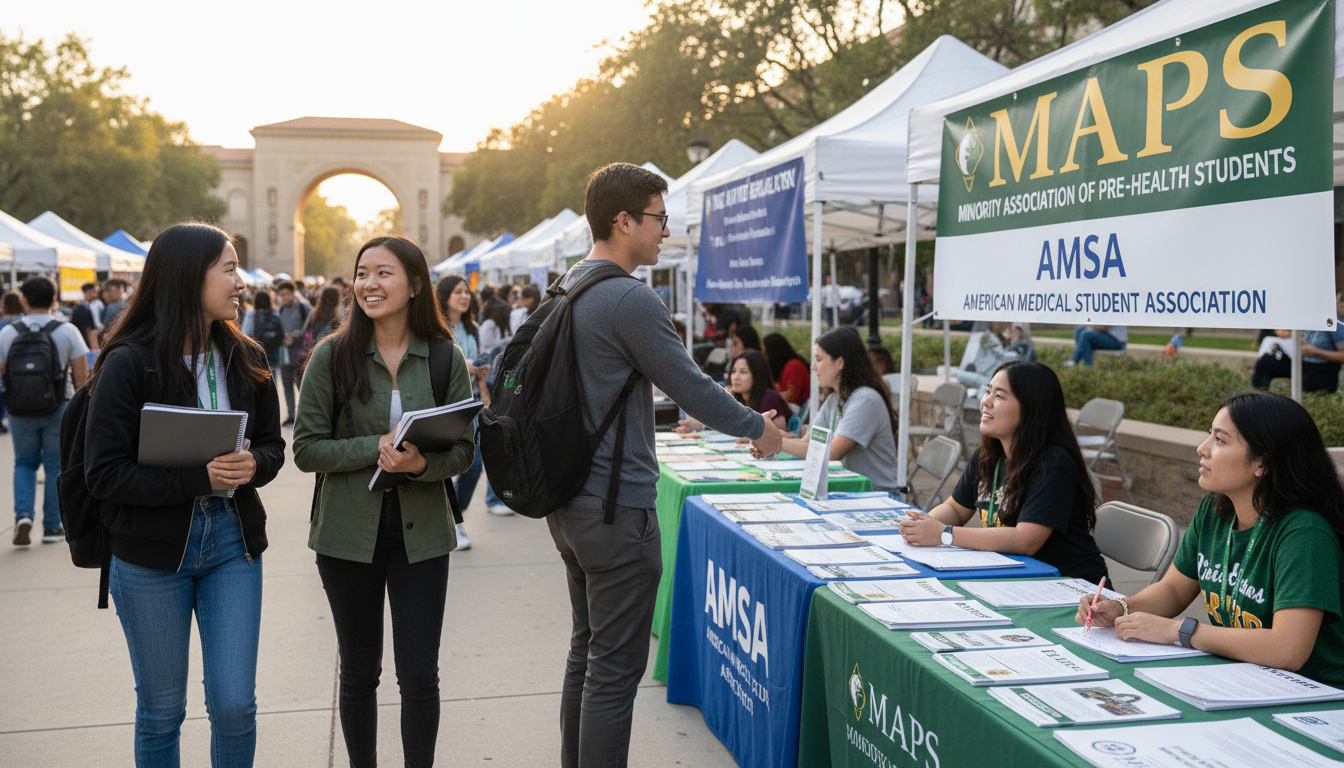
2.2: If Your Campus Has No Chapter, Go Regional
No chapter on your campus is not the end. It just means you build sideways.
Use national AMSA and SNMA chapter locators
- Visit the national websites:
- AMSA: search “AMSA chapter locator”
- SNMA: search “SNMA chapters” and “MAPS chapters”
- Look for:
- Nearby universities with active chapters
- Region‑wide events you can attend as a non‑member or guest
- Visit the national websites:
Email nearby chapter leaders Use a concise template (adapt as needed):
Subject: Pre‑med at [Your School] interested in attending AMSA/SNMA events
Dear [Name],
I am a pre‑medical student at [Your University], where we currently do not have an active [AMSA / MAPS] chapter. I saw that your chapter is active at [Their University] and I am interested in attending events, especially anything related to MCAT prep, application planning, or mentoring.
Would it be possible for me to attend your meetings virtually or in person, and are there any upcoming events that might be a good fit?
Thank you for your time,
[Your Name]
[Year/Major]
Many chapters will welcome you. Some will explicitly encourage cross‑campus involvement.
- Plan to attend at least one event within 30 days
- Virtual or in person.
- Prioritize:
- Application strategy nights
- MCAT panels
- Mentorship mixers
The goal is not just “information.” The goal is to meet 3–5 actual humans who can become part of your support network.
Step 3: Join Strategically, Not Passively
You do not want to be another name on a mailing list. You want to extract maximum value in minimum time.
3.1: Join Both if Possible, With Different Purposes
If you can, join:
AMSA for:
- Structure, national resources, and leadership roles that look strong on a CV
- MCAT discounts, test‑prep collaborations, big conferences
SNMA/MAPS for:
- Mentorship that understands URiM challenges
- Community that addresses representation, bias, and belonging
Having one of each type gives you both breadth and depth.
3.2: First‑Month Action Plan
For your first 4 weeks after joining, set specific output goals, not vague intentions.
Aim to:
Attend 2–3 meetings or events
- One general body meeting
- One workshop (MCAT, personal statement, clinical experiences, etc.)
- One social or mentorship‑focused event
Personally speak to at least 3 people per event
- One officer
- One med student (if present)
- One other pre‑med at the same phase as you
Use a simple intro:
“Hi, I am [Name], a [year] majoring in [X]. I am pretty new to pre‑med and trying to build a support network because I do not really have mentors yet. How has this group helped you so far?”
Then ask one specific follow‑up:
- “What did you use for MCAT prep?”
- “How did you find your first shadowing experience?”
- “What would you absolutely do differently if you were starting over?”
You are not networking for Instagram followers. You are mining for process knowledge.
- Follow up within 24 hours
- Connect via email, GroupMe, or WhatsApp.
- Send a short message:
“It was good meeting you at the AMSA meeting. I appreciated your advice about starting shadowing. Would you be open to a quick 15–20 minute call next week so I can ask a bit more about how you approached that?”
Most students will say yes. Few pre‑meds follow through. You will.
Step 4: Turn Members Into Actual Mentors
Having “people you know in AMSA/SNMA” is not enough. You want 3–5 active mentors filling specific roles:
- One or two undergrad pre‑meds 1–2 years ahead of you
- One med student
- Ideally, one physician or senior resident
4.1: Use Chapter Structures to Your Advantage
Many chapters already have mentoring frameworks. Your moves:
Ask directly about mentoring programs Questions to officers:
- “Does this chapter have any formal mentoring between pre‑meds and med students?”
- “Are there big‑little systems in this group?”
- “Do you pair people for application year support?”
If one exists, sign up immediately
- Complete any forms seriously: include your specific concerns (first‑gen, URiM, working part‑time, low GPA recovery, etc.).
- Attend the first mentor‑mentee event prepared with questions.
If no formal program exists, create a lightweight workaround Ask officers:
“Would it be possible to create a simple volunteer list of med students or alumni who are open to occasional questions from pre‑meds? I would be willing to help organize a Google Form and spreadsheet.”
That small initiative often gets you early access to mentors and can evolve into a real leadership role.

4.2: Run a 3‑Meeting Mentorship Protocol
Once you identify a potential mentor (med student, advanced pre‑med, or physician), use a clear 3‑conversation structure so the relationship does not fizzle.
Meeting 1: Story and Background (30 minutes)
Goal: understand how they got where they are and whether their path is relevant to yours.
Ask:
- “What did your pre‑med timeline look like from first year to acceptance?”
- “What were the biggest 1–2 obstacles you hit?”
- “If you were in my year again, what would you start doing this month?”
Your output: write a short “timeline sketch” for yourself based on what they described.
Meeting 2: Your Situation and Plan (30–45 minutes)
Before this, send them a 1‑page summary:
- Your GPA, major, and current courses
- MCAT target timeline
- Current experiences (clinical, volunteering, research)
- 3 biggest questions you have
Ask:
- “Given my current stats and experiences, what would you prioritize over the next 6–12 months?”
- “What mistakes do you see people like me commonly make?”
- “What would a realistic application year be for me?”
Your output: a draft 6‑month and 12‑month action plan.
Meeting 3: Check‑In and Calibration (20–30 minutes)
After 6–8 weeks of working your plan:
- Share what you have actually done:
- Meetings attended
- Clinical hours started
- MCAT study milestones
- Ask for calibration:
- “Does this seem on track for my goals?”
- “If I had to drop one commitment, which should it be?”
If the dynamic is helpful, you can continue informally with monthly check‑ins. If not, thank them, stay polite, and focus more energy on other mentors.
Step 5: Use AMSA/SNMA to Fix Specific Gaps in Your Application
You do not join these organizations for a line on the resume. You join to systematically close gaps: clinical exposure, shadowing, research, leadership, and MCAT.
5.1: Clinical Experience and Shadowing
Concrete moves:
Ask at meetings: “How are people here getting patient contact hours?”
- Listen for:
- Hospital volunteer programs that are friendly to your campus
- Local clinics that routinely accept students
- Scribing companies that recruit heavily from your school
- Listen for:
Request introductions, not vague advice
- Instead of “Do you know any places hiring?”, say:
“You mentioned you volunteer at [Clinic]. Would you be willing to introduce me by email to your coordinator so that I can ask about opportunities?”
- Instead of “Do you know any places hiring?”, say:
Leverage SNMA/MAPS for URiM‑friendly physicians
- Many SNMA physicians deliberately create shadowing pipelines.
- Ask MAPS officers:
- “Does your chapter have any partner physicians who offer recurring shadowing slots for students?”
- Be ready with:
- A 1‑page CV
- A professional email template
Turn one opportunity into many When you start shadowing:
- Show up early, be respectful, ask thoughtful questions.
- After 3–4 visits, ask:
“Do you know any colleagues who also allow pre‑meds to shadow, perhaps in different specialties?”
Shadowing is a network effect game. AMSA and SNMA get you in the first door.
5.2: MCAT Strategy and Execution
AMSA in particular is strong here, but SNMA conferences and MAPS events often include robust MCAT content too.
Your protocol:
Find or form a study group with structure
- Ask the AMSA academic chair: “Are there any current MCAT study groups or interest lists?”
- If not, propose:
- A weekly or twice‑weekly group
- A shared schedule (e.g., 4–6 month plan using Kaplan/AAMC resources)
Exploit discounts and resources
- National AMSA often partners with Kaplan, Princeton Review, Blueprint, etc.
- Compare discounts vs your budget.
- If you cannot afford a course, ask your chapter:
- “Have previous members shared any study schedules they used successfully?”
Use med students as reality check
- Ask them:
- “What score range did you target for your school list?”
- “How did your MCAT interact with your GPA?”
- You want realistic targets, not fantasy numbers.
- Ask them:
Track and share progress
- Once a month, share your practice test numbers with your study group or mentor.
- Ask for suggestions if you plateau.
Step 6: Build Leadership and Credibility (Without Overcommitting)
Leadership in AMSA/SNMA is not just about titles. When done thoughtfully, it becomes:
- Evidence of commitment
- Direct access to faculty, deans, and physicians
- A narrative about impact and initiative for your personal statement
6.1: Pick One Focused Role
Avoid the trap of doing five things poorly. Choose one of these that matches your skills and time:
Programming/Events Officer
- Run MCAT nights, mock interviews, specialty panels.
- You will naturally interact with med students and physicians.
Mentorship/Outreach Coordinator
- Build or manage the pre‑med–med student mentor list.
- Coordinate high school outreach or pipeline programs.
Community Service/Clinical Coordinator
- Organize recurring volunteer shifts at a free clinic, nursing home, or community health fair.
1 role done well beats 4 roles listed superficially.
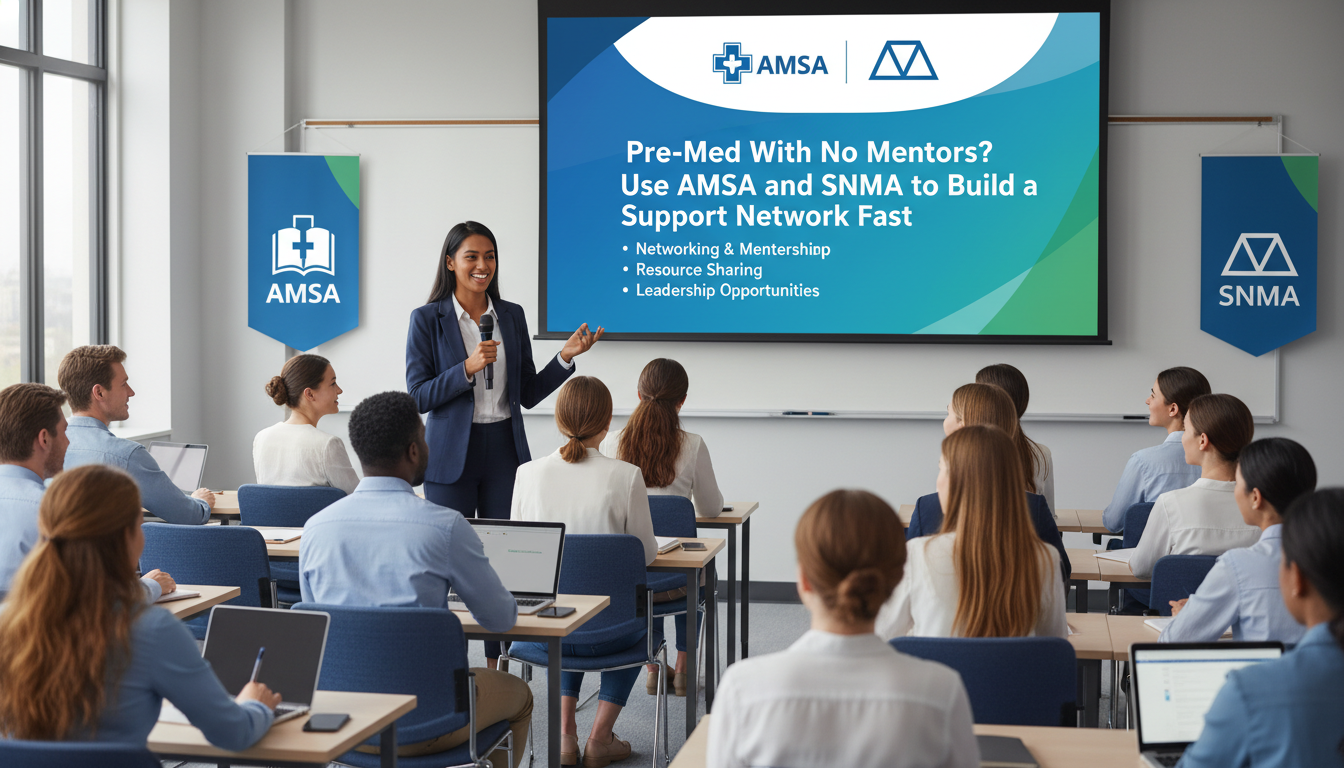
6.2: Make Your Leadership Measurable
You want outcomes, not just activity. Track impact:
- “Increased active MAPS membership from 12 to 35 students in one semester.”
- “Organized a 4‑session MCAT workshop series with average attendance of 25 and reported average practice score increase of 4 points.”
- “Coordinated a new monthly volunteer partnership at [Clinic], resulting in 20 students contributing over 300 clinical hours in 6 months.”
Keep a simple log:
- Date
- Event / Initiative
- Your role
- Quantifiable outcomes
This becomes gold when writing your personal statement and secondary essays.
Step 7: Fix Social Isolation by Design, Not Hope
A key hidden function of AMSA and SNMA is psychological: they keep you from emotionally imploding when orgo and physics hit simultaneously.
You want peers at your level as much as you want mentors above you.
7.1: Build a Core “Support Pod” of 3–5 People
From AMSA/SNMA/MAPS, intentionally assemble a small group:
- Same general timeline (e.g., all planning to apply in 2–3 years or in the same upcoming cycle)
- Different majors and backgrounds if possible
- Shared seriousness about medicine
Propose:
- A weekly or bi‑weekly check‑in (30–45 minutes, in person or virtual)
- Simple structure:
- One academic win and one struggle
- One professional step taken (shadowing, volunteering, MCAT work)
- One ask (e.g., “I need someone to look at my activity descriptions this week.”)
This is not a “complain circle.” It is mutual accountability.
7.2: Use Conferences to Expand Your Network Fast
Both AMSA and SNMA run powerful regional and national conferences.
If you can attend one:
Before you go
- List 3 goals:
- E.g., “Find 1 mentor in internal medicine,” “Collect 2 examples of strong personal statements,” “Learn what score range I need for X schools.”
- Reach out to chapter officers or national leaders:
- “I will be at [conference]. Are there any sessions or people you recommend I specifically try to meet given that I am a [year] pre‑med?”
- List 3 goals:
During the conference
- Sit near people who look engaged; introduce yourself quickly after sessions.
- Ask speakers 1 specific follow‑up question and then:
“Would you be open to my emailing you 1–2 specific questions later as I plan my path?”
After the conference
- Send short thank‑you emails to anyone who helped you.
- Add 2–3 people to your ongoing check‑in rotation.
Step 8: If Your Chapter Is Weak or Disorganized, Fix It Strategically
Some campuses have AMSA/SNMA in name only. Poorly attended, no real programming, no mentorship.
You have two options: extract what little value exists and look elsewhere, or become the person who rebuilds it.
8.1: Minimal Engagement Strategy
If you are overloaded or the organization is beyond saving this year:
- Stay on the email list for occasional relevant events.
- Attend only:
- The best‑advertised panels
- Any event featuring med school admissions staff
- Major workshops on MCAT or applications
Get your value, but build your real network using:
- Nearby campuses
- Virtual national events
- Direct outreach to med students found through LinkedIn and SNMA/AMSA directory listings
8.2: Rebuild Strategy (If You Have 1–2 Years Left)
If you are willing to invest, you can turn a dead chapter into a career asset.
Stepwise plan:
Find 1–2 other serious students interested in rebuilding.
Meet with a faculty advisor or pre‑health dean:
- Present a 1‑page plan:
- 2–3 events for the coming semester (MCAT panel, clinical opportunities workshop, med student Q&A)
- A basic leadership structure
- A membership recruitment idea (e.g., visiting intro bio lectures)
- Present a 1‑page plan:
Request institutional support
- Modest funding for food at events
- Access to email lists for pre‑health students
- Zoom / room reservations
Run 1 pilot event well
- Example: “How I Got Into Medical School: Panel of 3 Alumni”.
- Execute tightly: start on time, moderate professionally, gather turnout data.
Use success to recruit
- Present at intro science classes:
“At our last event, we had 40 students and 3 accepted applicants share detailed application timelines. If you want that kind of support as you plan your path, join us.”
- Present at intro science classes:
Rebuilding a chapter like this becomes a central leadership story in your application.
The Core Moves To Remember
Do not stay isolated. Use AMSA and SNMA/MAPS as pre‑built infrastructures for mentorship, clinical access, MCAT support, and realistic planning. Join at least one within the next month, preferably both.
Be intentional, not passive. Treat meetings as missions: speak to specific people, ask targeted questions, and follow up within 24 hours. Build 3–5 active mentors and a small peer “support pod.”
Translate involvement into outcomes. Use these organizations to directly fix application gaps: shadowing, clinical hours, MCAT strategy, and leadership. Track measurable impact and let that become the backbone of your story when you finally hit “submit” on your AMCAS.