
The dirty secret about AMSA on CVs is this: most faculty skim right past it—unless you give them a reason to stop.
You’ve been told for years that “AMSA involvement looks good on applications.” That’s only half-true. To the people actually sitting in the residency conference room or medical school admissions committee, “AMSA Member” is white noise. Everyone has it. It means nothing on its own.
When I sit in those meetings with program directors, clerkship directors, and admissions deans, here’s what really happens when we see AMSA on a CV: we run a quick mental filter in under three seconds—keep, flag, or ignore. Your entire year of meetings, fundraisers, and late-night advocacy emails often gets decided in that three‑second window.
Let me show you exactly how that filter works.
(See also: AMSA Conferences: What Happens in Invite‑Only Rooms You Never See for more details.)
The Truth: “AMSA Member” Alone Is Background Noise
On 90% of premed and medical student CVs, AMSA appears as one sad little line:
American Medical Student Association (AMSA), Member, 2021–2024
That line does nothing for you.
Faculty know AMSA is one of the default student organizations. It’s like “Biology Club” for undergrads or “Internal Medicine Interest Group” in medical school. Joining is easy. Showing up to a couple of meetings is easy. There’s no way for us to distinguish the passive member who went for pizza from the person who ran half the chapter… unless you spell it out.
Behind closed doors, here’s how it plays out:
- The junior faculty member reading your CV thinks: “Okay, you checked a box. Next.”
- The program director scanning quickly between cases glances over it with the same mental energy they’d give to “Hobbies: Reading, Traveling.”
- The one faculty member who actually values student advocacy might want to care, but if you give them no detail, there’s nothing to work with.
So the baseline rule is brutal but accurate:
“AMSA member” carries zero weight unless elevated by role, impact, or alignment with your story.
The question then becomes: what does catch their eye?
The Four AMSA Signals Faculty Actually Look For
When faculty do pause on your AMSA entry, they’re subconsciously scanning for four specific things:
- Leadership with real responsibility
- Evidence of initiative (you built something, not just maintained it)
- Tangible outcomes (numbers, changes, deliverables)
- Alignment with your stated career interests
If your AMSA line doesn’t telegraph at least two of those four, you’re leaving value on the table.
Let’s walk through how each one looks from our side of the table.
1. Leadership That Suggests You Can Herd Cats
Program directors know one sobering truth: residency is full of smart people who cannot organize anything to save their lives. So we look for signs you’ve already managed complex, messy, human situations.
“AMSA leadership” does not automatically mean anything impressive. Chair of “Social Media Committee” for a chapter of 10 people? That’s nice. It isn’t moving the needle by itself. But certain roles do make us sit up:
- Chapter President at a large school
- National leadership roles (even small ones)
- Regional or national committee lead with deliverables
- Conference planning with >100 attendees
The key is size and complexity. If I see:
AMSA Chapter President, 250+ member chapter; led 12‑person executive board and $18,000 annual budget
Now I’m thinking, “This person has actually run something that looks like a small residency program: budget, people, conflict, planning.”
Inside committees, the conversations are very specific:
- “Who’s going to be chief one day?”
- “Who can run a QI team and not fall apart?”
- “Who will actually answer emails and get things done?”
Substantial AMSA leadership, written clearly, makes us put you in that “possible chief / organizer” bucket early.
2. Initiative: Did You Create, Or Did You Just Inherit?
Faculty can smell “title collectors” instantly.
We see a CV with:
“AMSA Community Service Chair, 2022–2024”
and nothing else. No bullets, no explanation, nothing.
You probably answered a few GroupMe messages and showed up to a pre-existing service day. That’s not initiative. That’s maintenance.
But if I see:
Founded new AMSA Community Health Initiative coordinating monthly BP and diabetes screenings at 3 local churches; recruited and trained 27 volunteers.
Now we’re in a different category.
Behind the scenes, here’s the mental script:
“Okay, this student saw a gap, built something from scratch, got others involved, and stuck with it long enough for it to become real. That translates directly to residency: new clinic workflow, new QI project, new curriculum session.”
This is why two students with “same” AMSA title get treated very differently:
- Student A: “Co-Chair, Global Health Committee.”
- Student B: “Co-Chair, Global Health Committee – revived dormant committee; launched new virtual speaker series (10 sessions, average 60 attendees from 12 schools).”
Same line on paper. Entirely different credibility.
3. Outcomes You Can Count (And We Can Visualize)
Faculty live in the world of metrics: length of stay, readmission rates, patient satisfaction, board pass rates. We instinctively calibrate to numbers.
AMSA involvement that stays in “soft” language—“helped”, “participated in”, “worked on”—blends into the background. But if you give us numbers, we can feel the scale.
These are the kinds of outcomes that jump out:
- Attendance: “organized 4‑session Step 1 prep series; average turnout 90 students/session.”
- Fundraising: “raised $7,500 for free clinic through AMSA advocacy campaign.”
- Reach: “social media campaign reached ≈20,000 impressions across three platforms.”
- Policy wins: “contributed to AMSA resolution adopted at national convention, later cited in state-level telehealth policy brief.”
Faculty don’t expect you to single-handedly change national healthcare policy. We just want something concrete enough that we can say: “Ah, this wasn’t theoretical. It existed in the real world.”
4. Alignment: Does Your AMSA Story Match The Rest Of You?
This is the part almost no one thinks about, but every experienced faculty member does.
We’re always checking for thematic coherence. If your personal statement is about health policy and advocacy, but your AMSA involvement is limited to pizza socials and Step 1 review sessions, that disconnect weakens your credibility.
Flip it around:
- You say you’re passionate about primary care and underserved communities.
- Your AMSA work includes free clinic projects, community health fairs, and insurance literacy workshops.
- You then apply to family medicine or pediatrics.
Now your AMSA entry isn’t an “extracurricular.” It’s supporting evidence.
On the other hand, if you’re applying neurosurgery and your AMSA story is 100% about national single-payer reform, some programs will love that, and some will smile politely and move on. Alignment is also about knowing your audience.
The insiders’ trick:
Use your AMSA involvement to anchor your stated interests, not compete with them.
What Impresses Faculty More Than You Realize
Let me give you specific AMSA patterns that quietly impress committees—things students don’t realize we pick up on.
Longitudinal Commitment, Not One Shiny Year
We notice when your narrative looks like this:
- M1: General member, helped with small projects
- M2: Committee member, took on subprojects
- M3/M4: Leadership with defined responsibility
That upward trajectory says: you stuck around, learned the ropes, and earned leadership. That’s how we want to see you move through residency: intern, senior, chief, maybe fellowship.
A one-year “drop-in” presidency with no prior involvement raises more questions. Did no one else want the job? Was this mainly for the title?
Increasing Complexity Of Work
Another pattern we quietly track: did your tasks get more complex, or just louder?
- Starting with “organized one speaker event”
- Evolving into “coordinated full-day regional conference with 150 participants and 12 sessions”
- And finally “led debrief, compiled outcomes report, and transitioned structure to next year’s team”
That tells us you can scale up. Residents who can’t scale up stay permanently in “I can only handle one patient at a time” mode.
Evidence You Worked With Adults Outside The Bubble
AMSA that leaves the student bubble hits different:
- Collaborating with community clinics or local health departments
- Meeting with legislators or staffers for advocacy days
- Partnering with hospital administration on a policy or event
- Running health education in non-student communities (faith centers, shelters, schools)
When I see those, I infer you’ve already navigated some real-world power structures and bureaucracy. That matters, because residency is 50% medicine, 50% navigating systems.
Common AMSA Mistakes That Quietly Hurt You
Not only can AMSA be under-leveraged, it can actually harm you subtly when presented poorly. Here’s what we notice but rarely say out loud.
1. Overinflated Titles And Vague Claims
“National leader,” “key organizer,” “major role” without context gets side‑eyed in committee.
We see thousands of CVs. We know what real national leadership looks like because we’ve served on those committees or advised students who have. If you claim something grand and back it up with nothing concrete, it reads as exaggeration, and that’s poison in this process.
2. Scattershot Involvement In 10 Organizations
If AMSA is one of 9 different clubs, each with a “Treasurer” or “Co‑Chair” title, it starts to look like you collect leadership for its own sake. Faculty will quietly say things like:
- “When did this person actually study?”
- “Where did they actually dig deep? I don’t see depth anywhere.”
Three to four substantial commitments always beat ten shallow ones.
3. Aggressive Advocacy With No Nuance
This one is delicate, but it’s real.
Some AMSA chapters are highly political. That’s not inherently bad. But when your AMSA bullets read like a manifesto and never like a collaboration, some faculty worry about how you’ll function in a diverse clinical environment.
There’s a difference between:
“Led confrontational protest against hospital administration regarding equity.”
vs.
“Co‑organized equity-focused town hall between students and hospital leadership; facilitated discussion that led to revised interpreter use policy.”
Same underlying concern. Entirely different signal about how you handle disagreement and systems change.
How To Write Your AMSA Entry So Faculty Actually Care
You might already have meaningful AMSA experiences. They’re just buried under generic phrasing. The way you write this section is the difference between “ignored” and “this is interesting, tell me more.”
Here’s the blueprint faculty respond to:
- Clear role – not just “member.”
- Scope – size of group, budget, reach.
- Actions – what you actually did, not what the committee theoretically does.
- Outcomes – numbers, changes, products.
- Selective detail – 1–3 strong bullets, not a wall of text.
Compare these:
Weak:
American Medical Student Association (AMSA), Member, 2021–2024
– Attended meetings and participated in activities
– Helped with community service events
Strong:
American Medical Student Association (AMSA), Chapter Vice President, 2022–2024
– Co-led 220‑member chapter; oversaw 6 committees and $9,500 annual budget; implemented new officer transition structure now adopted by subsequent leaders.
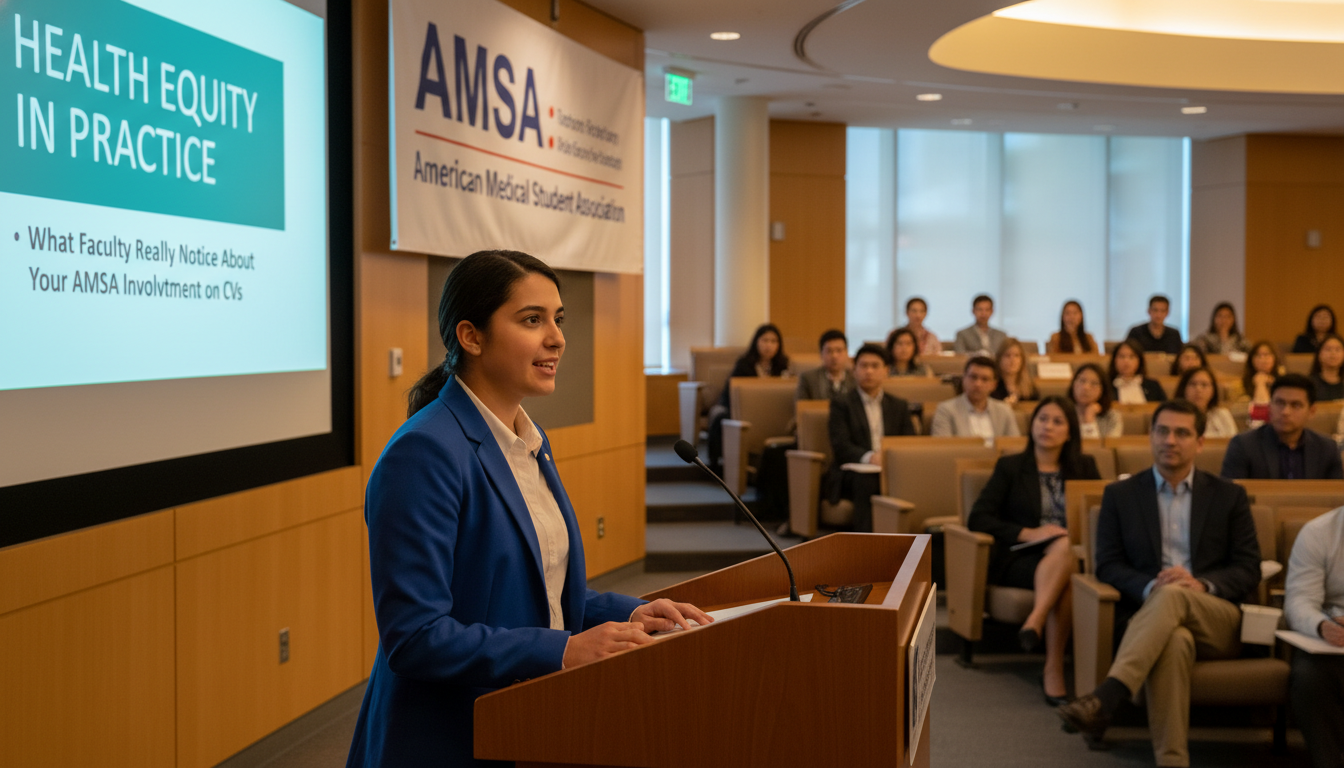
– Developed and launched monthly “Health Equity in Practice” series (8 sessions, average 80 attendees) featuring faculty, community physicians, and patient advocates.
– Coordinated 3 annual community health fair events serving ≈450 total participants; partnered with local FQHC to provide follow‑up primary care appointments.
Now a faculty member can see you in a workroom, in a clinic, in a meeting. You’ve become a three-dimensional person, not just a name on a list.
How This Plays Differently For Premeds vs Med Students
You’re in the “Premed and Medical School Preparation” phase, so the expectations shift a bit depending on where you are.
For Premeds
Admissions committees know your opportunities are more limited. You’re not expected to run national campaigns.
Here’s what we look for:
- Did you stick with AMSA (or premed AMSA) more than one semester?
- Did you earn trust—becoming an officer, running a project, helping new members?
- Can you show impact proportionate to your level?
A premed AMSA entry like this is strong:
AMSA Premed Chapter, Service Chair, 2023–2024
– Organized 6 health education events at local high schools (topics: vaping, sexual health, nutrition); reached ≈280 students total.
– Created feedback surveys for participants; 87% reported increased understanding of topic after sessions.
That’s gold at the premed level. Concrete, community‑facing, consistent.
For Medical Students
The bar rises.
If you’re an M3/M4 applying to residency, faculty expect your AMSA involvement—especially leadership—to translate into:
- Project management
- Collaboration across departments or institutions
- Some interfacing with faculty, administrators, or external organizations
- Reflection: how did this shape your approach to medicine?
A purely social AMSA role advertised as “Major Leadership” will feel thin. By M4, AMSA should be either deeply meaningful or honestly minor on your CV. Middle ground is hard to sell.
When AMSA Actually Becomes A Talking Point In Interviews
Here’s the final filter: out of fifty AMSA lines we see in applications, maybe five become actual interview conversation topics.
The ones that do usually have at least one of these:
- You did something innovative (new program, new format, new partnership).
- Your work ties directly to the specialty or population you’re applying to.
- There’s a story of failure and recovery (your first event flopped, you fixed it).
- The impact was clearly beyond what most students usually do.
On interview day, a faculty member will flip through your CV, circle one or two items, and say, “Tell me about this.” You want your AMSA entry to be circled.
When they ask, they’re not just gauging what you did. They’re watching:
- Do you credit your team?
- Do you own your mistakes?
- Can you articulate what you learned beyond “time management”?
- Do you show humility and pride appropriately?
A polished AMSA story can be your best “leadership/advocacy” answer. A vague one will get you through the question but won’t stick in anyone’s memory when we vote at the end of the day.
Where This Fits In Your Bigger Journey
In the long arc from premed to intern, AMSA is just one thread. But used well, it can be the thread that ties your narrative together: advocacy, leadership, systems thinking, patient-centered work.
Used poorly, it’s just another line that proves you learned how to sign up for a listserv.
Now you know what faculty really see when they skim your CV and land on “AMSA.” You know the silent calculus that happens in those three seconds. The next step is yours: either reshape what you’re already doing, or rewrite how you present it so the depth is visible.
You’re still early in the journey. With this lens, you can choose roles and projects now that will actually matter when someone like me is sitting in a windowless conference room, voting on your name.
The application file is only one part of the story. The way you live your training—that’s what we’ll talk about next time.