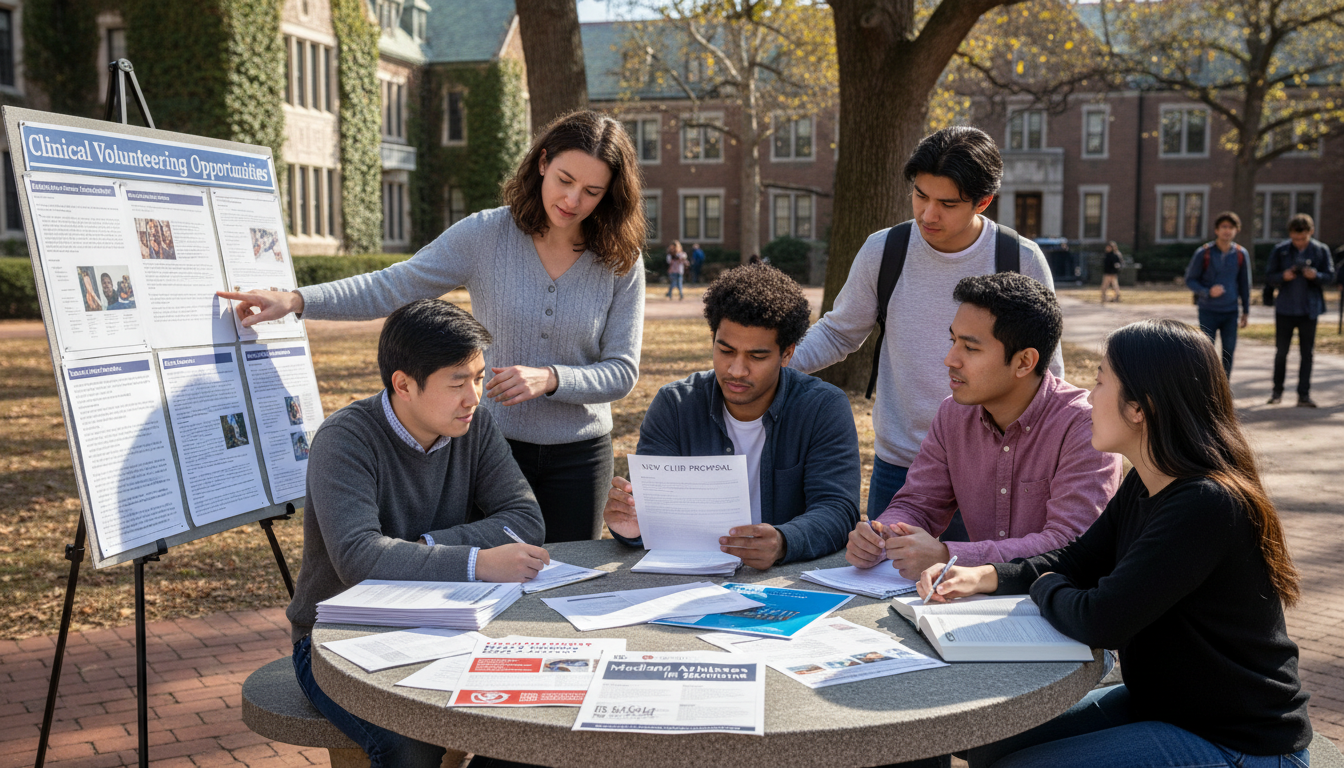
The obsession with “founding a club” is one of the most overhyped, least evidence-based strategies in premed culture.
Somewhere along the way, advising offices, Reddit threads, and anxious group chats turned “leadership” into “you must start a club or you’re doomed.” That’s not what medical schools are actually selecting for. At all.
Let’s dismantle this properly.
What Schools Actually Care About (Hint: It’s Not Your Club’s Constitution)
(See also: Are Student Organizations a Distraction? Evidence on Grades and Burnout for more insights.)
Admissions committees are not counting how many organizations you’ve created. They’re trying to answer a few very specific questions:
- Do you follow through on things over time?
- Do you make other people’s lives better in concrete, observable ways?
- Are you someone people trust, work with, and rely on?
- Do you have the discipline and maturity to handle medicine’s demands?
Those questions can be answered with or without a brand-new organization attached to your name.
Look at the AAMC’s core competencies for entering medical students: service orientation, reliability, resilience, teamwork, social skills, ethical responsibility, critical thinking, etc. Nowhere does it say, “Must found club to demonstrate worth.”
And when you read the MSAR (Medical School Admission Requirements) activity breakdowns or look at successful applicants’ experiences on places like Student Doctor Network or r/premed, a pattern appears:
- Long-term involvement in existing orgs (e.g., 3 years in AMSA, leadership in a service group)
- Sustained clinical volunteering or employment
- Research with increasing responsibility
- Meaningful community service, often outside campus
- A few targeted leadership roles (often in pre-existing organizations)
There’s no bonus column that says: “ +0.2 GPA equivalent if you invented a new club.”
Because that’s not how this works.
The Problem with the “Found a Club” Arms Race
Starting a club can be legitimate. It can also be the extracurricular version of empty calories.
Here’s the uncomfortable pattern admissions folks see all the time:
- A student “founds” a new organization junior year
- The club has:
- 4–10 members
- 2–3 meetings
- One “major event” that’s a panel or fundraiser with minimal impact
- A Canva-made logo and a group chat
- The activity description on AMCAS: “Founder and President of the XYZ Medical Outreach and Global Health Initiative”
On paper it looks grand. In reality, it’s indistinguishable from dozens of other short-lived orgs that vanish as soon as the founder graduates.
Committee members are not fooled by that. They’ve seen 10,000 versions.
They look for:
- Longevity: Did this exist for multiple semesters or years?
- Scalability: Did membership or impact grow?
- Outcomes: Did anything change for patients, communities, or peers?
- Independent corroboration: Is there evidence beyond “I said it was important”?
An unimpactful club with a flashy title can actually hurt you more than a modest, honest role with real substance. It signals that you’ve been optimizing appearances instead of service.
If your “club” is basically:
- You, your roommate, and a GroupMe
- One event + ghosting
- No clear purpose besides padding a CV
…admissions readers will recognize the pattern instantly.
What Actually Signals Leadership (Without Founding Anything)
Leadership isn’t about being the first name on the constitution. It’s about changing systems, improving experiences, and taking responsibility over time.
You can do that fully inside an existing structure.
Examples that routinely impress committees more than a flimsy “founder” title:
Clinic coordinator at a student-run free clinic
- You inherit an existing system
- You streamline patient flow, cut wait times, improve follow-up
- You train new volunteers and maintain quality
- Impact is visible, measurable, and verifiable
Treasurer or VP of an established organization
- You actually manage money and logistics
- You grow the budget, increase attendance at events, or expand a program
- Records exist; faculty advisors know you; impact is real
Lead TA for a high-demand course
- You don’t “found” anything
- You restructure review sessions, mentor struggling students, coordinate other TAs
- Faculty can write detailed letters about your reliability and initiative
Volunteer coordinator at a hospital or nonprofit
- You assign shifts, train new volunteers, rearrange workflows
- You solve human problems in real time (no-show volunteers, confused patients, frustrated staff)
- That’s leadership in its purest form: responsibility + people + stakes
All of those are more convincing than a thin “Founder & President” line item with no story, no outcomes, and no endurance.
Admissions officers read your activities not as a list of titles but as a narrative of what you actually did when given responsibility.
When Founding a Club Does Make Sense
Now for nuance. There are absolutely times when starting something new makes sense and is valuable. But the bar is higher than “I want another line on my AMCAS.”
Launching a new organization can be compelling when:
There’s a real, persistent gap
- Your school has zero support for first-gen premeds, LGBTQ+ premeds, or students interested in a niche combination (say, medicine and climate justice).
- Current groups are inactive or uninterested in that need.
You build something that outlives you
- You recruit a functioning leadership team.
- You create structure: bylaws, transition documents, advisor support.
- The club still exists 1–2+ years after you started it.
You can point to outcomes, not just meetings
- Did you run recurring events with good turnout?
- Did you partner with clinics, high schools, nonprofits?
- Did anything change for people outside your executive board?
You didn’t do it alone in a vacuum
- Collaboration with established organizations, departments, or community groups makes your work more credible.
- If only your friends and one professor can vouch for the club, it’s less convincing.
For instance, starting a campus chapter of a national organization (e.g., Universities Allied for Essential Medicines, Primary Care Progress) and growing it over several years is usually more meaningful than a one-off, fully independent club that never stabilizes.
Founding something is not inherently impressive. Founding something that works and matters is.
What the Data and Patterns Actually Show
Medical schools don’t publish “club founding” statistics, but we do have patterns from:
- AAMC data on applicant and matriculant activities
- Surveys of admissions deans
- Profiles of successful applicants on school websites and advising pages
- Recurring themes in accepted-student posts
Those patterns consistently emphasize:
Depth > Breadth
Applicants with 3–5 highly developed activities over several years are often preferred to those with 10+ shallow involvements.Impact > Titles
“Improved clinic show rates by 20% by redesigning reminder systems” tells a better story than “Founded XYZ Health Club.”Consistency > Novelty
3 years in a community health program with increasing responsibility routinely beats “created three short-lived organizations” in junior year.Alignment > Hype
Activities aligned with your stated interests and reflections in your personal statement matter more than flashy, disconnected achievements.
If you talk to experienced premed advisors who actually sit on or work closely with admissions committees, many will tell you the same quiet truth: 90% of “founder” titles look identical and carry little weight unless backed by substantial, sustained work.
How to Build a Strong Application Without Ever Starting a Club
Here’s a more reality-based blueprint.
You don’t need all of these, but a combination of several, done well and consistently, is far more valuable than forcing yourself to start a club you don’t care about.
1. Anchor Yourself in One or Two Core Service Roles
Examples:
- Free clinic volunteer who becomes shift leader, then training coordinator
- Hospital volunteer who moves into a specialized role (ED liaison, interpreter, patient navigator)
- Community health outreach worker with expanding responsibilities
Tell a story of growth: you start as a line volunteer; you end as someone shaping how the work gets done.
2. Go Deep in an Existing Student Organization
Pick one or at most two. Stay for years.
You might:
- Run the mentorship program for underclassmen
- Overhaul how events are planned and evaluated
- Build a partnership with a local school or nonprofit
- Grow membership and participation in a measurable way
This gives you concrete, credible leadership without inventing anything.
3. Invest in Longitudinal Projects
These can be research, quality improvement, outreach initiatives, or teaching programs.
What matters:
- You’re there long enough to see cycles of planning → implementation → reflection.
- You can answer: “What did you learn about working with others, systems, and setbacks?”
A year on a research project that goes from data collection to manuscript submission demonstrates more maturity than a spontaneous club that dissolves as soon as your apps are in.
4. Build Relationships That Lead to Strong Letters
Impressive titles are meaningless if nobody can write a detailed letter about how you actually function.
Work closely with:
- A PI or research mentor
- A clinic or program director
- A faculty advisor in an organization you did not create
- A community leader you’ve partnered with
Real leadership is easier to recognize from the outside when you step into and excel within existing complex systems.
What to Do If You Already Started a Club
If you’ve already jumped on the “founder” train, you’re not doomed. You just need to handle it honestly and strategically.
Ask yourself:
- Is this still active?
- Does it involve more than my close friends?
- Does it serve a real need?
- Could it survive after I graduate?
If the honest answer is “not really,” then:
- Treat it as a learning experience, not your flagship brag.
- Emphasize what you learned about organization, failure, and course correction.
- Do not oversell it as a major impact if it wasn’t.
If it is active and meaningful:
- Focus your application description on outcomes, not ego.
- Name who benefited and how.
- Mention continuity (new officers, advisor involvement, ongoing programs).
Your goal is to show maturity, not branding skill.
The Deeper Myth: Leadership = Spotlight
Beneath “you must found a club” sits a worse misconception: that leadership is about being the most visible, most decorated person in the room.
Medicine does not work that way.
The best residents and attendings:
- Take ownership when things go wrong
- Build functional teams quietly
- Notice gaps in care and fix them, sometimes without credit
- Improve processes so others succeed more easily
Most of those actions don’t come with a title, much less “founder.”
When admissions committees look at your extracurriculars, they’re trying to forecast what kind of colleague you’ll be:
- Will you show up when you’re tired?
- Will you put patients ahead of your image?
- Will you admit mistakes and improve systems?
None of those require you to have authored a constitution sophomore year.
The Bottom Line
Three key truths cut through the noise:
Founding a club is optional, not required. There’s zero evidence that “founder” status alone moves the needle more than deep, sustained involvement in existing organizations.
Impact, longevity, and responsibility matter more than titles. A low-ego, high-impact role in a functioning system beats a shallow “President & Founder” line almost every time.
You can build a standout application by doing real work in real settings. Clinics, labs, community organizations, established campus groups—these are all places to demonstrate leadership, growth, and service without inventing anything from scratch.
If you start something, do it because the gap is real and you’re prepared to build it for others, not because someone told you a “founder” title is your golden ticket. It isn’t.