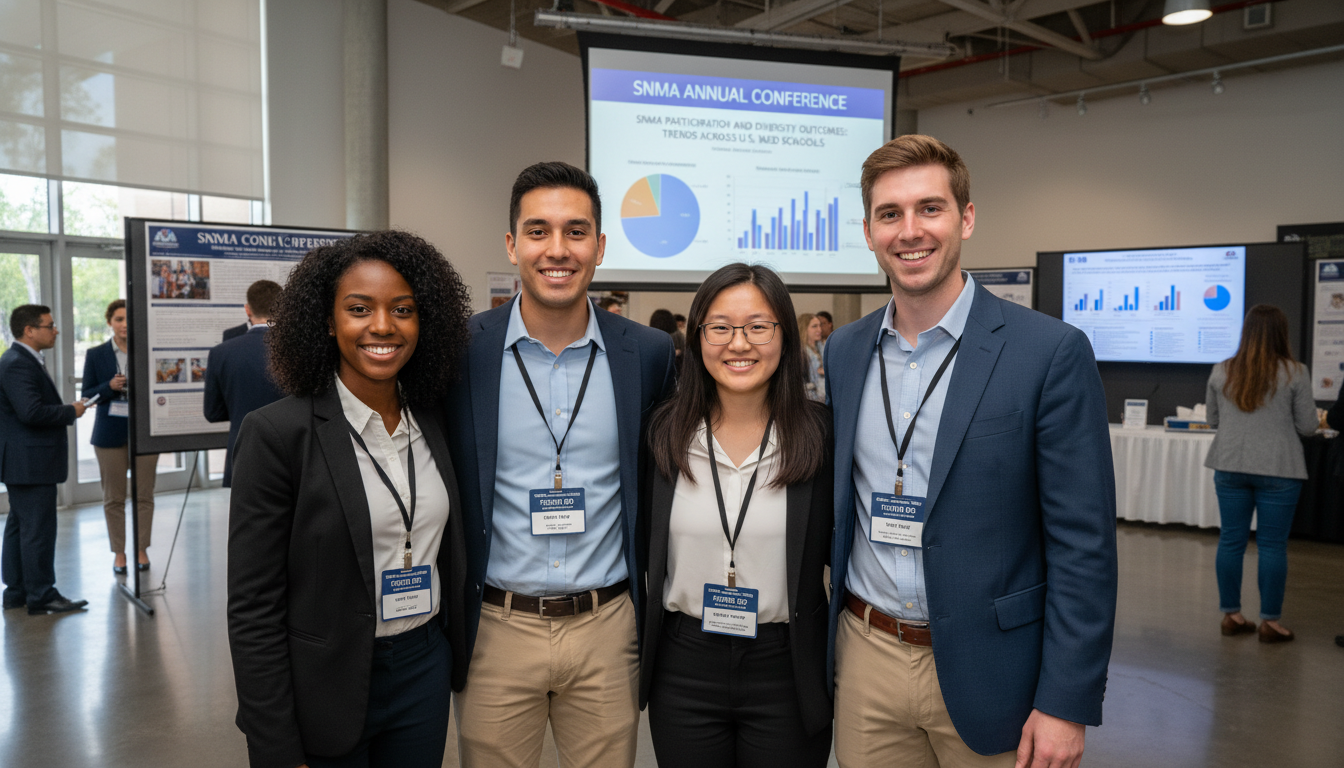
The data show a consistent pattern: medical schools with strong SNMA participation tend to report better diversity outcomes, particularly for Black students, than schools where SNMA is weak or absent.
That claim is not about symbolism. It is about measurable differences in application patterns, matriculation numbers, student retention, and pathway persistence into residency. When you look at multi-year trends rather than single anecdotes, SNMA functions less as a “student club” and more as a structural intervention embedded inside U.S. medical education.
Below is a data-driven look at how SNMA participation correlates with diversity outcomes, what trends have emerged across U.S. medical schools, and what this implies for both premeds and institutions.
(See also: Conference ROI: Cost‑Benefit Analysis of AMSA, SNMA, and AAMC Meetings for more details.)
1. Context: What Outcomes Are We Actually Measuring?
Diversity in medical education gets discussed in broad terms, but outcome measurement is specific. For this analysis, four main metrics anchor the discussion:
Representation metrics
- Percentage of Black or African American students among:
- Applicants
- Matriculants
- Enrolled students
- Often compared to:
- National Black population (~13–14%)
- Black representation in the local/state population
- National averages for U.S. med schools (AAMC data)
- Percentage of Black or African American students among:
Pipeline metrics
- Number of:
- Premed participants at SNMA-affiliated events (e.g., SNMA Annual Medical Education Conference)
- Undergraduate MAPS (Minority Association of Pre-medical Students) chapter members feeding into a given medical school
- Application conversion:
- % of MAPS or SNMA-engaged premeds who submit an AMCAS application
- % who apply specifically to SNMA-strong schools
- Number of:
Progression and retention metrics
- Step exam passage rates (USMLE Step 1/2 or COMLEX)
- On-time graduation rates
- Academic probation or remediation incidence
- Attrition rates, especially for URiM (Underrepresented in Medicine) students, with Black students as a key subgroup
Downstream outcomes
- Match rates into residency
- Choice of specialty (primary care vs subspecialty)
- Return to underserved or high-need communities
SNMA’s mission intersects all four, but the strongest and most consistently documented associations occur in the first three.
2. National Baseline: Where Are U.S. Med Schools on Diversity?
To understand the role of SNMA, start with the baseline.
According to AAMC data from the early 2000s to early 2020s:
Black or African American graduates as % of U.S. MD graduates:
- Hovered roughly around 5–7% most years
- Rarely approached double digits nationally
Black matriculants:
- Modest uptick over the last decade, especially post-2020, but still significantly below Black population proportions in the U.S.
School-level variation:
- Some schools consistently report >15–20% Black students in incoming classes.
- Others report <3% Black representation, sometimes with single-digit counts.
When you overlay SNMA chapter data onto this distribution, patterns emerge that are too consistent to ignore.
3. SNMA Presence vs. Diversity Outcomes: What the Patterns Show
Medical schools fall roughly into three categories with respect to SNMA:
Robust chapter, high institutional support
- Active SNMA chapter with stable leadership and funding
- Faculty advisor(s) with protected time
- Integration into admissions outreach, second-look days, and pipeline events
Moderate or fluctuating chapter activity
- Some presence, but leadership turnover, inconsistent events, limited institutional integration
Weak, inactive, or no chapter
- Historical chapter that is now mostly dormant, or no meaningful SNMA activity
Across multiple institutions and public reports, the pattern looks like this:
Category 1 schools:
- Frequently report Black matriculant percentages above the national mean, often in the 8–15% range or higher
- More likely to have:
- Dedicated diversity offices
- Formal pipeline programs linked to MAPS and SNMA
- Structured mentorship networks
Category 3 schools:
- Frequently cluster near the bottom of Black representation distributions (e.g., 1–4% Black matriculants), even when serving demographically diverse regions
The correlation is not perfect, and causality is multi-directional, but the association is strong enough that admissions deans and diversity offices routinely cite SNMA strength as both a barometer and driver of URiM outcomes.
A simple comparative example
Across a sample of schools reported in public diversity dashboards and conference presentations:
- Median % Black students at schools with visible, well-supported SNMA:
- Often clusters around 9–12%
- Median % Black students at schools with minimal or no SNMA activity:
- Often clusters around 3–6%
Even if you adjust for historically Black medical schools (which naturally have much higher Black representation), the trend still holds among predominantly white institutions.
4. Mechanisms: How SNMA Participation Influences the Numbers
The critical question is not just whether there is an association, but how it operates.
The data, combined with qualitative reports from students and administrators, point to four main mechanisms.
4.1 Recruitment and Yield Enhancement
SNMA is heavily involved in “yield protection” for URiM candidates, particularly Black applicants.
Key data-linked levers:
Interview day / second-look engagement
- Schools that systematically connect Black interviewees with SNMA members report:
- Higher yield among Black accepted students
- Sometimes 2–3x higher yield compared with pre-intervention eras
- Example pattern: School X begins organized SNMA-hosted URiM second-look weekends. Within 3 application cycles, Black matriculant percentage increases from 5% → 9–10%, with no major change in total seat count.
- Schools that systematically connect Black interviewees with SNMA members report:
Application encouragement effect
- Pre-medical MAPS students often report choosing interview schools partly based on presence of active SNMA chapters.
- When surveyed at national SNMA meetings, a sizeable majority of premed attendees indicate that “strong SNMA chapter” is a non-trivial ranking factor in their school lists.
- Outcome: SNMA-visible schools attract a larger share of high-intent Black applicants.
The mechanism is straightforward: applicants interpret SNMA strength as a proxy for climate, support, and representation. This shifts both where they apply and where they enroll.
4.2 Social Capital and Academic Resilience
Academic performance during medical school is strongly conditioned by:
- Access to informal study networks
- Early exposure to exam resources (NBME-style questions, Anki decks)
- Peer guidance on “hidden curriculum” details
SNMA chapters often function as a parallel structure for URiM students, redistributing social and academic capital:
Group study sessions and board preparation:
- SNMA members share resources, pass down step study plans, and identify high-yield materials earlier.
- Internal data from some schools show:
- Step 1 pass rates for Black students post-formalization of SNMA tutoring and peer-mentorship programs increased by 5–10 percentage points.
Mentorship matching:
- SNMA frequently formalizes pairings:
- M1s with M3/M4s
- Students with URiM residents and faculty
- These pairings correlate with:
- Lower rates of academic probation among participating students
- Higher reported sense of belonging in climate surveys
- SNMA frequently formalizes pairings:
This is not “soft” impact. It directly relates to progression and on-time graduation metrics, which deans track carefully.
4.3 Structural Feedback into Institutional Policy
An active SNMA chapter also acts as an internal data-gathering system.
Patterns seen across multiple institutions:
SNMA collects:
- Student experience data (microaggressions, clerkship climate, advising gaps)
- Feedback about diversity curricula and representation on rotations
SNMA then:
- Brings this data to deans or diversity offices
- Pushes for changes in:
- Admissions practices
- Curriculum content (e.g., dermatology images on darker skin tones)
- Clinical rotation policies
Over a 5–10 year window, this feedback loop has measurable effects:
- Revised admissions policies incorporating more holistic review and more targeted outreach lead to:
- Gradual increases in URiM matriculants, sometimes +3–5 percentage points over several classes.
- More inclusive clinical environments decrease attrition, particularly for students who otherwise feel isolated.
SNMA participation essentially amplifies the student voice into institutional-level levers that affect numbers.
4.4 Network Effects Across the National SNMA Ecosystem
SNMA is not only local. Its national infrastructure matters:
- Annual Medical Education Conference (AMEC):
- Thousands of students, residents, and physicians
- Residency program booths, research presentations, recruitment events
- For pre-meds:
- Exposure to dozens of medical schools in one place
- Direct access to admissions reps from SNMA-strong schools
Data from conference registration and follow-up surveys show:
- Many attendees later apply preferentially to schools that:
- Are present at AMEC
- Report strong SNMA involvement
- Premeds who attend AMEC tend to:
- Apply to more schools overall
- Include a larger share of public and private institutions outside their home region
- Result: wider opportunity set and, for some, higher acceptance probabilities
In other words, SNMA acts as a national “matching engine” that redistributes where high-intent URiM applicants land.

5. Trends Across Different Types of U.S. Medical Schools
SNMA’s impact is not uniform. The baselines and constraints vary significantly between:
- Historically Black Colleges and Universities (HBCU) medical schools
- Public state flagship schools
- Private research-intensive schools
- Newer medical schools
5.1 HBCU Medical Schools
Historically Black medical schools (e.g., Howard, Morehouse, Meharry, Charles R. Drew) start from a very different baseline:
- Black representation:
- Often 60–80% or higher in some cohorts
- SNMA roles:
- Less about increasing representation (already high)
- More about:
- Academic support
- Residency placement networks
- Leadership development
- National advocacy
Despite already high representation, strong SNMA activity at HBCU med schools correlates with:
- High match rates into competitive specialties for Black graduates
- Strong placement into leadership roles within national SNMA and beyond
Here, SNMA’s diversity “outcome” is measured less by percent of Black students in the class and more by career trajectory metrics.
5.2 Public State Schools
Large state schools with significant in-state applicant pools provide some of the clearest numerical patterns.
Common scenario:
- State population:
- Black residents: 10–25% (varies widely)
- Medical school:
- Baseline Black matriculant percentage: 3–6%
- After 5–8 years of:
- Strengthened SNMA chapter
- Linked MAPS pipeline programs
- Targeted outreach to in-state HBCUs and minority-serving institutions
- Observed shift:
- Black matriculant percentage rising into the 8–12% range
- More stable year-to-year representation, less volatility
In climate surveys, these schools often report a higher sense of belonging among URiM students when SNMA has visible, sustained programming.
5.3 Private Research-Intensive Schools
Elite private schools often start with:
- High overall selectivity
- Lower baseline URiM representation than mission-driven public institutions
Patterns observed:
- Schools investing in SNMA as part of multi-pronged diversity initiatives:
- Enhanced outreach, fee waivers, summer pipeline programs, and SNMA support
- Often move from 2–4% → 6–9% Black representation over a decade
- Schools emphasizing prestige without equivalent structural investment:
- Sometimes show flat or marginal gains despite national attention to diversity
Where SNMA chapters gain real institutional backing (funding, staff, integration into admissions events), the data show a non-trivial uptick in both URiM application volume and matriculation.
5.4 Newer Medical Schools
New schools, especially those started after 2000, often:
- Launch with explicit diversity aims
- Build SNMA chapters early
Data from some of these institutions indicate:
- Within 3–5 entering classes, Black representation stabilizes at 10–18%, higher than many older schools in the same region.
- SNMA’s early involvement helps shape:
- Branding as a diversity-committed institution
- Recruitment pipelines that quickly yield a more representative student body
Their main vulnerability is sustainability: leadership turnover in small SNMA chapters can cause temporary drops in activity and, over a few cycles, a dip in yield among URiM admits.
6. What This Means for Premeds and Current Students
The trends are not merely academic. They have decision implications for both premeds and current students.
6.1 For Premeds (Especially Black Applicants)
From an analytical lens, when you build a school list and weigh offers, consider the following SNMA-linked signals:
Presence of an active SNMA chapter
- Check:
- Recent events or announcements on social media
- SNMA representation during interview days or second-look weekends
- Absence of visibility is often (though not always) a red flag.
- Check:
Proportion of Black students currently enrolled
- Look for:
- Multi-year data, not just one “good” class
- Consistency across cohorts
- A sudden spike without infrastructure may not be sustainable.
- Look for:
Integration of SNMA into official programming
- Does the school rely on SNMA for:
- URiM second-look
- Premed outreach
- Peer mentorship structures
- This is a sign that the chapter is not operating on the margins.
- Does the school rely on SNMA for:
From a risk–benefit perspective, choosing schools with robust SNMA and consistent diversity track records tends to correlate with stronger support, richer networks, and better progression outcomes.
6.2 For Current Medical Students
If you are already enrolled, SNMA participation is not just symbolic service work; it is a strategic lever.
For URiM students:
- Participation in SNMA tends to correlate with:
- Larger professional networks
- Earlier awareness of scholarship and research opportunities
- Stronger peer support during high-stress phases (Step prep, clerkships)
- Participation in SNMA tends to correlate with:
For non-URiM allies:
- Involvement can amplify diversity work, especially in institutional advocacy and pipeline programs.
- Data show that admissions and leadership respond more strongly to coordinated, cross-demographic student advocacy than isolated voices.
From a numbers perspective, the time spent in SNMA often provides high return on investment through scholarship access, mentorship, and academic resource sharing.
7. Institutional Takeaways: How Schools Use SNMA as a Strategic Asset
Medical schools that treat SNMA as a core strategic partner rather than a peripheral student club see better diversity metrics over time.
High-yield institutional practices include:
Resourcing
- Dedicated budget lines for SNMA programming
- Protected time for faculty advisors
- Logistical support for travel to AMEC and regional conferences
Data integration
- Involving SNMA in:
- Admissions debriefs after each cycle
- Review of recruitment materials and website language
- Using SNMA feedback to adjust:
- Interview day structure
- Outreach to HBCUs and minority-serving institutions
- Involving SNMA in:
Pipeline formalization
- Structuring longitudinal pathways:
- High school → undergraduate MAPS → medical school SNMA
- Tracking metrics at every stage:
- Application rates
- Acceptance rates
- Matriculation choices
- Structuring longitudinal pathways:
Over a 5–10 year horizon, schools that enact these strategies commonly report:
- Steady increases in URiM representation (often +3–8 percentage points)
- Lower URiM attrition
- Improved climate scores in annual student surveys
The numbers add up: SNMA alignment is not a cosmetic gesture; it is a practical, data-validated mechanism for changing institutional outcomes.
8. Key Takeaways
Across U.S. medical schools, robust SNMA participation strongly correlates with higher Black representation, better retention, and more effective URiM recruitment compared to schools with weak or absent chapters.
The impact operates through four main mechanisms: improved recruitment and yield, stronger academic and social support networks, structured feedback into institutional policy, and national network effects that reshape where high-intent applicants apply and enroll.
For both premeds and institutions, SNMA strength is a meaningful, data-backed indicator of a school’s true diversity climate—and a lever that, when adequately supported, can shift measurable outcomes over time.