You sit through eight hours of lectures. You highlight three pages of First Aid. You feel like you've studied. You haven't. You've been sedated by proximity.
Every year, I watch a cohort of bright, capable M1 students walk into their first block exams expecting competence and walk out with a 68% and a knot in their stomach. They attended every lecture. They took neat notes. They re-watched the sped-up recordings at 1.5x. And they got crushed. Not because they lacked intelligence, but because they mistook attendance for acquisition.
This article is your warning label. Read it before the damage is done.
This article is for educational purposes only. It is not financial advice, not legal advice, and not tax advice. Figures vary by individual circumstances, so consult a qualified professional before acting.
(See also: What M1 Attendance Rules Won't Tell You When You're Sick or Overwhelmed for more.)
The Silent Killer: Why 'Showing Up' Isn't Enough
Let's name the disease first. I call it the Passive Attendance Trap, and it's the single most common reason otherwise brilliant students underperform in M1.
Here's how it works: You show up to lecture. The professor explains a concept, say, the Bohr effect or the complement cascade. You nod along. It makes sense in the moment. You follow the logic. You think, "I get this." You do not get this. You recognized this. Recognition is the cognitive equivalent of seeing a familiar face at a party; recall is being able to describe that person's life story from memory. They are not the same neural process, and medical school exams test the latter, brutally, under time pressure.
This is the Illusion of Competence, and it is a killer. Your brain conflates fluency of perception with depth of encoding. Because the material felt clear while someone else was explaining it, you assume you own it. You don't. You rented it for 50 minutes and returned it the moment the slide advanced.
The data backs this up. Studies on retrieval practice consistently show that students who rely on re-reading and passive exposure retain roughly 20-30% of material after 30 days. Students who use active recall, closing the book, forcing retrieval, self-testing, retain 60-80%. That gap isn't marginal. It's the difference between passing and remediating. It's the difference between a 230 and a 245 on Step 1.

Medical school doesn't test whether you've been exposed to content. It tests whether you can retrieve and apply that content under pressure, often in twisted formats designed to punish surface-level understanding. A question won't ask, "What does aldosterone do?" It'll describe a patient with a Conn adenoma, give you labs that look like five other disorders, and expect you to reason your way backward through three physiological systems in 90 seconds.
If your study strategy is built on exposure, you will fail that test. Not because you're not smart enough, but because you trained the wrong muscle.
Mistake #1: Highlighting Instead of Retrieving
You know exactly what this looks like. You open Pathoma or First Aid. You've got four colors of highlighter. You spend two hours going through a chapter on inflammation, and by the end, the page glows like a neon sign. You feel productive. You feel accomplished.
You wasted two hours.
Highlighting is a low-cognitive-load activity. It feels like work because your hands are moving and colors are changing, but your brain is operating in recognition mode, not encoding mode. You're identifying important information, yes, but you're not forcing your brain to hold it, retrieve it, or connect it to anything else. The neural pathways that would let you recall that information three weeks later in a high-stakes exam aren't being built. You're decorating, not constructing.
Here's the test: If you can read along with a Pathoma video without pausing, without stopping to quiz yourself, without closing the book and trying to explain what you just watched to an empty chair, you're wasting your time. I don't say that to be cruel. I say it because I've watched students do this exact thing for an entire semester and then spiral when they hit the real exam.
What works instead: Active recall. After you finish a section, close the book. Close the video. Put your phone face-down. Now, out loud or on a blank sheet of paper, explain what you just learned. Every detail you can't produce is a gap. Every gap is a target for your next study cycle. This feels harder, slower, and more painful than highlighting. That discomfort is the feeling of actual learning. If it feels easy, you're not learning, you're reviewing what you already know, which is comfortable but useless.
Anki done properly is one of the best tools for this, but even Anki can become passive if you're just clicking through cards without engaging with the explanation. The act of retrieval is the mechanism. The app is just the delivery system.
Mistake #2: Ignoring UWorld Until 'Everything' Is Learned
This is the procrastination trap that wrecks more M1 students than any other: the belief that you need to "finish learning everything" before you touch practice questions.
You tell yourself, "I'll start UWorld after I finish the immunology block." Then it's after the renal block. Then it's after spring semester. Then it's "once I review First Aid one more time." Suddenly it's April of M2 and you've done 200 questions while your classmates have done 2,000, and you're wondering why your predictive scores are catastrophically low.
Here's what's happening neurologically. Spaced repetition and retrieval practice are the two most evidence-backed learning mechanisms in cognitive science. Massed practice, cramming all your content into a compressed window before an exam, produces short-term performance but rapid forgetting. You'll pass the in-house exam. You'll fail Step 1.
The problem is that students treat Qbanks like assessments rather than learning tools during M1. You think a 45% on a UWorld block means you're not ready. It doesn't mean that. It means you're doing exactly what you're supposed to be doing: identifying gaps before they become failures. A 45% on a tutor-mode block in October of M1 is data. A 45% on a timed mixed block in March of M2 is a crisis. The difference is timing and intent.
Start questions early. Start them messy. Use tutor mode so you see the explanation immediately after each question. Don't worry about the percentage. Worry about whether you understand the explanation after you read it. Every question you get wrong in practice is a question you won't get wrong on the real thing, but only if you engage with the explanation, understand why you were wrong, and encode the correction.
The guilt-driven study cycle, avoiding questions because you feel unprepared, then feeling worse because you haven't done questions, is a spiral I've watched destroy student confidence. Break it now.
Mistake #3: Letting Anatomy Dissociation Happen
Anatomy in M1 is a beast with a specific profile: it's almost pure volume with relatively little conceptual reasoning compared to physiology or biochemistry. This makes it a trap for passive study habits because students default to memorizing lists, origins, insertions, innervations, actions, and call it learning.
It's not. It's list memorization, and it produces what I call Anatomy Amnesia: the phenomenon where you can't recall a single clinically relevant anatomical relationship by the time you're two blocks into M2 pathology. You "learned" the brachial plexus for the exam. You can't reason through a Saturday night palsy presentation four months later because you never built the spatial and functional connections.
Anatomy requires spatial understanding. You need to be able to visualize the relationship between the phrenic nerve and the pericardium, not just recite that the phrenic nerve innervates the diaphragm. You need to understand why a posterior shoulder dislocation damages the axillary nerve specifically, not just that "axillary nerve injuries happen with dislocations." The clinical correlation is what anchors the fact. Without it, the fact floats and eventually sinks.
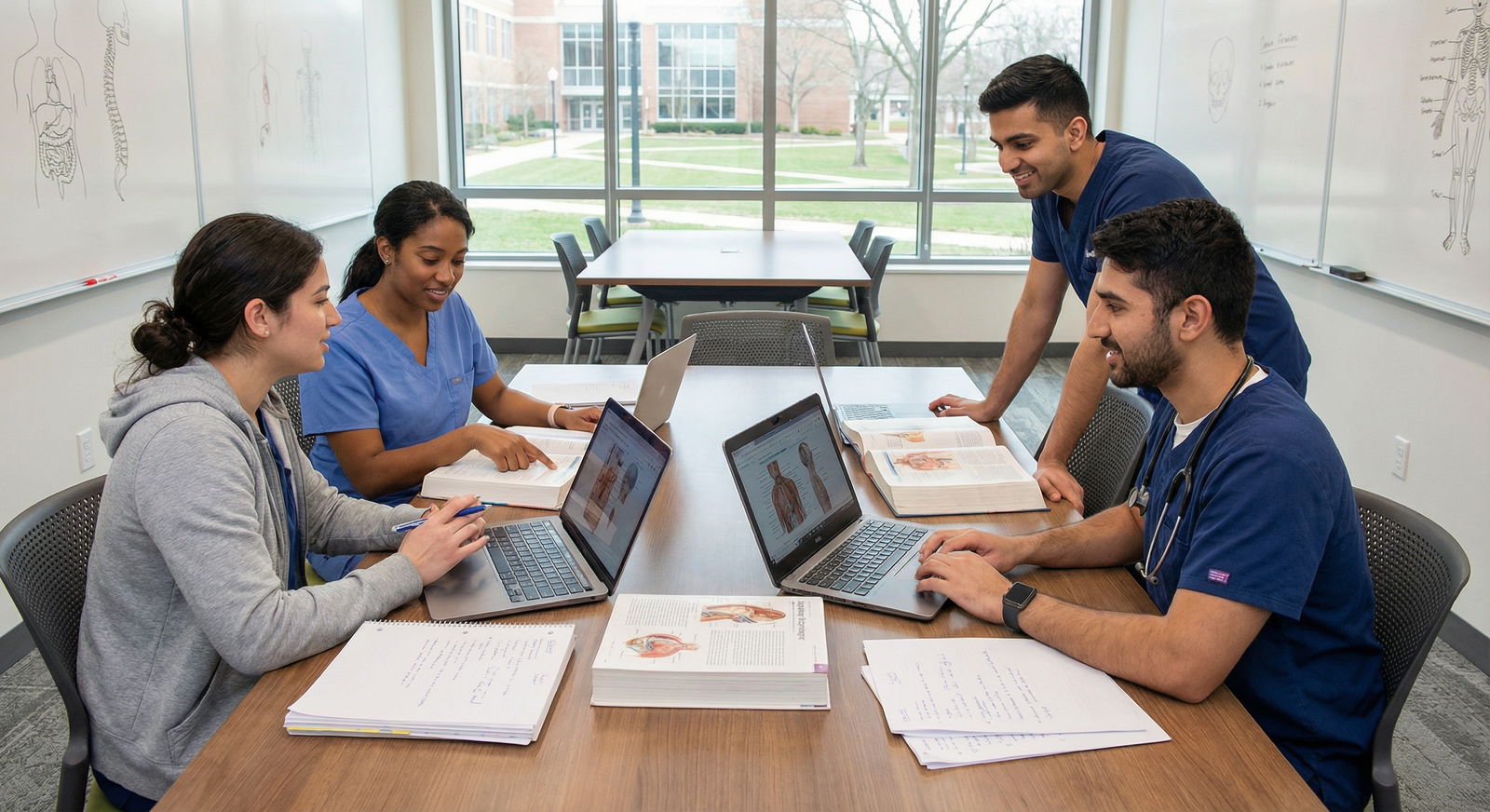
The same principle applies across systems. Histology, physiology, embryology, and clinical correlates for a given organ system are not separate subjects to be learned in isolation. They're layers of the same story. If you learn them as disconnected modules, you'll have to relearn them as a connected system during Step 1 prep, and you won't have time.
Link them deliberately. When you study the nephron in physiology, pull up the histology slide of the same segment. When you study the embryology of the heart, connect it to the congenital defects you'll see in pathology next year. Integration isn't a bonus skill; it's the exam format.
The Corrective Protocol: How to Fix Your Study Habits Now
You're not doomed. But you need to act today, not after the next exam.
Shift to question-based learning immediately. After each block of content, do related questions in tutor mode. Don't wait for mastery. Use questions as your diagnostic.
Implement active recall as your primary mechanism. Anki is fine, but enforce strict review limits and prioritize understanding the explanation over rote card-flipping. If you can't explain a card's concept out loud, you don't own it yet.
Embrace failure as data. A 50% on an early practice block is not a judgment on your worth as a future physician. It's a map showing you where to focus. Stop treating practice questions like graded assessments.
Schedule deliberate rest. Burnout produces cognitive decline that mimics the effects of poor study habits. Sleep is a study tool. Breaks are study tools. If you're studying 14 hours daily with 5 hours of sleep, you're performing worse than someone studying 8 hours with 8 hours of sleep. That's not opinion; it's neuroscience.
Final Warning: Do Not Wait Until Step 1 Results
Here's the cost of inaction, stated plainly: M1 mistakes compound. Remediation stays on your record. Stress erodes your performance in M2, which erodes your Step 1 score, which narrows your residency options. A weak foundation doesn't just crack, it cracks at the worst possible moment, under the highest pressure, when there's no time to rebuild.
Audit your habits today. Identify one passive activity you're currently doing and eliminate it. If you're highlighting, stop. If you're re-reading, stop. If you're avoiding questions, stop avoiding them.
You are not paying tuition to attend lectures. You are investing in competence. Act like it.