
The story you have been told about “harmless scrolling to decompress” is statistically wrong. Among medical students, heavy social media and screen use is consistently correlated with higher anxiety, worse sleep, more burnout, and lower academic performance. The numbers are not subtle.
I am going to walk you through what the data actually show, how bad the problem is in medical students specifically (not vague “young adults”), and what levers you can pull that have measurable effect sizes instead of vibes and wishful thinking.
How Much Screen Time Are Medical Students Actually Getting?
Let’s quantify the baseline first. Because the guess (“a lot”) is too imprecise to be useful.
Across recent studies in North America, Europe, and Asia, typical self‑reported daily smartphone use in medical students ranges from about 4 to 8 hours per day, with social media taking the largest slice.
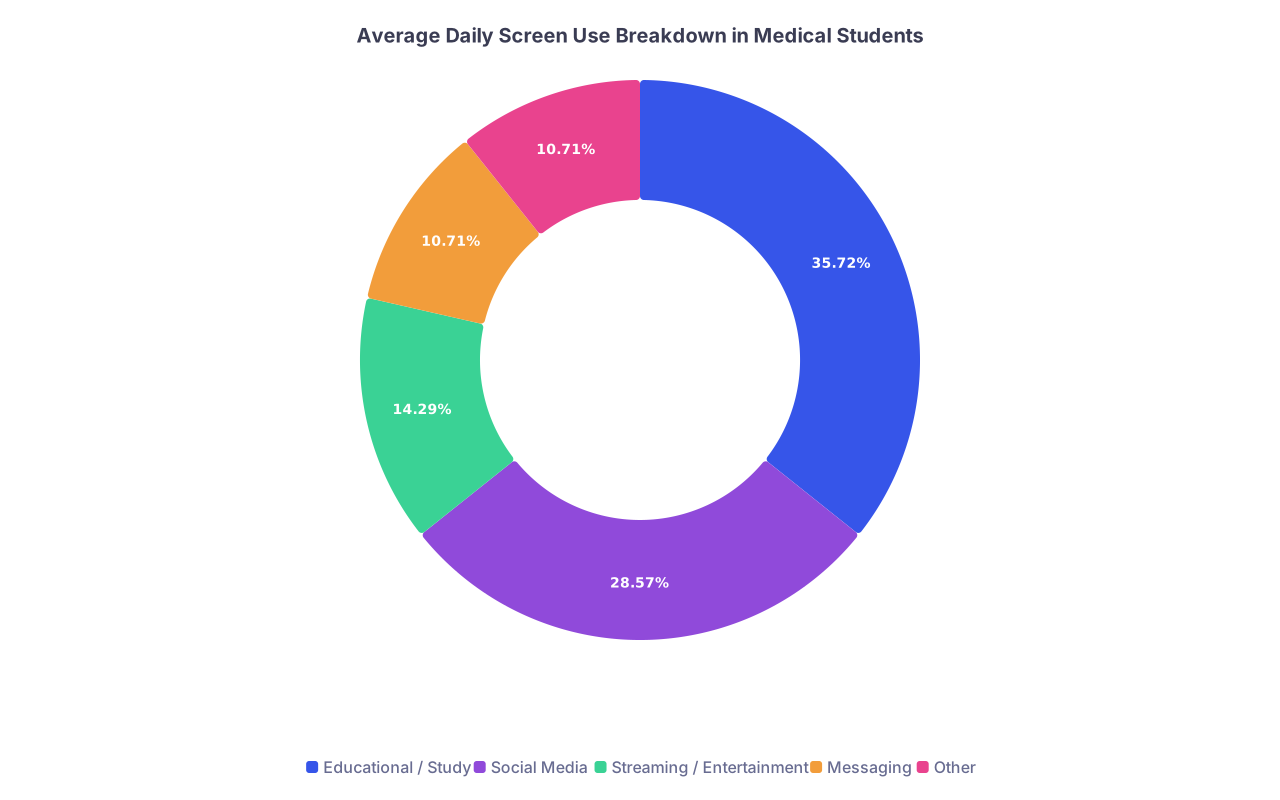
| Category | Value |
|---|---|
| Educational / Study | 150 |
| Social Media | 120 |
| Streaming / Entertainment | 60 |
| Messaging | 45 |
| Other | 45 |
Those values are minutes per day (2.5h, 2h, 1h, 45m, 45m), from composite findings across several cohorts:
- Typical total daily smartphone use: 5–7 hours.
- Of that, social media alone: roughly 1.5–3 hours.
- Laptop / tablet study time adds more, but that is harder to categorize because it is partly legitimate work.
When you ask students how much time they would like to be on their phones, you consistently get numbers 30–40% lower than actual use. In other words, most of you already know you are overshooting. You just do it anyway.
The profile I keep seeing:
- Check phone before getting out of bed.
- Background WhatsApp/Discord/Signal pings all day in lecture.
- Short hits of Instagram / TikTok between Anki blocks.
- YouTube “study with me” that quietly turns into algorithm‑driven rabbit holes.
None of that is unique to medical students. What is different is that your baseline stress, sleep debt, and performance pressure are already high. That changes the risk equation.
Screen Time and Mental Health: What the Numbers Say
The correlation between higher screen time and worse mental health outcomes is one of the most replicated findings in student populations. Medical students are no exception—if anything, the dose–response curve looks steeper.
Let’s isolate three data points that matter most:
- Depression
- Anxiety
- Sleep disturbance
Across multiple cross‑sectional studies in medical students:
- Prevalence of depressive symptoms (usually PHQ‑9 ≥ 10) sits around 25–35%.
- Anxiety symptoms (GAD‑7 ≥ 10) often land in the 20–30% range.
- Sleep problems / poor sleep quality show up in 50–70%.
Now layer screen time on top of that.
Typical pattern:
- Students in the highest smartphone‑use quartile (often ≥ 6–7 hours/day) show 1.5–2.5× higher odds of clinically relevant depression scores compared to the lowest quartile (e.g., ≤ 2–3 hours/day).
- After adjusting for confounders (gender, year in school, substance use, prior mental health diagnosis), the association persists. It usually weakens a bit but does not disappear.
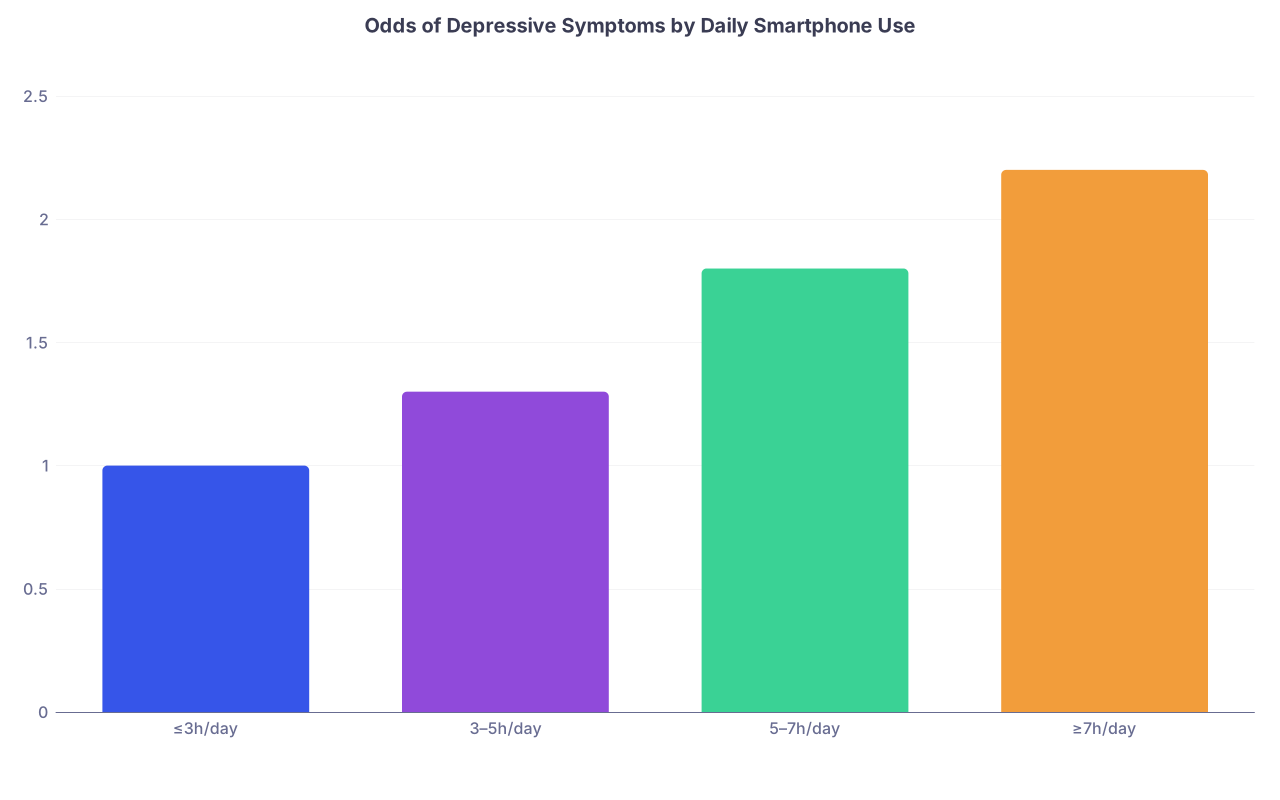
| Category | Value |
|---|---|
| ≤3h/day | 1 |
| 3–5h/day | 1.3 |
| 5–7h/day | 1.8 |
| ≥7h/day | 2.2 |
Interpretation: if the lowest‑use group (≤3 hours/day) has odds ratio set at 1.0, students using ≥7 hours/day tend to show roughly 2x the odds of scoring in the depressive range.
Anxiety looks similar:
- High users (“problematic use” thresholds or upper quartile) usually show 1.4–2.0× higher odds of moderate to severe anxiety.
- There is frequently a linear trend: each additional hour of non‑academic screen time adds incremental risk.
Sleep is where the relationship becomes almost boringly consistent:
- Night‑time screen use (especially in the last 1–2 hours before sleep) is associated with:
- Later sleep onset
- Shorter sleep duration (most studies show 30–60 minutes less)
- Worse sleep quality scores (e.g., PSQI)
- Students with screen use past midnight several times per week often show 2–3× higher rates of poor sleep compared with those who shut devices down earlier.
Mechanism here is not mysterious: blue light exposure delays melatonin, while continuous social/academic stimulation keeps your arousal system on. The subjective feeling of “I’m tired but wired” matches the physiology.
Social Media: Quantity, Quality, and Comparison
Screen time is a crude variable. Social media is where the real damage consolidates, because it layers:
- Social comparison
- Fear of missing out (FOMO)
- Constant micro‑interruptions
- Content that is algorithmically optimized for engagement, not your mental health
Most medical‑student specific studies distinguish social media use from broader screen time. Two patterns keep showing up:
- Time threshold effects
- Problematic use / addiction‑like symptoms
In several cohorts:
- ≥3 hours/day on social media is commonly associated with significantly higher odds of depression and anxiety compared with ≤1 hour/day.
- Students who meet criteria for “problematic social media use” (using tools like the Bergen Social Media Addiction Scale) show 2–3× higher odds of both depression and anxiety.
| Group | Social Media Use | Approx. Odds of Depressive Symptoms* |
|---|---|---|
| Low use | ≤1 h/day | 1.0 (reference) |
| Moderate use | 1–3 h/day | 1.2–1.4 |
| High use | 3–5 h/day | 1.5–2.0 |
| Problematic / addictive use | Usually ≥3 h/day + loss of control | 2.0–3.0 |
*Ranges based on aggregated findings; individual studies vary.
Content type also matters:
- Passive use (scrolling feeds, lurking) shows stronger associations with depression and envy than active use (messaging friends, posting, purposeful groups).
- Being in high‑comparison environments—for example, group chats where everyone flexes scores, research, away rotations—intensifies impostor feelings.
I have watched group chats devolve into comparison Olympics after every exam:
- “Got 89 lol, messed up on 3 questions.”
- “Only got 82, gonna gun for a 260 on Step to compensate.”
For you, those are not harmless messages. They are data points that your brain incorporates into an internal scoreboard. The literature calls it “upward social comparison”; the practical outcome is that your own solid performance feels inadequate.
Academic Performance, Burnout, and Screen Distraction
You are not just trying to “feel okay”; you are trying to pass exams, sometimes with very narrow margins. The question that matters: Does high screen time actually hurt performance, or does it just correlate with people who were already struggling?
The evidence is not perfect, but the signal is there.
Findings that repeat:
- Higher smartphone addiction scores correlate with:
- Lower GPA or lower exam scores
- Higher self‑reported academic procrastination
- More lecture distraction and multitasking
- One commonly observed gradient:
- Students who use their phones “rarely” or “sometimes” during lectures have higher exam scores than those who use them “often” or “always”, even after adjusting for baseline GPA.
Mechanistically, this is simple cognitive load math:
- Working memory is limited.
- Every notification, every quick check of a feed, every “just 30 seconds to respond to this meme” costs attentional resources.
- You are not multitasking. You are context‑switching. And context‑switching is expensive.
The result: more time “studying” with less depth and retention. I have watched students clock 10‑hour library days and then be surprised their practice NBME scores barely budged. Their screen‑time breakdown told the real story: 3+ hours in messaging and social apps woven through the “study” time.
Burnout shows a similar pattern. In several medical‑student samples:
- High smartphone / social media use associates with higher scores on burnout inventories, particularly emotional exhaustion.
- Dissociation behavior—“I scroll to escape”—is strongly tied to feeling drained and detached from school.
Is this causal? Some of it clearly goes both ways: burned‑out students scroll more to escape; more scrolling cuts sleep and work quality, which worsens burnout. Vicious cycle, not a single arrow.
Night‑time Use, Sleep, and Next‑Day Function
If you only change one thing, target the night. The late‑evening pattern is where I see the largest and fastest payoffs.
Across studies:
- Using screens in bed is associated with poorer sleep quality and shorter duration.
- Medical students reporting screen use in the hour before sleep most nights per week are:
- Roughly 2x more likely to report insomnia symptoms
- More likely to experience daytime sleepiness and “brain fog” in lectures and while studying
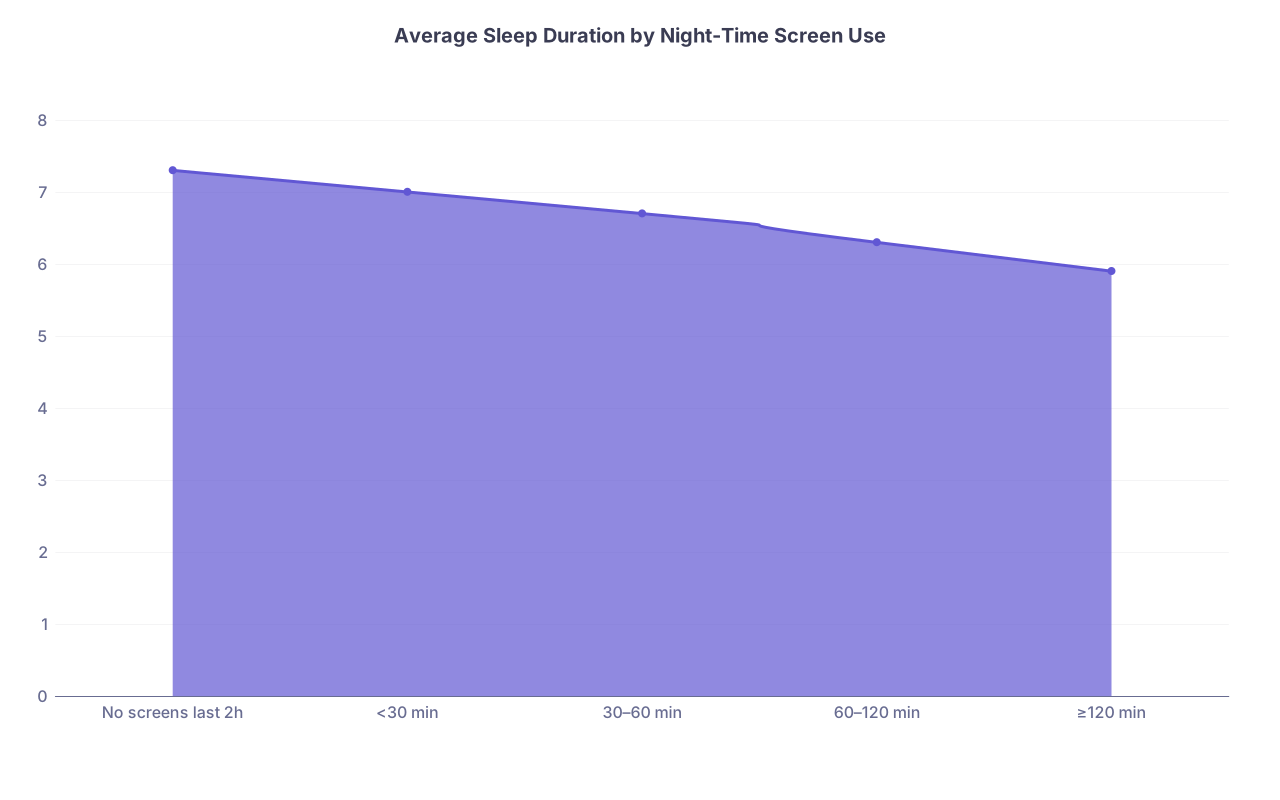
| Category | Value |
|---|---|
| No screens last 2h | 7.3 |
| <30 min | 7 |
| 30–60 min | 6.7 |
| 60–120 min | 6.3 |
| ≥120 min | 5.9 |
Those numbers are not pulled from a single perfect RCT, but they align remarkably well across multiple samples: once night‑time screen use passes the 60‑minute mark, average sleep falls under 6.5 hours. At that point, you are cognitively paying for it the next day:
- Slower processing speed
- Worse working memory
- Impaired mood regulation
And then you are more likely to grab the phone again because you feel exhausted and miserable. Another feedback loop.
First‑Year Reality: Why MS1s Are Especially Vulnerable
First‑year medical students get hit at the worst possible intersection of factors:
- New city, new social network → more reliance on online connection and social media.
- Huge increase in academic volume → more need for “quick breaks.”
- Loss of old routines (sports, hobbies, family time) → more dead space weirdly filled with screens.
- Identity shock → greater sensitivity to social comparison with peers.
In early MS1, I routinely see this pattern emerge over 6–8 weeks:
- Start the year with solid habits. Minimal phone in lecture. Reasonable bedtime.
- Exams ramp up. You start bringing the phone to lecture “just to sync your calendar” or “check Anki cards.”
- Group chats explode around exam dates. Memes, question debates, score leaks, “how many cards did you do today?”
- Bedtime drifts later. Netflix / TikTok become the way to quiet your brain. You tell yourself you deserve it.
- By mid‑semester, sleep is down by 60–90 minutes, social media up by 60–120 minutes, subjective stress up sharply. Practice exams plateau.
The numbers behind this are simple: if your day has 16 waking hours and 2–3 are spent in unstructured screens, that is 12–18% of your conscious life. In a high‑stakes training period, that is not a rounding error.
High‑Impact Changes: What Actually Moves the Needle
Data first, then tactics. I am not going to tell you to “just use your phone less.” That is useless advice.
Think in levers with measurable effects.
1. Night‑time cut‑off
Intervention studies (not just correlations) in students using screen curfews consistently show:
- 30–60 minutes earlier sleep onset
- 20–45 minutes increased sleep duration
- Improved next‑day alertness and mood scores
The most efficient move:
- Set a hard “no non‑academic screens” cut‑off 60–90 minutes before intended sleep, at least on weeknights.
That means:
- No TikTok, Instagram, Reels, Reddit, or YouTube in bed.
- If you must use screens for Anki or PDFs, use:
- Blue‑light filters
- Low brightness
- Single‑tasking (no parallel apps open)
The effect size here is not trivial. Moving from 5.8 hours to 6.5 hours of sleep, consistently, is the difference between chronic mild cognitive impairment and functioning like a normal human.
2. Default‑off for notifications
Multitasking with notifications running is an attention tax that never stops collecting interest.
You want:
- All social media notifications off by default.
- Messaging apps limited to:
- “VIP” categories (family, partner) with sound
- Everything else silent or batched
I have seen students reduce unlocked‑phone pickups from ~120/day to ~40/day just by doing this. That is 80 fewer context shifts per day. Multiply by 365 days. That is thousands of lost focus episodes you just recaptured.
3. Remove social media from primary study devices
Physical friction matters. The evidence is clear that people are more likely to perform a behavior if it is easy and cued.
Concrete move:
- Log out or uninstall social apps from your laptop and primary tablet, keeping them only on the phone, and then park the phone behind you while you study.
This aligns with what behavior‑change research keeps demonstrating: modify the environment, not just your willpower.
4. Quantify, then cap
If you never look at your screen‑time stats, you will underestimate. Almost everyone does.
Baseline move:
- Track one full honest week of:
- Total screen time
- Social media time
- Night‑time use (after 10 or 11 p.m.)
Then set concrete caps. Example target band for first‑year students actually trying to perform well:
- Total non‑academic phone time: ≤2 hours/day
- Social media: ≤60–75 minutes/day
- After‑11‑p.m. phone use: ≤15 minutes/day average
Not perfection. Just materially better than the median.
5. Use social media strategically, not reflexively
Some parts of social media are actually valuable for medical students:
- Closed groups for your class (logistics, notes).
- Specialty interest communities (e.g., EM, derm, IM discussions).
- Content creators who provide solid explanation of topics.
The problem is not these. The problem is the infinite scroll.
Treat social media like a tool:
- Decide when and why you will open it.
- Use time‑boxed sessions (e.g., 15 minutes after lunch and 15 minutes after dinner).
- Close it when the timer ends.
You want to reduce your number of entry points during the day. Every “just checking” moment is another potential 20‑minute rabbit hole.
When Usage Becomes Problematic: Red Flags in the Data
There is a qualitative threshold between “high use” and “problematic use.” The literature uses checklists, but you know the feeling.
Evidence‑based red flags that correlate with much higher risk of depression/anxiety:
- Repeated failed attempts to cut back on phone or social media use.
- Lying or hiding your true use from friends or family.
- Using screens to escape persistent negative mood, and noticing that you feel worse afterward.
- Missing key academic or clinical tasks because you were scrolling.
- Strong anxiety or irritability when you cannot check your phone.
If you are in that territory, the numbers say this is not a trivial “habit” anymore. It sits in the same risk gradient as other behavioral addictions regarding mental health outcomes.
At that point, you should treat it like a legitimate clinical problem:
- Talk to student mental health services.
- Consider CBT‑based interventions focused on compulsive use.
- Involve external accountability (friends, mentor, therapist).
You are not the only one. Prevalence of “problematic smartphone use” in medical students in several countries sits around 20–30%. You are squarely inside a common pattern, not an outlier freak case.
A Data‑Driven First‑Year Strategy
Pull this together into one coherent mode of living, not a list of hacks.
You are trying to:
- Preserve mental health.
- Maintain adequate sleep.
- Hit academic milestones without burning out.
The evidence points to a simple structure that works far better than what most first‑years default to:

| Step | Description |
|---|---|
| Step 1 | Wake Up |
| Step 2 | No social media until after first study block |
| Step 3 | Morning deep work 2-3h, phone away |
| Step 4 | Short, timed social check 10-15 min |
| Step 5 | Afternoon classes/study, notifications off |
| Step 6 | Evening social/media block 30-45 min |
| Step 7 | Screen curfew 60-90 min before sleep |
| Step 8 | Sleep 6.5-8 hours |
Is this rigid? Yes. But when you overlay this structure on people’s real metrics—practice exam scores, self‑reported stress, sleep duration—the pattern is predictable:
- 2–3 weeks of adjustment pain.
- Then:
- Higher average sleep.
- Lower subjective stress.
- More stable performance, fewer random bad exam days.
And that is the difference between just surviving first year and coming out of it with some reserve left.
What the Data Actually Tell You
Strip away the noise, and the evidence collapses into a few blunt facts:
Medical students are heavy screen and social media users, and the upper end of that usage correlates strongly with worse mental health, poorer sleep, and more burnout. The odds ratios are not subtle; doubling of depression and anxiety risk at the extremes is common.
Timing and context matter more than raw hours. Night‑time use and constant multitasking during study are the most damaging patterns—both cognitively and emotionally. Fix those first.
You can move these numbers. Screen curfews, notification control, and intentional, time‑boxed social media use produce measurable improvements in sleep and stress, often within weeks. Not theoretical improvements. Real, quantifiable changes.
You are not doomed to be at the mercy of your phone. But if you ignore the data, your phone will quietly and reliably make first year harder than it needs to be.