
You Bombed An Exam. Now Your Brain Is Screaming “Residency Is Over.”
It’s 1:47 a.m. You’re lying in bed, staring at your ceiling, replaying that stupid first-year exam over and over.
You missed questions you knew yesterday. You walked out thinking “maybe that wasn’t so bad,” and then the grades dropped. Class average: 83. You: 65. Or worse, you’re bracing because you already know you failed.
Now your brain’s running this greatest-hits playlist:
- “This is going on my transcript forever.”
- “Competitive specialties are gone.”
- “Program directors will see ‘FAIL’ in bold red letters and toss my application.”
- “Everyone else is fine. I’m the only fraud.”
You start Googling “failed first-year exam residency chances” like it’s a code blue.
So let’s sit in the ugly reality for a second: you did badly. Maybe really badly. Maybe you even failed.
Now the actual question: does one bad exam in first year ruin your future residency chances?
No. It doesn’t. But it can cause damage if you react badly to it.
Let’s walk through this like someone who’s seen a lot of these disaster spirals play out.
| Category | Value |
|---|---|
| Clinical performance & letters | 30 |
| Board scores | 25 |
| Interview & fit | 20 |
| Research/activities | 15 |
| Pre-clinical grades | 10 |
How Much Do First-Year Exams Actually Matter?
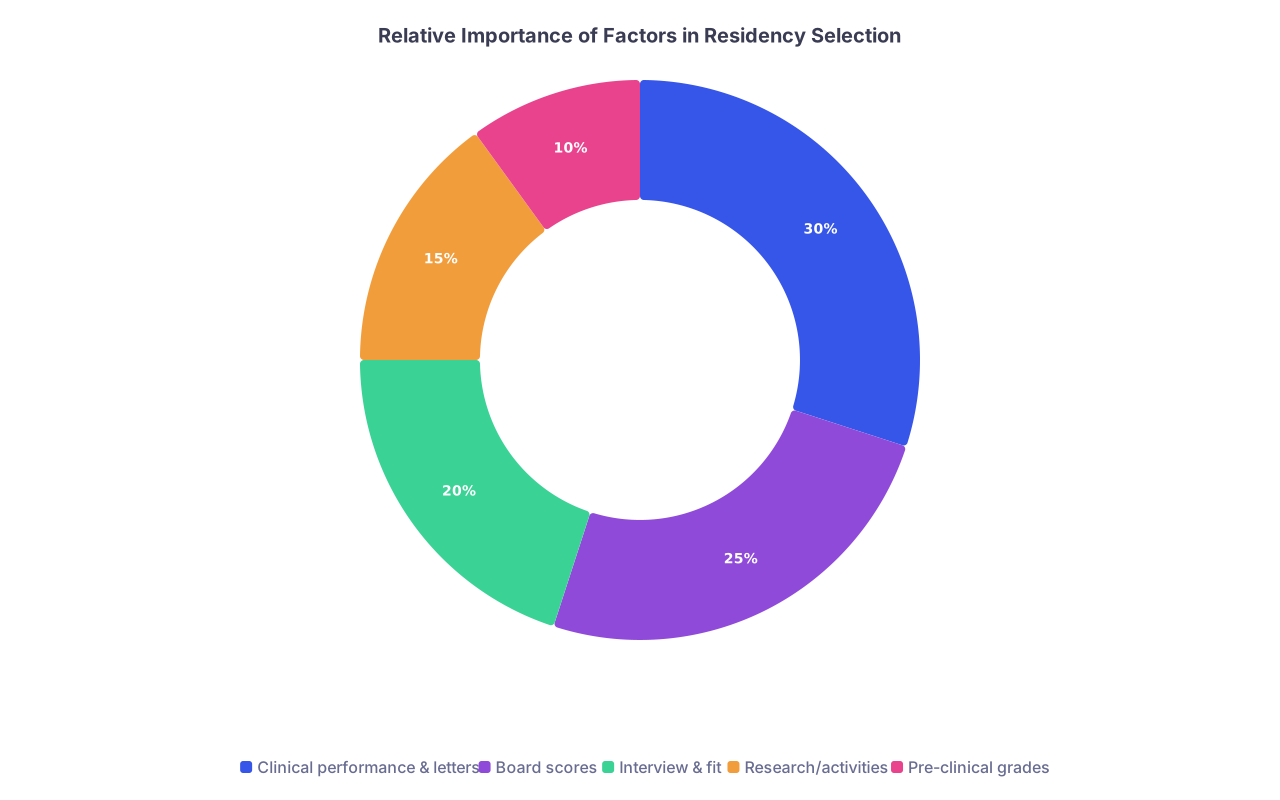
Here’s the blunt truth people don’t say out loud on day one of med school: F1 exams feel huge to you, but they sit pretty low on the list of things residency programs care about.
What programs actually lean on (in rough order for most fields):
- How you did on your clinical rotations (third year mostly)
- What your attendings and letter writers say about you
- Your board scores (Step 2 especially now)
- Your interview and overall story
- Then way down here… pre‑clinical performance
Not “do they matter zero?” But they’re background noise compared to who you become later.
Most programs don’t care if you got an 86 vs 72 on your first renal exam in October of M1. They care whether, as a third-year, you showed up, knew your patients, were teachable, and weren’t a disaster on the wards.
The only time first-year performance starts to matter more is:
- If you repeated multiple courses
- If you failed whole blocks repeatedly
- If there’s a pattern of just barely passing everything
One rough exam? Even one failed course that you remediated and then improved from? That’s not “your future is over.” That’s “okay, what changed after that?”
I’ve seen plenty of residents in competitive fields who had early stumbles. I’ve also seen people with straight honors flame out because their attitude sucked on the wards.
Programs are pattern-hunters, not single‑data‑point hunters.

Worst-Case Scenarios You’re Afraid Of (And What Actually Happens)
Let me just say the quiet parts out loud, because I know what’s bouncing around in your head.
“What if I actually failed the whole course?”
Annoying? Yes. Catastrophic? No, unless there’s a cascade of failures.
Most schools will:
- Let you remediate over the break or with a separate exam
- Mark it as “remediated pass” or show the fail plus the final pass
- Maybe have you meet with the dean or an academic advisor
What residency programs see later:
- A transcript line that looks like: “Foundations of Medicine – Remediated Pass”
- Or a single F/P shift with a note in your MSPE about improvement
Does it raise a question? Yes. Is that question “are you unemployable?” No. It’s “what happened and what did you do about it?”
“What if this one bad grade wrecks my class rank?”
First, some schools don’t even do class rank anymore. Or they lump people into big buckets like “top 1/3, middle 1/3, lower 1/3.”
Second, that rank is made up of years of performance. One ugly mark can absolutely sting, but it doesn’t freeze your rank forever.
You can climb.
I’ve seen people start in the bottom half pre‑clinically and end up with honors in multiple core clerkships, great Step 2 scores, and strong letters. If I’m a PD, that upward trend means a lot more to me than “you were perfect in M1, plateaued, and never grew.”
“What if I wanted derm/ortho/ENT/neurosurg and now it’s dead?”
Harsh but honest: for the super-competitive specialties, everything counts more.
But even there, the big killers are:
- Low Step 2 without explanation
- Mediocre or vague letters
- No research in the field at all
- Repeated academic or professionalism issues
One bad first-year exam? Not the thing that closes the door. At worst, it’s a yellow flag that you can override with:
- Strong Step 2
- Honors in relevant clerkships
- Solid research and mentorship
If you end up with a pile of red flags stacked on top of each other, then yeah, doors close. But that’s not where you are right now.
Right now, you’re at “this sucks, but it’s fixable.”
| Issue | How Bad Is It Really? |
|---|---|
| Single failed *exam* (not course) | Mostly irrelevant by M3 |
| Single remediated M1 course | Mild concern, explainable |
| Multiple failed courses | Moderate–serious concern |
| Poor clinical evals on core clerkships | Very serious |
| Big drop or low score on Step 2 | Serious, but can be framed |
The Part That Does Matter: What You Do Next
This is where people quietly sabotage themselves.
The exam isn’t what kills their chances. Their reaction is.
Here’s what I’ve seen play out in real life:
Bad reaction #1: “I suck at this, why even try?”
You start doing the minimum. You avoid practice questions because they make you feel stupid. You sort of “study” with your notes and highlighters but never test yourself again.
Reality: residency programs sniff out that pattern. Chronic underperformance with no improvement story is hard to defend.
Bad reaction #2: “I’ll just work 3x harder doing the exact same thing”
You pull more all-nighters. You keep rewriting your notes. You listen to every lecture twice. You feel like you’re dying but your score barely moves.
That’s not grit. That’s banging your head into the same wall.
Bad reaction #3: “I’m too embarrassed to ask for help”
You don’t go to faculty office hours, because you don’t want them to see your score. You don’t talk to upperclassmen because “everyone else seems to be fine.” So you stay stuck, quietly panicking.
The students who recover well all eventually do the opposite:
- They get brutally honest about what went wrong
- They change their study approach (not just more hours)
- They loop in someone: dean, learning specialist, older student, tutor
- They look for a trend line: is the next exam a little better? Can we build on that?
That’s the story you want to be able to tell later if anyone ever asks:
“Yeah, I bombed that early exam. Here’s exactly what I changed, and here’s the improvement that followed.”
Program directors love that story. It screams resilience and insight.

| Step | Description |
|---|---|
| Step 1 | Bad M1 Exam |
| Step 2 | Ignore problem |
| Step 3 | Repeat poor performance |
| Step 4 | Multiple red flags |
| Step 5 | Harder residency search |
| Step 6 | Analyze what went wrong |
| Step 7 | Change study plan |
| Step 8 | Seek support |
| Step 9 | Improved future performance |
| Step 10 | Stronger residency application |
| Step 11 | React Productively? |
How To Turn This From “Ruin” Into “Plot Twist”
Let’s get less theoretical and more concrete. You’re still spiraling, so here’s what I’d actually do if I were in your shoes.
1. Do a cold, emotionless autopsy of that exam
Not “I’m dumb.” That’s useless.
I mean literally:
- How many questions did you miss because you never saw that content?
- How many because you saw it but couldn’t retrieve it?
- How many because you misread the question or ran out of time?
That points you toward the actual problem:
- Content gaps → didn’t cover enough / too passive
- Retrieval issues → not enough spaced repetition / active recall
- Timing issues → didn’t do enough practice under exam conditions
You’d be shocked how often the problem is “I just reread notes and never tested myself.”
2. Compare your habits to someone who’s doing well
Not to torture yourself. To steal tactics.
Find a classmate who did solidly (doesn’t have to be #1) and ask specific things:
- “How far before the exam do you start doing questions?”
- “What does a normal study day look like during a block?”
- “Do you go to lecture live or use recordings?”
- “How do you use Anki or Qbanks, specifically?”
Then be honest: were you doing anything close to that? Or were you “busy” but not actually learning in a way that sticks?
3. Use the annoying resources your school keeps emailing you about
Every med school has:
- A learning specialist / academic support office
- Faculty who will review exams with you
- Sometimes senior students who tutor or mentor M1s
Yes, it’s humbling. Yes, it may feel like admitting defeat.
But the students I see who climb out of holes are the ones who swallow their pride early instead of waiting until M2 when things are on fire.
| Category | Value |
|---|---|
| Lectures | 40 |
| Making notes | 30 |
| Practice questions | 15 |
| Anki/review | 15 |
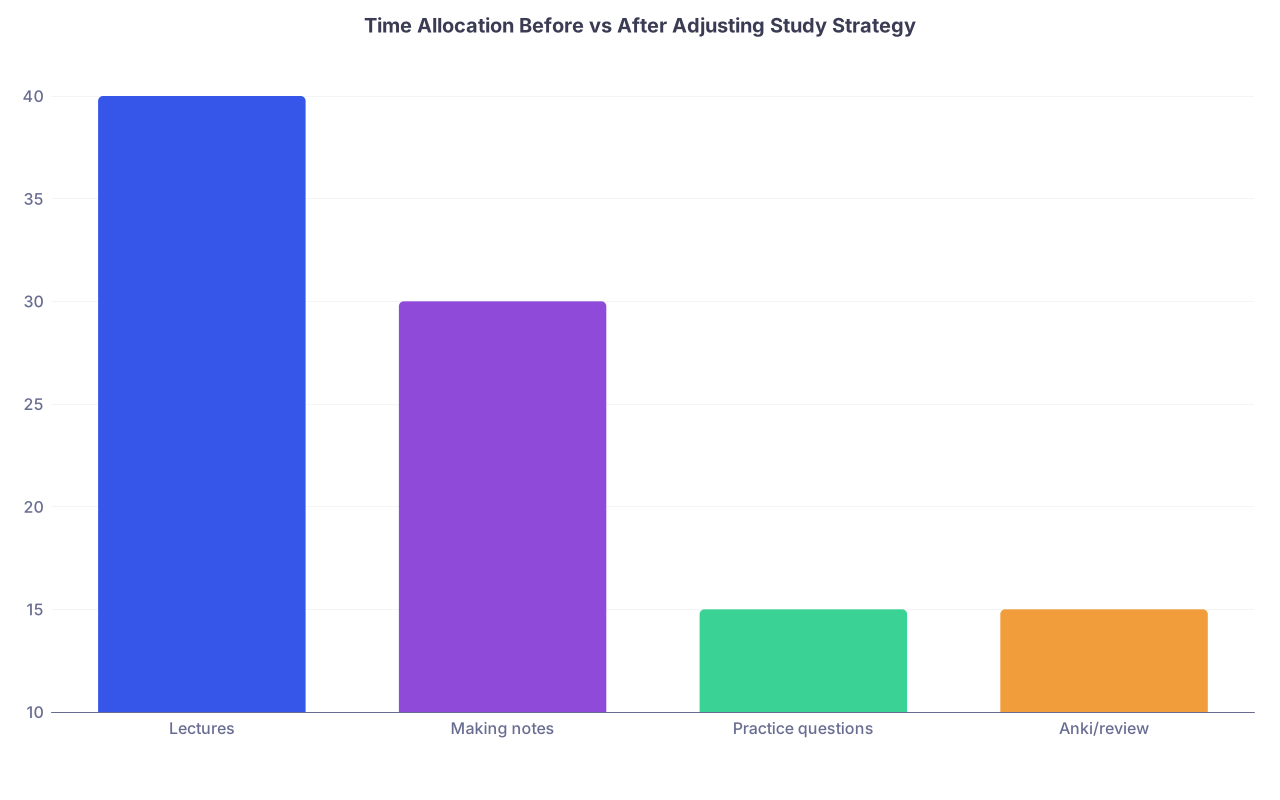
Above is what a lot of struggling M1s unknowingly do: most of their time on passive stuff. They sit in lectures, rewrite notes, and feel “busy” but don’t build retrieval.
The version that tends to work better flips that: less time re-copying, more time actually pulling information from your brain on practice questions and spaced repetition.
What This Looks Like On Your Future Application
Fast-forward a couple years. You’re a rising M4, putting in ERAS.
Here’s what a program director actually has in front of them:
- Your Step 2 score
- Your clinical grades (Honors/High Pass/Pass, etc.)
- Your MSPE (dean’s letter) with comments from rotations
- Your letters
- Your research / activities
- Your personal statement
- And yes, your transcript, which might have that one ugly early mark
If the rest of your file says:
- Strong Step 2
- Solid or improving clerkship performance
- Comments like “hardworking, takes feedback well, knows patients”
- Some involvement in something meaningful (research, leadership, community work)
Then that M1 exam or even a remediated course is just… context. Not destiny.
If someone asks in an interview, your script sounds like:
“Early in first year I really struggled with X exam and actually did poorly/failed it. I realized my approach was too focused on passively re-reading and not enough on active recall and questions. I met with our learning specialist, changed my routine, and you can see from my later pre-clinical and clinical performance that those changes stuck. It taught me a lot about how I learn and how to adjust when something isn’t working.”
That’s not a red flag anymore. That’s a growth story.
What does read badly is:
- Multiple struggles, same excuses, no change
- Blaming everyone else
- No insight into what went wrong or how you adapted
Your future self wants to be able to say, “Yeah, I got punched early. Then I learned how to fight.”

When You Actually Might Need To Reconsider Your Specialty
I’m not going to lie and say nothing that happens early can ever affect your options. That’s fake comfort and you’re not dumb.
If over time you notice:
- You hate the kind of studying medicine requires
- You’re consistently at the bottom despite trying smart strategies
- You have major anxiety that paralyzes you every testing situation
- Even with support, you’re barely scraping by
- Your school is putting you on academic probation or extending your program
Then it’s fair to ask bigger questions later:
- “Is a hyper-competitive specialty really the best fit?”
- “Do I need more formal eval for learning differences or test anxiety?”
- “Do I actually want this, or am I here because I was too scared to step off the treadmill?”
But that’s long-game reflection, not a conclusion you need to draw because of one exam in the first semester.
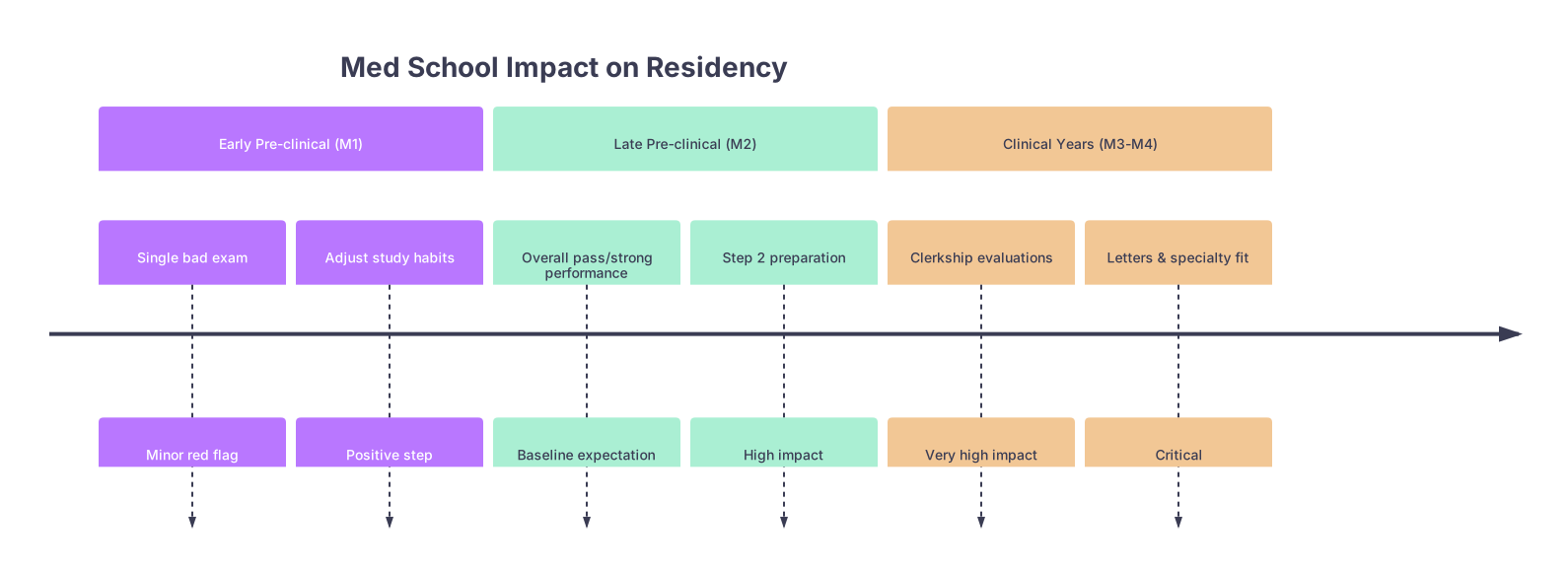
Right now, you don’t have a trend. You have a single data point.
| Period | Event |
|---|---|
| Early Pre-clinical (M1) - Single bad exam | Minor red flag |
| Early Pre-clinical (M1) - Adjust study habits | Positive step |
| Late Pre-clinical (M2) - Overall pass/strong performance | Baseline expectation |
| Late Pre-clinical (M2) - Step 2 preparation | High impact |
| Clinical Years (M3-M4) - Clerkship evaluations | Very high impact |
| Clinical Years (M3-M4) - Letters & specialty fit | Critical |
What You Can Actually Do Today
You can’t un-take that exam. You can’t erase the grade from the database. You also can’t jump to M4 and fix everything in one move.
Here’s what you can do before you go to bed tonight or by the end of the day:
Open your last exam or practice questions and categorize 20 missed questions into 3 buckets: content gap, retrieval issue, or test-taking mistake.
Literally make three columns on a piece of paper or a doc:
- “Didn’t know it at all”
- “Knew it but couldn’t pull it out”
- “Misread / rushed / tricked”
That’s it. Just do that one, small, unglamorous thing.
Because that’s the first brick of the new story you’re going to tell later:
“I stopped just panicking about the grade and actually figured out why I missed things. Then I changed.”
One bad exam in first year doesn’t ruin your residency chances.
Ignoring what it’s trying to teach you? That’s the only thing that might.