
It’s 11:47 p.m. You’ve read the same path slide three times and still have no idea what it’s showing. Your group chat is pinging with “lol I’m so behind” messages that somehow sound like humblebrags from people who are actually fine. Tomorrow you have small group. The facilitator is a legit big-name attending. And there’s a “check-in” portion at the beginning.
You’re already rehearsing lies in your head.
“Yeah, it’s busy, but I’m managing.”
“It’s a lot, but I’m keeping up.”
“It’s an adjustment, but I’m okay.”
You are absolutely not okay.
And now the question that’s really eating you:
If I tell faculty I’m overwhelmed, will they judge me? Will they think I’m weak, lazy, not cut out for this? Will they remember my name—in a bad way—when it’s time for grades, letters, away rotations?
Let’s be honest: you’re not scared of being overwhelmed. You’re already overwhelmed. You’re scared of getting labeled.
The Fear Behind “I’m Overwhelmed”
This isn’t just “I’m stressed.” Everybody is stressed; that’s almost the culture.
You’re worried about something more insidious:
- What if they think I can’t hack it?
- What if it affects my grades or evals?
- What if this follows me into clerkships, residency, forever?
- What if I finally say something and they hit me with: “Well, this is just how medicine is”?
That last one stings because you’ve probably heard some version of it already. From a resident. From a burned-out upperclassman. From someone on Reddit flexing how they studied 15 hours a day.
So now you’re stuck between two bad-feeling options:
Option A: Say nothing, keep pretending you’re fine, quietly fall apart.
Option B: Admit you’re drowning and risk being judged.
It feels like a trap. But it’s not as binary as it looks.
What Faculty Actually Think (From What I’ve Seen)
Let me just say the part you’re probably too nervous to believe:
Most faculty are not sitting around thinking, “Which M1 can I secretly blacklist for being human today?”
They’re thinking:
“How do I finish notes, sign labs, answer emails, show up for teaching, go home before midnight, and not completely forget my kids’ names?”
Do some faculty suck at empathy? Yeah. I’ve seen the eye-roll, the “back in my day,” the “we didn’t have Pass/Fail and we survived” speech. Those people exist.
But here’s what else is true, and I’ve watched this more than once:
Students who quietly disappear—stop coming to things, bomb exams out of nowhere, miss required sessions—get way more negative attention than the ones who say early, “I’m struggling and need help figuring this out.”
The faculty who work directly with students most (course directors, small-group leaders, learning specialists, student affairs folks) see overwhelmed students constantly. You are not some rare failure specimen. You are Tuesday.
The students who show up and say, “I’m overwhelmed, here’s what’s going on, I want to get back on track,” almost always walk out of that conversation with more support and less risk to their reputation, not the other way around.
That doesn’t erase the fear. But the reality is a lot less catastrophic than the version your 2 a.m. brain is playing.
Who You Tell Matters (A Lot)
Here’s where you need to be strategic, not performative.
If the person you’re thinking of telling is also the person grading your exam next week, writing your high-stakes evaluation, or known for being old-school, you don’t have to start with them.
You can choose your first “I’m overwhelmed” audience.

The safer starting options are usually:
Student affairs / dean of students / wellness office
These people literally exist for this. Their whole job is “students in distress + support + solutions.” They know policies, options, accommodations, remediation paths, all of it. They also know which faculty are actually good humans.Learning or academic support services
If your school has a learning specialist, that person has heard every variation of “I was an A student and now I feel stupid.” They’re not shocked. They’re not judging your worth. They’re thinking about schedule, strategy, Step timing, exam skills.A trusted upperclassman
Not some random “gunner vibes” M2 who flexes their UWorld percentage. Someone who’s been honest in the past, or who you’ve seen be real about struggling. They can tell you: “Don’t talk to Dr. X, talk to Dr. Y—she actually cares.”A faculty mentor who explicitly invited honesty
Not the attending who lectures 300 people and then disappears. The one who says things like, “If you’re struggling, please reach out early. I’d rather know than have you vanish.”
Telling “faculty” isn’t one thing. There are safer doors to knock on first.
What You Should Say (Without Oversharing Yourself Into Panic)
Your nightmare script is something like: “Everything sucks, I’m behind on everything, I’m not sleeping, I hate anatomy, I think I’m not meant to be a doctor, I’m failing, I’m broken.”
You don’t need to unload all of that at once. You need something clear, specific, and honest without turning the meeting into a total meltdown (unless you absolutely can’t help it, and even then, you won’t be the first).
Think something more like:
“I wanted to talk because I’m feeling really overwhelmed by the pace and volume right now. I’m putting in a lot of time, but it’s not translating into the performance I expected. I don’t want to fall further behind, and I’m not sure what to adjust. I’d really appreciate some guidance or resources.”
That says:
- I care.
- I’m trying.
- I’m not managing.
- I want help.
Which, by the way, is exactly the kind of thing responsible adults say when something isn’t working.
If mental health is a big part of it (burnout, anxiety, depression, panic attacks), you can layer that in selectively:
“On top of that, I’ve been having a lot more anxiety than usual, and it’s starting to affect my studying and sleep. I’m planning to reach out to counseling, but I also wanted to let someone here know what’s going on and see what options might exist for support or flexibility.”
You are not required to give your entire psychiatric history. You are allowed to have boundaries.
Will They Think You’re Weak?
This is the part that feels personal, because somewhere in your brain you’ve tied “asking for help” to “incompetent.”
Let me flip this.
The students who scare faculty the most aren’t the ones who say “I’m overwhelmed.” It’s the ones who:
- act totally fine until they fail an exam by 20 points
- disappear off email for two weeks
- stop showing up to required stuff
- go from engaged to shut down with zero explanation
That’s when the whispering starts:
“What’s going on with them?”
“Are they okay?”
“Why didn’t they reach out sooner?”
You don’t want to be a mystery. You want to be a known quantity with a story that makes sense: “They were struggling, they spoke up, we adjusted, they improved.”
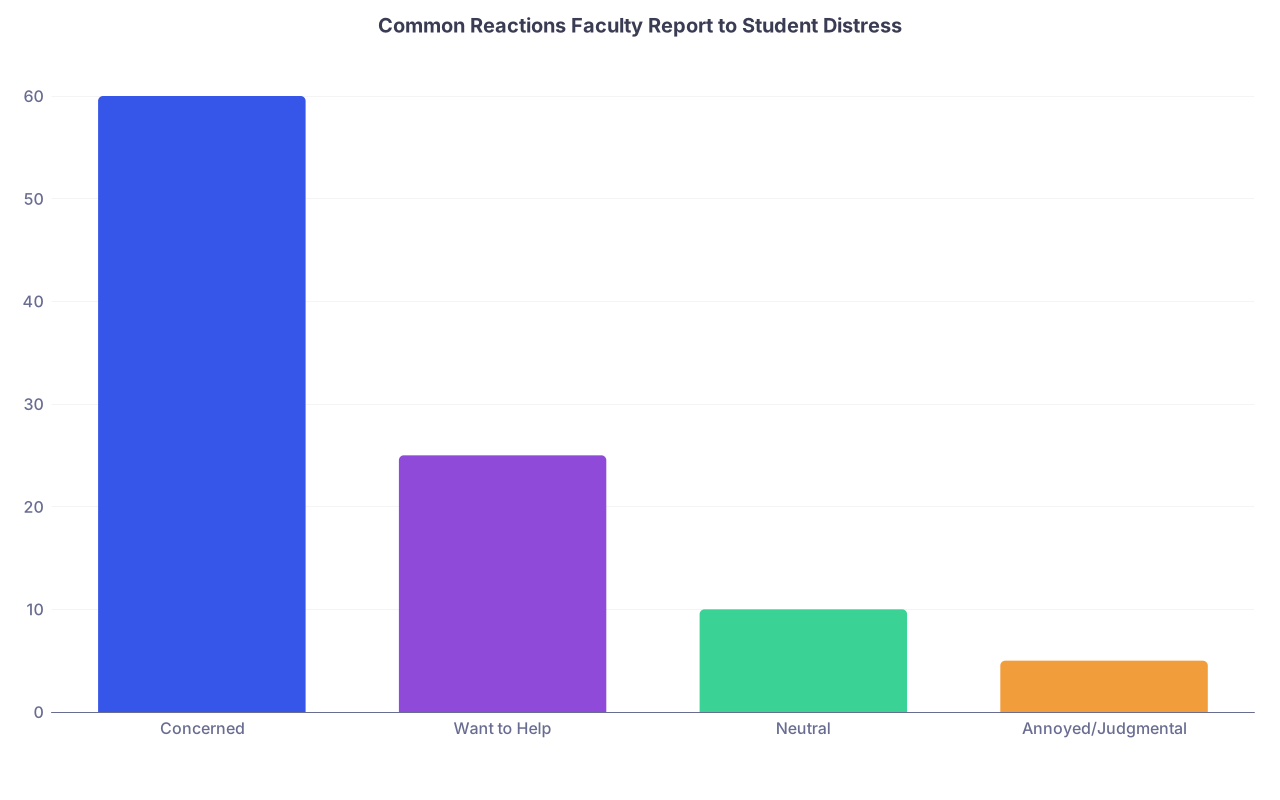
| Category | Value |
|---|---|
| Concerned | 60 |
| Want to Help | 25 |
| Neutral | 10 |
| Annoyed/Judgmental | 5 |
I’ve heard versions of this more times than I can count:
“I wish they had come to me earlier. There’s a lot we can do before someone crashes, but not much after the fact.”
Weak is pretending you’re totally fine until your life is on fire.
Strong is saying, “This is too much. I need a different plan.”
The Real Risk: Saying Nothing
You’re scared of the imagined risk: You tell someone, they secretly hate you forever, your career dies.
The much bigger, more actual risk is this:
You grind in silence.
You keep telling yourself, “Next week I’ll fix it.”
You fall further behind, your grades slide, your sleep is wrecked.
You start believing that asking for help now would somehow be more embarrassing, because “I should’ve reached out earlier.”
Then something forces the issue:
- you fail an exam, or
- you miss a deadline, or
- you hit a mental health crisis
At that point, someone will ask: “Why didn’t you say anything?”
And now you’re trying to dig out of a deeper hole with less emotional energy and fewer options.

| Step | Description |
|---|---|
| Step 1 | Feeling Overwhelmed |
| Step 2 | Stay Silent |
| Step 3 | Fall Behind Academically |
| Step 4 | Sleep & Mood Worsen |
| Step 5 | Performance Drops / Fail Exam |
| Step 6 | Forced Crisis Conversation |
| Step 7 | Speak Up Early |
| Step 8 | Support & Adjustments |
| Step 9 | Stabilize & Recover |
This is why student affairs people practically beg for early contact. Not because they want to put a scarlet letter on you. Because they’d rather re-route the train than scrape it off the tracks later.
Will This Go In My “Permanent Record”?
Another fear you probably won’t say out loud:
“Is there some secret file where they write ‘this person struggled; do not trust them with residency’?”
Schools do keep records. That’s just reality. But there are a few key distinctions:
There’s a massive difference between “student reached out early about stress, used support services, and passed” vs. “student repeatedly failed courses and required formal remediation.” Those are not treated the same.
Wellness visits and counseling are usually confidential and separate from academic records. You can ask explicitly: “Where is this documented and who can see it?”
Most residency programs do not see some blow-by-blow of your M1 emotional life. They see your transcript, MSPE (dean’s letter), and any major professionalism or academic issues. Not “had a rough week in cell bio.”
If you’re really freaked out about this, be direct:
“I’m a little anxious about how this conversation is recorded, if at all. Can you tell me what gets documented and who has access to it?”
Any decent faculty member should be able to answer that without making you feel punished for asking.
How to Pick the Right Person (And Avoid the Wrong One)
You know the “wrong ones” already, instinctively.
The attending who brags about working 120-hour weeks and never complaining? The one who says, “This is just how it is; if you can’t handle it, maybe medicine isn’t for you”? That’s not your person.
Look for people who:
- Acknowledge that medical training is hard now in a different way than when they trained
- Say things like, “I care more about you learning and staying well than about you pretending to be okay”
- Are recommended by other students specifically for being supportive, not just “famous in their field”
| Option | Safer First Step? |
|---|---|
| Student Affairs Dean | Yes |
| Learning Specialist | Yes |
| Random Big-Name Lecturer | Usually No |
| Clerkship Director (M1) | Not First |
| Trusted Mentor / Advisor | Often Yes |
And honestly, ask around. Quietly.
“Hey, if someone’s really struggling, who here is actually good to talk to?”
You’d be surprised how quickly names come up.
What If I Cry? What If I Fall Apart in the Meeting?
You might. You probably will hold it together until that one question—“How are you really doing?”—and then the tears come out before the words.
I’ve watched this. I’ve been the person sitting there while someone absolutely loses it after weeks of pretending to be fine.
You know what usually happens?
The faculty slows down. Lowers their voice. Grabs tissues. Says something like:
“Okay. I’m glad you told me. Let’s figure this out step by step.”
Not always. But far more often than the horror-movie version running in your head.
Crying in front of a faculty member does not make you “that unstable student no one wants.” It makes you… a med student under actual, insane pressure who finally cracked open a little.
You won’t be the first. You definitely won’t be the last.

Concrete Things That Can Actually Change If You Speak Up
Your brain might be saying, “Even if I tell them, they can’t really do anything.”
That’s not true.
I’ve seen students get, for example:
- Short-term flexibility on deadlines or lab requirements
- Referral to actual, competent mental health care quickly
- Adjusted exam timing (e.g., deferring a test or board date when life explodes)
- Structured study plans from learning specialists that actually fit their brain, not generic “study more” advice
- Approved reduced course loads or temporary leave, without torpedoing their whole career
None of that happens if no one knows you’re struggling. From the outside, you just look like the student who “didn’t care enough” or “couldn’t keep up.”
Speaking up doesn’t guarantee some magical fix. But it opens a door that is 100% locked if you stay silent.
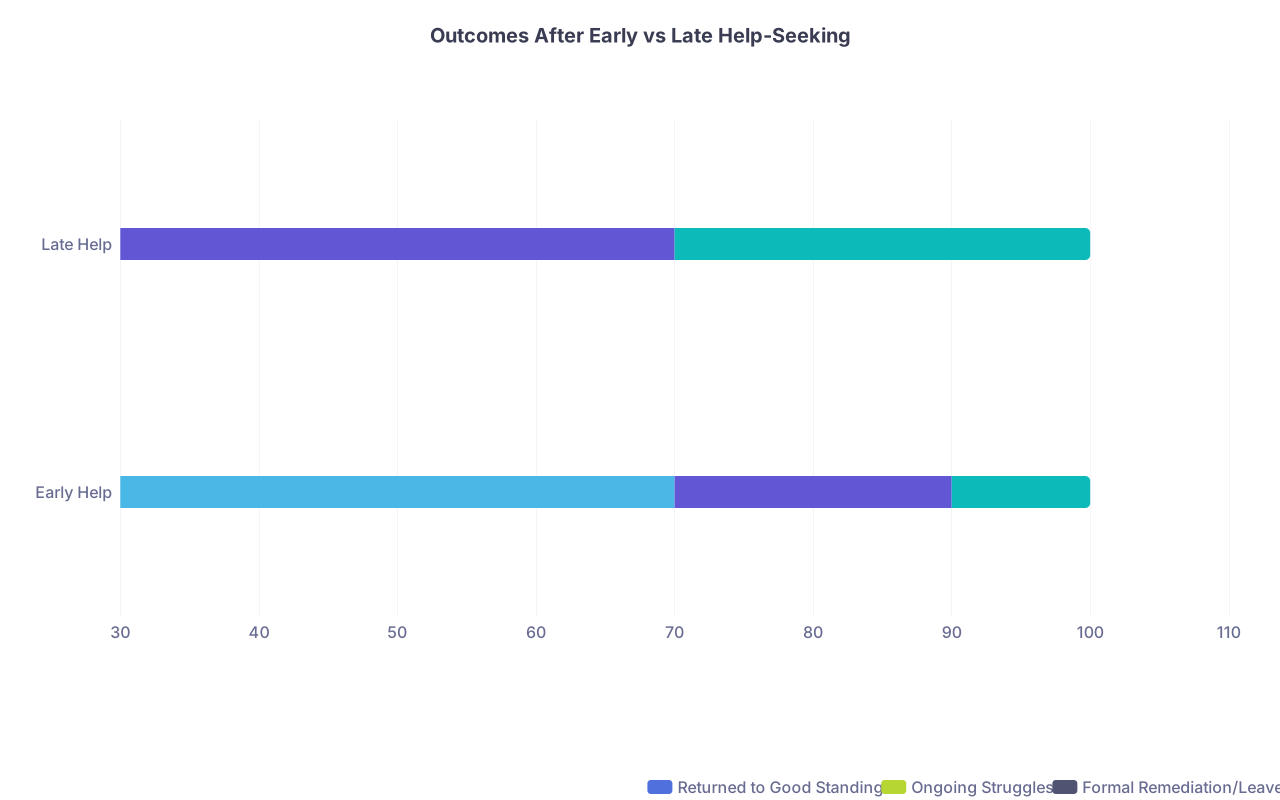
| Category | Returned to Good Standing | Ongoing Struggles | Formal Remediation/Leave |
|---|---|---|---|
| Early Help | 70 | 20 | 10 |
| Late Help | 30 | 40 | 30 |
How to Start If You’re Paralyzed
If the idea of talking out loud makes your stomach twist, you can start with an email. Short. Simple. Not a therapy session in paragraph form.
Something like:
Subject: Quick Check-In
Dear Dr. ___,
I was wondering if you might have 15–20 minutes for a quick check-in. I’ve been feeling pretty overwhelmed with the current workload and would really appreciate your advice on how to get back on track and what resources might be available.
Thank you for your time,
[Name], MS1
You don’t have to bare your soul in the email. The goal is to get on their calendar.
And if even that feels like too much, walk into the student affairs office and say, “I think I need to talk to someone. I’m really overwhelmed.” That’s enough to start the process.

FAQ (Exactly 5 Questions)
1. If I tell faculty I’m overwhelmed, can that hurt my chances at a competitive specialty later?
Not if this is handled reasonably. Programs aren’t reading some secret log of every time you felt stressed as an M1. They care about your performance, professionalism, and growth over time. Early, proactive help-seeking usually protects those, not harms them. What actually tanks competitiveness is failing courses, repeated professionalism issues, or completely burning out and stepping away without a plan. Talking early is damage prevention, not evidence you’re broken.
2. Should I tell my small-group facilitator specifically, or go straight to student affairs?
If you don’t know your facilitator well, or they’re directly grading you, I’d start with student affairs or a learning specialist. They’re safer, more neutral, and they can tell you whether looping in your facilitator makes sense later. If your facilitator has already shown they’re approachable and student-centered, they can be a good first stop—but you’re allowed to choose the route that feels less risky.
3. What if I’m “only” overwhelmed and not failing—am I being dramatic by asking for help?
No. Waiting until you’re failing to ask for help is like waiting until you’re in the ICU to say, “Hey, my chest has been hurting all week.” Overwhelm before failure is exactly when interventions work best. You don’t get bonus points for waiting until your life implodes. You just get more fallout.
4. What if the first person I talk to is dismissive or unsupportive?
Then they’ve told you something valuable: they’re not your person. That sucks, but it’s not the end. You go up or sideways. “I tried talking to X, but I didn’t feel heard. Is there someone else I could speak with?” Talk to student affairs, another faculty member, or a dean. One bad response doesn’t mean everyone secretly agrees or that you’re overreacting. It means that one person isn’t good at this.
5. How do I know if what I’m feeling is ‘normal med school stress’ or a problem I should flag?
Here’s the line: if your stress is consistently wrecking your sleep, appetite, concentration, motivation, or you’re dreading each day in a way that feels heavy and unrelenting, that’s not just “lol med school is hard.” If your grades are slipping despite effort, or you’re having thoughts like “they made a mistake admitting me” all the time, that’s a sign to talk to someone. You don’t need a diagnosis to justify asking for help. Feeling miserable most days is enough.
If you remember nothing else:
- Saying “I’m overwhelmed” to the right person is seen as responsible, not weak.
- The real danger to your career isn’t speaking up; it’s silently falling apart until it’s too late.
- You’re not the first overwhelmed M1, and you won’t be the last. The system expects this. Use the support it pretends to offer.