It’s 7:45 a.m. Your anatomy lab starts at 8. You’re standing outside those heavy double doors, pretending to scroll your phone while your heart is doing supraventricular tachycardia in your chest. You can hear the muffled talk and metal clinking inside. You’re thinking:
“What if I walk in, see the cadaver, and just collapse? What if I throw up? What if I can’t touch the body and everyone realizes I shouldn’t be a doctor?”
Yeah. This is the brain spiral.
Let me say this bluntly: being scared of cadaver lab does not mean you’re weak, broken, or not cut out for medicine. Honestly, I’m more suspicious of people who say, “Oh yeah, no big deal, I was excited to cut into a dead body,” with zero emotion. Most normal humans have at least some level of “oh my god” reaction.
Let’s unpack the worst-case scenarios you’re already imagining and talk about what actually happens.
What Actually Happens to People in Cadaver Lab
You’re probably picturing some movie scene where you step into the lab, look at the body, your vision tunnels, and you hit the floor dramatically. Crowd gasps. Professor judges. Career over.
Reality is much less cinematic, much more boring, and honestly way kinder.
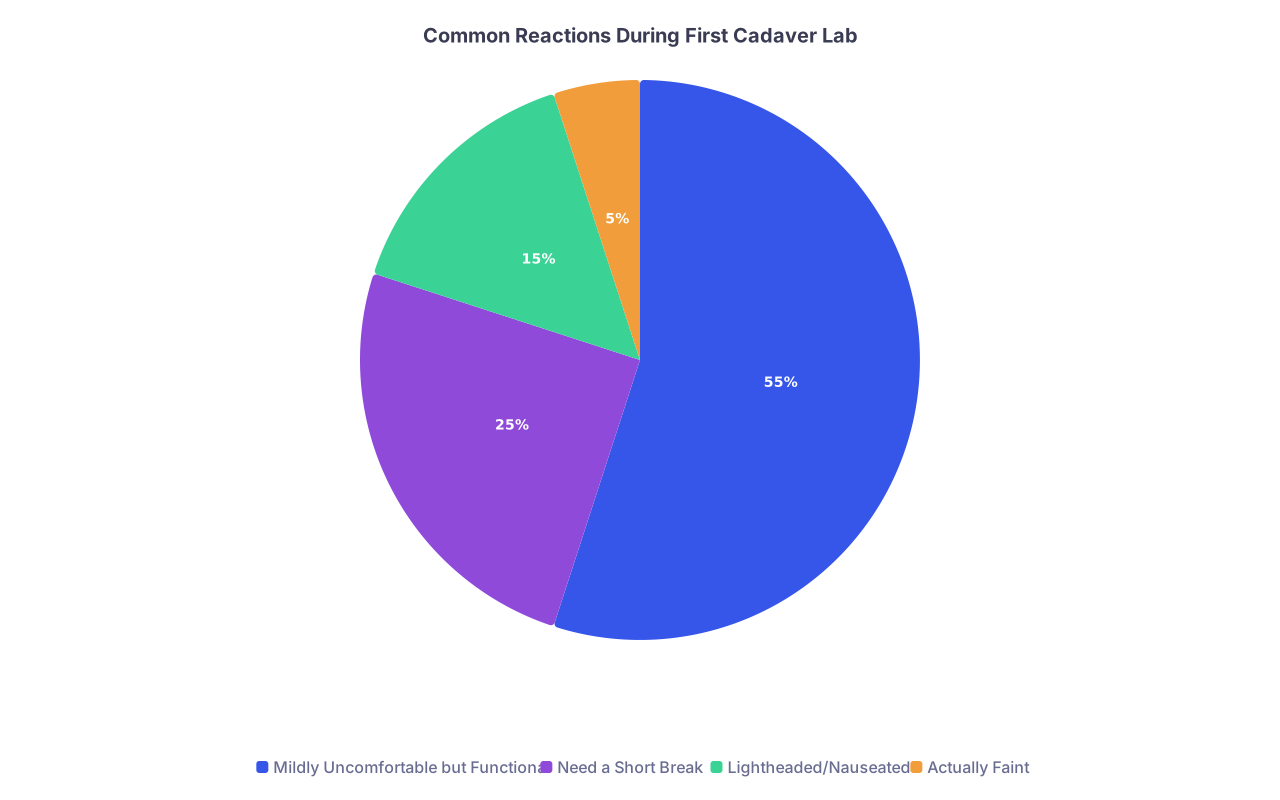
| Category | Value |
|---|---|
| Mildly Uncomfortable but Functional | 55 |
| Need a Short Break | 25 |
| Lightheaded/Nauseated | 15 |
| Actually Faint | 5 |
Most first-year classes follow a pattern on day one:
- A few people are pale and quiet, gripping the table.
- A couple step out for a breather as soon as the bags come off.
- One or two might actually faint or nearly faint.
- The rest push through while internally screaming.
Faculty have seen this a thousand times. Literally. You faint? They don’t think, “Wow, future malpractice lawsuit.” They think, “Yup, it’s Tuesday.”
I’ve watched this play out:
- Student’s knees buckle.
- Tablemate catches them (sort of).
- TA helps them into a chair.
- They get some water, maybe juice.
- They sit out for a bit. Come back later that day or next session.
Nobody writes a professionalism note. Nobody whispers they’re not “doctor material.” The only one brutal about it is you, in your own head.
Why You Might Freeze, Panic, or Feel Sick (And Why That’s Normal)
Let’s be honest. Anatomy lab is a perfect storm for your nervous system:
- You’re sleep-deprived.
- You’ve hyped this day in your mind for months.
- You’re surrounded by sharp tools, chemical smells, and metal tables.
- Oh, and there’s a human body in front of you, not a plastic model.
Your brain is trying to process at least three different kinds of stress:
Emotional / existential
“That was a person. They had a life, a family. One day that’ll be me.”
That’s heavy. It hits some people instantly, others slowly.Sensory / visceral
The smell, the look, the feel of the tissue. Your stomach is like, “Nope.”
That’s not moral failure. It’s just biology.Performance / shame
“Everyone else looks fine. Why am I freaking out? I must be weak.”
This is the one that really wrecks people. The shame spiral.
Here’s the truth nobody announces out loud:
You’re not supposed to be totally okay with dissecting a dead human.
The fact that you care, that you hesitate, that you feel something—good. That’s you being a person, not a scalpel robot.
Worst-Case Scenarios You’re Terrified Of (And What Actually Happens)
Let’s just drag your nightmares into the light.

“What if I actually pass out?”
Then you pass out. And?
Here’s what typically happens:
- Someone notices you swaying or going glassy-eyed.
- They get you to sit before you fully hit the deck.
- TA/prof creates a little bubble of privacy as much as possible.
- You’re checked on, maybe sent to sit outside with some water.
- You get told: “This is really common. Take your time.”
I’ve seen students who fainted on day one of lab go on to be surgeons. It’s a vagal response. Not a personality test.
Concrete tips to lower the odds:
- Eat something 1–2 hours before lab. Carbs + a bit of protein.
- Don’t go in dehydrated.
- Don’t lock your knees. Move your legs a bit while you stand.
- If you even feel the slightest wave of heat or tunnel vision, say it out loud: “Hey, I’m feeling a bit lightheaded, I’m going to sit.”
That last part? That’s what actual professionals do. Recognize early signs, act early. Waiting until you collapse is the opposite.
“What if I freeze and can’t touch the body?”
Then you step back. You observe. You start with the least intense tasks.
You do not have to be the first person to pick up the scalpel. You don’t prove anything by muscling through while your hands shake and you feel like you might cry.
Talk to your group early:
“Hey, I’m a little nervous about the first day. I might hang back at first and then join once I’ve adjusted. Just want to let you all know in advance.”
Normal human sentence. Saves you from having to explain in a panic later.
A very common pattern:
- Day 1: you stay at the foot of the table, maybe don’t touch much.
- Day 2–3: you start helping retract, reading from the atlas, pointing out structures.
- Week 2+ : you’re actually dissecting and realizing your brain can handle more than you thought.
You’re allowed to ramp. This isn’t a cold plunge where they shove you in and walk away.
“What if I cry in lab?”
Then you cry. Wipe your eyes. Step out. Come back if and when you’re ready.
But here’s the important thing: crying about cadaver lab doesn’t mean you “can’t handle medicine.” It means you see the body as a person and not a training object. That’s actually protective against the kind of emotional numbing that leads to burnout and terrible bedside manner.
I’ve seen students get quietly emotional when they find surgical scars, tattoos, evidence of disease. A lot of them say that moment actually made them more committed, not less.
Things You Can Do Before Day One To Make It Less Awful
You can’t erase the intensity. But you can shave a big chunk off the fear spike.
| Strategy | What It Helps With |
|---|---|
| Eat + hydrate | Fainting, nausea, fogginess |
| Talk to classmates | Shame, isolation, “I’m the only one” feeling |
| Visit lab beforehand (if possible) | Sensory shock, smell, environment |
| Pre-brief with faculty/TA | Fear of judgment, “what if I freak out” |
| Grounding/breathing plan | Panic spikes, freezing |
Some specific moves:
Ask upperclassmen how their first session went.
You’ll hear: “Honestly? It was rough at first. It got better.” Over and over.Email or talk to your anatomy instructor/TA before the first lab:
“I’m a little anxious about my first exposure to the cadaver lab and worried I might get lightheaded. Do you have any recommendations or things I should know?”
You’re not the first person to send that message. They usually respond with something reassuring and practical, and they’ll quietly keep an eye on you.Have a script ready for your body.
First whiff of panic, you do:- Plant your feet.
- 4–6 slow breaths. In through nose, out through mouth.
- Find and name 3 objects in the room (out loud in your head): “Sink. Clock. Door.”
Basic grounding. It yanks you back from the edge.
Desensitize in low-stakes ways if you’re really worried:
Watch real surgical videos, anatomy dissection videos, not just diagrams. It’s not the same as being in the room, but it helps your brain see bodies as anatomy, not just “person = horror.”
What Professors Really Think When Someone Struggles in Lab
You’re convinced they’re going to mentally put a big red X over your head: “Too squeamish. Not a real doctor.”
No. Here’s what they’re actually watching for:
- Are you respectful of the donor?
- Are you trying to engage, even if it’s in a modified way?
- Are you communicating needs? (“I need a second,” “I’m feeling lightheaded.”)
- Over time, are you improving, even a little?
They do not expect you to be totally okay on day one. Some of them still remember their first time. (A surprising number of attendings will quietly admit they got woozy during their first surgery or first autopsy.)
The only thing that looks concerning long-term is if:
- You refuse to participate at all, ever.
- You treat the body disrespectfully as a joke or a prop.
- You hide everything and then have a catastrophic episode in silence because you “didn’t want to bother anyone.”
Struggling and adjusting? Fine.
Refusing and mocking? Red flag.
Fainting? Extremely boring to them. They’ve seen it.
What If You Have a History of Fainting or Strong Reactions?
If you already know you’re a “fainter” (needles, blood, the sight of your own scraped knee) or you’ve got anxiety that just loves new triggers, plan more intentionally.

| Step | Description |
|---|---|
| Step 1 | Before First Lab |
| Step 2 | Email instructor/TA |
| Step 3 | Basic prep: eat, hydrate |
| Step 4 | First Lab Day |
| Step 5 | Start at edge of table |
| Step 6 | Observe from distance |
| Step 7 | Gradually participate more |
| Step 8 | After Lab Check-in with self |
| Step 9 | History of Fainting/Anxiety? |
| Step 10 | Feeling OK? |
More concrete steps:
Tell someone in advance. TA, professor, student wellness.
Not in a dramatic way. Just: “Hey, in the past I’ve fainted around medical things. I’m working on it, but wanted to give you a heads up so we can have a plan if I need to step out.”Position yourself smartly.
Stand where you can sit down quickly. Don’t wedge yourself between people and metal.Give yourself permission to observe first.
Your job isn’t to be the most hardcore one in the room. Your job is to learn anatomy and not hit your head on the floor.
You’re not the first anxious, vasovagal, catastrophizing student to walk into that lab. You definitely won’t be the last.
How Long Until It Stops Feeling So Intense?
This is the part your brain doesn’t believe, but it’s true: you adapt.
First week: every lab session feels like A Big Deal.
Second–third week: it’s still heavy, but also… you’re worrying more about quizzes and less about the fact that there’s a cadaver.
By later in the course: you’re focused on “Where the hell is that nerve?” and “What time does lab end?”
What usually changes:
- The smell becomes just “lab smell” instead of “assault on my soul.”
- The visual shock of seeing the whole body lessens; you see regions, structures.
- The emotional punch becomes more thoughtful than panicky. Gratitude, respect, curiosity.
If it never gets easy, that’s okay. It’s not supposed to become casual. But it becomes workable. Your brain learns: “I can survive this.”
If You’re Already Thinking “Maybe I Shouldn’t Be a Doctor”
This is the nasty little conclusion your anxiety is pushing:
“If I’m this scared of cadaver lab, I don’t belong in med school.”
I’m going to be blunt: that’s garbage logic.
Cadaver lab is:
- A very artificial, extreme test of your senses and emotions.
- Nothing like the way you’ll interact with living patients.
- Not even used in every medical school anymore. Plenty of excellent doctors never touched a cadaver.
You don’t need to love it. You don’t need to be unfazed. You just need to:
- Show up.
- Do what you can.
- Communicate when you hit your limit.
- Keep trying to expand that limit gradually.
That’s what being a physician actually is: noticing your own response, managing it, and still doing right by the person in front of you.
The fact that you’re so worried about this, that you care this much about “what kind of person this makes me,” tells me more about your potential as a doctor than whether you stand tall or wobble slightly under the fluorescent lights.
FAQ: Cadaver Lab Panic Edition
1. What if I’m the only one who reacts badly?
You won’t be. You might be the only one you notice, because everyone hides it. But in every class, people step out, feel sick, or quietly cry later in the bathroom. The “everyone else is fine” illusion is exactly that—an illusion.
2. Can I ask not to participate in dissection at all?
Some schools have limited alternatives (like observing only, using prosections, or more digital resources), but most still expect at least some participation. You can absolutely ask for modified involvement, especially early on—more observing, less direct cutting. Talk to your course director or student affairs; this isn’t a weird request.
3. Will fainting or stepping out go into my record or evaluations?
No, not in any meaningful “you’ll never be a doctor” way. People faint in ORs, clinic, lab—it’s treated as a common, manageable thing. The only red flag behavior is not communicating and pushing yourself until there’s an unsafe situation.
4. What if the smell makes me gag or almost vomit?
You’re not alone. Some students use a tiny dab of menthol or essential oil on their mask. Others take short “fresh air” breaks. You can also start a bit further back from the table and move closer gradually as your brain gets used to the smell. It’s not a moral test. It’s just your nose being dramatic.
5. I’m worried I’ll start associating dead bodies with my loved ones and freak out.
This happens. Your brain does quick, dark comparisons. The fix isn’t to shut it down completely; it’s to anchor to the donor’s role: they chose to help you learn. Some students actually write a short thank-you note (even if they never send it) just to reframe the body as a teacher, not a horror scene. If it really sticks and spirals, that’s a perfect thing to bring to counseling—lots of students do.
6. At what point should I actually be concerned about my reaction?
If weeks go by and you: cannot enter the lab at all, are having full-blown panic attacks regularly, or find that your distress is bleeding heavily into your sleep, appetite, and daily functioning, that’s when to pull in more support. Not because you’re “failing,” but because this has crossed from “hard but doable” into “your nervous system needs backup.” Student health, counseling, course directors—they’ve all seen this. You don’t have to white-knuckle it alone.
Key takeaways:
- Being terrified of cadaver lab is painfully common and says nothing about your potential as a doctor.
- Passing out, stepping out, or easing in slowly are all normal, acceptable responses—not career-ending events.
- The goal isn’t to be fearless; it’s to show up, communicate, and let your tolerance grow over time.