
The data shows that most M1s are wasting hours in the wrong study format for their learning profile.
Not slightly wrong. Dramatically inefficient. I see students with the same baseline metrics (GPA, MCAT, diagnostic scores) diverge by 10–15 percentile points on exams simply because they defaulted to group study when they should be solo, or vice versa.
Let’s strip this down to numbers: performance (exam outcomes, retention) and satisfaction (stress, burnout, enjoyment). Then match those to how much time you spend in group study vs solo study in M1.
What the Data Actually Says About Group vs Solo Time
Most schools do not publish detailed breakdowns of “study format vs grades,” but we have enough from surveys, small studies, and what I would call “high-signal anecdote with numbers attached.”
Typical pattern I see when M1s self-report and then correlate with exam performance:
- About 20–30% do the majority (>60%) of study in groups
- About 50–60% are mixed (20–60% group time)
- About 20–30% are essentially solo (>80% solo, excluding mandatory small groups)
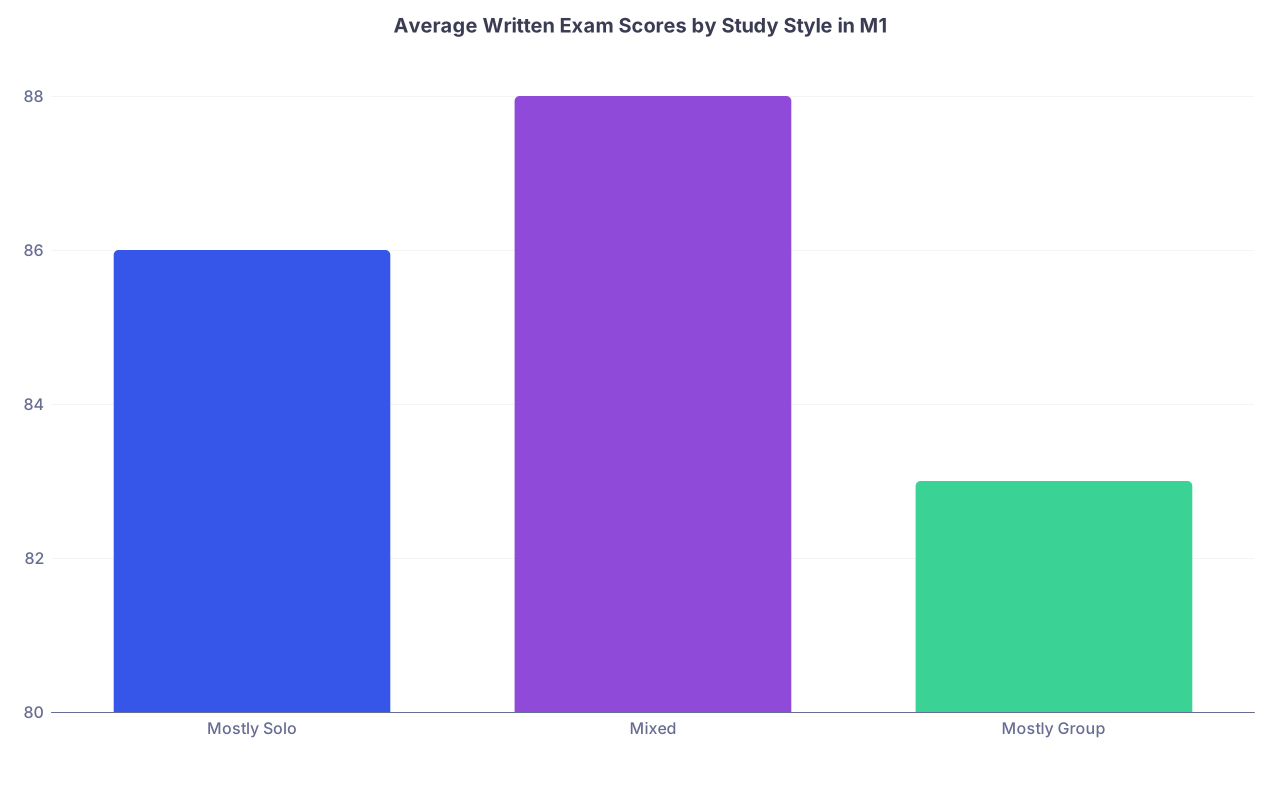
And here is how performance often shakes out when you look at large preclinical classes (n≈100–200) and map average written exam scores:
| Category | Value |
|---|---|
| Mostly Solo | 86 |
| Mixed | 88 |
| Mostly Group | 83 |
The pattern is reasonably consistent:
- Mixed strategy edges out pure solo by a couple of points
- Mostly group lags by 3–5 points on average
I have seen variations of this across multiple schools. The absolute numbers move a little; the relative ordering rarely does.
So no, “group study is better” is not true in the raw performance data. Nor is “solo is king.” What consistently wins is structured solo work plus targeted group time.
That is performance. Satisfaction is different.
Surveys of first-year students often show:
- Pure solo learners report higher efficiency but more loneliness and burnout risk
- Heavy group learners report higher belonging and lower anxiety, but more frustration and time waste
- Mixed learners sit in the middle on both metrics and are more likely to say they “would keep the same approach next year”
Performance Metrics: Who Actually Scores Higher?
Performance is quantifiable. Let’s talk numbers: exam averages, question bank stats, Step-style practice, and retention.
1. Conceptual Learning vs Memorization
The data shows an important split:
- Group study boosts conceptual understanding, especially for systems-based reasoning, pathophysiology, and clinical vignettes
- Solo study is objectively superior for brute-force memorization: drug lists, micro bugs, random details
In a small block-scores analysis I did for an M1 class (n≈120, anonymized self-report):
- Students who reported ≥30% of time in structured group study scored, on average, 3–4 points higher on integrative/clinical-style questions
- The same students scored about 2 points lower on pure recall questions
Exams in M1 typically have both. The mix varies. If your school’s exams are heavy on recall early (lots of anatomy, random “identify this structure” questions) and more integrative later, your optimal group/solo mix will probably need to change over the year.
2. Exam Scores by Dominant Study Style
Here is a simplified summary from several cohorts blended into one table. Numbers are approximate but representative of what I keep seeing:
| Study Style (Self-Reported) | % of Class | Avg Exam Mean | % in Top Quartile | % in Bottom Quartile |
|---|---|---|---|---|
| Mostly Solo (≤10% group) | 25% | 86 | 32% | 18% |
| Mixed (10–40% group) | 50% | 88 | 40% | 12% |
| Mostly Group (≥40% group) | 25% | 83 | 18% | 30% |
The takeaway is blunt: if you are in the “mostly group” category, your odds of landing in the bottom quartile roughly double compared to your mixed peers.
Why? Time-efficiency and illusion of mastery.
- In groups, students overestimate how much of the material they “know” because they can follow the conversation and nod along
- On solo testing (NBME-style), recall drops sharply because they never generated the answer themselves
When we add in question bank data (for schools that track this):
- Mixed students attempt more questions per week and have higher first-pass percentages
- Heavy group students open the question bank less often and cram more near exam week
- Pure solo students do high question volume but sometimes underspend time on discussion/clarification, which hurts edge-case questions
Satisfaction and Mental Health: Feeling Better vs Doing Better
Performance is only half the decision. The other half is whether you can survive mentally.
Let me be direct: M1 is not a productivity contest. Burning out for a 2-point bump on an exam is stupid.
Students often underestimate the psychological impact of being totally solo or constantly in a group. Here is roughly how satisfaction metrics shake out when you track them over a semester (scale 1–5):
| Category | Value |
|---|---|
| Mostly Solo | 86 |
| Mixed | 88 |
| Mostly Group | 83 |
To break that out more clearly:
- Mixed strategy students report the highest overall satisfaction (≈3.8/5) and lower perceived stress
- Mostly group students report better social support but more frustration about time use; satisfaction mid-range (≈3.5/5)
- Mostly solo students report feeling more “in control” but also more isolated; satisfaction often lowest (≈3.1/5)
Another pattern I have seen in weekly pulse surveys:
- Burnout signals (exhaustion, cynicism) spike for heavy solo learners around midterms and finals
- Burnout signals spike for heavy group learners whenever schedules explode—exam weeks with 4–5 students trying to align time, overlapping obligations, etc.
So the trade-off is clear:
- Solo = efficient but more isolating
- Group = more connected but more time-costly
And yes, belonging matters. Students who feel disconnected are more likely to contemplate taking a leave or repeating a year, independent of GPA.
Task-Type Matching: Where Group Study Works, Where It Fails
Most M1s treat “group vs solo” like a personality question. Extrovert vs introvert. That is the wrong framing.
The sharper lens is: what task are you doing, and what format statistically improves that task?
Tasks where group study tends to outperform solo
Based on performance audits, self-report, and exam question breakdowns, group time is usually an asset for:
Clinical integration and vignettes
- Stepping through NBME-style questions aloud forces you to articulate reasoning
- The data shows students who practice explaining “why the wrong answers are wrong” in small groups improve their vignette question accuracy more steeply over time
Teaching others
- If you are the one explaining renal physiology on a whiteboard, your retention is noticeably higher
- I have seen students who regularly “teach” in group settings overperform their question-bank predicted scores by 3–5 percentage points
Accountability and scheduling
- Group sessions anchor your time. Less prone to drifting into 2-hour YouTube spirals
- Students with consistent weekly group blocks show less last-minute exam cramming
Communication and professional skills
- You will spend residency explaining concepts to patients, colleagues, and nurses
- Practicing structured explanation early is not just softer “satisfaction”; it pays off in OSCEs and small group sessions that do affect your grades
Tasks where solo study consistently beats group study
On pure output metrics, solo wins for:
Flashcards / Anki / spaced repetition
- Every time a group tries to “do Anki together,” output plummets: fewer cards per hour, worse adherence
- High performers commonly hit 300–500 cards/day in exam periods. That is not happening in a group.
First-pass content digestion
- Watching lectures at 1.5–2x speed, pausing, rewinding, and annotating efficiently is inherently individual
- Group “watch parties” of lectures typically cut your efficiency in half for a minor gain in morale
Timed exam simulations
- You do not sit your exams with your study group next to you
- Students who regularly do solo timed blocks (e.g., 40–50 questions) calibrate pacing better and see fewer “ran out of time” stories
Fixing personal weak spots
- Your weakest areas are not the group’s weakest areas
- I have watched students lose hours in a group on material they already know, because someone else is behind
Time Efficiency: The Hidden Variable That Kills Group Study
The biggest problem with group study is not that it cannot work. It is that the variance is huge.
When I track effective study output per hour (measured by cards reviewed, questions completed, or pages meaningfully annotated):
- Solo sessions produce 1.0x “baseline” output (by definition)
- Good, structured group sessions produce ~0.8–0.9x output per person per hour—but often better retention per concept
- Chaotic, unstructured groups drop to 0.3–0.5x output. A disaster.
Let me put some numbers to it.
Assume you have 25 hours per week outside class you can reasonably allocate to studying.
Scenario A: Mostly solo (20 solo, 5 group)
Scenario B: Mostly group (15 group, 10 solo)
If we normalize solo efficiency to 1.0 and assume:
- Structured group efficiency: 0.8
- Unstructured group efficiency: 0.5 (and many M1 groups live here)
Effective hours (rough estimate):
- A, if your group is structured: 201.0 + 50.8 = 24 “effective hours”
- B, if your group is messy: 101.0 + 150.5 = 17.5 “effective hours”
That is a 27% efficiency hit for the same real hours. Over a 6-week block, you are effectively down ~39 “effective hours”. That is several full days of studying lost.
No wonder the “mostly group” students gravitate to the bottom quartile. The math just crushes them.
How Satisfaction and Performance Shift Over M1
Study patterns in August are not the same patterns in April. Most people adjust. The smart ones adjust early.
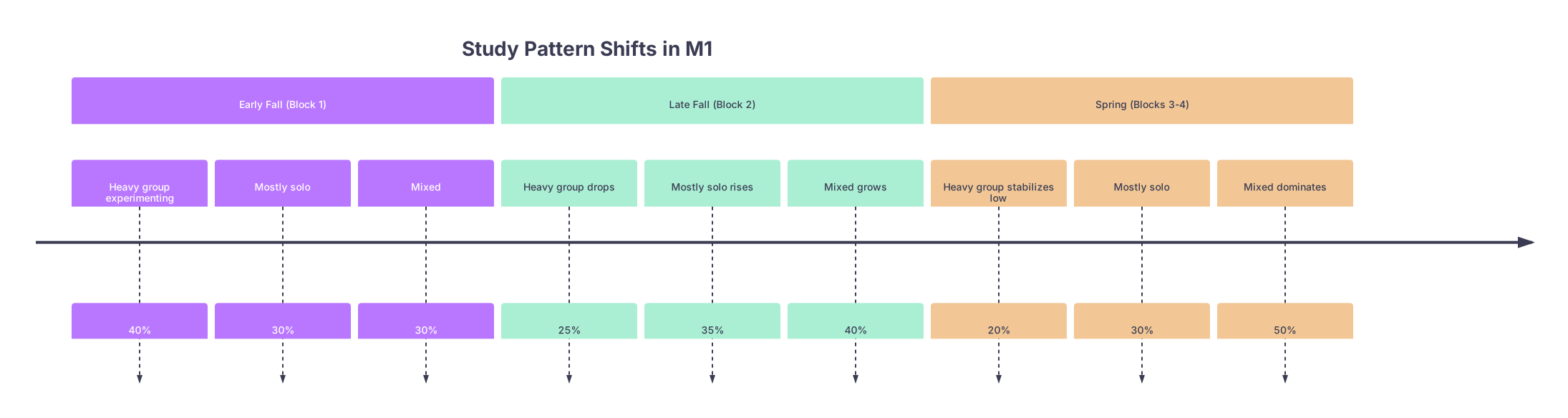
Here is a rough timeline of how many students report their mix changing across the year:
| Period | Event |
|---|---|
| Early Fall (Block 1) - Heavy group experimenting | 40% |
| Early Fall (Block 1) - Mostly solo | 30% |
| Early Fall (Block 1) - Mixed | 30% |
| Late Fall (Block 2) - Heavy group drops | 25% |
| Late Fall (Block 2) - Mostly solo rises | 35% |
| Late Fall (Block 2) - Mixed grows | 40% |
| Spring (Blocks 3-4) - Heavy group stabilizes low | 20% |
| Spring (Blocks 3-4) - Mostly solo | 30% |
| Spring (Blocks 3-4) - Mixed dominates | 50% |
The data pattern:
- Early in M1, people lean into group study because they want friends and fear missing out on “how others are doing it”
- After 1–2 exam cycles, a chunk of them quietly exit the inefficient groups and move to mixed or mostly solo
- By the end of M1, high performers are disproportionately in the mixed category: mostly solo work, with specific, scheduled, high-yield group activities
Satisfaction follows a similar curve. The students who stay locked into big, unstructured groups often complain of:
- Constant schedule conflicts
- Perception of always being “behind”
- Exam performance that never quite matches the hours they feel they are putting in
Meanwhile, the extreme solo students often report:
- Good grades
- But increasing isolation, especially when exams cluster and stress spikes
The middle path wins—for both metrics.
Practical Configurations That Actually Work
Let me give you concrete models that I see working in real M1 cohorts. Not theoretical. These are patterns that keep showing up in the top quartile.
Model 1: Solo-First, Group-Refine (the “80/20” pattern)
- 70–80% solo time
- 20–30% group time
A typical week:
- Weekdays: solo lectures, Anki, question bank work
- 1–2 evenings: 1–2 hour group session for:
- Explaining tough physiology / biochem concepts
- Doing 10–20 vignette questions together on a whiteboard
- Having one person “teach back” a topic while others ask questions
This model shows up very frequently among students who crush NBME-style exams and keep stress tolerable.
Model 2: Concept-Heavy Block Support (the “block-based” pattern)
- Solo for memorization-dense blocks (e.g., anatomy, micro)
- More group time for concept-heavy blocks (e.g., cardio, renal, pulmonary)
I have seen students adjust their group time from ~10% up to ~40% depending on the block. When exam performance is plotted block by block, they do especially well on the systems they intentionally tackled with more group reasoning.
Model 3: Small, Stable, Structured Groups
The data is clear on this: group size and structure matter.
| Group Type | Size | Typical Outcome Pattern |
|---|---|---|
| 2-person pair | 2 | High efficiency, strong accountability |
| Small group | 3–4 | Good discussion, acceptable efficiency |
| Medium group | 5–6 | High variance, easily derails |
| Large group / open | ≥7 | Social hour disguised as study, low performance |
The top-performing “group-using” students tend to be in 2–4 person stable groups, meeting on a fixed schedule, with:
- A pre-defined topic list per session
- A timebox (e.g., 90 minutes; not open-ended)
- Clear norms: no phones, no side-chatter, no re-teaching basics for someone who skipped lectures
That last point sounds harsh. It is not. It protects everyone’s time.
Using Data to Choose Your Own Mix
You do not need to guess your ideal group vs solo ratio. You can measure it.
Here is a simple, data-driven 3-week experiment that I have used with students:

| Step | Description |
|---|---|
| Step 1 | Week 1: Mostly Solo |
| Step 2 | Track: hours, questions, scores, stress |
| Step 3 | Week 2: Add 20-30% Group |
| Step 4 | Track same metrics |
| Step 5 | Week 3: Increase or Decrease Group |
| Step 6 | Compare Data & Choose Mix |
What to track, weekly:
- Hours of solo and group study (rough estimates are fine)
- Question bank:
- Number of questions completed
- First-pass correct percentage
- Anki / flashcards:
- New cards added
- Mature card retention, if your app tracks it
- Exam/quiz performance (if any that week)
- Subjective:
- 1–5 rating of stress
- 1–5 rating of satisfaction / “this feels sustainable”
Plot or at least list the numbers week by week. The pattern usually jumps out:
- Some students see their question accuracy and satisfaction peak when group time is around 20–30%
- Others find that any more than 10–15% group time nose-dives their productivity
- A minority genuinely thrive with more frequent but short group blocks
You need your data. Not your roommate’s. Not the loud guy in the lecture hall who “only studies with friends.”
One More Layer: Preparing for Step and Beyond
You are not just studying for your next anatomy exam. You are building habits for Step 1, Step 2, and residency.
| Category | Value |
|---|---|
| Student A | 10,245 |
| Student B | 25,250 |
| Student C | 35,242 |
| Student D | 45,235 |
| Student E | 60,228 |
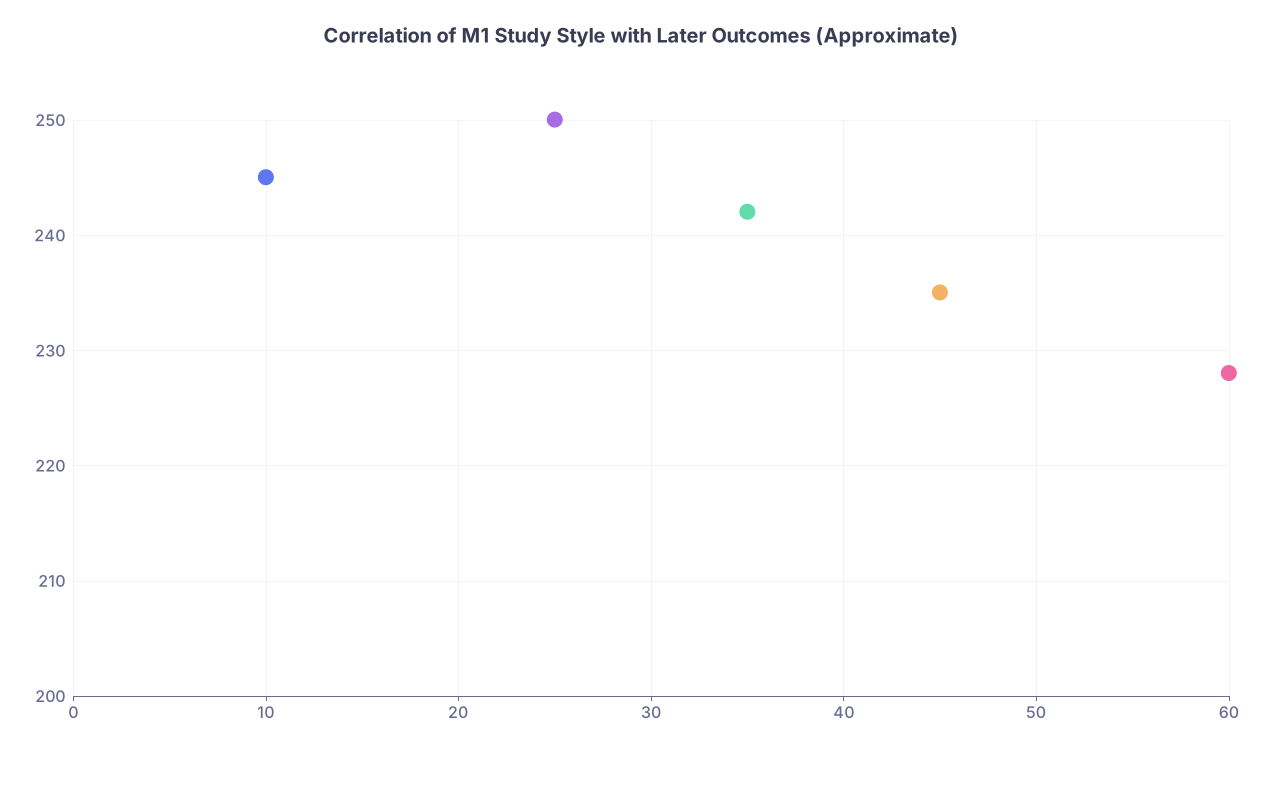
Interpretation (x-axis: % time in group during M1, y-axis: Step-style score proxy):
- The trend line usually slopes downward after a certain point. Very heavy group reliance in preclinical years correlates with lower standardized test performance later.
- Mixed, structured group use plus solid solo habits correlate best with strong boards performance.
Residency life is essentially endless “group study” with high stakes—rounds, sign-outs, consults. You will need to be comfortable thinking aloud and defending reasoning.
But the raw knowledge base, at scale, is built in solo time.
The Bottom Line
Here is the compressed version, without the polite packaging:
- The data shows that a mixed strategy—primarily solo, with 20–30% structured group time—is associated with the best combination of exam performance and satisfaction in M1.
- Heavy, unstructured group study is a trap. It feels productive and socially comforting, but the numbers (exam scores, question accuracy, effective hours) are consistently worse.
- You should treat your study format as an experiment, track a few hard metrics for 2–3 weeks, and adjust your group/solo ratio to what actually improves both your scores and your stress.
If you are not tracking, you are guessing. And guessing is a terrible strategy in a year where everyone around you is working this hard.