
Is It Okay to Say No to Research or Clubs in My First Med School Year?
What actually happens if you don’t join research or any big clubs in M1 — do you quietly ruin your residency chances, or is that fear completely overblown?
Let me be blunt:
Yes, it can be absolutely okay to say no to research and clubs in your first year.
But it depends on three things:
- Your specialty interest (or lack of one)
- How you’re actually doing with classes and exams
- Your stress level and mental health
You are not behind just because your classmates spammed the GroupMe with “Research opportunity!” in October. But you can mess things up by overcommitting early, burning out, and then scrambling in M3 with weak grades and no time.
Let’s break this down like a decision you’d make on rounds: focused, practical, and honest.
What Program Directors Actually Care About (More Than Your M1 Club List)
Before you panic about “CV gaps,” you need to understand the real hierarchy of what matters to residency programs.
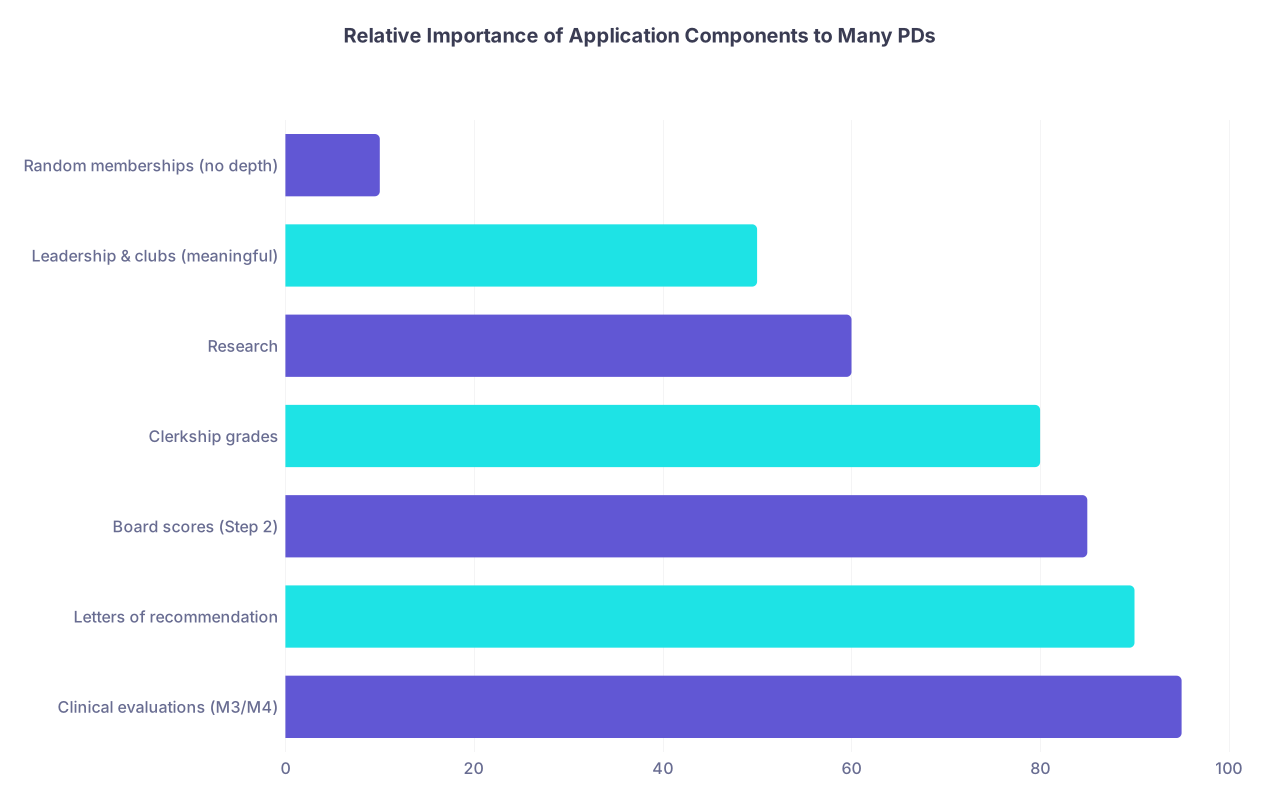
| Category | Value |
|---|---|
| Clinical evaluations (M3/M4) | 95 |
| Letters of recommendation | 90 |
| Board scores (Step 2) | 85 |
| Clerkship grades | 80 |
| Research | 60 |
| Leadership & clubs (meaningful) | 50 |
| Random memberships (no depth) | 10 |
Here’s the uncomfortable truth most M1s don’t hear clearly:
- Strong clinical performance and solid Step 2 score carry more weight than your M1 club buffet.
- A few deep, meaningful activities beat a CV packed with random memberships.
- Half-hearted research where you barely contributed is almost useless. PDs see right through fluff.
If you’re drowning in anatomy and biochem and thinking, “I cannot imagine adding research meetings on top of this,” listen to that. Learning how to learn medicine is your real job in M1.
I’ve seen two common disaster paths:
- The “CV maximalist”: Joins 5 clubs, 2 research projects, tutors, starts a podcast. Ends M1 exhausted, average grades, no real progress on any project.
- The “silent burner”: Never says no, feels guilty saying yes, ends up on 3 “teams” where they do all the grunt work, get zero authorship, and resent everyone.
You do not need to become either of those.
When It’s Completely Fine (Even Smart) to Say No in M1
If any of these fit you, saying “no for now” is not only okay — it’s wise.
1. You’re still figuring out how to study
If your scores are:
- Barely passing
- Or passing but feel fragile (lots of stress, last-minute cramming, anxiety before every exam)
You have no business stacking extra obligations yet.
Your priorities M1 should be:
- Mastering efficient study routines
- Learning what works: Anki vs notes, lectures vs boards-style resources
- Protecting your sleep and basic mental health
If you need all your bandwidth just to keep your head above water, adding research or a major leadership role is like adding weight plates when you haven’t learned the movement yet. It looks “hardcore” until something tears.
2. You have no idea what specialty you want
You don’t need “orthopedic surgery research” if you don’t even know if you like surgery. Or the OR. Or bones.
Shadowing, low-commitment interest groups, and talking to upperclassmen are enough in early M1. Actual niche research can wait until:
- Late M1 (spring)
- Or early M2, once you have some direction
Forced, premature research just to “check a box” often produces exactly what programs don’t care about: shallow participation and weak output.
3. Your mental health is not stable
If you’re:
- Already overwhelmed adjusting to med school
- Struggling with anxiety, depression, or burnout
- Dealing with major life events (family, finances, health)
Then yes — you can absolutely say no. And you should. A residency director would rather see:
- Stable grades
- A consistent track record
- Slightly fewer activities
…than a transcript and CV that scream “I was falling apart.”
When You Probably Should Not Completely Opt Out
Now the other side. There are situations where totally avoiding all non-class involvement all through M1 is a mistake.
1. You’re already eyeing a competitive specialty
Talking things like:
- Dermatology
- Plastic surgery
- Orthopedic surgery
- Neurosurgery
- ENT
- Ophthalmology
- Radiation oncology
For these, research is not “nice to have.” It’s almost standard. You don’t need to start in month one, but you also cannot show up in M3 with zero research and expect to be competitive at most places.
What makes sense here:
- Say no to most clubs.
- Say yes to one reasonable research project once you’ve stabilized academically, usually late fall or spring of M1.
- Find something with a clear role and realistic timeline (case report, retrospective chart review, simple QI project, etc.).
2. Your school culture heavily values involvement
At some schools, almost everyone is doing something — a clinic, a QI project, an interest group with actual responsibilities. You don’t need to “keep up with the most intense person in your class,” but you also do not want to be the only one who did literally nothing for two years.
That does not mean leadership titles in 5 clubs. It might mean:
- Joining 1–2 groups that sincerely interest you
- Attending occasional events
- Maybe taking on a very small, low-pressure role in spring of M1
The key: visibility, not volume. Being a consistent, present person in one setting is better than a ghost member of ten.
How to Decide: A Simple Framework
Here’s the decision tree I’d actually use with an M1 asking me this.

| Step | Description |
|---|---|
| Step 1 | Start M1 |
| Step 2 | Focus only on classes and wellness |
| Step 3 | Reassess after 1-2 blocks |
| Step 4 | Add 1 small research project after 1-2 blocks |
| Step 5 | Keep M1 light: 1 interest group max |
| Step 6 | Join 1-2 clubs, low-commitment |
| Step 7 | Skip major leadership until M2 |
| Step 8 | Are you passing comfortably? |
| Step 9 | Interested in competitive specialty? |
| Step 10 | Mental health stable and time capacity? |
If you answer:
- “No” to comfortable passing → skip research/clubs for now
- “Yes” to comfortable passing, “Yes” to competitive specialty → 1 research project after you prove you can handle school
- “Yes” to comfortable passing, “No” to competitive specialty, “Yes” to stable mental health → 1–2 small involvements are fine, but not required
The worst combo is: barely passing, mentally exhausted, and still saying yes to research to “look competitive.” That’s how people end up remediating classes or burning out.
What “Saying No” Should Actually Look Like (Scripts Included)
Most M1s don’t know how to say no without feeling guilty. So they ghost. Or half-commit. Both look worse than just being honest.
Here’s how to do it like a professional.
Saying no to research
“Thank you so much for thinking of me. Right now I’m still adjusting to the curriculum and I want to make sure I’m solid academically before I commit to a research project. I’d love to reach back out in a few months once I have a better handle on my schedule.”
That’s it. You did not close the door. You just delayed it. This is normal.
Saying no to a club leadership role
“Thanks for the offer—I’m flattered. I’m trying to keep my M1 year focused so I don’t overcommit and then underperform. I’d be happy to stay involved at the member level this year and consider leadership later on once I know what I can realistically handle.”
Notice what you’re doing: protecting your name. Taking a leadership role and underperforming looks worse than never taking it at all.
Saying yes, but with boundaries
If you do say yes, you need a limit. For example:
- “I can commit to one meeting a month and helping with one event this semester, but I can’t take on ongoing weekly tasks right now.”
If they react poorly to that? Red flag. That’s not a team you want anyway.
A Smart, Low-Stress Involvement Strategy for M1
If you want a template that usually works well, here it is.
Fall of M1 (first semester)
Priority: Learn how to be a med student without falling apart.
Reasonable involvement:
- Attend a few interest group talks to see what specialties feel interesting.
- Maybe join one longitudinal clinic or volunteer activity if it’s low-frequency (e.g., once a month).
- No major leadership. No big research commitments unless your school sets it up automatically and keeps it low-work.
Spring of M1
Priority: Build slowly, not suddenly.
At this point you know:
- Roughly how much time exams actually take
- Whether you’re consistently passing or thriving
- How much mental bandwidth you have
Now consider:
- 1 research project if you’re interested in something competitive or just curious about research
- 1 club where you actually show up, not just pay dues
- Maybe very small leadership (like being a liaison or helping run one event) if it doesn’t add weekly tasks

M2 and Beyond
M2 is where you:
- Deepen a research project or pick up another one if needed
- Take on 1–2 real leadership roles if you enjoy that sort of thing
- Drop activities that aren’t meaningful or that no longer fit your goals
By M3, you want a clear story:
- “I got involved in X, stuck with it for several years, and here’s what we produced or changed.”
Not: “I joined everything, but I don’t really remember what we did.”
How Much Is “Enough” Involvement By The Time You Apply?
Do you need your CV to look like a small novel? No. You want a pattern that looks like this:
| Aspect | Solid, Realistic Track | Overloaded, Shallow Track |
|---|---|---|
| Research | 1–3 projects, 1–2 tangible outputs (poster, pub) | 6+ projects, little to no real contribution |
| Clubs | 1–3 groups, consistent participation | 8+ memberships, barely attended |
| Leadership | 1–2 roles with real responsibility | Multiple titles, vague impact |
| Clinical extras | 1–2 clinics/volunteer sites over years | Many short, disconnected activities |
The left column is very achievable without killing yourself in M1. You can build that mainly from late M1, M2, and early M3. But only if you don’t burn out and crash early.
If You Already “Did Nothing” in M1 — Are You Screwed?
I’ve seen this a lot: Students hit late M2 or early M3 and suddenly panic: “I didn’t join anything M1. Is it over?”
No. Not even close.
Here’s how you recover:
- Get serious about one clinical or service activity you actually like. Start now and stay consistent.
- Pick up research that’s realistic: chart review, QI project, case reports, something with a timeline that fits your schedule.
- If you care about leadership, find one role, not five, and actually commit to doing it well.
Residency programs absolutely understand a slow start if the later years show maturity, focus, and follow-through. I’d take that over someone who peaked in M1 doing 20 things and then disappeared.

Quick Reality Check: Signs You’re Saying “Yes” For the Wrong Reasons
If any of these resonate, step back:
- “Everyone else is doing it, so I will look lazy if I don’t.”
- “I’m scared programs will judge me if I’m not constantly involved in something.”
- “I don’t actually care about this project, but it might be a line on the CV.”
Those motives usually produce mediocre results and resentment. Good rule: if you cannot explain why you’re doing something in one clear sentence that isn’t driven by fear, reconsider.
FAQ: Saying No to Research and Clubs in M1
1. Will it hurt my residency chances if I skip research and clubs for all of M1?
If you do absolutely nothing for all of med school, yes, that hurts you. But skipping big commitments in M1 alone? No. You can still build a strong application starting in late M1 or M2, especially if your grades and Step 2 are solid and you develop 1–3 meaningful activities over time.
2. I want a competitive specialty. Do I have to start research in M1?
You don’t have to start on day one, but you probably should start somewhere between late M1 and early M2. That lets you build at least one or two completed projects and maybe a poster or publication by application time. Just don’t sacrifice basic academic performance for it; failing classes hurts you more than starting research a few months later.
3. How many clubs should I join in first year?
Join as many as you want passively, but actively engage in 1–2 max. More than that in M1 usually leads to shallow involvement or burnout. You’re better off going to a few events and then committing more deeply once you see what actually matters to you.
4. How can I tell if I’m actually ready to add research or leadership?
Check three things: You’re consistently passing without last-minute miracles, you’re sleeping at least somewhat normally (not 3–4 hours nightly), and your anxiety feels manageable. If one of those is way off, stabilize first. Adding commitments won’t magically create more time or focus.
5. What’s one simple step I should take this semester if I’m unsure?
Do this: focus hard on nailing your next exam block, attend 1–2 interest group sessions that genuinely sound interesting, and set a reminder for two months from now to reassess. At that point, if you’re stable academically, talk to an MS2/MS3 you trust about 1 small project or activity to add. That’s enough forward motion without panic.
Key takeaways:
- Yes, it’s okay — and often smart — to say no to research and big club roles in M1 if your academics or mental health are shaky.
- You do not need a packed M1 CV; you need a few meaningful, consistent activities built over time, starting when you’re actually ready.
- Say no clearly, protect your bandwidth, and then add things intentionally once you’ve proven to yourself you can handle the core job: learning medicine well.