
Why Support Systems Matter in Your First Year of Medical School
Entering Medical School is both exciting and disorienting. You’re suddenly surrounded by brilliant peers, facing an intense volume of material, and trying to build a new life in a demanding environment. Most students quickly realize that academic ability alone isn’t enough. What consistently predicts Student Wellness and Academic Success is not just how hard you study, but the Support Systems you build around yourself.
During the first year, you’ll make dozens of decisions about how you study, who you spend time with, and when (or whether) you ask for help. Having the right people and resources in your corner can be the difference between barely surviving and genuinely thriving.
This guide walks you through how to:
- Understand why support systems are essential in medical training
- Intentionally build a strong network with classmates, faculty, and mentors
- Use your school’s academic and wellness resources effectively
- Maintain relationships with family and friends outside of medicine
- Protect your mental health in a high-pressure environment
The goal is not to do more, but to feel less alone while you do it.
The Critical Role of Support Systems in Medical School Life
Support Systems are not a luxury in medical school; they are a core component of professional formation. Your first year is when habits, mindsets, and relationships begin to shape your identity as a future physician.
Emotional Support: Protecting Your Mental Health
Medical school often brings:
- Imposter syndrome (“Did they make a mistake accepting me?”)
- Sleep deprivation and chronic stress
- Anxiety before exams and practical assessments
- Feelings of isolation, especially if you’ve moved away from home
Emotional support from peers, mentors, family, and mental health professionals can:
- Normalize your experience (“You’re not the only one who feels this way.”)
- Provide perspective when you catastrophize a bad quiz or OSCE
- Offer encouragement when you’re considering giving up on a goal
- Help you set boundaries and maintain basic self-care
Healthy Student Wellness isn’t “feeling good all the time.” It’s having people and tools that help you recover when things are hard.
Academic Assistance: Learning Together, Not Alone
No matter how strong your undergraduate background was, the pace and density of medical content will feel like a leap. A strong academic support system can:
- Break down difficult topics (e.g., renal physiology, pharmacology)
- Share high-yield resources and question banks
- Provide accountability and structure through study groups
- Help you identify gaps in your understanding before big exams
Medical school is designed around teamwork. You’re practicing for a career where collaboration is the norm—learning to learn with others is a core professional skill.
Networking and Career Development: Planting Seeds Early
Networking in medical school is not about being transactional—it’s about forming genuine relationships that shape your training and career. A thoughtful network can help you:
- Learn about different specialties early (through shadowing, interest groups)
- Join research projects that strengthen your residency application
- Obtain letters of recommendation from faculty who know you well
- Hear honest stories from residents and attendings about different paths
The connections you build in your first year can follow you into clerkships, away rotations, residency, and beyond.
A Positive Environment: Belonging in a High-Pressure World
When your daily environment is competitive and stressful, you need spaces where you feel:
- Seen as a person, not just a test score
- Safe to admit when you’re struggling
- Encouraged to maintain interests outside of medicine
- Motivated by peers who lift each other up instead of tearing each other down
A positive community doesn’t remove stress—but it buffers its impact and helps you maintain perspective and purpose.
Building Your Core Network: Classmates and Peer Support
Your classmates are your frontline Support System. They’re going through the same exams, deadlines, and emotions at the same time.
Connecting Intentionally with Classmates
Instead of waiting for friendships to “just happen,” be deliberate:
Show up consistently
- Attend orientation, welcome events, and early mixers
- Go to anatomy lab reviews, case discussions, and review sessions
- Sit with different people in lectures during the first few weeks
Ask small, specific questions to start conversations
- “Hey, what are you using to study for anatomy?”
- “Have you tried any Anki decks you like?”
- “Are you planning to join any student orgs yet?”
These micro-interactions often grow into study relationships and friendships.
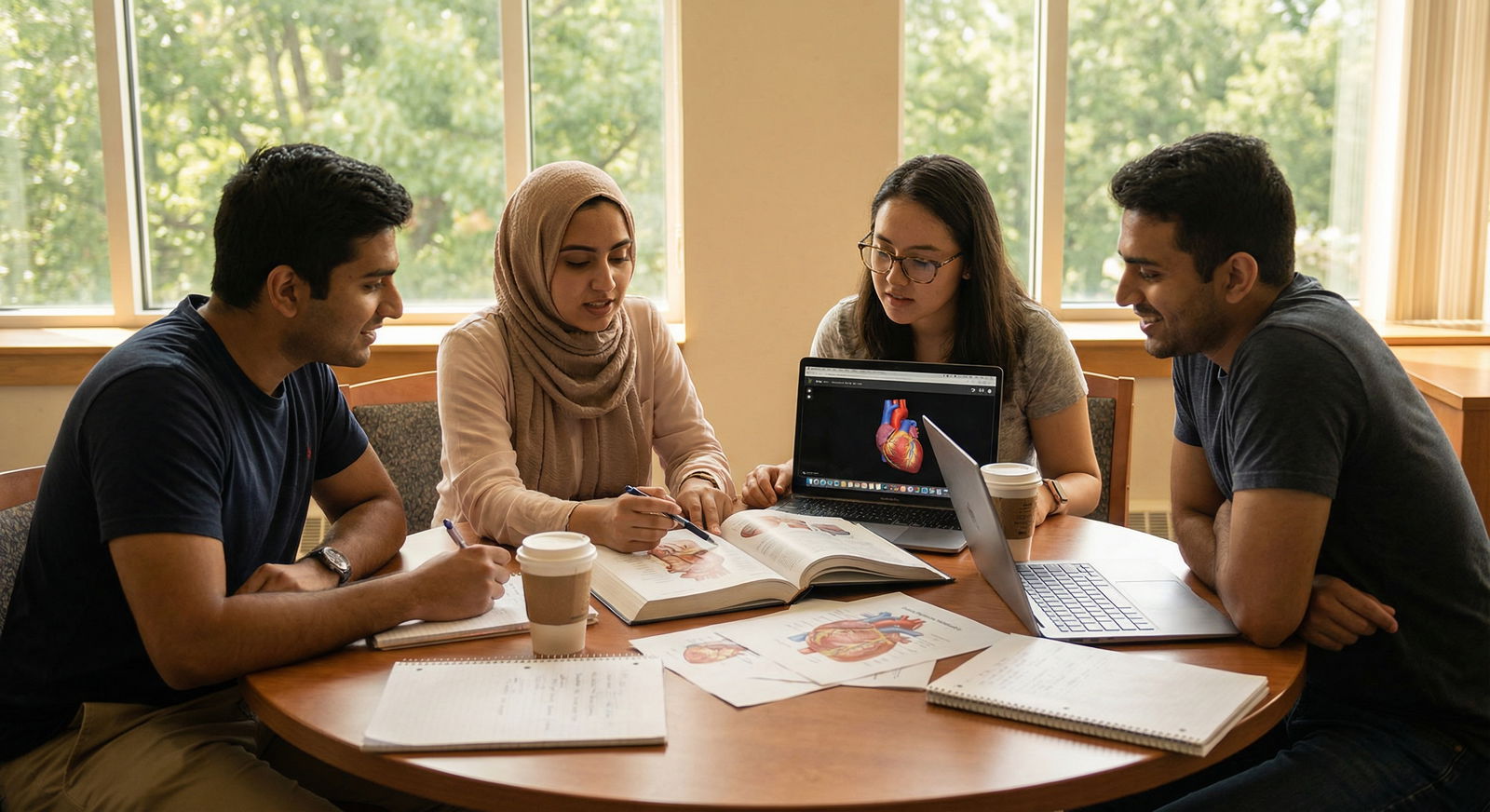
Forming Effective Study Groups
Study groups can boost Academic Success—but only if they’re structured well.
Characteristics of a good study group:
- 3–5 students (large enough for diversity, small enough to stay focused)
- Clear purpose (e.g., weekly review of lectures, practice questions, pathology review)
- Agreed-upon norms (start/end time, no phones, participation expectations)
Practical tips:
- Start with a trial period: “Let’s try this for 3 weeks and then reassess.”
- Rotate roles: question leader, timekeeper, scribe for unclear topics
- Use active learning:
- Teach-back: each person explains a concept to the group
- Practice questions together and discuss why answers are right/wrong
- Create diagrams or tables collaboratively
If a group becomes unproductive or stressful, it’s okay to step back and restructure or find a better fit.
Leveraging Digital Tools and Social Platforms
Digital spaces can keep you connected and organized:
- Group chats (WhatsApp, GroupMe, Signal, Discord)
- Class-wide groups for announcements, reminders, and resource sharing
- Smaller groups for study partners or lab teams
- Shared documents
- Google Drive folders for notes, lecture summaries, and collaborative study guides
- Calendar sharing
- Shared calendars for exam dates, review sessions, and important school events
These tools help with both Networking and logistics—just be mindful of information overload and mute channels when you need focus.
Faculty Mentors, Advisors, and Academic Resources
Beyond your peers, your school likely has multiple layers of support designed to help you succeed. Many students underuse these in their first year—don’t make that mistake.
Building Relationships with Faculty Mentors
Faculty can be intimidating at first, but they are often eager to support engaged students.
How to start:
- Attend office hours not only when you’re lost, but also when you’re curious
- Send a short, respectful email:
- Introduce yourself
- Mention a specific part of their lecture or research you found interesting
- Ask one or two focused questions or request a brief meeting
Example:
“I really appreciated your lecture on heart failure management, especially the discussion of social determinants of health. I’m interested in cardiology and public health—would you be open to a brief meeting to discuss potential ways for first-year students to get involved?”
Over time, these conversations may turn into mentorship that influences your specialty choice, research involvement, and residency planning.
Engaging with Academic Advisors and Learning Specialists
Most Medical Schools offer structured academic support:
Academic advisors or deans help with:
- Course and exam planning
- Navigating leaves of absence or personal challenges
- Understanding school policies (remediation, step exam timelines)
Learning specialists or academic coaches can assist with:
- Study strategies tailored to your learning style
- Time management and realistic weekly schedules
- Test-taking strategies for multiple-choice and practical exams
Meeting with these professionals early—before you’re in crisis—can prevent small problems from becoming major setbacks.
Using Tutoring, Review Sessions, and Workshops
Common academic resources include:
- Peer tutoring by upperclassmen
- Faculty-led review sessions before major exams
- Workshops on:
- Anki and spaced repetition
- NBME-style question strategies
- Time and stress management for medical students
Treat these not as signs you’re “behind,” but as part of a high-performance toolkit. Many top-performing students are the ones who use school resources consistently and early.
Getting Involved in Research and Professional Development
Your first year is a good time to explore interests without overcommitting.
Steps to start:
- Identify fields you’re curious about (even if you’re not sure).
- Look up faculty profiles and ongoing projects in those departments.
- Ask older students which mentors are supportive and student-friendly.
- Reach out with a concise email:
- Who you are
- Why their work interests you
- What level of involvement you’re realistically able to commit to
Saying “no” or asking to start small (e.g., literature reviews, data entry, chart reviews) is better than overpromising. This is Networking with honesty and professionalism.
Student Organizations, Upperclassmen, and Community
Support Systems extend beyond your immediate class and faculty. Your broader school community is full of people who have already walked the path you’re just starting.
Joining Student Organizations Strategically
Student organizations can be powerful for Networking, wellness, and professional growth—if you’re intentional and realistic with your time.
Common types include:
Specialty interest groups (e.g., Internal Medicine, Surgery, Pediatrics, EM)
- Panels with residents and attendings
- Skills workshops (suturing, ultrasound, EKG interpretation)
- Shadowing connections and research leads
Identity-based and affinity groups
- Support around shared experiences (e.g., first-generation, LGBTQ+, URiM groups)
- Community, mentorship, and advocacy opportunities
Community service and global health groups
- Volunteer clinics, health fairs, educational outreach
- Exposure to social determinants of health early in training
Wellness and support organizations
- Mindfulness, yoga, running clubs, peer support circles
- Non-academic spaces that protect Student Wellness
Start by attending meetings for a few groups, then commit deeply to one or two rather than superficially to many.
Learning from Upperclassmen: Real-World Advice
Upperclassmen are one of your most valuable resources. They:
- Know which resources are actually high-yield at your specific school
- Can share old study schedules and exam strategies that worked for them
- Understand the hidden curriculum (unwritten expectations and norms)
- Can reassure you that what feels impossible in month one will become routine
Ways to connect:
- Join formal peer mentorship programs if your school offers them
- Attend student-run review sessions before big exams
- Ask to grab coffee with someone whose path you admire (e.g., a second-year who balances research, wellness, and leadership)
Questions to ask:
- “What do you wish you’d done differently in M1?”
- “How did you prepare for your first anatomy practical / OSCE?”
- “What do you do to disconnect and recharge?”
Their small tips can save you hours of trial and error.
Family, Friends, and Mental Health: Support Beyond Campus
While your world may start to revolve around medical school, relationships outside medicine remain critical for emotional balance and perspective.
Maintaining Relationships with Family and Non-Medical Friends
It’s easy to drift away from people who don’t “get” medical training. You don’t have to choose between your new life and your old one—you just need structure and communication.
Practical strategies:
- Schedule recurring calls (e.g., Sunday night family check-in, monthly video call with college friends)
- Set expectations:
- Explain upcoming stressful blocks (e.g., exam weeks)
- Be honest when you’re less available—this prevents misunderstandings
- Share both the highs and lows:
- A meaningful patient interaction in standardized patient encounters
- A tough exam week or challenging anatomy dissection
These relationships remind you that you are more than your grades and that life exists beyond the next exam.
Using Formal Mental Health Resources
Student Wellness is not just a buzzword; it’s a requirement for safe, ethical practice. Most Medical Schools provide:
- Confidential counseling or psychotherapy
- Psychiatric evaluation and medication management if needed
- Crisis support or urgent appointments after major stressors
- Workshops on resilience, mindfulness, and coping skills
Consider normalizing for yourself that:
- You don’t need to be “in crisis” to seek counseling
- Many students quietly access mental health care during training
- The earlier you intervene, the easier it is to course-correct
If stigma or fear is holding you back, talking with a trusted faculty mentor or upperclassman about their experience with mental health support can be reassuring.
Peer Support and Wellness Practices
In addition to professional care:
- Join peer-led support or reflection groups if your school offers them
- Create small wellness routines:
- A 10-minute walk between study blocks
- Simple home workouts or yoga videos
- Journaling for 5 minutes before bed
- Set “protected time” (even 2–3 hours per week) where you do something non-medical:
- Hobbies, music, cooking, creative projects
- Faith or spiritual practices, if important to you
These habits support resilience and prevent burnout from becoming your baseline.

Putting It All Together: Practical Strategies and Mini-Case Examples
To see how Support Systems can function in real life, consider two composite examples based on common student experiences.
Case 1: Sarah – From Overwhelmed to Supported
Sarah started medical school in a new city, far from home. Initially, she:
- Studied alone, afraid others would think she wasn’t smart enough
- Avoided asking questions in class or office hours
- Felt isolated and near tears after her first anatomy exam
After a difficult week, she decided to make changes:
- Joined a small anatomy study group and realized her classmates shared similar struggles
- Started attending office hours for two of her courses; one professor later became a mentor and invited her to join a small quality-improvement project
- Went to a student wellness workshop and set up an appointment with counseling services when her anxiety spiked before her second exam block
- Scheduled a weekly video call with her parents to stay connected
By the end of first year, Sarah’s scores had improved, but more importantly, she felt less alone, more confident in her abilities, and clearer about her goals.
Case 2: Mark – Using Networking to Explore Careers
Mark entered medical school thinking he might be interested in surgery but wasn’t sure. He:
- Joined the surgery interest group and attended skills nights and resident panels
- Asked a second-year mentor about research opportunities and was introduced to a surgical outcomes research team
- Developed a relationship with a faculty advisor who later wrote a strong letter of recommendation
- Balanced this with involvement in a wellness group that hosted yoga sessions and outdoor hikes to protect his Student Wellness
By the time he reached clinical rotations, Mark had a network of residents, fellows, and faculty who knew him personally, and he had concrete experiences to talk about in residency interviews.
Simple Action Plan for Your First 3 Months
You don’t need to do everything at once. Consider this starter plan:
Week 1–2
- Join at least one class group chat
- Attend orientation events and sit with different classmates
- Identify your academic advisor and bookmark how to schedule an appointment
Week 3–6
- Form or join a small, structured study group
- Attend at least one office hour and introduce yourself
- Go to an interest group or wellness group meeting
Week 7–12
- Meet at least one upperclassman for coffee or a brief chat
- Try one workshop (study skills, wellness, or exam prep)
- Set a recurring call with family or close friends
Small, consistent steps compound into a robust support network over time.
FAQ: Support Systems and Networking in Your First Year of Medical School
Q1: What if I’m introverted or shy—can I still build a strong support system?
Yes. You don’t need to be outgoing to build meaningful connections. Focus on small, low-pressure steps: sit next to someone new in class, ask one classmate about a study resource, or attend events in smaller settings (like a small-group review) rather than big mixers. One or two genuine connections are more valuable than trying to know everyone.
Q2: How do I know if a study group is helping or hurting my Academic Success?
Reflect honestly after 2–3 weeks:
- Are you leaving sessions with clearer understanding or more confusion?
- Do you cover material efficiently, or does the group drift off-task?
- Are you able to ask questions without feeling judged?
If the answer to these is mostly “no,” try proposing changes (clear agenda, time limits) or consider a different group structure.
Q3: I’m worried that asking for help will make me look weak. Will it hurt my reputation?
In medical training, appropriately seeking help is seen as a strength and a marker of professionalism. Faculty, advisors, and residents are generally more concerned about students who struggle in silence. Using tutoring, counseling, or academic coaching is common—even among top students—and typically kept confidential.
Q4: How do I network without feeling fake or transactional?
Think of Networking as building genuine professional relationships. Be curious, ask about others’ paths, and share your interests honestly. Send thank-you emails after someone spends time with you. Instead of “What can I get from this person?” think “What can I learn from them?” Authenticity and follow-through matter more than perfect small talk.
Q5: How can I balance maintaining Support Systems with limited time and a heavy workload?
You don’t need hours every day. Integrate support into what you’re already doing:
- Study with a friend instead of always studying alone
- Walk to class with a classmate and talk about non-medical life
- Use a 20-minute lunch break to call a family member
- Schedule one social or wellness activity per week and protect it from last-minute cancellations
Investing a small amount of time in your relationships and wellness can significantly improve focus, efficiency, and long-term performance.
By intentionally building Support Systems, protecting your Student Wellness, and using your Medical School community wisely, you create the conditions for sustainable Academic Success. You’re not meant to do this alone—and you will be a better physician because of the people who help you along the way.