
Entering Medical School is both exhilarating and disorienting. Your first year will likely be one of the most intense transitions of your life: new city, new friends, new expectations, and more information than you ever imagined possible. It can feel chaotic—but that chaos is navigable.
This guide breaks down practical, evidence-informed Study Tips, Time Management strategies, and Stress Management tools to help you not just survive, but build a strong foundation for the rest of Medical School and your future residency.
Understanding the First-Year Medical School Environment
The better you understand what you’re stepping into, the less overwhelming it feels. First year isn’t just “more school”—it’s a new culture, a new language, and a new level of responsibility.
The Structure of the First-Year Curriculum
Most Medical Schools organize the first year around foundational sciences that you’ll build on in your clinical years. While exact structures differ (systems-based vs. discipline-based, pass/fail vs. graded), most include:
Anatomy
- Cadaver dissection or prosection labs
- Surface anatomy and imaging (X-rays, CT, MRI)
- Practical exams (identifying structures, clinical correlations)
Biochemistry & Molecular Biology
- Metabolism, genetics, molecular mechanisms of disease
- Often highly testable and concept-dense
- Directly relevant to pharmacology and pathology later on
Physiology
- How organ systems function in health
- Concepts like hemodynamics, renal function, neurophysiology
- Central to understanding why diseases cause certain symptoms
Histology & Cell Biology
- Microscopic anatomy of tissues and organs
- Virtual slides or microscopes
- Often integrated with pathology in later years
Some curricula also include foundations of clinical medicine, behavioral sciences, public health, and early exposure to Health and Wellness, professionalism, and ethics.
Common Teaching and Learning Formats
You’ll encounter a mix of learning methods. Knowing what to expect helps you design smarter study strategies:
Lectures (In-Person or Recorded)
- Cover a large volume of material quickly
- Often aligned with exam content
- Many schools provide recorded lectures—tempting to binge, but dangerous without structure
Small-Group Learning (TBL, CBL, Discussions)
- Team-Based Learning (TBL), Case-Based Learning (CBL), or seminar sessions
- Encourage active participation, application of knowledge, and peer teaching
Problem-Based Learning (PBL)
- Student-led discussion of patient cases
- Focus on clinical reasoning, self-directed learning, and group skills
- Great practice for how you’ll think as a clinician
Clinical Skills Sessions
- Practice history-taking, physical exam, communication skills
- Work with standardized patients or early clinical preceptors
- Build confidence and remind you why you came to Medical School
Understanding how your school tests (multiple-choice, practicals, oral exams) and which sessions are high-yield is essential. During orientation or the first few weeks, ask upperclass students:
- Which sessions are critical to attend live?
- Which resources align best with your school’s exams?
- How are labs and clinical skills graded?
Their answers will shape your study and Time Management plan from day one.
Developing Effective Study Habits for Medical School
Your old “cram and coast” approaches from undergrad will not sustain you here. First year demands intentional, efficient, and sustainable Study Tips and systems.

Establishing a Realistic and Sustainable Routine
Consistency beats intensity over the long haul. Build a flexible, repeatable weekly framework:
Anchor Your Day
- Fixed points: classes, labs, clinical skills, workouts, meals, sleep.
- Protect 7–8 hours of sleep like an appointment with a patient—non-negotiable.
Block Your Study Time
- Use focused blocks (e.g., 50 minutes of work, 10 minutes of break) or the Pomodoro Technique (25/5).
- Plan 2–4 high-quality blocks per day rather than endless unfocused hours.
Match Tasks to Your Energy
- Morning: high-focus work (new material, concept-heavy topics)
- Afternoon: review, flashcards, group study
- Evening: light review, planning, or practice questions
Schedule Review, Not Just New Content
- Dedicate time daily to revisit older material (e.g., flashcards, quick summaries).
- This prevents week-before-exam panic and supports long-term retention.
Using Evidence-Based Learning Strategies
Medical School rewards active learning, not passive rereading.
Active Recall
You learn most when you force your brain to retrieve information rather than just re-expose yourself to it.
- Use practice questions after lectures or at the end of each topic.
- Close your notes and try to teach the concept out loud to yourself or a friend.
- Write “test-yourself” questions in the margins of your notes and answer them later.
Spaced Repetition
Spaced repetition helps you remember massive amounts of detail (pathways, drug names, anatomy) over months and years.
- Consider tools like Anki or similar flashcard platforms.
- Start early and add cards consistently rather than cramming 1,000 cards before exams.
- Limit daily new cards to avoid burnout; focus on consistent reviews.
Dual Coding and Concept Mapping
- Combine words + visuals (diagrams, charts, flowcharts) to solidify understanding.
- Create concept maps connecting physiology → biochemistry → clinical manifestations.
- For example: build a map linking the renin–angiotensin system to blood pressure control, medications, and heart failure.
Choosing and Managing Resources Wisely
Information overload doesn’t just come from lectures—it comes from thousands of available resources. Your job is to curate, not collect.
Core categories to consider:
Primary Sources
- Your school’s lecture materials and required readings
- Practice questions written by faculty
Board-Oriented Resources
- Review books (e.g., First Aid for the USMLE Step 1 or equivalent for your region)
- Question banks (UWorld, Amboss, etc. later in MS1 or MS2)
Video Platforms
- Osmosis, Boards & Beyond, Sketchy, Khan Academy Medicine, etc.
- Helpful for visual learners and complex pathways
How to avoid drowning in resources:
- Ask 2–3 upperclass students: “If you had to do MS1 over again at this school, which 2–3 resources would you use and in what order?”
- Commit to a limited set (e.g., lecture slides + one video resource + one question bank or flashcard system).
- Regularly prune: if a resource isn’t clearly improving your scores or understanding after a few weeks, drop it.
Making Study Groups Work for You
Study groups can be a powerful tool—or a massive time sink.
Benefits:
- Explaining concepts to others deepens your own understanding.
- You can divide and conquer complex topics or large reading assignments.
- Emotional support: you realize you’re not alone in your struggles.
Best practices:
- Keep groups small (3–5 students).
- Agree on a clear agenda and time limit for each meeting (e.g., “Cardiac physiology cases, 90 minutes”).
- Focus on application and questions, not mutual complaining or copying notes.
- Periodically reassess: Is this group helping your grades, clarity, or confidence? If not, it’s okay to step back.
Time Management: Building Balance into Your Schedule
Time Management in medical school is about intention and boundaries, not just cramming more hours into the day.
Using Technology to Stay Organized
Digital tools can help you manage lectures, assignments, exams, and life outside school.
Calendars (Google Calendar, Outlook)
- Color-code blocks: lectures, study time, workouts, social events, exams.
- Add exam dates and assignment deadlines at the start of each block or semester.
Task Managers (Todoist, Notion, Trello)
- Break bigger tasks into smaller, actionable steps (e.g., “Review renal physiology lecture 1–3”).
- Use daily or weekly checklists to stay grounded.
Focus Tools (Forest, Focus To-Do, website blockers)
- Limit social media and distracting websites during study blocks.
- Protect your attention as if it were your most valuable resource—because it is.
Setting SMART Goals
Vague intention (“study more physiology”) rarely works. Use SMART goals:
- Specific – “Complete 20 renal physiology questions.”
- Measurable – You know when it’s done.
- Achievable – Realistic given your energy and schedule.
- Relevant – Directly tied to your curriculum and exams.
- Time-bound – “By 7 pm today” or “Before Friday afternoon lab.”
Build weekly and daily study goals:
- Weekly: “By Sunday, I will have watched all cardiac physiology lectures, completed 50 relevant practice questions, and reviewed all Anki cards due.”
- Daily: “After class, I’ll spend 2 hours reviewing today’s lectures and 30 minutes on flashcards.”
Protecting Personal Time and Preventing Burnout
In Medical School, there is always “more you could do.” If you don’t set limits, the work will consume every waking hour.
- Schedule non-study time: meals, exercise, hobbies, downtime with friends.
- Treat them as appointments that matter—because they’re essential to long-term performance.
- Learn to differentiate:
- Urgent and important (tomorrow’s exam review)
- Important but not urgent (long-term Step/board prep, relationships, wellness)
- Not important (doomscrolling, unplanned YouTube binges)
A well-protected life outside school is not a luxury; it’s a performance enhancer.
Building a Support Network and Managing Stress
You’re not meant to do this alone. Connection and Stress Management are pillars of Health and Wellness in your first year.
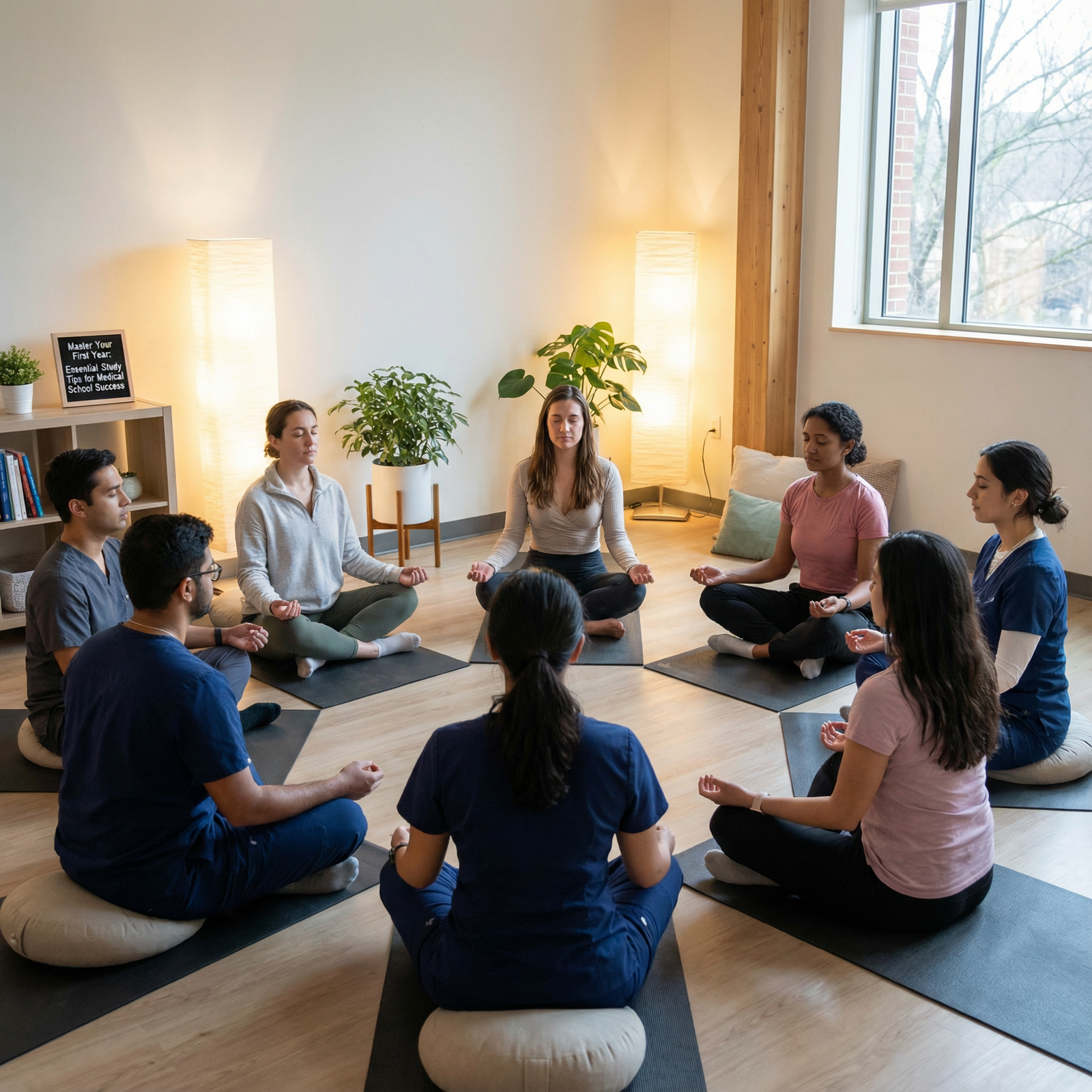
Creating a Strong Support Network in Medical School
Finding Your Community
Your classmates will be your colleagues for decades. Building relationships now not only boosts your mental health but also your professional future.
- Introduce yourself in the first weeks—everyone is new and open to connection.
- Join student interest groups (surgery club, internal medicine, global health, arts in medicine).
- Participate in peer-mentoring programs; many schools pair MS1s with MS2–MS4 mentors.
You don’t need to be close with everyone. Focus on finding a few people you can trust both academically and personally.
Leveraging Campus and Institutional Resources
Most Medical Schools now prioritize student Health and Wellness. Take advantage of:
Academic support services
- Learning specialists, tutors, skills workshops
- Help with learning styles, board prep planning, or remediating difficult courses
Counseling and mental health services
- Confidential, often free or low-cost
- Accessible for anxiety, depression, adjustment issues, or burnout
Wellness and resilience programs
- Workshops on Stress Management, mindfulness, nutrition, and sleep
- Peer support groups
You do not need to wait for a crisis to seek support. Many high-performing students use these resources proactively.
Stress Management and Health: Staying Well While Working Hard
Stress is inevitable; suffering doesn’t have to be. The goal is to manage stress, not eliminate it.
Mindfulness, Meditation, and Simple Grounding Tools
Mindfulness is the practice of bringing full attention to the present moment without judgment. Research shows it can:
- Reduce anxiety and perceived stress
- Improve focus and emotion regulation
- Help with sleep
Practical ways to integrate mindfulness:
- 5-minute morning practice: Before opening your phone, sit quietly and follow your breath.
- Between-study-block resets: Close your eyes, inhale slowly through your nose for 4 seconds, hold for 4, exhale for 6–8.
- Use apps like Headspace, Calm, or free resources on YouTube or Insight Timer.
Even 5–10 minutes per day is beneficial if done consistently.
Recognizing When You Need More Support
Normal stress:
- Worried before exams, tired after long days, occasional self-doubt.
Concerning signs (talk to a professional or trusted faculty/mentor):
- Persistent sadness, hopelessness, or inability to enjoy things you usually like.
- Ongoing difficulty concentrating despite adequate sleep and effort.
- Thoughts of self-harm, wishing you weren’t here, or feeling like a burden.
- Using alcohol, stimulants, or substances to cope regularly.
Seeking help is a mark of maturity and professionalism, not weakness.
Maintaining a Healthy Lifestyle: Fueling Brain and Body
Your brain is not disconnected from your body. Health and Wellness choices directly impact memory, concentration, mood, and resilience.
Nutrition that Supports Learning
You don’t need a perfect diet, but you do need a sustainable approach.
Practical strategies for busy weeks:
- Meal prep once or twice a week:
- Batch-cook proteins (chicken, tofu, beans) and grains (rice, quinoa).
- Wash and chop vegetables so they’re ready to go.
- Aim for balance at most meals:
- Protein (eggs, fish, lentils, yogurt)
- Complex carbs (whole grains, fruits, starchy vegetables)
- Healthy fats (nuts, seeds, olive oil, avocado)
Keep quick, relatively healthy options on hand:
- Nuts, yogurt, hummus, fresh fruit, cut veggies, string cheese
- Pre-made salads or frozen vegetable mixes for quick stir-fries
Moderation is key—coffee and occasional takeout are fine, but avoid relying on caffeine and sugar in place of meals.
Sleep Hygiene for Medical Students
Sleep is one of the most powerful “study tools” you have.
- Aim for 7–8 hours per night whenever possible.
- Keep a consistent sleep schedule, even on weekends when you can.
- Create a wind-down routine:
- 30–60 minutes before bed: no intense study, no screens or at least use blue-light filters.
- Light reading, stretching, or mindfulness instead.
If you’re regularly sacrificing sleep for late-night studying, track your performance. Many students find their efficiency and recall drop with chronic sleep debt.
Physical Activity as a Cognitive Booster
Exercise improves mood, focus, memory, and overall Stress Management.
Realistic ways to integrate movement:
- 20–30 minutes of brisk walking between classes.
- Short bodyweight workouts or yoga videos at home.
- Join intramural sports or use the campus gym 2–3 times per week.
Consistency matters more than intensity. Think, “How can I move a bit most days?” rather than “I must do a 1-hour workout every day.”
Embracing the Learning Process and Preparing for the Clinical Years
First year is about more than memorizing facts; it’s about thinking like a clinician and embracing the identity of a lifelong learner.
Active Learning in Clinical Context
Look for ways to apply what you learn:
Case studies:
- Work through patient vignettes that require you to connect physiology, pathology, and pharmacology.
- Practice generating differentials (What could be causing this symptom?) and reasoning through them.
Simulations and skills labs:
- Take every simulation seriously—they’re a safe place to make mistakes.
- Ask for feedback actively: “What’s one thing I did well, and one thing I could improve?”
Linking basic science to real patients:
- When you meet a patient with heart failure, diabetes, or asthma, mentally connect back to your lectures.
- This strengthens memory and motivation: the material becomes real, not abstract.
Adopting a Growth Mindset
You will forget things. You will miss questions. You may even fail an exam or practical. This is normal.
A growth mindset reframes these experiences:
Instead of: “I’m not smart enough for Medical School.”
Try: “I didn’t use the right strategy for this exam; what can I change for next time?”Instead of: “Everyone else understands this except me.”
Try: “If others learned it, I can too. What resources or help do I need?”
Seek feedback from faculty, residents, and peers—and act on it. Over time, this reflective approach will shape you into a better learner and, ultimately, a better physician.
Balancing Academics with Life Outside Medical School
You are more than your grades and more than your white coat. Maintaining your identity outside Medical School is crucial to long-term resilience.
Choosing Meaningful Extracurricular Activities
You don’t have to join every club. Instead:
- Pick 1–2 activities that genuinely align with your interests or values (e.g., community health clinics, interest groups, research, advocacy).
- Ensure your commitments remain manageable during dense exam blocks.
- View extracurriculars as:
- A chance to explore potential specialties
- A source of mentorship and networking
- A way to stay connected to your “why” for pursuing medicine
Learning to Say No
Boundaries are a skill, not a personality trait.
- Practice polite but firm responses:
- “I’d love to, but I don’t have the bandwidth to commit fully right now.”
- “My plate is full this semester; can we revisit this next term?”
- Remember: Saying “yes” to everything often means saying “no” to sleep, Health and Wellness, and quality study time.
Looking Ahead: Laying the Groundwork for Clinical Years
Even in first year, you can start forming habits that will help during rotations and residency.
- Practice clear, organized note-taking about patients in early clinical experiences.
- Get comfortable with:
- Vital signs, basic physical exam maneuvers
- Building a simple differential diagnosis
- Presenting a short, structured summary of a case
These skills will reduce anxiety and boost confidence when you step fully into the wards.
Frequently Asked Questions: Surviving and Thriving in Your First Year of Medical School

1. What should I do if I feel overwhelmed during my first year?
Feeling overwhelmed is extremely common, especially in the first months. Start by:
- Breaking tasks into smaller steps: Focus on “What can I do in the next 60 minutes?” rather than the entire semester.
- Talking to someone you trust: A classmate, upperclass mentor, faculty advisor, or counselor.
- Using campus resources: Academic support, counseling, wellness programs are designed for exactly this situation.
If you notice persistent anxiety, sleep problems, or low mood, reach out early to a mental health professional or your school’s counseling services.
2. How can I balance my social life with the demands of Medical School?
Balance doesn’t mean equal time—it means intentional time.
- Schedule time for friends, family, and hobbies just like you schedule lectures and study blocks.
- Combine socialization with Health and Wellness (e.g., workouts with classmates, group dinners).
- Recognize that some weeks (e.g., exam weeks) will be heavier; plan social events more on lighter weeks.
A sustainable social life improves emotional resilience, reduces burnout, and makes Medical School more fulfilling.
3. What study techniques work best for Medical School?
Highly effective strategies for Medical School include:
- Active recall (practice questions, teaching others, self-quizzing)
- Spaced repetition (regularly reviewing material over days and weeks, often via flashcards like Anki)
- Application of knowledge (case-based learning, clinical vignettes)
- Dual coding (combining visual aids with written or verbal explanations)
Passive rereading, highlighting, and excessive note-taking without testing yourself are generally low-yield for long-term retention.
4. How important is networking during the first year?
Networking in Medical School isn’t just about career advancement; it’s about support and mentorship.
- Relationships with classmates provide community and collaboration.
- Connections with faculty, residents, and advisors:
- Open doors to research, leadership roles, and specialty exploration.
- Provide guidance during key decisions (e.g., specialty choice, Step/board strategy).
You don’t need to “network” in a forced way—focus on genuine curiosity, reliability, and professionalism. Over time, these relationships become invaluable.
5. Is it okay to take breaks or days off from studying?
Yes—and it’s often necessary. Strategic breaks:
- Prevent burnout and mental fatigue
- Improve long-term retention and productivity
- Maintain Health and Wellness
Plan regular short breaks within study sessions, lighter evenings after exams, and occasional partial days off. As long as you’re consistent with your overall routine and Time Management, rest will help you perform better, not worse.
Your first year of Medical School will challenge you, stretch you, and change you. With intentional Study Tips, thoughtful Time Management, proactive Stress Management, and a commitment to your Health and Wellness, you can navigate the chaos and emerge more confident, capable, and connected to your purpose in medicine.