
It’s September of MS1. Your email is a war zone.
“Leadership opportunity!”
“Founding member needed!”
“Perfect for your CV!”
You’ve got white coat still creased from the ceremony, Anki decks multiplying, and somehow you’ve already put your name down for: student council interest list, three specialty interest groups, a free clinic shift, a research meeting, and that “can’t miss” global health project that casually mentions weekly 7am Zooms.
You tell yourself: “I’ll manage. Everyone else is doing it.”
Let me stop you there. This is where people break themselves without realizing it. Not in third year. Not on Step season. Right here. First year. Saying “yes” to everything.
I’ve watched first-years burn out by Thanksgiving because they treated extracurriculars like a Black Friday sale instead of a long game. You’re not just at risk of being tired. You’re at risk of sabotaging your grades, your mental health, and ironically, the very CV you’re trying to build.
Let’s talk about the traps that pull you in and how to avoid walking straight into them.
The Biggest Lie: “You Need To Get Involved In Everything”
There are two phrases that should immediately set off alarms:
- “It’ll only take an hour a week.”
- “Everyone does it first year.”
Those are almost always lies.
Here’s what really happens:
You join 6–8 things “just to try them.”
Each one sends you:
- Doodle polls
- Slack/GroupMe messages
- “Quick” tasks
- New projects that “would look great for residency applications”
So that “hour a week” mutates into:
- 15 minutes here
- 30 minutes there
- Random Sunday-night “can you edit this?” requests
- Emergency meeting when something falls apart
Death by a thousand “quick” asks.
Overcommitting in MS1 doesn’t look dramatic. It looks like:
- Eating lunch standing up while answering messages
- Falling two lectures behind but telling yourself you’ll catch up over the weekend
- Skimming slides instead of really learning them because you have a committee meeting
By the time exams hit, you’re not just underprepared. You’re scattered. Your brain doesn’t have a home base.
You do not need to “get involved in everything.” You need to get involved in very little and do it very well.
Trap #1: Joining Every Single Interest Group
This is the first landmine.
During orientation, there’s usually a club fair. Every table looks shiny:
- Emergency Medicine
- Surgery
- Derm
- Ortho
- Global Health
- Medical Spanish
- Student Government
- XYZ Honor Society
So you do what everyone does—you write your email on every sheet. “Just to receive updates.”
Here’s the cost you don’t see coming: attention fragmentation.
You end up with:
- 10+ GroupMes or WhatsApp groups
- Emails about lunch talks, service projects, shadowing sign-ups
- Constant FOMO because you can’t attend everything
You think you’re just “on the list.” You’re not. You’re mentally on the hook.
A quick rule I tell every first-year:
If you’re “interested” in more than 3–4 groups, you’re just indecisive, not ambitious.
Better approach:
- Week 1–2: Attend a few intro meetings as a guest, not a member.
- Week 3–4: Pick 1–2 groups to show up consistently for.
- Everything else: stay off their rosters. You can always join later.
Overcommitting early isn’t impressive. It just makes you the person who’s always “sorry, I can’t make it this time.”
Trap #2: The “Leadership Position” That’s Actually Free Labor
Another classic: you get approached for a “leadership role.”
Sounds like:
- “We’d love to have you as first-year rep.”
- “We need someone to help with social media/communications.”
- “You’d be perfect for this coordinator role.”
What they often mean is:
- We need someone to be the email middleman.
- We need someone to schedule things nobody else wants to schedule.
- We need a first-year to handle logistics because upperclassmen are busy.
I’ve seen this mistake: MS1 accepts 2–3 “tiny” leadership roles. Suddenly they’re:
- Drafting emails
- Making flyers
- Managing spreadsheets
- Herding other people to commit to things
- Attending planning meetings that accomplish almost nothing
Meanwhile, their actual life:
- Path exam next week
- Anatomy practical creeping up
- No real study blocks left intact
You want leadership roles that build skills or relationships, not ones that make you the unpaid administrative assistant.
Red flags for a bad leadership role:
- No clear description of responsibilities
- No upperclassman willing to talk about what the job actually took
- “It’s basically just sending some emails” (it never is)
- They sound more desperate than selective
Green flags:
- You get a clear estimate of hours per month
- The prior person can tell you honestly what was miserable about it
- The role aligns with your actual interests (not just your anxiety about CVs)
If you’re MS1, one real leadership position is plenty. Two is pushing it. More than two? That’s self-sabotage.
Trap #3: Early Research Chaos
Research is where ambitious MS1s wreck themselves.
You hear upperclassmen say, “You need research to match competitive specialties.”
True, for some fields. But what you do not need is:
- Three half-baked projects
- With three different mentors
- In three totally unrelated fields
- None of which you can actually finish
The worst pattern I see:
- MS1 panic-signs onto any project with the word “publication” attached.
- Realizes the PI is disorganized or chronically unavailable.
- Tries to compensate by adding another project with another PI.
- Ends up on five author lists, but nothing gets submitted, and they’re exhausted.
That’s how you burn your nights and weekends for work that never materializes.
If you’re going to do research first year, avoid these mistakes:
- Do not start before you’ve survived at least one exam block. Prove you can pass first.
- Do not say yes to more than one project at a time until you know the workload.
- Do not work with someone who can’t give a timeline or structure.
What matters for residency isn’t “I was on 7 projects.” It’s:
- Did you finish something?
- Are you on a poster, abstract, presentation, or paper?
- Can you talk about it intelligently?
One completed project beats five zombie projects that never leave the draft folder.
Trap #4: Free Clinics and Volunteering Overload
Let me be clear: student-run clinics and volunteering can be meaningful. They can also ruin your sleep schedule if you’re not honest with yourself.
Common mistake:
MS1 signs up for:
- Weekly clinic shift
- Plus another volunteer commitment (tutoring, outreach, screenings)
- Plus call-style “backup” shifts “in case they’re short”
This sounds virtuous. Until you’re:
- Prepping for your first big exam
- Getting emails to cover “just this one” extra clinic night
- Coming home at 10–11pm wired and behind on lectures
The trap is especially bad for people who feel guilty saying no. You know who you are.
How to avoid getting crushed:
- Do not commit to weekly anything in your first 2–3 months. Sign up for single shifts you can see on your calendar.
- Cap clinical/volunteering to 1–2 sessions per month until you know your bandwidth.
- If a clinic requires mandatory training plus long-term shifts, delay it until mid-year.
You’re not a bad person if you protect your time. You’re a safer future physician.
Trap #5: The Group Chat Spiral
This one looks harmless, but it’s deadly because it feels like “not a real commitment.”
You join:
- Class GroupMe
- “Serious study” group
- Memes group
- Social group
- Every interest group chat
Now your phone is pinging 200+ times a day.
None of this is formally on your schedule. But your cognitive load is high. You’re constantly context-switching:
Lecture → group chat → email → Anki → club messages → back to lecture.
Your brain never gets to drop anchor.
This is the invisible way students overcommit: not to tasks, but to unfiltered access.
What to do instead:
- Mute almost everything. Check on your terms.
- Have 1–2 essential chats: maybe your small study group and your school announcements channel.
- Treat every new group like a subscription service: do I seriously need this information in real time?
You don’t have to quit chats. You just have to stop letting them own your attention.
What Overcommitment Actually Costs You (That You Don’t See Yet)
People assume the cost is “less free time.” That’s the surface-level loss. The real damage is deeper:
Shallow learning
You stop actually learning medicine. You start cramming to survive. That will haunt you on boards and in clinical years.Identity dilution
When you’re in 10 things, you become “the person who’s always kinda there.” Never the person anyone associates with actually owning something.Burned bridges with mentors
Overpromising and underdelivering looks worse than never signing up. PIs remember who disappeared. So do faculty and clinic directors.Chronic low-grade anxiety
Always feeling behind. Always wondering what you forgot. Never actually resting because something is always half-done.
I watched one MS1 who was on student council, three interest group boards, two research projects, and clinic committee. By spring, they were:
- Barely scraping passes
- Ghosting one of their PIs
- Snapping at classmates
- Seriously questioning if medicine was a mistake
It wasn’t medicine that was the problem. It was the fantasy that you can live like LinkedIn on fire and still be a functional human.
How Many Commitments Is Actually Safe in MS1?
You want numbers? Good. Most people dance around this. I won’t.
Here’s a reasonable maximum for first-year once you’ve made it through your first block and understand your school’s rhythm:
| Area | Safe Maximum (At Once) |
|---|---|
| Interest groups (active, not just email) | 2–3 |
| Leadership positions | 1 (2 only if one is very low lift) |
| Research projects | 1 active, 1 pending at most |
| Recurring clinics/volunteering | 1 per month, not weekly at first |
And yes, there are exceptions. But they’re rare, and they’re usually people who already had:
- Strong time-management systems
- Prior experience balancing heavy loads
- A clear specialty interest that directs their choices
If you’re not sure you’re that person, you’re probably not. Stick with conservative numbers.
Here’s what a healthy MS1 setup looks like for many students:
- School + studying: your primary job
- 1–2 interest groups you actually show up for
- 1 small research project or 1 leadership role (not both at once early)
- Occasional clinic/volunteering (a couple of times per month tops)
- Protected time for exercise, sleep, something non-medical
Not flashy. But sustainable.
A Better Way To Choose: Three Filters
Before you say yes to anything, run it through three filters:
Time Reality Filter
- Ask: “On average, how many hours per month does this take for someone doing it well?”
- If they can’t answer, that’s a red flag.
- Multiply whatever they say by 1.5. That’s closer to reality.
Alignment Filter
- Does this match something you care about? Specialty interest, population, skill (teaching, QI, advocacy, research)?
- Or are you just scared of missing out or “falling behind”?
Trade-Off Filter
- Literally name what you’re giving up:
“If I say yes, I’m saying no to: 1 free evening a week, my Saturday mornings, and slower but deeper studying.” - If you can’t clearly accept that trade, you have no business saying yes.
- Literally name what you’re giving up:
If an opportunity fails any one of those filters, pause. You probably don’t need it.
How To Back Out (Without Burning Everything Down)
Maybe you’re reading this already overcommitted. Fine. Let’s do damage control.
Steps:
List everything you’re involved in. Be brutal and honest:
- Leadership
- Groups
- Research
- Clinics
- Tutoring, mentoring, etc.
Star the 1–3 that:
- Actually matter to you
- You can plausibly do well
- Have mentorship or clear outcomes
For the rest, you send some version of:
“I’ve realized I overextended myself this semester and it’s starting to affect my coursework. I need to step back from [role/project/committee] so I can refocus and not let anyone down halfway through the year. I’m happy to help with a short handoff or transition if needed.”
Most reasonable people will respect that. Anyone who responds with guilt-tripping is confirming you were right to leave.
You save your sanity now—and your reputation later. Because showing up well to a few things looks far better than being flaky at many.
Visual: How Overcommitment Creeps Up Over Time

| Category | Value |
|---|---|
| Aug | 10 |
| Sep | 18 |
| Oct | 25 |
| Nov | 32 |
| Dec | 38 |
| Jan | 45 |
That “just one more thing” pattern? It’s real. And most people don’t notice the climb until they’re already drowning.
A Saner First-Year Timeline
If you want a rough structure for not wrecking yourself:
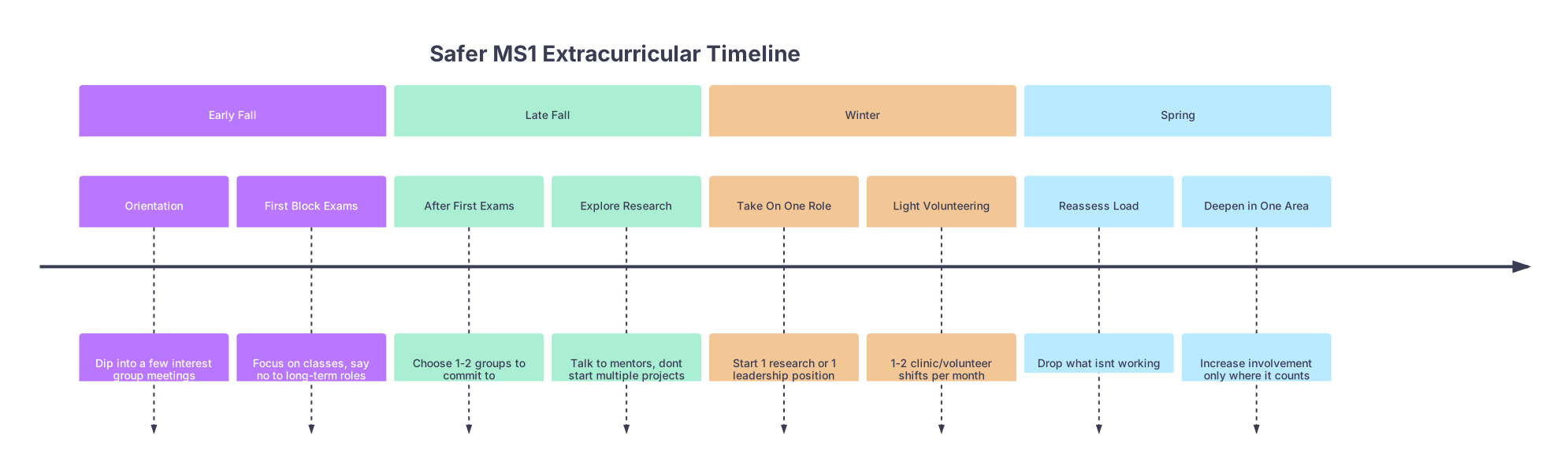
| Period | Event |
|---|---|
| Early Fall - Orientation | Dip into a few interest group meetings |
| Early Fall - First Block Exams | Focus on classes, say no to long-term roles |
| Late Fall - After First Exams | Choose 1-2 groups to commit to |
| Late Fall - Explore Research | Talk to mentors, dont start multiple projects |
| Winter - Take On One Role | Start 1 research or 1 leadership position |
| Winter - Light Volunteering | 1-2 clinic/volunteer shifts per month |
| Spring - Reassess Load | Drop what isnt working |
| Spring - Deepen in One Area | Increase involvement only where it counts |
This is slower than your anxiety wants. And exactly the pace your future self will thank you for.
What Actually Impresses Residency Programs (Hint: Not Volume)
Here’s the part nobody tells MS1s bluntly enough:
Residency programs aren’t counting bullets on your CV like they’re tally marks. They’re asking:
- Did you show consistency over time?
- Did you actually accomplish something?
- Does this tell a coherent story about who you are?
They’d rather see:
- 2–3 years of meaningful clinic involvement
- 1–2 finished research projects with your name on something real
- A leadership role where you actually improved something
Than:
- 12 clubs
- 7 leadership titles that mean nothing
- 6 research projects with nothing submitted
Overcommitment leads to surface-level involvement. Surface-level involvement leads to boring, unimpressive applications.
Ironically, doing less now often leads to a stronger, sharper application later.
Quick Self-Check: Are You Already Too Committed?
If you’re not sure, answer honestly:
- Are you more than 2 lectures behind right now?
- Have you blown off a commitment in the past month because you forgot or were too tired?
- Does your calendar stress you out just looking at it?
- Do you feel guilty almost every day about something you “owe” to someone?
If you said yes to 2 or more, you’re likely already overcommitted.
That’s fixable. But not if you just keep adding more and “hoping” it works out.
One Last Visual: What Programs Actually Care About
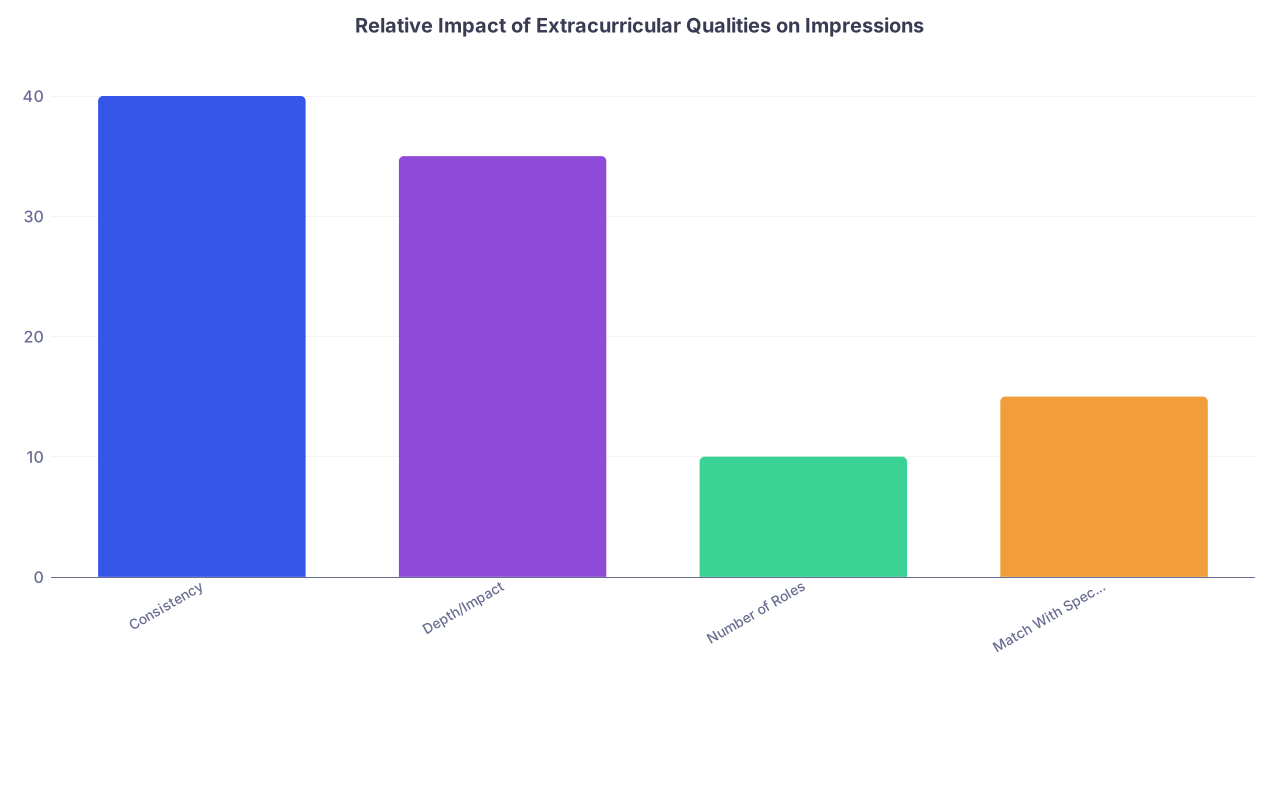
| Category | Value |
|---|---|
| Consistency | 40 |
| Depth/Impact | 35 |
| Number of Roles | 10 |
| Match With Specialty | 15 |
You’re over-optimizing the “Number of Roles” bar and starving everything else.
FAQs
1. Won’t I fall behind my classmates if I don’t jump into everything right away?
No. You’ll fall behind if your grades tank, you burn out, or you gain a reputation for flaking. Plenty of very successful residents started slow: they focused on mastering school first, then added 1–2 meaningful activities. What matters is sustained involvement and completion, not being on every flyer from month one.
2. Is it bad to say yes early and then back out later if it’s too much?
It’s not ideal, but it’s far better than silently drowning or disappearing without explanation. Just don’t make it a habit. Back out early, be honest (overcommitted, need to refocus on academics), give a brief handoff if needed, and then learn from it. The real mistake is clinging to every commitment out of guilt while your core responsibilities suffer.
3. How do I know if a research mentor or project is worth committing to?
Ask very specific questions: What’s the realistic timeline? What’s my role? How many students are already involved? What has actually been published from this group in the last 2–3 years? If you do not hear a clear plan and see evidence of completed work, assume you’re signing on for frustration and unfinished drafts. One solid, well-structured project beats three vague “maybe publication” promises.
4. What if I genuinely like being involved in lots of things?
Then prove it by doing fewer things really well first. If, after a semester or two, your grades are strong, your sleep is decent, your mood is stable, and the people you work with would vouch for you, then you can experiment with slowly adding one more thing. Enjoyment doesn’t cancel out limits. Even highly capable people have a bandwidth ceiling—and first year is not the time to find it the hard way.
Key takeaways:
Protect your bandwidth in MS1 like it’s oxygen. Limit yourself to a few well-chosen, aligned commitments. And remember: depth, follow-through, and sanity will do far more for your future than a bloated, chaotic list of half-finished roles ever will.