
Email and Messaging Missteps That Make You Look Unprofessional in M1
It is 11:37 p.m. on a Tuesday. You are exhausted, half‑studying for anatomy, half‑doom‑scrolling, when you remember you never emailed the course director about missing tomorrow’s lab. You bang out something like:
“hey, I’m not gonna make it to lab tmw, I have some stuff going on. can I get the slides?”
You hit send.
The next morning, your small group facilitator mentions “we expect professional communication, even by email” in front of the whole group. No names. But you know.
This is exactly the kind of low‑level, avoidable mistake that follows you through M1 and beyond. Not because faculty are petty. Because they remember who is reliable, respectful, and professional—and who is sloppy, late, or casually rude.
Let me be blunt: unprofessional emails and messages are one of the fastest ways to hurt your reputation in medical school. Faster than bombing a quiz. Faster than asking a “dumb” question in lecture. You can recover from academic stumbles. A pattern of bad communication is harder to shake.
This is your warning label.
Why Email and Messages Matter Way More Than You Think
You are about to live and die by email, GroupMe, Slack, Teams, and whatever sad LMS your school uses. Most of your “first impressions” will not be in person. They will be in someone’s inbox.
A few realities people underestimate:
- Faculty forward emails. To each other. To the dean. To your future LOR writers.
- Program directors ask, “Is this student professional?” Your preclinical behavior is part of that answer.
- Residents and upperclassmen remember people who are chaotic in communication. They will quietly avoid working with you.
And the worst part? The bar is not high. You do not have to sound like a lawyer. You just have to not make the same predictable mistakes.
Here are the big ones that make you look unprofessional as an M1—and exactly how to avoid them.
Mistake 1: Treating Email Like Texting
If your emails read like your group chat, you are already behind.
Common red flags:
- No greeting or sign‑off
- Lowercase everything, text‑speak, or abbreviations (“u”, “tmrw”, “idk”)
- One‑line, context‑less messages: “what’s the homework?”
- Emojis or “lol” in anything to faculty or staff
- Random subject lines or none at all
I have seen “Subject: Hey” sent to a department chair. More than once. They remember that.
What to do instead:
Use a real subject line
“Question about Monday’s small group assignment” is clear. “Help!!!” is not.Add a simple greeting
“Dear Dr. Smith,” or “Hello Dr. Smith,” is fine. Not “Hey Doc” or “Hi there!” to someone you have never met.Write in short, clear paragraphs
One or two sentences per paragraph. No walls of text. No single block with 12 lines.End with a brief sign‑off
“Best,” “Sincerely,” or “Thank you,” plus your full name and class year. Every time.
You are not writing literature. You are signaling: I take this seriously.
Mistake 2: Emailing Like Everything Is an Emergency
Another big one: constant “urgent” vibes.
You do not get to turn your poor planning into someone else’s crisis. But many M1s try.
Red flag behaviors:
- Marking trivial emails as “High Importance” or “Urgent”
- Emailing the course director the night before an exam asking for accommodations
- Expecting responses within an hour and sending follow‑ups: “?” or “Did you see this?”
- CC’ing the dean on small logistical questions to “make sure it gets handled”
This screams: “I cannot manage my time. I will be high‑maintenance on rotations.”
Use this rule of thumb:
- Same day response: classmates, group projects, time‑sensitive logistics for that day.
- 24–48 hours: faculty, admin, preceptors, anyone doing you a favor.
- More urgent than that? You probably should have handled it earlier.
If there is a true emergency (illness, family crisis, hospital admitted), you can say so. One line is enough: “I apologize for the late notice; I was admitted to the hospital this evening.” No drama needed.
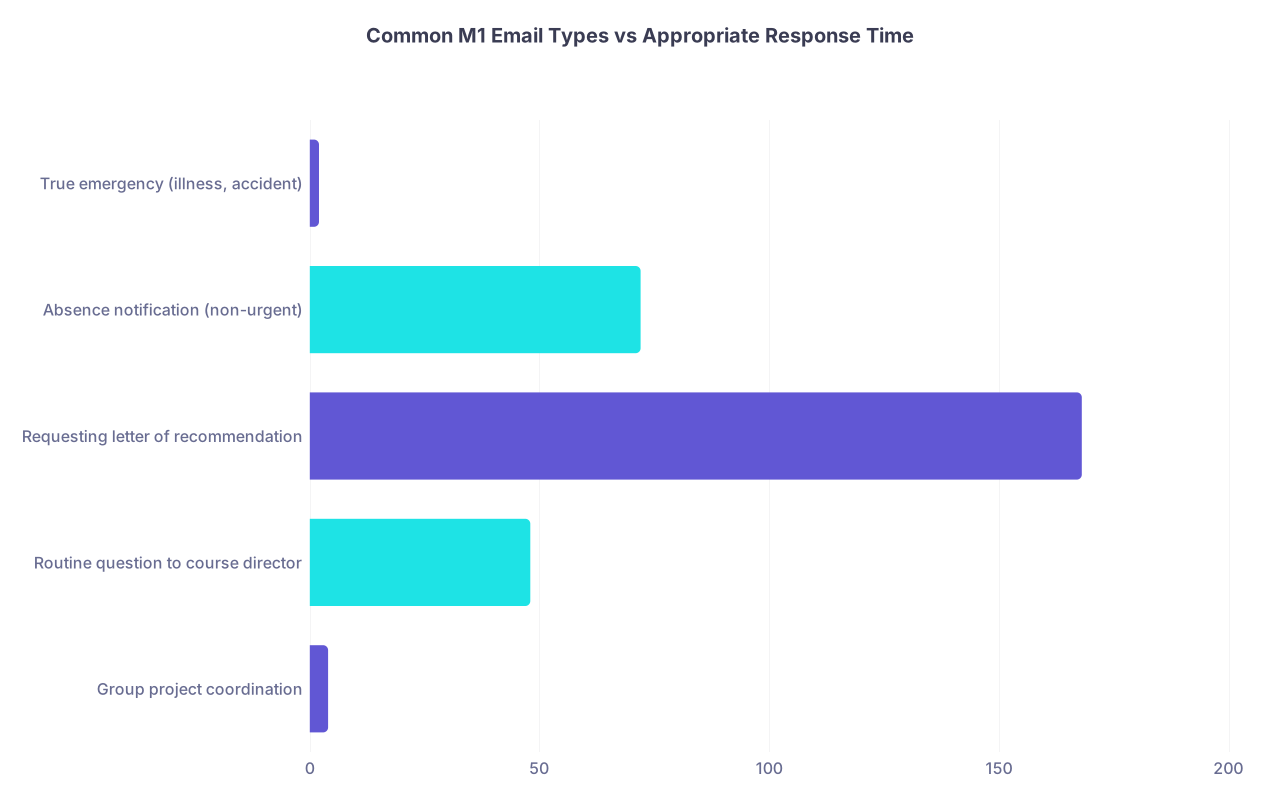
| Category | Value |
|---|---|
| Group project coordination | 4 |
| Routine question to course director | 48 |
| Requesting letter of recommendation | 168 |
| Absence notification (non-urgent) | 72 |
| True emergency (illness, accident) | 2 |
(Values are hours—notice how few scenarios actually justify a < 4‑hour expectation.)
Mistake 3: Being Vague, Rambling, or Emotionally Dumping
Faculty do not have time to decode your life story before figuring out what you need.
Common train‑wreck email structure:
“Hi, I’m really struggling with the course for a lot of reasons. In undergrad I had similar issues and tried many things but nothing really worked and I’m starting to get really overwhelmed and I don’t know what to do and I also have a lot of stuff going on at home and I just wanted to reach out.”
No clear ask. No specific question. Just emotional fog.
This is not therapy. This is professional communication.
Better pattern:
- One sentence of context
- Clear question or request
- Any necessary detail, briefly
- Thanks
Example:
“Dear Dr. Lee,
I am having difficulty keeping up with the renal physiology material and would like guidance.
Would it be possible to meet briefly during your office hours next week to discuss study strategies and clarify some concepts?
Thank you for your time,
Alex Patel, MS1”
You can be human. You can mention you are struggling. But you need a clear “ask.” If they have to guess what you want, you have already made their job harder.
Mistake 4: Over‑Familiarity with Faculty and Residents
This one burns people.
You met a resident once on a shadowing day. They said, “Call me Sam.” You decide this means you can:
- DM them on Instagram for shelf resources
- Text late at night about career doubts
- Send “hey man” emails asking to scrub in on cases
No. That is not what it means.
Over‑familiar signs:
- Using first names with attendings who sign “Dr. [Last Name]”
- Jokes, memes, or slang with people you barely know
- Telling personal stories not relevant to the request
- Sending casual messages in professional channels: “lmk if I can get that excused thx”
Mirror how they communicate with you. If they keep it formal, you keep it formal. If they relax over time, you can loosen slightly. But you do not start there.
When in doubt: err professional, not buddy‑buddy.
Mistake 5: Mixing Personal Drama into Professional Channels
Some of your classmates will treat class GroupMe or Slack like their Twitter feed. Do not be that person.
Red flags in group chats / school channels:
- Venting about specific faculty or staff by name
- Complaining about grading, exams, or “how this school sucks”
- Posting NSFW memes, dark jokes about patients, or anything that would look bad on a screenshot
- Starting arguments about politics, religion, or sensitive issues in class channels
- Subtle‑but‑not‑subtle shots at classmates (“some people really need to learn how to be quiet in lecture”)
Screenshots travel. People show faculty. People show the dean. People use them when they write professionalism evaluations.
Use a simple separation:
- Official school channels (email, Teams, Slack, class listservs): professional, on‑topic, polite.
- Side group chats with trusted friends: your space to vent. Carefully.
You are not as anonymous as you think.
Mistake 6: Being Sloppy, Error‑Filled, or Disorganized
You think nobody cares if you misspell a few words in an email?
They do not care about spelling perfection. They care that you cared enough to look.
Frequent sloppiness says: “This student will be equally careless when writing orders or documenting.”
Typical sloppiness:
- Faculty name spelled wrong (especially bad when requesting letters)
- Wrong title (calling a PhD “Dr. Smith?” okay; calling a nurse “Ms.” when they prefer their credentials? risky if you ignore cues)
- Sending to the wrong person or wrong group
- Reply‑all accidentally with something meant to be private
- Attaching the wrong document—or forgetting the attachment altogether
At minimum, do a 20‑second checklist before sending any email to faculty or administration:
| Item | Question to Ask Yourself |
|---|---|
| Recipient | Is this going to the right person? |
| Subject line | Does it clearly state the topic? |
| Greeting & sign-off | Are both present and appropriate? |
| Attachments / links | Did I actually attach or link them? |
| Tone & clarity | Is my request obvious and polite? |
That 20 seconds can save you from some truly stupid mistakes.
Mistake 7: Ghosting, Non‑Responses, and Poor Follow‑Through
Want to get a silent “do not recommend” from someone who might have written you a strong letter one day? Ghost them.
Patterns that worry faculty:
- Not replying with “Thank you” after a faculty member helps you in a substantive way
- Ignoring administrative emails that require a response (survey completion, scheduling, forms)
- Saying you will follow up by a certain date, then disappearing
- Not confirming received information when asked
I have seen students get quietly blacklisted from opportunities because they were chronically non‑responsive. Not because they were unkind. Because nobody wanted to chase them.
You do not need to reply to every mass email. But if:
- Someone did something specifically for you
- You requested something and they responded
- They asked for a yes/no or time selection
You respond. Briefly. Promptly.
Example:
“Thank you for sending these resources, I appreciate your help.”
Twelve words. That is it.
Mistake 8: Using the Wrong Channel for the Wrong Thing
Another classic M1 error: blasting people on whatever platform is open instead of choosing the right tool.
Misuses I see a lot:
- DM’ing a course director on Teams at 10 p.m. with a non‑urgent question
- Texting a resident’s personal number for something that should go through the clerkship coordinator
- Asking graded‑exam policy questions in a public group chat rather than emailing the course director
- Slacking classmates at all hours for things that could wait, making everyone feel constantly “on‑call”
As a rough map:
- Email: anything formal, grade/attendance related, LORs, absences, accommodations, meeting requests.
- LMS/Teams/Slack (official): course questions, clarification, logistics when invited by faculty.
- Text/WhatsApp/GroupMe: peer coordination, social plans, study groups, quick logistics among classmates.
- In‑person or Zoom: complex issues, emotional topics, feedback discussions.
Use channels the way your school uses them. If they send everything through email, default there. If they say, “Post all questions on the forum,” do that first.

| Step | Description |
|---|---|
| Step 1 | Need to contact someone |
| Step 2 | Send Email |
| Step 3 | Use Course Forum or LMS |
| Step 4 | Text/Group Chat |
| Step 5 | Schedule Call/Meeting |
| Step 6 | Who is it? |
| Step 7 | Formal or grade/attendance related? |
| Step 8 | Quick logistics or complex issue? |
If you pick the wrong channel once, you will be fine. If you repeatedly disregard boundaries, people notice.
Mistake 9: Over‑Requesting and Under‑Appreciating
Your M1 year depends heavily on others doing things for you: writing notes, opening doors, explaining concepts, sharing resources, bending schedules. That is normal. What is not normal is behaving as if everything is owed to you.
Two ugly patterns:
Constant asks, minimal gratitude
“Can you send me your old Anki deck?” “Can I get your notes?” “Can you explain this concept to me?” with no follow‑up thanks or reciprocity.Asking for big things without relationship
First email to a faculty member: “Can you write me a letter of recommendation?”
First message to an M4: “Can you send me all of your Step study materials?”
People keep mental score. Not perfectly. But enough.
When you ask for something:
- Be specific
- Acknowledge the time/effort cost
- Express genuine appreciation
- Do not demand a fast turnaround unless absolutely necessary
And remember: “No” is a reasonable response. Do not guilt‑trip. Do not push.
Mistake 10: Emotionally Reacting in Writing
You will have unfair moments in M1. Exams that felt off. Group members who flaked. Faculty who misspoke about something sensitive. The worst thing you can do in those moments is fire off an emotional email.
Signs you should not send it yet:
- You are typing fast and hard
- You are using words like “unacceptable,” “outraged,” “ridiculous”
- You are writing paragraphs without breathing
- You are hoping they feel bad when they read it
Stop. Draft it. But do not send it.
Let it sit overnight. Or at least an hour. Then ask:
- Does this email have a clear goal, or am I just venting?
- Would I be comfortable with the dean or a residency program director reading this?
- Can I remove blame language and focus on facts and impact?
You can absolutely advocate for yourself. You can say what did not work and how it affected you. But you need to sound like someone they want to help, not someone they have to defend themselves against.
Example: Before and After
Let me show you what this looks like in practice.
Bad M1 email:
“hey,
I didnt realize the attendance was mandatory for the lab today and I already made other plans and it’s really frustrating that this wasnt clearer. Can this be excused I dont think it’s fair to penalize us for being confused
thanks,
Sam”
Professional version:
“Dear Dr. Rivera,
I am writing regarding today’s lab session. I misunderstood the expectations and did not realize that attendance was mandatory for this particular session, and I had already made other plans.
I understand this was my responsibility to clarify, and I apologize for the oversight. Would it be possible to discuss whether there is any way to make up this session or mitigate the impact on my grade? I want to ensure this does not happen again.
Thank you for your time,
Sam Johnson
MS1”
Same situation. One makes you look defensive and careless. The other makes you look accountable and teachable.
FAQ: Email and Messaging in M1
1. How formal do my emails really need to be?
More formal than you think. Aim for: clear subject line, greeting with title and last name, full sentences, no slang, and a sign‑off with your full name and class year. Once a faculty member starts dropping titles or writing very casually, you can mirror that slightly. Until then, keep it professional.
2. Is it okay to email faculty at night or on weekends?
You can send emails when it is convenient for you, but do not expect a response outside regular hours. Avoid language that pressures for a fast reply. For truly urgent, time‑sensitive issues (like sudden illness before an exam), an evening email is acceptable. Just own the timing and apologize briefly for the late notice if it was preventable.
3. What if I already sent an unprofessional email—can I recover?
Yes. One bad email will not sink you. If it was mildly sloppy, improve going forward. If it was clearly inappropriate (overly emotional, rude, boundary‑crossing), you can send a short follow‑up: apologize, clarify your intent, and reset the tone. Then be consistently professional from that point on. Patterns matter more than single events.
4. Should I use emojis or memes with residents or near‑peer mentors?
Default to no, unless they clearly use that style with you first and the context is informal (for example, a group chat they created for students). Even then, never use emojis or memes when asking for formal things like letters, research positions, schedule changes, or evaluations. If it might be forwarded to someone more senior, keep it clean.
5. How long is too long for an email?
If your email is longer than 2–3 short paragraphs, you are probably trying to do too much. For complex issues (accommodations, major conflicts, personal difficulties), keep the email focused on requesting a meeting and give only essential context. Detail belongs in conversation, not in a massive wall of text nobody wants to read.
Two or three things to carry with you from all of this:
- Your emails and messages are part of your professional identity. Sloppiness here is not “just M1 stuff”; it follows you.
- Clear, respectful, concise communication builds allies. Bad communication quietly closes doors.
You are busy, tired, pulled in twenty directions. All the more reason not to let easily avoidable messaging mistakes do damage you will regret later.