
You are here
It is the first weekend of winter break in M1. Your last final ended 48 hours ago. Your group chat is split between people bragging about starting Boards Anki again and people who say they are deleting every study app for two weeks. You are tired, vaguely anxious, and already hearing the phrase “Step 1” in your head like background static.
You have about 2–3 weeks off. That time can either:
- Actually restore your brain, stabilize your habits, and set up a sane Step 1 plan, or
- Turn into three weeks of half-guilty Netflix + scattered Anki + doom-scrolling Reddit about score reports.
Let me walk you through the timeline of this break. What to do and when so you rest, reset, and think about boards without letting Step 1 colonize your vacation.
Big Picture: How to Use Winter Break (Day 0 Overview)
Before we zoom into days, you need a frame.
Over this break, your priorities, in order:
- Recover – sleep debt, mental fatigue, physical exhaustion.
- Stabilize your life systems – schedule, workspace, tech, basic routines.
- Clarify your boards strategy – realistic, minimal, not panic-driven.
- Do light high-yield setup – not hours of UWorld. Foundations only.
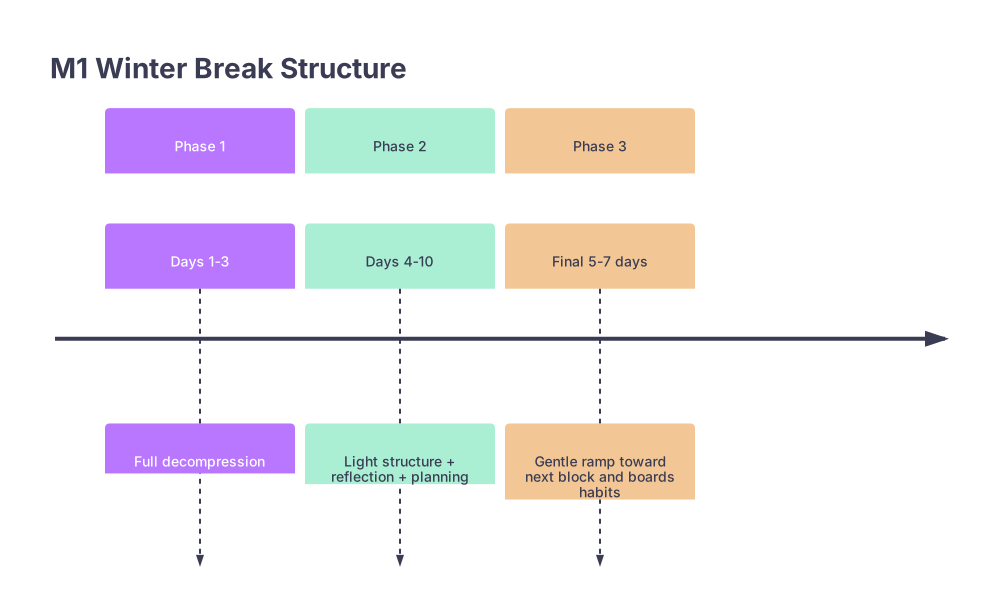
Think of your break in three phases:
| Period | Event |
|---|---|
| Phase 1 - Days 1-3 | Full decompression |
| Phase 2 - Days 4-10 | Light structure + reflection + planning |
| Phase 3 - Final 5-7 days | Gentle ramp toward next block and boards habits |
You are not “falling behind” if you do zero board questions during break. But you are wasting an opportunity if you reach January 2nd with no plan except “I’ll just do some Anki and see.”
Phase 1: Days 1–3 – Full Decompression (Yes, Actually Rest)
At this point, you should not be studying. At all.
Days 1–2: Hard reset
Your job these first 48 hours:
- Sleep until you wake up without an alarm. Multiple days if needed.
- Hydrate, move your body, eat food that was not handed to you in a plastic container at 10 pm.
- Allow yourself to mentally crash. The adrenaline from finals needs to clear.
Concrete checklist for Days 1–2:
- Turn off all school app notifications (Canvas, email, GroupMe, Slack).
- Put Anki on pause. Do not “keep your streak.” Streaks are a trap.
- Tell 1–2 close people: “I’m off the grid for 48 hours post-exams.”
- Do 1 purely non-medical thing each day (movie in a theater, long walk, baking, gaming, whatever you actually like).
You will feel a pull to “at least review a little.” That is fatigue talking. You do worse, not better, when you never allow a true reset. I have watched smart M1s drag half-burnt brains through January because they refused to take three real days off.
Day 3: Gentle awareness, no pressure
Day 3, you still are not “studying,” but your brain will start waking up.
At this point, you should:
- Spend 15–20 minutes looking back at fall semester:
- What worked? (lecture speed, Anki timing, group study)
- What consistently broke down? (sleep, exercise, admin tasks, notes)
- Write this out. Not in your head. Pen and paper or a simple doc.
Then stop. Go live your life. If you want to read fiction, go out, or see family, this is the day.
Phase 2: Days 4–10 – Reflection, Systems, and Early Boards Planning
This is the core of your break. You are partially recharged. Not yet in “grind” mode. Perfect time for:
- Honest review of M1 so far
- Fixing broken routines
- Designing a boards strategy that is realistic for you, not Reddit
Think of these 7 days as a progression: reflect → structure your life → define boards plan → do minimal setup.
Days 4–5: Autopsy of Fall Semester
At this point, you should spend 1–2 hours total over two days reviewing your first half of M1.
Break it into buckets:
Academics
- Did you usually know material but run out of time on exams?
- Or were you walking into tests already behind on content?
- Were you relying heavily on class slides or external resources?
Time use
- Were your “study days” 10 hours at your desk but only 4 hours of focused work?
- When were you freshest? Morning vs late night?
Health
- Average sleep? (Be honest. Not your “ideal” number.)
- Exercise frequency? Once a week? Once a month? Zero?
- Any warning lights: chronic headaches, GI issues, mood tanking.
Write this into something like:
- “Lecture: 2x speed, watched most but zoned out by afternoon”
- “Anki: ~500 due most days, constantly behind, never felt caught up”
- “Exams: did OK (mid-Bs) but guessed a lot, very anxious”
You cannot plan for boards wisely if you pretend your systems are fine.
Day 6: Life systems reset (non-academic, but crucial)
At this point, you should clean up your physical and digital environment:
Physical
- Clear your desk entirely and reset it.
- Sort papers: shred, file, or recycle. No random piles “for later.”
- Decide on 1–2 places where you will study next semester. Not 8.
Digital
- Organize class folders:
- /M1_Fall → labeled by course (Anatomy, Biochem, etc.)
- Archive what you are done with.
- Turn off non-essential notifications on your phone permanently.
- Unsubscribe from random school spam that clogs your email.
- Organize class folders:
This stuff sounds trivial. It is not. I have watched students derail boards prep because their Anki decks, PDFs, and notes were so chaotic they spent 30 minutes just finding things.
Day 7: Boards reality check and info gathering (not panic scrolling)
Day 7 is when you let “Step 1” into the room in a controlled, structured way.
At this point, you should spend about 60–90 minutes doing only this:
Clarify exam timing
- When does your school expect you to take Step 1?
- How long is your dedicated period? 4 weeks? 6? 8?
- Do you have a summer between M1 and M2 or year-round blocks?
Understand what Step 1 looks like now
- It is pass/fail. But residency programs still care about:
- Pass vs fail (obviously)
- Step 2 CK score
- Pattern: did you pass first try, on time
- It is pass/fail. But residency programs still care about:
Inventory what you already own
- First Aid? Boards & Beyond? Pathoma? Sketchy? UWorld subscription later?
- Existing Anki decks (AnKing, Lightyear, school-specific)?
Ask one upperclassman you trust
- “If you could redo your M1 winter break to help Step 1, what would you actually do?”
- Not the gunner who claims they did 40 UWorld questions a day from October. Someone who matched decently and seems reasonably sane.
Do not:
- Buy 4 new question banks in a panic
- Start a massive board Anki deck because everyone else did
- Write a 12-month boards schedule with daily tasks
You are gathering reality, not chaining yourself to a spreadsheet.
Day 8: Choose your boards philosophy and main tools
This is the key decision point.
At this point, you should commit to one of two broad approaches for M1→M2 boards prep:
Curriculum-first, boards-integrated (recommended for most)
- Priority: pass school exams solidly, build concepts.
- Boards: light integration of dedicated resources during systems.
- Dedicated period: main push for Step 1.
Aggressively boards-first (only if you are already crushing school easily)
- Priority: anchor learning around UWorld/Anki, use lectures mainly for admin.
- Risk: if school exams start to suffer, this backfires fast.
For 90% of M1s, curriculum-first with boards integration is the right choice. You are still learning how to learn medicine. Pure “boards grind” in M1 often produces shallow pattern recognition and burnout by M2.
Choose 2–3 core boards resources. Not 7.
| Role | Example Resource |
|---|---|
| Core text/map | First Aid |
| Video explanation | Boards & Beyond |
| Pathology focus | Pathoma |
| Qbank | UWorld (later in M2) |
| Spaced repetition | AnKing / Lightyear |
Your job on Day 8:
- Decide which ONE big video resource you will lean on (e.g., Boards & Beyond).
- Decide whether you will use a premade Anki deck, and if so, which one.
- Decide if you will treat First Aid as:
- A reference during systems, or
- Only a dedicated-period consolidation tool.
Once decided, write a one-paragraph boards philosophy for yourself, e.g.:
“For the rest of M1, I will prioritize understanding material for my blocks. I will lightly integrate AnKing cards only for systems I am currently in. I will not start UWorld until M2. First Aid will be a reference, not a daily assigned book.”
Short. Clear. The point is to prevent panic-based flip‑flopping in February.
Days 9–10: Light setup work (max 1–2 hours per day)
Now you do small, high-yield actions that your future self will thank you for. Not intense studying.
At this point, you should:
Clean and configure Anki
- Download the deck you plan to use (if any).
- Learn how to suspend cards, use tags, and adjust daily limits.
- Decide on sustainable limits:
- Example: 100 new cards/day max for school content during intense blocks
- 0–20 new long-term board cards/day during M1 (or even 0; that can be fine)
Map your upcoming blocks to boards
- Look at your January–May courses: e.g., cardio, pulm, renal.
- For each, link to:
- Corresponding Boards & Beyond video sections
- Relevant Pathoma chapters
- Relevant AnKing subdecks
This can be as simple as a one-page document:
- “Cardio block (Jan–Feb):
- B&B Cardio videos 1–20
- Pathoma Cardio chapters 8–9
- AnKing tags: #Cardiology#Physiology, #CardioPath”
- Create a “minimum weekly boards touch” rule
- Example:
- During systems: 2–3 short B&B videos per week matching that system, or
- 3 days/week of 20–30 tagged Anki cards that align with current lectures.
- Example:
The key word is minimum. This is the floor, not the ceiling. You are defining the level where you are still doing something boards‑relevant without sacrificing school.
Phase 3: Final 5–7 Days – Gentle Ramp Back Up
You are heading back toward actual school. Now the goal is to:
- Protect the recovery you achieved
- Establish a sustainable rhythm
- Test‑drive your boards integration plan lightly
5–7 Days Before Classes Start: Rebuild a routine
At this point, you should start living more like “school‑you,” just with less pressure.
Daily structure template (adjust times, not principles):
- Wake at your target school‑year time (or within ±30 minutes).
- Morning:
- 20–30 minutes light exercise (walk, yoga, bodyweight stuff).
- 20–30 minutes of reviewing basic physiology or anatomy from fall (no details, just big ideas).
- Midday:
- 30–60 minutes of “admin”:
- Skim syllabi for next blocks
- Note exam dates, big assignments
- Block off personal non‑negotiables (family events, prior commitments)
- 30–60 minutes of “admin”:
- Late afternoon:
- Optional 30–45 minutes boards integration practice:
- E.g., watch 1–2 B&B videos related to your first January material
- Or experiment with 20–40 AnKing cards to confirm your settings
- Optional 30–45 minutes boards integration practice:
Do not ramp to 8–10 hours of “studying.” That is how you walk into January already tired.
3–4 Days Before Classes: Finalize realistic weekly boards plan
At this point, you should convert your earlier philosophy into an actual weekly template.
Build something like:
During lighter blocks (e.g., ethics, intro courses):
- 3–4 days/week
- 20–30 min boards videos tied to current material
- 20–30 min Anki (school + limited boards tags)
- 3–4 days/week
During heavy systems blocks (cardio, neuro):
- 5 days/week
- 60–90 min school-focused Anki + review
- 2 days/week
- 20–30 min boards videos / reference alignment
- 5 days/week
You can sketch this in a simple table:
| Day | School Work Focus | Boards Touch (Light) |
|---|---|---|
| Mon | Lectures + review | 20 min B&B on same system |
| Tue | Small group + Anki | 20–30 min AnKing tagged |
| Wed | Labs + practice questions | Off from boards |
| Thu | Lectures + catch-up | 20 min B&B or First Aid skim |
| Fri | Wrap-up + Anki | 20–30 min retention cards |
Notice: nothing insane here. This is sustainable. That is why it works.
1–2 Days Before Classes: Mental reset and boundaries
At this point, you should protect yourself from starting the semester in panic mode.
Do this:
Write down clear “I will not” rules
- “I will not start UWorld until [date or M2].”
- “I will not let Anki go over [X] reviews/day without adjusting settings.”
- “I will not study past [time] on more than [2] nights/week.”
Clarify what “enough” looks like day-to-day
- For school: “If I watched today’s lectures, did my Anki, and reviewed for 30–60 min, that was enough.”
- For boards: “If I hit my minimal weekly boards touches, that was enough.”
Give yourself a short letter or note
- 3–5 bullet points reminding you:
- You already did the hard part of getting into med school.
- Passing Step 1 is about consistent, moderate effort over time, not masochistic heroics.
- Burnout in M2 is far more dangerous than not doing 200 Extra Cards Per Day.
- 3–5 bullet points reminding you:
Stick this note where you study. On your wall, monitor, or notebook.
Example: A 14-Day Winter Break Timeline
To put this all together, here is a sample 14-day break plan that respects both rest and boards:
| Day | Focus | Main Tasks (1–3 only) |
|---|---|---|
| 1-2 | Full rest | Sleep, non-medical activities |
| 3 | Gentle reflection | 20–30 min semester review |
| 4-5 | Deeper review | 1–2 hrs total: academics/time/health |
| 6 | Systems reset | Clean desk, organize files, notifications |
| 7 | Boards reality check | Timing, resources, 1 mentor convo |
| 8 | Choose philosophy/tools | Decide on approach + primary resources |
| 9-10 | Light setup | Anki config, map blocks to boards |
| 11 | Routine ramp | Wake time, light review + exercise |
| 12 | Test weekly template | Trial “school day” + boards touch |
| 13 | Finalize plan | Write weekly boards plan + rules |
| 14 | Mental prep | Boundary note, early night |
No 10-hour days. No 200-question marathons. Just deliberate moves.
What Not To Do Over Winter Break (Quick List)
At this point, you should be very clear on things that sound productive but are actually traps:
- Starting full‑time UWorld as an M1 “to get ahead”
- Memorizing First Aid cover‑to‑cover without context
- Joining every group chat and Discord about Step 1 resources
- Letting Anki run wild with 500 new cards/day from AnKing
- Letting guilt push you into low‑quality, half‑focused “studying” all break
If you really want to “do something extra,” pick one:
- Solidify weak M1 concepts (e.g., biochem basics, physiology graphs) for 30–45 min on a few days.
- Practice 10–15 questions from an M1‑level bank or school practice questions a couple of times, just to re-familiarize yourself with question styles.
That is plenty.
Visual: How Your Effort Should Look Over the Year
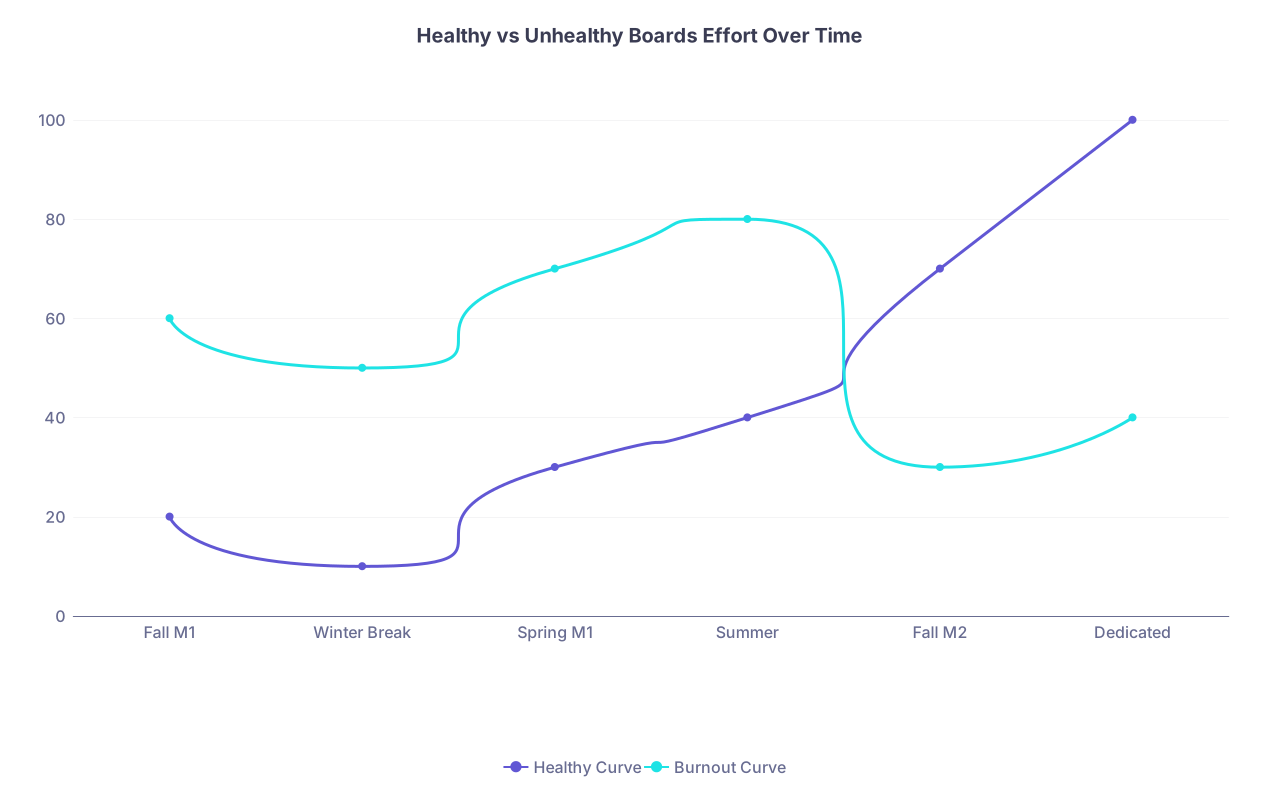
You want a gradual build‑up, not a spike and crash. Think of Step work this way:
| Category | Healthy Curve | Burnout Curve |
|---|---|---|
| Fall M1 | 20 | 60 |
| Winter Break | 10 | 50 |
| Spring M1 | 30 | 70 |
| Summer | 40 | 80 |
| Fall M2 | 70 | 30 |
| Dedicated | 100 | 40 |
The healthy curve dips during break, then slowly climbs. The burnout curve never rests and then collapses when it matters.
Final 3 Takeaways
Use the first 3 days of break to truly disconnect. No Step 1, no “quick Anki,” just full decompression. You are not losing ground; you are repairing your brain.
Middle of break is for systems and strategy, not grinding. Clean up your life, choose a sane boards philosophy, and set up tools lightly so January you is not scrambling.
End of break is a gentle ramp, not a sprint. Test your sleep schedule, trial your weekly boards integration, and set hard boundaries so you do not let Step 1 anxiety run your entire M1–M2.
If you finish winter break actually rested, with a simple and realistic plan, you are already ahead of most of your class for boards.