
The myth that “it gets easier after a few weeks of M1” is false. It does not get easier. You get sharper, tougher, and more strategic—or you drown.
You are not just fighting content. You are fighting timing. Your stress does not stay constant through first year. It spikes. It crashes. It plateaus in boring but dangerous ways. If you know when each phase hits, you can blunt the damage.
I am going to walk you month‑by‑month through a typical M1 year and tell you, very specifically, at each point:
- How your stress usually behaves
- What you should and should not be doing that month
- Exact interventions to keep you from unraveling before boards even enter the picture
Assume a standard U.S. curriculum: M1 runs August–May with organ systems starting second semester. Adjust the exact months a bit if your school starts earlier or follows a different schedule. The pattern is the same.
August – Shock Month: Orientation, First Blocks, Identity Whiplash
Stress pattern: Starts low, then spikes sharply the first week real content hits.
At this point you are:
- Figuring out where the lecture halls and bathrooms are
- Meeting 100+ new classmates, all of whom seem smarter than you
- Underestimating how much volume will hit you in Week 2
You think you are stressed, but you are not—yet. You are disoriented.
Week 0–1 (Orientation / First Real Lectures)
Your priorities here are not grades. They are systems.
At this point you should:
Lock in your study pipeline by the end of Week 1.
Decide:- Will you watch lectures at 1.5–2x and annotate slides?
- Will you use school Anki decks, AnKing, or make your own minimal cards?
- When, daily, will you do reviews? Morning or night—pick one and protect it.
Build a fixed daily skeleton.
Not perfect. Just consistent. For example:- 7:00–8:00 – Wake, breakfast, light review
- 8:00–12:00 – Lecture / watching recordings
- 13:00–16:00 – New content + Anki creation
- 17:00–19:00 – Exercise / dinner
- 19:00–21:00 – Anki reviews + practice questions
- 21:30 – Wind down, in bed by 23:00
You will tweak later, but having any skeleton dramatically reduces anxiety.
Limit social bingeing.
You do not need to attend every happy hour, every interest group kickoff, every lunch talk. Pick:- 1–2 interest groups you actually care about
- 1–2 social events per week max
Over-socializing in August is one of the classic M1 errors. You pay for it in September.
Do a “tech sanity check.”
- Get your Anki add‑ons working
- Test school VPN, lecture capture, anatomy software
- Set up a file structure for slides and PDFs that you will not hate in May
Red flags in August
- You still do not have a fixed wake‑up time by the end of Week 2
- Your Anki due count is already >500 because you keep skipping reviews
- You have not yet looked at a practice question source for your course (NBME-style, B&B questions, or course‑provided)
September – First Exam Block: Reality Hits, Impostor Syndrome Peaks
Stress pattern: First major spike. Anxiety > fatigue.
At this point you should expect:
- Your first real graded exam or two
- Your first “I studied and still missed 40%” experience
- A serious temptation to add more resources instead of using a few well
Early September – Pre‑Exam Build‑Up
This is where most M1s crack their system or overcomplicate it.
At this point you should:
Commit to a limited resource set for each course.
For a typical basic science block:- Primary: Lecture slides / syllabus (this is what they test)
- Support: One board‑oriented resource (Boards & Beyond, Pathoma later on, Sketchy for micro)
- Practice: One main Q‑bank source (school questions, USMLE‑style banks if allowed)
If you are juggling 6+ sources, you are not hardcore. You are inefficient.
Implement 7‑day exam countdowns.
Seven days before any exam, do this:- Make a one‑page list of tested topics
- Tally how many Anki cards or questions you have done per topic
- Mark 3 “weakest systems/topics” and schedule 2–3 extra passes over them
Run at least 2–3 “exam rehearsal” study blocks.
You sit down for 90–120 minutes, do nothing but timed questions or active recall, then immediately review. No phone. No breaks. Mimic exam conditions.
Late September – Post‑Exam Crash
You get the grade back. Maybe it is lower than expected.
At this point you should:
- Spend 1–2 hours maximum “post‑mortem” on:
- Where questions came from (lecture vs external resource)
- What type of errors (knowledge gaps vs misreading vs time)
Then you adjust your daily schedule. Not your entire life philosophy.
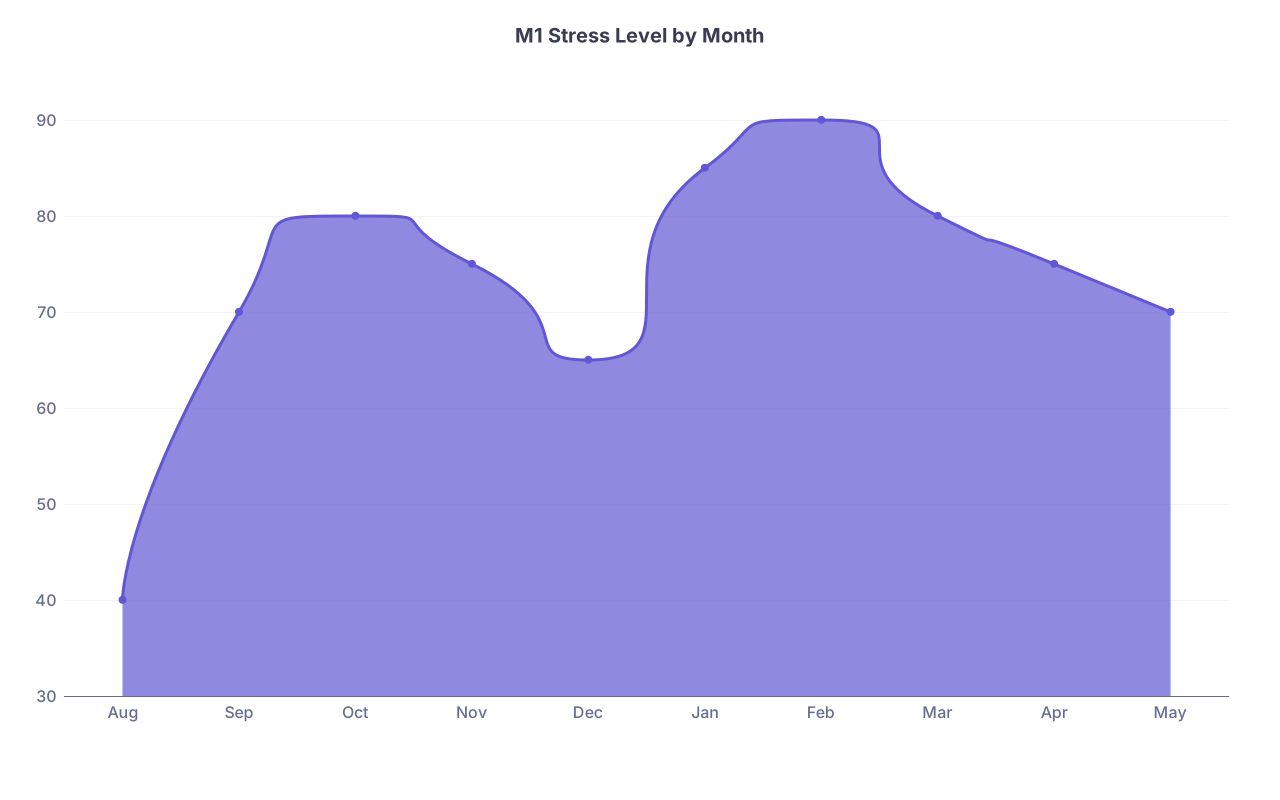
| Category | Value |
|---|---|
| Aug | 40 |
| Sep | 70 |
| Oct | 80 |
| Nov | 75 |
| Dec | 65 |
| Jan | 85 |
| Feb | 90 |
| Mar | 80 |
| Apr | 75 |
| May | 70 |
October – Volume Month: Chronic Fatigue, Quiet Burnout
Stress pattern: High and sustained. Less panic, more grind. Dangerously numbing.
By now:
- The novelty is gone
- The content has doubled
- Group chats are full of “I am so behind” messages
This is the month where people start “studying all the time” but getting less done.
At this point you should:
Install hard boundaries. Seriously.
Pick:- A nightly cut‑off time (e.g., 22:30—no exceptions unless exam is <48 hours away)
- One half‑day off per week (Saturday afternoon or Sunday morning)
Without this, your productivity per hour will collapse by November.
Switch from marathon days to sprints.
Do your studying in 45–60 minute focused blocks with 5–10 minute breaks.
During the block:- No group chat
- No mid‑block resource switching
- One objective: “Finish these 50 cards” or “Do 15 questions + review”
Tighten your Anki discipline.
- Daily reviews are non‑negotiable
- New cards only after reviews are done
- If the queue is >1000, suspend low‑yield / duplicate cards and restart with a leaner deck
Protect your physical basics.
At this point you do not need a “fitness program.” You need:- 3×/week 20–40 minute walks or light workouts
- Regular meals that are not just vending machine food
- Caffeine cut‑off by mid‑afternoon
Watch for
- Naps that become 3 hours
- “Studying” in bed with YouTube open
- Skipping all social contact for weeks—that backfires by November
November – Cumulative Exams, Anatomy Hell, and Hidden Depression
Stress pattern: Peaks again around big practicals or cumulative tests. Emotionally heavier.
Many schools hit you with:
- Anatomy practicals
- Cumulative written exams
- Group projects or professionalism assignments
I have seen more quiet breakdowns in November than any other M1 month. Not big dramatic events. Just people disappearing and “not feeling like themselves.”
At this point you should:
Shift from detail‑memorizing to pattern‑recognizing.
For anatomy or heavy memorization blocks:- Use checklists for repeated structures (e.g., “branches of external carotid” list)
- Draw simple diagrams from memory
- Teach a classmate a region in 5 minutes without notes
If you are still trying to memorize Netter plate by plate, you are wasting time.
Plan exam month as a whole, not week‑by‑week.
Take a calendar and mark:- All exam dates
- All mandatory sessions (labs, standardized patients, etc.)
- One full “mental recovery” day after your hardest exam
Then back‑plan review days for each exam. No day should have >2 “priority topics.”
Check yourself for depressive drift.
Quick self‑audit once a week:- Sleep: wildly off? (awake at 02:00 scrolling?)
- Appetite: almost none or constant junk?
- Joy: literally nothing feels good—not even non‑school stuff?
If yes to all 3 for >2 weeks: email student health. That is not weakness; that is survival.
Be ruthless with obligations.
- Step back from low‑yield clubs
- Decline extra leadership roles
- Stop feeling guilty about not going to every optional noon lecture
December – Pre‑Holiday Finals: Acute Panic, Then Emotional Whiplash
Stress pattern: Another sharp spike for finals, then abrupt drop with break.
You are exhausted. You are also closer to failing than you like to admit, because these finals feel heavier.
At this point you should:
Use “power triage” for finals.
For each course:- Identify 3 highest‑yield topic clusters
- Look at prior exams or practice questions to see what repeats
- Allocate 60–70% of your time to those, 30–40% to patching true gaps
Do not chase obscure one‑off facts from lecture 3 months ago.
Run micro‑review loops.
Day before a big exam:- Morning: 2–3 hours of active recall on key topics (Anki / questions)
- Midday: 1–2 hours re‑doing the same highest‑yield questions you missed previously
- Evening: Light notes / flashcards, then protect sleep
All‑nighters before finals are a bad idea for most people. Your recall tanks.
Plan your break before finals end.
Decide:- How many days are “no medicine content whatsoever” (should be at least 3–5)
- What small tasks you will do the second week of break (board resource setup, light preview of next block, cleaning your apartment)
Winter Break – The Illusion of “I’ll Fix Everything in Two Weeks”
Stress pattern: Drops, then subtle anxiety about next semester creeps in.
You will be tempted to “get ahead” hardcore. Binge Boards & Beyond, start First Aid, etc.
At this point you should:
Recover first, then optimize.
First 3–5 days:- Sleep
- See family / friends
- Move your body
After that, then you can do 1–2 hours a day of light academic work.
Do a serious M1 Midyear Audit.
Ask yourself:- What actually worked last semester? (Be specific: “Evening Anki + morning questions.”)
- What completely failed? (“I never opened that 600‑page syllabus and it did not matter.”)
- Which resources are you dropping next semester?
Write this down. Do not trust your future stressed brain to remember.
Decide your board‑adjacent plan, not a board‑study plan.
As M1, you are not in dedicated Step time yet. But you can align:- Pick one central video resource (B&B / Pathoma / Sketchy) to pair with blocks
- Decide whether you will start very light AnKing or similar general decks
- Do not sign up for 3 Q‑banks you will not touch
January – New Semester, Organ Systems, Confidence Reset
Stress pattern: Ramps back up faster than August, because volume starts high.
Now you probably start systems (cardio, pulm, renal, etc.). Exams feel more “board‑relevant,” which freaks people out in a new way.
At this point you should:
Align every block with 1–2 board resources.
For example:- Cardio block:
- Lectures + syllabus
- Boards & Beyond cardio videos
- Sketchy pharm for cardio drugs
- Start small. Do not try to fully annotate First Aid for every lecture.
- Cardio block:
Introduce a slow, steady question habit.
- 10–20 board‑style questions, 3–4 days per week
- Tied to what you learned that day or week
- Focus on learning from explanations, not score percentage
Guard against “New Year, New Me” over‑promising.
Do not suddenly jump from 6 to 12 study hours per day. You will flame out within 2 weeks. Instead:- Improve one concrete habit (e.g., no phone at desk, or finish Anki before lunch)
- Add one productivity tool only if needed (e.g., time‑blocking app, task list)

February – Peak Cognitive Load: Systems Stack, Fatigue Accumulates
Stress pattern: Often the absolute peak of M1. Everyone is tired, sick, or both.
You are juggling:
- Multi‑system integration
- More complex practice questions
- Possibly early research/interest group expectations
At this point you should:
Prioritize integration over perfection.
When studying:- Connect physiology, pathology, and pharmacology for each disease
- Make simple tables: disease → key pathophys → hallmark findings → first‑line treatment
You do not need to know everything about every disease. You need the skeleton.
Run weekly “stress triage.”
Once a week, 10 minutes:- List 3 biggest stressors (e.g., cardio exam, OSCE, roommate drama)
- For each, write: “One thing I can do about this in 20 minutes or less”
- Do those three things that day
This prevents stress from turning into vague overload.
Double‑down on sleep as a non‑negotiable.
At this point, cutting sleep for more study hours is a net loss.
Minimum target: 6–7 hours real sleep. If you are at 4–5 nightly, fix that before adding more resources.Accept “B with sanity” instead of “A with breakdown” in some courses.
Not every quiz is worth maximal effort. Save your highest gear for:- Cumulative exams
- Clinical skills assessments
- Courses that set you up directly for Step content
March – Plateau and Cynicism: “Is This All There Is?”
Stress pattern: Still high but flatter. Emotional fatigue and cynicism rise.
You have been grinding for months. You start questioning your choice of career on bad days. That is normal. Everyone does this privately.
At this point you should:
Inject small doses of meaning back into your schedule.
- Shadow one afternoon in a specialty you like
- Spend 30 minutes with a real patient if your curriculum allows
- Talk to an M3 or resident about a case that interested them
Remind yourself why you started this.
Tighten your social circle.
You do not need to maintain 50 acquaintances. Deepen 2–3 supportive friendships where you can say “I am not fine” without performing.Simplify your system, again.
Look for:- Any resource you “intend” to use but never open—drop it
- Any workflow that feels clunky—fix it or discard it
- Any habit that gives minimal return (doomscrolling between Anki sets)—replace it with a quick walk or snack
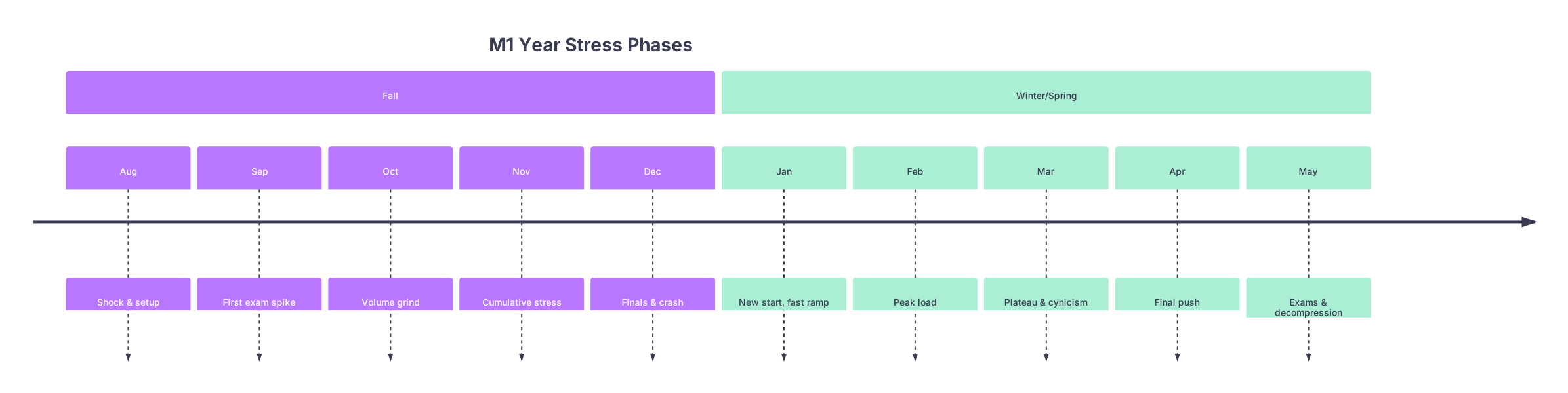
| Period | Event |
|---|---|
| Fall - Aug | Shock & setup |
| Fall - Sep | First exam spike |
| Fall - Oct | Volume grind |
| Fall - Nov | Cumulative stress |
| Fall - Dec | Finals & crash |
| Winter/Spring - Jan | New start, fast ramp |
| Winter/Spring - Feb | Peak load |
| Winter/Spring - Mar | Plateau & cynicism |
| Winter/Spring - Apr | Final push |
| Winter/Spring - May | Exams & decompression |
April – Final Push: Exams, OSCEs, Pre‑Summer Planning
Stress pattern: Another bump with end‑of‑year assessments and OSCEs. More structured panic.
You are closer to the end, which helps, but the stakes feel higher.
At this point you should:
Treat clinical skills / OSCE prep like another exam block.
- Make checklists for key stations (HPI, focused physical, counseling)
- Practice aloud with a partner, not silently in your head
- Focus on structure, not memorized phrases
Map the remaining exam landscape very clearly.
Build a “to‑the‑end” calendar:- All written exams
- All practicals / OSCEs
- Any required assignments
Then back‑schedule: at least 3 days of focused review per major exam.
Start sketching your summer—not obsessing over it.
Decide broadly:- Research? If yes, roughly how many weeks and with whom?
- Shadowing or clinical work?
- Pure rest with minimal obligations? (more valid than students admit)
The goal is to avoid hitting June with zero plan.
| Phase | Primary Stressor | Main Focus | Key Tool |
|---|---|---|---|
| Aug–Sep | Shock & first exams | Build systems | Daily routine + Anki |
| Oct–Nov | Volume & burnout | Boundaries + triage | Time blocks + cutoffs |
| Dec–Jan | Finals & reset | Smart review + audit | Power triage + audit |
| Feb–Mar | Peak load & fatigue | Integration + recovery | Weekly stress triage |
| Apr–May | Cumulative assessments | Structured final push | End‑of‑year calendar |
May – Last Exams, Emotional Exhaustion, Slow Decompression
Stress pattern: Final spike for end‑of‑year exams, then long, uneven decline.
At this point you should:
Protect your last big assessments from distraction.
- Silence nonessential group chats in the final 72 hours
- Stop resource surfing; use only what has worked all year
- Sleep, do questions, quick reviews. Repeat.
Do a deliberate decompression plan after your last exam.
For the first 72 hours:- No schedule
- No guilt about “wasting time”
- Do whatever makes you feel human again
After that, gently reintroduce structure so you do not drift into a month‑long fog.
Close out M1 with a written reflection and a hard reset.
Take 30–60 minutes alone:- What were the 3 worst habits you formed this year?
- What were the 3 best decisions you made?
- What will you refuse to repeat in M2?
Then: clean your study space, archive old files, and actually delete unused apps / resources.

Daily and Weekly Anchors That Keep You Sane All Year
Stress follows a yearly curve, but your defense is built in days and weeks.
Daily anchors (non‑negotiable most days):
- One fixed wake‑up time
- One main study block for new content
- One completed Anki queue (or your equivalent review system)
- One period with real movement (walk, gym, stretching)
- One off‑screen wind‑down window before bed
Weekly anchors:
- One half‑day off from medicine
- One 10‑minute “stress triage” session
- One conversation with someone who is not in your class or does not care about your grades
- One mini‑audit: “What worked this week? What failed?”

Key points to remember:
- Your stress in M1 is cyclical and predictable; plan ahead for the spikes instead of acting surprised every block.
- At each phase, you should adjust process, not just effort—simplify resources, protect sleep, and use structured triage.
- Boundaries and small, consistent habits will save you more than heroic all‑nighters; your goal is not to survive one exam, but to still be functional by the end of the year.