
Two weeks after the first anatomy exam, an MS1’s name comes up on the agenda of a faculty committee meeting. They are out in the library right now thinking they barely passed, refreshing their email, telling themselves they just have to “work harder.” Inside the conference room, their name is printed on a packet labeled “Academic Concerns.” And the way they get talked about in that room is nothing like what they imagine.
Let me walk you into that room, because nobody ever does. Students hear rumors, attend some vague “support” meetings, maybe get an email with “we’re concerned,” but the real conversations—the tone, the labels, the quiet decisions that shape your entire trajectory—those all happen behind closed doors.
You deserve to know how it actually works.
How You Even End Up on the Radar
There’s a myth that faculty know you intimately, are tracking your every move, and “notice” when you struggle. They don’t. What they notice is data. You land on a list first. Only then do they start building a story around you.
Here’s how you usually get flagged as an MS1:
Exam performance trends, not one bad test
One anatomy exam at the 10th percentile? That alone might not trigger anything. Three exams in a row below a threshold (often 70 or a designated “borderline” category)? Now you’re showing up on the Academic Performance Review spreadsheet.Course failures or near-fails
Any actual failing mark in a pre-clinical course will get you onto an agenda, period. Some schools have a “C or below” or “Remediation required” category that automatically pushes your name into committee circulation. For pass/fail schools, “conditional pass,” “marginal pass,” or “needs remediation” are red flags that get tracked.Patterns across systems
Struggling in anatomy only? Might be shrugged off as “some people are just not anatomy people.” Struggling in anatomy, biochem, and then physiology too? People start using the phrase “global difficulty.”Professionalism or behavioral reports
Chronic tardiness. Unexplained absences from required sessions. Concerning behavior in small groups. An email from a lab instructor that says, “I’m not sure what’s going on with this student, but I’m worried.” Those go into a “concerns” folder that gets summarized.Self-disclosure that actually reaches the right person
If you tell a course director, “I’m really struggling, I failed the last two practice exams,” and that director is even remotely conscientious, your name may get floated early with a softer tone: “We might want to check in with them before they fall off a cliff.”
So no, you’re not invisible. But also no, they’re not obsessing over every point you miss. You become visible when your pattern stands out against the background noise of normal MS1 chaos.
The Room: Who’s There and What They Actually Say
Let me demystify the meeting itself, because that’s where the real power lies.
There’s typically some version of:
- Associate Dean for Student Affairs
- Course/clerkship directors (for MS1, usually block or system leaders)
- Learning specialist / academic support person
- Sometimes a psychologist or wellness representative
- Occasionally a student rep (but not when specific cases are discussed)
They have a table, a printed or digital spreadsheet, and a set of names.
And then this happens.
“Okay, next student…”
The way your case is presented sets the entire tone. Here’s the part students do not understand: language in that room sticks. Words used in September are still echoing in March.
Typical patterns:
Case 1: The “we can save them” narrative
“Okay, Student X. Failed the first anatomy exam, did marginally on the second, but they reached out, they’ve been attending review sessions, and their small-group facilitator says they’re very engaged. They’ve got significant family stress at home.”
The subtext: this is someone we’ll try to protect. There’s empathy, and the conversation shifts to: “What support can we give?”
Case 2: The “chronic underperformer” narrative
“Student Y. This is their third course with borderline performance. Didn’t attend review, no-shows for office hours. No response to our initial email until we pinged them a second time.”
That student instantly gets a different story: disorganized, unmotivated, resistant to help. Whether it’s true or a function of anxiety and avoidance doesn’t matter much. Perception hardens quickly.
Case 3: The “something’s wrong” narrative
“Student Z. They were a strong applicant—high MCAT, great undergrad record. Now they’re failing multiple blocks. Their small-group tutor thinks this is not about effort. They seem withdrawn, maybe depressed.”
This story turns into, “We need to get them evaluated. This is not just academics.”
There’s a quiet, very real taxonomy of struggling students: salvageable, self-sabotaging, concerning, and lost. Nobody writes those words down, but I’ve heard all four phrases used almost verbatim.
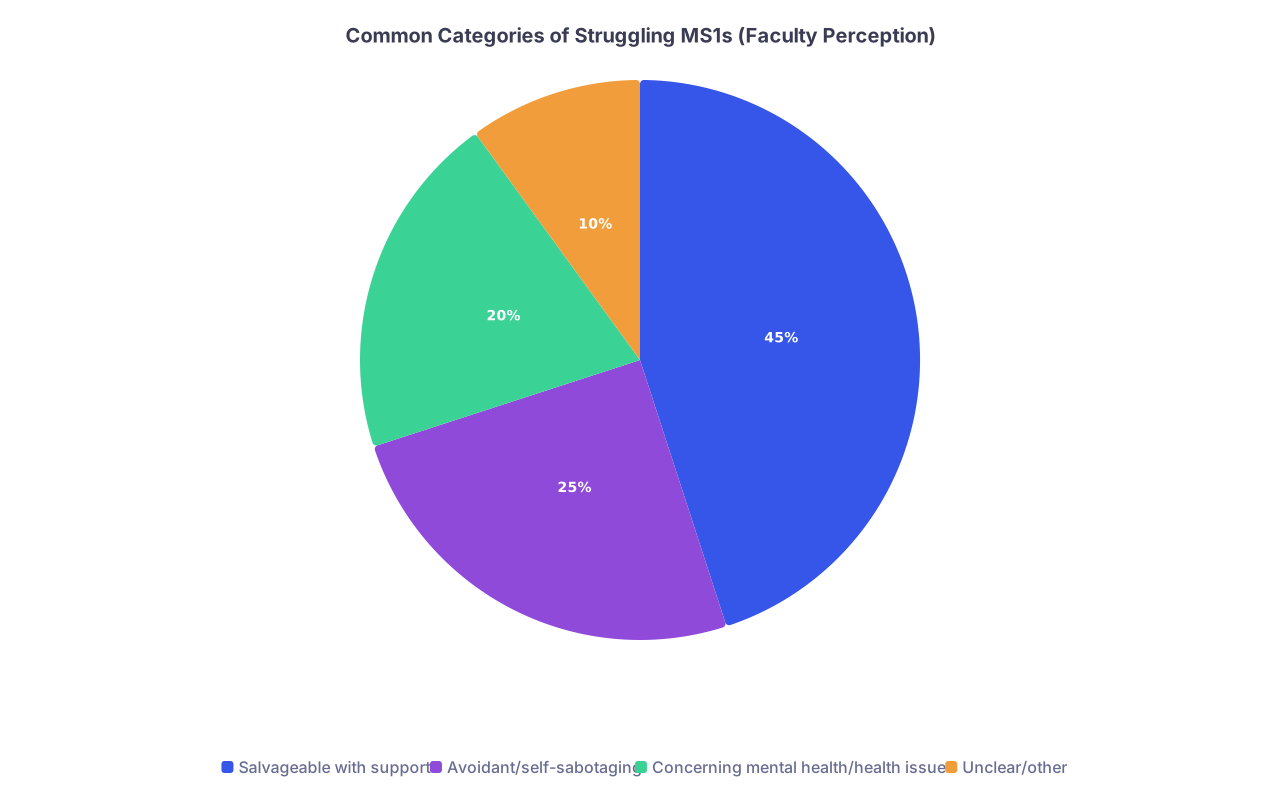
| Category | Value |
|---|---|
| Salvageable with support | 45 |
| Avoidant/self-sabotaging | 25 |
| Concerning mental health/health issues | 20 |
| Unclear/other | 10 |
The Three Things They Judge You On (More Than Your Score)
Faculty like to tell you “we care about your learning, not just outcomes.” That’s half-true. Behind closed doors, three things matter far more than most students realize:
1. Trajectory
Your absolute score is less important than your direction of movement.
If you start at 62% and then move to 68%, then 72%, people in that room say things like, “They’re trending up. Maybe our supports are working.” They’re more patient.
If you start at 78% and slide to 70%, 65%, 61%, someone will say, “This worries me more. This is a downward spiral.” Downward trends trigger sooner, and with more urgency.
2. Engagement with help
This one is brutal, because anxious and ashamed students often look disengaged from the outside.
What gets you labeled “engaged” in that room:
- You show up to required academic support meetings on time.
- You’ve met with the learning specialist at least once.
- You respond to emails within a day or two.
- You actually implement at least one suggestion and can report back on it.
What gets you labeled “resistant” or “avoidant”:
- You bail on scheduled meetings more than once.
- Your email replies are late, evasive, or nonexistent.
- Faculty have to chase you to talk about your own struggles.
- You say you’ll change study strategies and then clearly do not.
You might be overwhelmed, depressed, or frozen. They see “resistant.” That label hurts you more than a single low exam ever will.
3. Professionalism and reliability
Here’s the uncomfortable truth: professionalism concerns carry more weight than your anatomy score.
I’ve seen this exact exchange:
Course director: “They’re barely passing, but they’re always in lab, they’re prepared, they’re respectful.”
Dean: “Okay, we can work with that.”
Versus:
Course director: “They’re fine academically, but they keep missing required sessions, never tell anyone what’s going on, and other students are complaining.”
Dean: “That’s a bigger concern for me.”
Your reputation as reliable/irresponsible, respectful/difficult, honest/evasive—those adjectives get attached early and are very hard to shake.
How Mental Health and Personal Issues Actually Get Framed
You may assume that telling the school you’re struggling with mental health will destroy you. Or you assume it will magically excuse everything. Both are wrong.
Here’s how it really plays out.
If a dean walks into that meeting and says, “Student X is going through a major depressive episode, is connected with counseling, and is working on accommodations,” the room shifts. People say:
- “Okay, that explains the performance.”
- “We should consider a reduced load.”
- “Let’s not penalize them the same way as someone just not putting in effort.”
You’re not getting a free pass, but the narrative moves from “underperformer” to “student in crisis who’s doing the right thing by seeking help.”
Contrast that with the student who is clearly falling apart and refuses all help, avoids all conversations, and never provides any context. That student ends up being talked about as “a risk”—to patients later, to professionalism standards, to the school’s accreditation standards.
I’ve heard the line: “We can tolerate struggle, we cannot tolerate denial and concealment forever.” That’s the real attitude.
The safest path isn’t hiding everything. It’s controlled disclosure to the right people, with documented steps you’re taking to improve.
What Decisions They Actually Make in Those Meetings
Let’s get concrete. That room isn’t just venting; they’re making decisions about you.
Possible outcomes for a struggling MS1
| Outcome | Typical Trigger |
|---|---|
| Informal monitoring | Single low block, mild concerns |
| Required meeting with dean/learning specialist | Repeated low scores or pattern |
| Formal remediation of course/block | Failed or marginal pass in a course |
| Modified schedule/reduced load | Multiple courses at risk, health issues |
| Leave of absence (voluntary or recommended) | Severe ongoing difficulty or crisis |
| Academic probation or dismissal | Repeated failures, no improvement |
What you don’t see is how early those “future” possibilities are quietly mentioned.
I’ve sat in September meetings where a name comes up and someone says, “We might be heading toward a reduced load if this doesn’t turn around.” That’s three blocks before anything is officially offered to the student.
So while you’re thinking, “I just need to pass this next exam,” they’re thinking in arcs: “Are we on a path to remediation? To probation? To leave?” The long game is being played with your name months before you ever see paperwork.
Why Some Students Get Mercy and Others Get the Hammer
This part is going to sound unfair. Because it is.
Students with the same numbers do not always get treated the same way. Here’s what tilts the field:
You had deposits of goodwill before you struggled.
If you were visibly trying, asked good questions, showed up prepared early in the year, your later struggle is framed as “something happened.” You get more patience.You have an advocate in the room.
A small-group facilitator who likes you. A course director who says, “I’ve met with them, they’re working.” The opposite is also true: one powerful person who’s written you off can color the entire discussion.You actually followed through on prior plans.
If in October they said, “Meet with the learning specialist, attend weekly review,” and by November you’ve done both, they say, “Okay, they’re doing their part.” Faculty are much more likely to meet you halfway when you follow through.You don’t blame everyone and everything else.
The student who walks into a dean’s office and says, “The exams are unfair, the teaching is terrible, my group is toxic, I shouldn’t be doing this badly” without any ownership—behind closed doors, they are labeled as lacking insight. That label is poisonous.
I’ve seen borderline students protected fiercely because they’re viewed as humble, coachable, and honest. I’ve also seen technically fixable cases spiral toward dismissal because the student kept fighting reality instead of addressing it.

How You Can Influence That Conversation Without Being in the Room
You can’t sit at the table. But you are absolutely shaping what gets said there.
Here’s what changes your story:
1. Make your struggle legible
Faculty are not mind readers. They see scores and attendance. If you’re crashing, you need a clear, simple narrative that can be repeated in that room:
- “They’ve been dealing with a new medical diagnosis and are now under treatment.”
- “They were completely overwhelmed with care responsibilities but have since arranged support.”
- “They realized their study strategies were all cramming; they’re working with the learning center and have shifted to more active retrieval.”
You want the dean to be able to say, in one or two sentences, who you are and what’s being done.
2. Show movement, not just remorse
Everyone says “I’ll do better.” Committees don’t believe that anymore.
What gets their attention:
- “After the last exam I started using spaced repetition, I’m doing 40 practice questions daily, and I’ve cut back work hours.”
- “I met with Dr. X weekly for the last month and my quiz scores have improved.”
They want evidence of behavior change. Not vibes.
3. Be annoyingly responsive
You don’t have to be perfect. But when there’s a dean email, you respond. When they offer a meeting, you show up early. When they suggest a resource, you at least try it once.
Responsiveness gets interpreted as professionalism and willingness to engage. That buys leniency.
4. Own your part—without self-destruction
The goal is not to grovel and call yourself lazy and incompetent. That actually worries people too.
A good faculty-facing statement sounds like:
“I underestimated the volume and tried to study like undergrad. That didn’t work. I’ve started working with the learning specialist and changed my schedule. I’m also getting help with my anxiety, which was making me avoid studying when I felt behind.”
Owning specific behaviors and showing specific corrections signals maturity. That goes a long way.
What You’re Overestimating vs Underestimating
MS1s consistently misjudge two things: how bad their situation is, and what faculty care about most.
You tend to overestimate:
- How fatal one bad exam is.
- How much faculty sit around talking about you specifically. (They don’t have that much time.)
- The stigma of needing help. Most of the people in that room sought help themselves in training.
You tend to underestimate:
- How quickly reputations form and solidify.
- How much your response to struggle matters more than the struggle itself.
- How early long-term decisions (leave, remediation risk, probation risk) are quietly forecast.
One more thing you underestimate: how common this is. Every year, multiple MS1s end up on those lists. Many of them survive, adjust, and graduate fine. You don’t hear their stories because no one wants to talk about being on the edge.

| Step | Description |
|---|---|
| Step 1 | Low Exam Score |
| Step 2 | Pattern of Struggle |
| Step 3 | Flagged on Faculty List |
| Step 4 | Meeting with Dean |
| Step 5 | Improvement & Monitoring |
| Step 6 | Remediation/Reduced Load |
| Step 7 | Leave or Probation Risk |
| Step 8 | Return to Regular Status |
| Step 9 | Engaged with Support? |
| Step 10 | Continued Difficulty? |
If You’re Already Struggling Right Now
If you see yourself in any of this—if you know your name is probably on a spreadsheet—here’s what I’d do tomorrow, not next month:
- Email your dean or student affairs contact and request a brief check-in about your academic plan. Keep it professional and concise.
- Schedule one session with the learning specialist and actually use one strategy they suggest for two weeks.
- Tell one course director or small-group faculty member that you’re working on this, and ask for one concrete suggestion.
That alone changes how your name lands in the room. You’ve shifted from “silent struggler” to “proactive student in difficulty.” The second one gets written off far less often.
You can’t control every decision. But you can absolutely control the evidence they have when they sit down to talk about you.
Years from now, you won’t remember the exact percentage you got on your third anatomy exam. You will remember whether, when everything started to slip, you hid and hoped, or you stepped into the uncomfortable light and forced the story about you to change.