It is Sunday night before your first big block exam. Cards still in the thousands. Lecture recordings at 1.0x that you never watched. Group chat on fire with “who has a mnemonic for the brachial plexus??” You feel behind, guilty, and wired on bad coffee.
This is where people ruin otherwise decent weeks of studying.
Not because they are lazy. Because in the last 72 hours, fear takes over and they start making panic moves that feel productive but quietly wreck recall, focus, and performance on test day.
That is what I want to stop you from doing.
You probably have enough knowledge to pass. Maybe even to honor. The danger is not only what you have not learned yet. It is what you will sabotage in the final stretch if you panic and change strategies, schedules, or habits at the worst possible time.
Let’s go through the big last‑minute decisions that reliably hurt med students during test week—and how to avoid walking into the same traps.
1. The “New Study Plan at T‑48 Hours” Disaster
Two days before the exam, someone posts their “insane high‑yield schedule” in the class group: 10 lectures, 500 Anki cards, 3 Q‑banks per day, plus a 100‑question practice test. And you believe, for a moment, that you too can compress three weeks of work into a weekend.
You throw out your existing plan and try to copy theirs.
This is one of the fastest ways to convert a borderline pass into a fail.
Why it hurts you:
- Switching strategies at the end breaks your memory consolidation. You have been reviewing material one way for weeks; your brain has patterns built around that. Abruptly changing from, say, “Anki + lecture slides” to “watch every Boards & Beyond video at double speed” forces you into shallow exposure instead of strengthening what you already know.
- You lose time context‑switching. Re‑organizing, re‑sorting decks, making new to‑do lists, installing new apps—this is all time you do not have.
- You chase other people’s strengths. That classmate’s plan might work because they pre‑read, or because they did questions daily for the last month. Copying someone else’s endgame without their preparation is like copying someone’s marathon sprint without having done their training runs.
What to do instead in the last 48–72 hours:
- Lock your method, not your content. You can adjust which topics to emphasize, but do not radically change how you study. If you have been using active recall + spaced repetition, keep that. No brand‑new systems.
- Shorten your list, do deeper passes. Take what you already have (cards, notes, question sets) and prioritize weak, testable topics. Fewer resources, more repetitions.
- Reserve the last 24 hours mainly for review, not discovery. New concepts ≈ low yield this late unless they are clearly central (e.g., Starling forces for physiology, basic immunology arms for micro).
If you feel the urge to burn everything down and start a new “perfect plan,” that is your sign you are afraid, not strategic. Do less. But do it more deliberately.
2. Dropping Sleep to “Buy” Extra Study Hours
This one is brutal because it feels responsible: “I have not done enough, so I will just sleep 3–4 hours the last few nights to squeeze in more.”
I have watched very smart students do this, walk into an exam glassy‑eyed, and miss questions they could answer in their sleep—if they had slept.
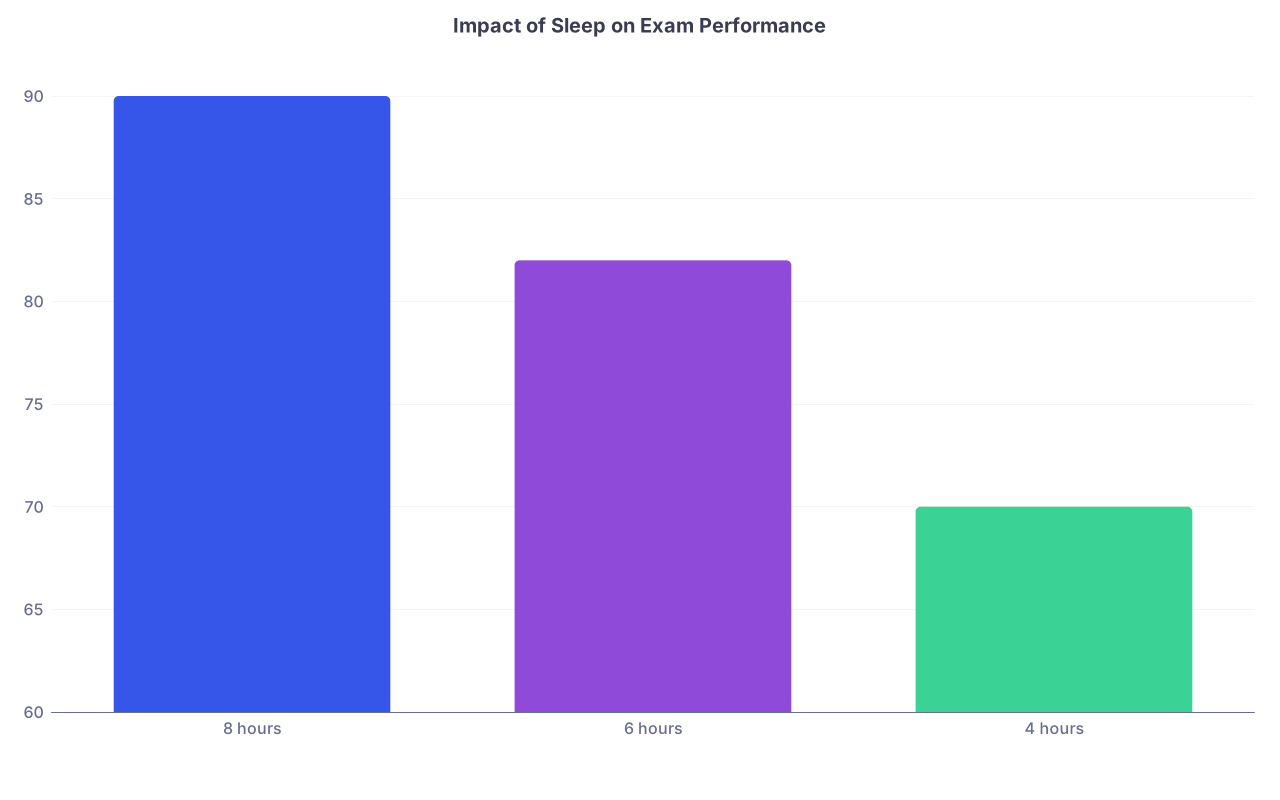
| Category | Value |
|---|---|
| 8 hours | 90 |
| 6 hours | 82 |
| 4 hours | 70 |
What actually happens when you cut sleep during test week:
- You sabotage memory consolidation. The nights before the exam are exactly when your brain is trying to move short‑term learning into long‑term storage. You are literally throwing away the benefit of the studying you already did.
- You wreck attention and working memory. Exams are not pure recall. They are long, complex vignettes that require holding details in mind, excluding distractors, and doing small mental calculations. Sleep‑deprived brains drop details and fall for traps.
- You increase emotional reactivity. That one unexpected obscure question? On 8 hours, you shrug and move on. On 3 hours, you spiral—then lose focus for the next five questions.
Red flags you are about to make this mistake:
- You are telling yourself, “One all‑nighter won’t matter; I’ll recover after the test.”
- You are calculating, “If I sleep only 4 hours, that gives me 4 more hours of review.”
- You are comparing yourself to classmates bragging about all‑nighters.
Better rules for test week sleep:
- Non‑negotiable minimum: 6–7 hours the nights before the exam. Eight is ideal. Under 5 is self‑sabotage unless there is an emergency.
- Protect the last night especially. You will not “learn” much meaningful content at 2 a.m. Your brain will not encode it properly in time for a 9 a.m. exam anyway.
- Cut content, not sleep. If it is 11:30 p.m. and you are choosing between 2 more lectures versus 1 more hour of sleep, the sleep will almost always give you more net points.
If your plan mathematically requires chronic sleep deprivation in the last 3–4 days, your plan is wrong. Not your stamina.
3. Introducing New Resources at the Last Second
You have been using Pathoma, First Aid, your lecture notes, and UWorld questions. Then, 3 days before the exam, someone says, “Oh, this YouTube channel is so high‑yield, I watched all of it and got an A.”
And you think: “I cannot afford to not use that.”
So you add it. Then maybe another “high‑yield summary” PDF. Then a “must‑do” Anki deck.
This is how people end up skimming six resources and mastering none.

Why last‑minute resource switching backfires:
- Different language, same concept = dangerous confusion. Every resource names pathways, structures, or bugs slightly differently. You waste time translating between vocabularies, not learning.
- No time to calibrate difficulty. You do not know if this new Q‑bank is harder, easier, or aligned with your exam. You will misinterpret your performance and either panic or get false confidence.
- Surface exposure without retention. You may feel “busy” racing through 30 videos. But with no review cycles, what you remember is a blur of colors and sound, not usable knowledge.
How to use new resources safely during test week:
- Cap the number. For the final 5–7 days, pick your primary 1–2 resources and stick with them.
- Only add micro‑resources for specific holes. For example: a 10‑minute histology refresher for kidney if that has always been your weak spot. Not an entire new “renal crash course” series the night before.
- Vet alignment with your course. If your exam is faculty‑written and lecture‑based (many first‑year exams are), then “USMLE‑level” external resources are supplementary, not primary.
A simple test: if the new resource requires you to learn a system (new note‑taking method, new app, new deck structure), it is too late. Save it for the next block.
4. Abandoning Active Recall for Passive Cramming
Three days out, some of you will drop questions and cards and suddenly go all‑in on rewatching lectures at 2x speed, scrolling through PDFs, or reading outlines.
It feels safer. You are “covering everything.”
You are also guaranteeing that you will forget half of it by question 25.
Typical pattern I see:
- First 3 weeks: decent mix of Anki, practice questions, and summaries.
- Final week: panic about “not having seen everything,” shift to rereading slides, reviewing handouts, and marathon lecture recordings.
- Result: good familiarity, poor retrieve‑ability.
The exam does not care what looks familiar. It cares what you can pull out of your head under pressure.

| Step | Description |
|---|---|
| Step 1 | 3 Weeks Out: Mixed Study |
| Step 2 | 1 Week Out: Panic |
| Step 3 | Questions & Flashcards |
| Step 4 | Lectures & Rereading |
| Step 5 | Better Retrieval on Exam |
| Step 6 | Recognition Without Recall |
| Step 7 | Decision |
How to avoid this:
- Keep a mandatory dose of active recall every day of test week. That means:
- Practice questions (even small sets of 10–20).
- Closed‑book quizzing yourself on lecture objectives.
- Anki or whatever flashcard system you actually use.
- Use passive review after active recall, not instead of it. Do questions, then quickly scan relevant notes to fill gaps. Not the reverse.
- Do “brain dumps” for key frameworks. For example, from blank paper: draw the brachial plexus, list the complement pathways, outline the cardiac cycle phases. If you cannot produce it on paper, you will not produce it on the exam.
When you feel tempted to trade questions for “just one more pass” through the slides, remember: familiarity is the illusion of competence. The exam will pierce that illusion fast.
5. Over‑Practicing Full‑Length Questions at the Expense of Review
There is another group that goes too far in the opposite direction: addicted to question sets.
They hear “do questions” and interpret it as “do as many blocks as humanly possible right up to the exam.” Six blocks of 40 questions in a day, no time for serious review, brain completely fried.
More is not always better.
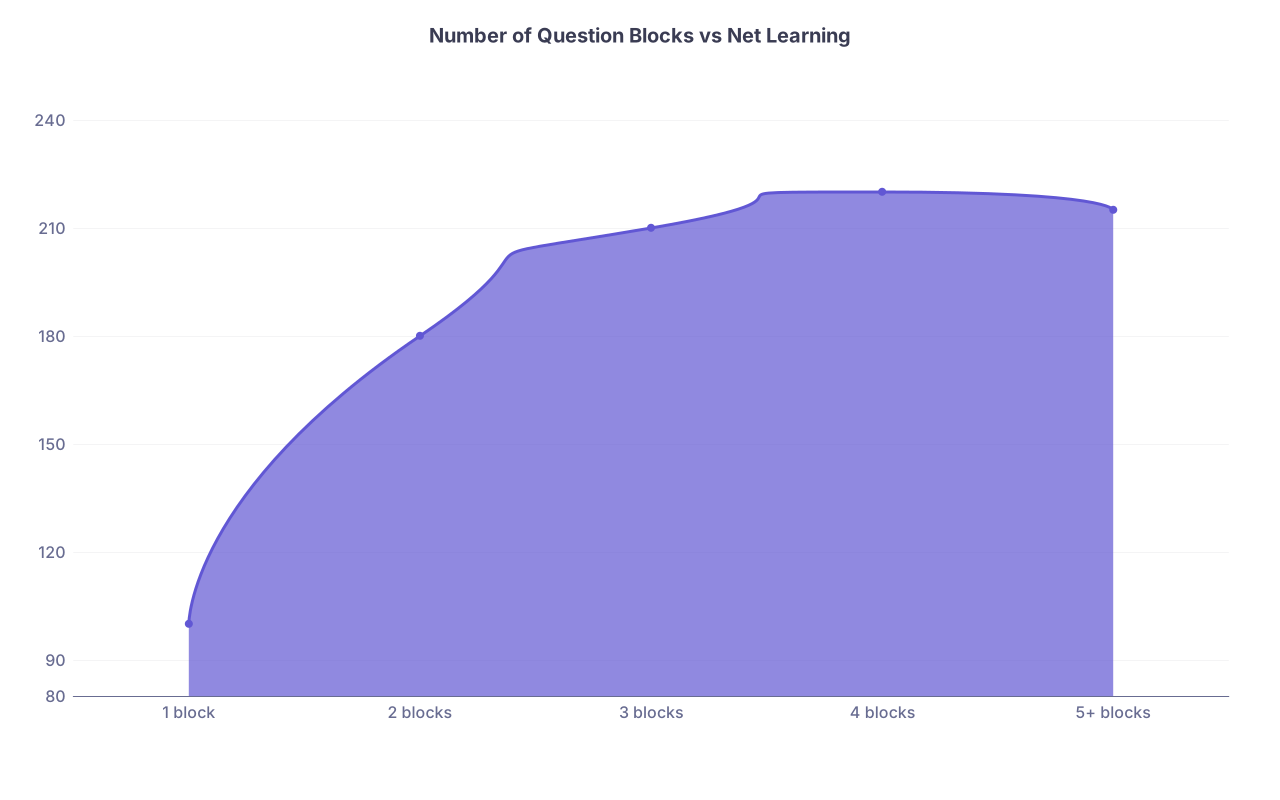
| Category | Value |
|---|---|
| 1 block | 100 |
| 2 blocks | 180 |
| 3 blocks | 210 |
| 4 blocks | 220 |
| 5+ blocks | 215 |
Here is the problem with over‑doing full blocks:
- You trade depth for volume. The learning happens when you review questions: understanding why each answer is right or wrong, relating it to your notes, and extracting general principles. Blasting through blocks without deep review is just high‑stress entertainment.
- You exhaust your focus for test day. Your attention is not infinite. If you run several fake exams at full tilt the day or two before, you walk into the real test with a half‑charged battery.
- You confuse yourself with new tangents. Commercial Q‑banks especially love edge cases. Test week is not when you want random oddball pathologies displacing the bread‑and‑butter topics in your memory.
Smarter way to use questions late:
- 3–5 days out: 1–2 focused blocks per day, with intense review (double or triple the time it took you to answer them).
- 1–2 days out: switch to short sets (10–15 questions) on high‑yield topics, mainly to keep your diagnostic muscles warmed up.
- Day before: if you do any questions at all, make it light. Think “warmup,” not “last stand.”
If reviewing a block properly will take 2 hours you do not have, do a smaller block, not a rushed review.
6. Changing Food, Caffeine, or Medication Habits Abruptly
People underestimate this one until they spend half of their exam time thinking about their stomach instead of the questions.
Typical last‑minute changes I see:
- Tripling caffeine intake “just for test week.”
- Trying a new pre‑workout, energy drink, or supplement on exam morning.
- Fasting for the exam when they normally eat breakfast. Or eating a gigantic breakfast because “food is brain fuel.”
- Popping someone else’s ADHD medication or anti‑anxiety pill for the first time.
You are not a chemistry experiment. Test day is not the time to try new variables.

What goes wrong:
- GI upset. New foods + stress hormones + high caffeine = nausea, diarrhea, cramps. Hard to analyze a renal physiology stem when your colon is staging a protest.
- Jitters and impaired concentration from too much caffeine or stimulants. A little helps. A lot gives you racing thoughts, palpitations, and a shorter attention span.
- Unexpected side effects from borrowed meds. I have seen students feel dizzy, emotionally blunted, or hyper‑focused on the wrong things because they were figuring out their brain on a medication they had never taken before—during an exam.
Safer rules:
- Two weeks before the exam, stabilize your usual routines. Do not make big changes. Tweak only if something is clearly not working.
- During practice exam sessions, eat and drink exactly what you plan for test day. If something upsets your stomach during practice, fix it now.
- Test day: normal caffeine, normal food, nothing new. If anything, a little less than your max.
Your brain does not need heroic hacks. It needs a stable, predictable environment.
7. Social Media and Group Chat Doom‑Scrolling
The 24 hours before a big exam, group chats become a minefield:
“Wait, did we even cover renal tubular acidosis type 4?”
“Does anyone understand the complement pathways?”
“Prof. X said the exam was ‘harder than usual’…”
“Random question: how do you calculate alveolar gas again??”
You open the chat or Discord “to ask one quick question” and emerge 90 minutes later, heart hammering, convinced you are failing.
You think you are gathering data. You are actually spreading anxiety and diluting your focus.

| Step | Description |
|---|---|
| Step 1 | Check Group Chat |
| Step 2 | See Panic Messages |
| Step 3 | Feel Behind |
| Step 4 | Change Study Plan |
| Step 5 | Lower Efficiency |
| Step 6 | More Panic |
How this backfires:
- You see the loudest, most anxious voices, not the true average. The calm students quietly studying are not posting hot takes in the group.
- You get sucked into explaining concepts to others as a form of procrastination. Teaching can be helpful, but not when you are doing full tutorials for classmates instead of consolidating your own weak areas.
- You discover topics your course barely touched and suddenly feel compelled to “learn everything” about them at 10 p.m.
Safer approach:
- Hard mute large group chats 24 hours before the exam. You can survive a day without real‑time updates.
- If you must ask a question, pick 1–2 trusted people and message them directly. Avoid the chaos of 100‑person threads.
- No last‑minute “what are you guys focusing on??” polls. They almost always mislead you away from your own syllabus.
Your professor writes the exam. Not the group chat.
8. Last‑Minute Life Admin and Emotional Landmines
This one is softer but just as real.
I have seen students wreck their focus by:
- Starting big roommate or relationship arguments the day before the exam.
- Staying up late to help someone move, fix a car, or plan an event “because they asked and I felt bad.”
- Doing heavy life admin at midnight: loan applications, housing forms, big financial decisions.
You only have so much emotional bandwidth. If you spend it all elsewhere, there is not much left for 120 questions of neuroanatomy and biochem.
| Activity Type | Why It Hurts Performance |
|---|---|
| Major arguments | Raises stress, ruins sleep |
| Big errands/favors | Steals time and mental energy |
| New long-term plans | Triggers worry and rumination |
| Complex paperwork | Decision fatigue before the test |
| Intense social events | Disrupts routine and sleep |
Protect your exam window like a surgical case:
- No major conflicts. If something blows up, say, “I have a major exam; I’m not ignoring this, I just need to revisit it after.” Then do exactly that.
- No new big commitments. “I can help with that after Tuesday” is a full sentence.
- Clear your admin earlier in the week. If there is essential paperwork, do it several days prior or delay if possible.
Your job during test week is narrow: protect your brain and your time.
FAQ: Test Week Panic Moves
1. Is it ever worth pulling an all‑nighter before a medical school exam?
Almost never. The only scenario where it might be defensible is if you truly did zero work and need any exposure just to avoid a catastrophic fail. But for most students who have done at least some studying, all‑nighters cost more points via impaired cognition than they gain via extra content review. If you are considering one, a better move is usually a solid 5–6 hour sleep and a focused 2–3 hour morning review.
2. How many practice questions should I do the day before the exam?
For most first‑year blocks, 10–30 targeted questions total is enough on the final day, mainly to warm up your thinking and identify any last small gaps. The mistake is doing multiple full‑length blocks that exhaust you. If you feel mentally tired after a small set, stop. The goal is to walk into the exam feeling sharp, not depleted.
3. What if I realize two days before the exam that I studied the “wrong” things?
You triage, not panic. Identify the 3–5 highest‑yield topics the exam is almost guaranteed to hit (e.g., autonomic pharmacology basics, major cardiac pathologies, basic immunology). Spend your limited time scoring as many points as possible on those instead of trying to skim every neglected minor topic. You are optimizing damage control, not perfection.
4. Is it bad to watch any new videos or use new resources right before the test?
Not inherently, but scope matters. A single 10–15 minute video to clarify a specific concept you have always struggled with is reasonable. Starting a new 20‑video series or a giant new Anki deck 48 hours out is not. Use new resources like a scalpel, not a bulldozer, this late.
5. How far in advance should I “lock in” my exam week routine?
By about 7 days before the exam, you should have a stable general plan: primary resources, daily study blocks, approximate sleep schedule, and test‑day food/caffeine routine. You can adjust details within that framework, but avoid foundational changes in the final 3–4 days. The closer you get to test day, the more your focus should shift from “what else can I add?” to “how do I protect what I already know?”
Key points: do not burn down your study system in the last few days, do not trade sleep for the illusion of productivity, and do not let group panic or new resources hijack your focus. Test week is about protecting your brain and consolidating what you already built—not proving how much you can suffer in 72 hours.