
Most M1s do not have a time-management problem. They have a system design problem. Their weekly schedule is built on fantasy, not on how human brains and medical curricula actually work.
I am going to walk you through building a schedule from zero that:
- Survives exam weeks
- Does not collapse the first time a lab runs late
- Protects your sleep and sanity without tanking your grades
This is not “use a planner and color-code your notes” fluff. This is a step-by-step protocol you can apply this week.
Step 1: Map Your Non‑Negotiables First (The Reality Check)
You cannot build a stress‑proof schedule until you stop lying to yourself about your time.
Pull up:
- Your official course calendar
- Your current commitments (work, family, commuting, etc.)
- A blank weekly grid (Google Calendar, Notion, paper – do not overthink the tool)
Now we build the skeleton.
1.1 Block the hard constraints
These are things you must attend or that cannot move.
Block these first, in solid, non-editable events:
- Required lectures / mandatory sessions
- Labs (anatomy, histo, clinical skills)
- Small groups / PBL / TBL
- Exams and required reviews
- Commute times (both directions)
Be ruthless. If anatomy lab is 1–4 p.m. and your commute is 30 minutes, you block:
- “Transit to campus” 12:30–1:00
- “Anatomy lab” 1:00–4:00
- “Transit home” 4:00–4:30
Not “lab 1–4” and then pretend you will magically teleport.
1.2 Block the human basics next
Most M1s treat basic physiology (their own) like an elective. That is exactly why they burn out in October.
Block these before any study blocks:
- Sleep: fixed 7–8 hours, same wake time daily (yes, weekends too, within ~1 hour)
- Meals: 30 minutes x 3 per day, minimum
- Hygiene / morning + night routine: 30–45 minutes per day
Do not pretend you can “eat while watching lecture” and call that a meal block. That is how you lose both focus and digestion.
1.3 Add pre‑existing life commitments
Now, add:
- Standing family obligations (e.g., Friday dinner, religious services)
- Work shifts (if you absolutely must work)
- Essential appointments (therapy, medical, etc.)
At this point, your week is probably 60–70 percent blocked. Good. Now we see what is actually available.
Step 2: Decide Your Study Strategy Before You Schedule It
Most students do this backward. They drag random “study” blocks into the calendar, then decide later what to do in them. That is chaos.
Before placing a single study block, you answer three questions:
- How will I consume content?
- Live lecture vs recorded at 1.5x–2x
- Textbook vs boards-style resources
- How will I encode and review content?
- Anki or no Anki
- Practice questions (how many, when)
- What is my daily cognitive budget?
- How many true deep-focus hours can I sustain? (Most humans: 3–5)
You are designing a system, not just a calendar.
2.1 Choose a content pipeline
Here is a simple, effective model for most M1s:
- Primary exposure: recorded lectures at 1.5x–2x or in-person, same day
- Concept consolidation: brief notes, diagrams, or pre-made resources (e.g., B&B, Pathoma for certain systems)
- Active recall + spaced repetition: Anki every single day
- Application: question banks for your course (or basic board-style questions aligned with topics)
So your weekly “study” blocks are going to be divided into:
- Content intake (lecture watching / reading)
- Card review (Anki or equivalent)
- Active recall (closed-book summaries, whiteboard)
- Questions (NBME-style, school Qbank, etc.)
- Pre‑exam consolidation (condensed outlines, last passes, etc.)
We will embed each of these in the schedule, with a recurring pattern.
2.2 Define your daily “deep work” maximum
If you schedule 10 hours of intense study daily, you are writing fiction. You will not sustain it.
Be realistic:
- Most M1s can manage:
- 3–4 hours of high intensity (focused, no phone, deep cognitive load)
- 2–3 hours of medium intensity (review, cards, light questions)
So your schedule must reflect intensity zones, not just hours filled. More on that next.
Step 3: Build a Daily Template Before Filling the Week
Now we create templates for three types of days:
- Regular lecture day
- Heavy lab + lecture day
- Pre‑exam / exam-period day
You will reuse these patterns, not reinvent the wheel every Sunday.
3.1 Example: Regular lecture day template
Assume:
- Sleep 11 p.m.–6:30 a.m.
- Commute 20–30 minutes
- 3–4 hours of scheduled lecture
A working template could look like:
- 6:30–7:15: Wake, hygiene, light breakfast
- 7:15–8:00: Anki + quick review of yesterday’s content (medium intensity)
- 8:00–12:00: Lecture (live or recorded); insert 5–10 minute micro-breaks per hour
- 12:00–12:30: Lunch (no studying)
- 12:30–2:00: Deep study block #1 – same-day lecture consolidation
- Rewrite condensed notes, sketch pathways, build or tag Anki cards
- 2:00–2:15: Break – walk, stretch, snack
- 2:15–4:00: Deep study block #2 – questions + active recall
- 15–25 questions on that day’s or week’s topics
- 4:00–5:00: Low‑intensity admin + review
- Email, logistics, group chat, schedule adjustments, light card reviews
- 5:00–6:30: Dinner and decompress
- 6:30–8:00: Optional light block – only if energy is there
- Anki reviews, flashcards, or gentle concept review; no new heavy content
- After 8:00: Wind‑down, social, no more new info
Key rule: Same-day processing of lecture. Do not carry “today’s lecture backlog” into tomorrow. That is how things avalanche.
3.2 Example: Heavy lab day template
Assume anatomy 1–4 p.m., lecture 8–10 a.m.
- 6:30–7:15: Wake, hygiene, breakfast
- 7:15–8:00: Anki review
- 8:00–10:00: Lecture
- 10:00–11:00: Short deep block – process morning lecture
- 11:00–12:00: Early lunch + light anatomy preview (structures of the day, not full-on cramming)
- 12:00–12:30: Transit / prep
- 1:00–4:00: Lab
- 4:00–4:30: Transit + snack
- 4:30–5:30: Low‑cognitive task
- Label diagrams, quick anatomy recall, or simply rest if completely drained
- 5:30–7:00: Dinner and downtime
- 7:00–8:30: Gentle work only if absolutely needed
- Catch up on missed cards or yesterday’s material, not 3 hours of new content
On heavy lab days, your brain is already taxed. You protect your future self from burnout by not pretending this is just another 10-hour cerebral day.
Step 4: Allocate Your Weekly Study Blocks by Function, Not Vibe
Now you have templates. Time to assign specific functions to your weekly open spaces.
Open your weekly grid. For each day, mark:
- Deep blocks (D): 60–120 minutes, no interruptions, no notifications
- Medium blocks (M): 45–60 minutes, solid focus but slightly lighter tasks
- Light blocks (L): 20–45 minutes, suitable for cards, review, or admin
Now you label these by study type, not just “study”:
- Content – “Lecture watch / reading”
- Cards – “Anki / spaced repetition”
- Questions – “Qbank / practice problems”
- Consolidation – “Concept mapping / summary pages”
- Admin – “Plan week, check syllabus, messages”
That sounds fussy, but this is why your schedule will work when things get messy: you know exactly what each block is for.
Here is how a balanced weekly functional mix might look for an M1 during a systems block:
| Block Type | Hours/Week | Purpose |
|---|---|---|
| Content Intake | 8–12 | Lectures, primary resources |
| Cards (Anki) | 7–10 | Daily spaced repetition |
| Questions | 5–8 | Qbank, practice exams |
| Consolidation | 3–5 | Summaries, diagrams |
| Admin/Planning | 2–3 | Calendar, logistics, syllabi |
If your week has:
- 20+ hours of raw “lecture time”
- Plus 20+ hours of “studying”
You are going to break. Cut something. Usually that means:
- Stop rewatching entire lectures
- Stop over-notetaking like a court stenographer
- Use targeted resources and move on
Step 5: Build Buffer and Recovery In On Purpose
A schedule without buffer time is not a schedule. It is a wish list.
You are M1. Things will go wrong:
- Lab runs late
- You get sick
- A quiz appears you forgot about
- Tech fails during a quiz, your entire afternoon is shot
You pre‑empt that chaos by designing slack into your week.
5.1 Daily micro‑buffers
Every day should include:
- 10–15 minutes between major blocks
- At least 1 full 30–60 minute “white space” block, unscheduled
- Use for catch‑up or rest, but do not pre‑allocate it
This gives you flex. If a lecture runs 30 minutes over, you encroach on buffer, not on sleep.
5.2 Weekly macro‑buffers
Choose:
- One light evening (no heavy work after 6 or 7 p.m.)
- One partial day off (e.g., Sunday afternoon or Friday evening + Saturday morning)
No, this will not destroy your grades. It will save them.
Think of it this way:
- Your brain consolidates memories away from active input
- Continuous 14‑day grinds with no real break destroy performance
So you formalize recovery:
- Light day = lighter cognitive load, focus on review and logistics
- Partial day off = minimum work, just enough Anki so your deck does not explode on Monday
Design those into your calendar from the start, before you get desperate and “accidentally” doom-scroll for 4 hours.
Step 6: Adjust for Exam Weeks Without Blowing Up the System
Exam weeks are where most “great schedules” die. Students panic, abandon their normal routine, and create a brand-new, insane schedule 5 days before the test.
Do not do that.
You build an exam-week variant of your normal routine, not an entirely new animal.
6.1 The 7‑day pre‑exam shift
About 7 days before a major exam, you adjust your weekly template:
- Reduce new content intake
- Last 3–4 days before the exam: no major new topics if possible
- Increase questions + active recall
- Target: 60–70 percent of study time
- Shorten, do not eliminate sleep
- If you cut below ~6.5 hours repeatedly, your recall tanks harder than you think
A sample 7 days out:
Day –7 to –5:
- 50%: finish remaining content, but faster
- 30%: questions on older material
- 20%: consolidation (summary sheets, high‑yield lists)
Day –4 to –2:
- 60–70%: questions (mixed + by topic)
- 20–30%: review of missed questions + weak areas
- 10%: cards, quick passes through facts
Day –1:
- 40–50%: light questions / flashcards only
- 50–60%: calm, structured review; no brand-new topics
- Sleep: earlier than usual, not later
6.2 Put this into the weekly grid
On exam week, your schedule changes like this:
- Deep blocks: questions + targeted review only
- Medium blocks: cards, error log review, summary pages
- Light blocks: logistics, printouts, exam instructions, packing bag, food prep
You do not:
- Start watching all the lectures you skipped in full
- Create 40 pages of fresh notes from scratch
- Decide this is the week to redo your entire Anki deck
You use what you already built and tighten the screws slightly.
Step 7: Use a Weekly Review Ritual to Fix the System Continuously
A “stress‑proof” schedule is not one you design once. It is one you repair weekly.
Set a recurring event:
- Sunday afternoon or evening
- 30–45 minutes
- Phone out of reach
The agenda is simple.
7.1 Look back
Ask yourself:
- Where did I actually study vs what was on calendar?
- Which blocks felt productive? Which felt like pushing a car uphill?
- Which commitments were fake “non‑negotiables” I should drop?
Then look for patterns, not isolated failures:
- Always dead after anatomy lab? Stop scheduling deep work immediately after
- Cards always pushed to late night? Move them to first thing in the morning
- Constantly late to first lecture? Adjust wake time or your expectations
7.2 Look forward
Then:
- Open syllabus and exam calendar
- Mark all quizzes, practicals, and exams in next 4–6 weeks
- Adjust upcoming weeks, now, for known heavy periods
You want zero “surprise” exam weeks. The exam dates were not secret. You just never built them into your planning.
Step 8: Guardrails So You Do Not Sabotage Yourself
Let me be blunt. The schedule is not your biggest enemy. You are. Your habits will try to break anything I help you build.
So you need guardrails.
8.1 The 24‑hour backlog rule
If you miss a block (you will), you do this:
- If a task is missed today, it gets exactly one chance tomorrow in a flexible buffer block
- If it is missed again, you do not keep shifting it forward forever
- Instead, you rescope: condense, drop, or replace with a more efficient method
Example:
- You planned to rewatch 2 hours of Monday’s cardio lecture
- You miss it Monday and again Tuesday
- New plan: watch a 30–40 minute high-yield summary / board resource + 20 board-style questions on the same content instead
The rule: After 24–48 hours, you switch from “catching up” to “damage control and coverage”.
8.2 The 2‑block phone rule
To keep distractions from killing your deep blocks:
- For every 2 deep blocks, you are allowed 1 intentional, timed “phone check”
- 5–10 minutes, timer on, then out of sight again
If you start noticing:
- Phone wandering into every block
- “Accidental” 30‑minute Instagram scrolls
You are not “bad at discipline.” You just need to move your phone out of reach during deep blocks. In another room if necessary. Very mundane, very effective.
8.3 The red‑zone fatigue rule
There is a specific kind of exhaustion where:
- Rereading the same sentence 3 times
- Making dumb mistakes in easy questions
- Feeling weirdly emotional about a quiz
At that point, the rule is: you stop.
You switch to:
- Light review only
- Logistics (meal prep, cleaning, tomorrow’s plan)
- Or actual rest
Grinding past the red zone is how you turn one bad day into a bad week.
Step 9: A Concrete Example: Building One Week from Scratch
Let’s build a sample week for an M1 in a cardio block:
Assumptions:
- Lectures 9–12 Mon–Thu
- Anatomy Tue/Thu 1–4 p.m.
- Exam next Monday
- Commute 20 minutes
- Sleep 11–6:30
Monday (regular lecture)
- 6:30–7:15: Morning routine
- 7:15–8:00 (M): Anki + yesterday’s review
- 8:00–9:00: Transit + settle
- 9:00–12:00: Lectures
- 12:00–12:30: Lunch
- 12:30–2:00 (D): Process morning lectures (notes + cards)
- 2:00–2:15: Break
- 2:15–3:45 (D): Questions on last week’s cardio + review
- 3:45–4:30 (L): Admin, email, upcoming schedule
- 4:30–6:30: Dinner, walk
- 6:30–7:30 (M): Light review / Anki
- After 7:30: Off
Tuesday (heavy lab)
- 6:30–7:15: Morning routine
- 7:15–8:00 (M): Cards
- 9:00–11:00: Lectures
- 11:00–12:00 (D): Process key lecture concepts
- 12:00–1:00: Lunch + brief anatomy preview
- 1:00–4:00: Lab
- 4:00–4:30: Transit
- 4:30–5:30 (L): Label diagrams / low-energy tasks
- Evening: Mostly off, maybe light cards if energy allows
Wednesday (regular, with exam coming up)
- Similar to Monday, but:
- Afternoon deep block is 50% questions, 50% weak-topic review
- Evening block reserved for summary page creation
Thursday (last lab before exam)
- Morning: lectures + brief processing
- 11:30–1:00: Early questions on lab-relevant topics
- 1:00–4:00: Lab
- 4:30–5:30: Very light work
- Evening: OFF except cards (partial recovery for exam push)
Friday (exam –3 days)
- Morning: cards + targeted review
- Late morning / early afternoon: 2 deep blocks of mixed questions
- Late afternoon: review missed questions, make list of “Top 20 weak concepts”
- Evening: light review only
Saturday (exam –2 days)
- 2–3 hours questions (split across day)
- 2 hours review of weak concepts, diagrams
- Cards
- At least half the day is break, social, or exercise
Sunday (exam –1 day)
- Morning: quick cards, light questions
- Midday: calm walkthrough of high-yield summaries
- Late afternoon: pack bag, logistics
- Evening: off screens early, sleep
Is this perfect? No. But it is functional. It is stable. And, more importantly, it is adjustable.
Step 10: Tools That Actually Help (And How to Use Them)
Use tools that work with your brain, not against it.
A few that consistently help M1s:
- Google Calendar / Outlook
- Put in all non‑negotiables and study block labels, not micro‑details
- Task manager (Todoist, Apple Reminders, Notion)
- Track tasks by category: content, cards, questions, admin
- Anki
- Set a realistic new card limit; daily is non‑negotiable, duration flexible
Do not turn this into a second job. The planning system should take:
- 10–15 minutes nightly for adjustment
- 30–45 minutes weekly for review
If you are spending 3 hours a week tinkering with your color coding, you are now procrastinating with “productivity”.
A Quick Visual: How Your Week Shifts as Exams Approach
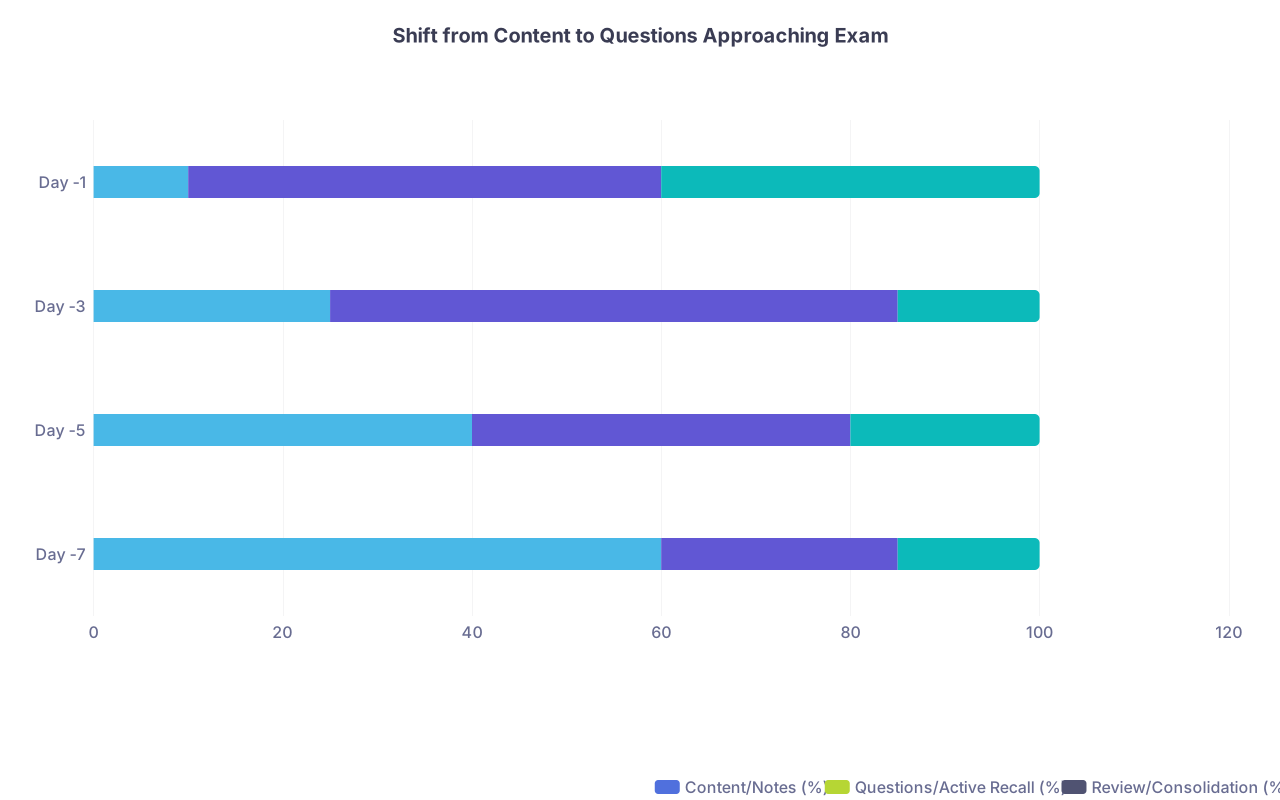
| Category | Content/Notes (%) | Questions/Active Recall (%) | Review/Consolidation (%) |
|---|---|---|---|
| Day -7 | 60 | 25 | 15 |
| Day -5 | 40 | 40 | 20 |
| Day -3 | 25 | 60 | 15 |
| Day -1 | 10 | 50 | 40 |
You are deliberately shifting the kind of work you do, not just increasing raw hours.
The Bottom Line: Your Schedule Is a Clinical Tool
You would not treat a patient by guessing and hoping it works out. Yet most M1s “treat” their week that way.
You now have:
- A clear process to map non‑negotiables
- Templates for different kinds of days
- Rules for buffer, fatigue, and backlog
- An exam‑week modification plan
- A weekly review ritual to keep the system honest
Do not try to make this perfect. Make it operational.
Your Next Step (Today)
Open your calendar right now and do three things:
- Block your non‑negotiables for the next 7 days: required sessions, commute, sleep, meals.
- Add exactly two deep study blocks and one card-review block to tomorrow, labeled by function (e.g., “Lecture consolidation,” “Anki,” “Questions”).
- Create a 30‑minute “Weekly Review” event for this coming Sunday.
Once those are in place, you are no longer “hoping” your week works. You are running a system. Adjust it every week, and it will carry you through M1 without breaking you.