The belief that you must choose between a social life and good grades in medical school is flat-out wrong. The students who burn out hardest are usually the ones who try to sacrifice everything that is not studying.
You do not need more motivational quotes. You need a triage plan.
A clear, ruthless system for:
- What social life you keep
- What you cut
- What you schedule
- What you protect during exam season
Let me walk you through that system.
Step 1: Diagnose the Problem Accurately
Before you “fix” your social life, you need to figure out what is actually broken. Most first-years misdiagnose this part.
There are three common failure patterns:
The Ghost
- You disappear from friends, family, and hobbies.
- You study constantly but your brain still feels fried.
- You feel guilty whenever you are not studying, even when nothing is going in.
- By mid-block you are exhausted, irritable, and lonely.
The Pretend Undergrad
- You try to keep your undergrad level of social life.
- Every weekend is open. Group chats blow up your phone.
- You “study with friends” which is mostly scrolling, chatting, and half-reading slides.
- Grades start slipping. Panic follows.
The Ping-Pong
- You swing between total isolation and social binges.
- Study 12 days alone → go hard for 2 days → feel behind → isolation again.
- Emotionally scattered, no rhythm, no stable habits.
Your first task this week: identify your pattern.
Ask yourself, as bluntly as you can:
- Do I feel guilty when I am not studying?
- Do I feel behind most of the time?
- When I hang out with people, do I actually enjoy it or just feel stressed?
- Have I lost touch with people who mattered to me pre-med?
If you answer “yes” to:
- Guilt + behind → you are likely “The Ghost” or “Ping-Pong”
- Behind + stressed when social → “Pretend Undergrad” or “Ping-Pong”
You are not special here. Almost everyone lands in one of these buckets.
Good. Now we can fix it.
Step 2: Triage Your Social Life Like a Patient
You are in medicine. Use that brain.
We are going to treat your social life like an ED triage board:
- Red: Must save. Critical.
- Yellow: Important, but can delay.
- Green: Optional. Nice-to-have, not essential.
- Black: Time sink. Let it go.
Break your social life into categories:
- People
- Activities
- Communication channels
Then classify.
1. People Triage
List the main people in your life. Be specific:
- Roommate(s)
- Close friends (med and non-med)
- Partner / spouse
- Family (parents, siblings, etc.)
- Group chat people you talk to often
Now tag them:
Red (Critical – must preserve contact)
- Someone whose support holds your mental health together
- Your partner / spouse (assuming not toxic)
- One or two core friends you actually open up to
- Possibly one family member (often a parent or sibling)
Yellow (Important – scheduled, not constant)
- Friends you like but do not need daily contact with
- Family you want to check in with but who drain time on long calls
- Med school classmates you are friendly with but do not study well with
Green (Optional – when time + energy allow)
- Old acquaintances from undergrad
- Group hangout friends you enjoy but do not rely on emotionally
- Social circles where you are more “show up and have fun” than deeply connected
Black (Let go or heavily cut)
- People whose messages spike your anxiety or guilt
- Friends who resent your schedule and constantly pressure you
- Anyone who drains your energy and does not respect boundaries
You are not writing people off as human beings. You are acknowledging capacity. You are in a professional program with brutal demands. You cannot be everyone’s 24/7 best friend.
2. Activity Triage
Do the same with activities:
- Weekly bar nights
- Intramural sports
- Religious group
- Game nights
- Brunches
- Party weekends
- Mindless scrolling / social media drama
Classify:
Red activities
- 1–2 recurring things that recharge you deeply
Example:- Weekly dinner with partner
- Sunday family call
- One religious service or small group
- One exercise-related social thing (running club, pickup basketball)
Yellow activities
- You like them, but they can shift during exam blocks
Example:- Game night twice a month
- Monthly brunch with friends
- Group movie night
Green activities
- Fun but totally optional.
Example:- Random nights out
- Attending every single med school social event
- Extended, unstructured parties
Black activities
- Anything that reliably leads to:
- Massive next-day regret
- Lost study time with no real mental benefit
Often: - 2 a.m. bar crawls, especially during exam week
- Endless TikTok / Instagram / Discord drama loops
This is where you get ruthless. You are not “too busy for a social life.” You are too busy for an unfiltered social life.
Step 3: Build a Weekly “Social-Study” Template
You do not need a perfect productivity system. You need a simple, realistic weekly template that bakes in both studying and social connection.
Here is a baseline structure that actually works in first year for most people.
The Core Rules
- You protect 1–2 red social blocks per week like exams.
- You use time-blocking, not vibe-based studying.
- You have one “off-duty” evening per week where you stop by 8–9 p.m. latest and do not open Anki again.
- You scale social time—do not delete it—during exam week.
Let us build it.
Step-by-step:
Block your non-negotiables first
- Class (if required in-person)
- Lab, small groups
- Commute
- Sleep (yes, actually block it: 11 p.m.–7 a.m. for example)
Add 1–2 red social anchors Examples:
- Wednesday 7–9 p.m.: Dinner + walk with partner
- Sunday 4–5 p.m.: Family video call
These are not “if I finish Anki”. They are scheduled maintenance for your brain.
Add 1 “off-duty” evening
- Usually Friday or Saturday
- You stop productive work by 7–8 p.m.
- You can:
- Go to a party
- Movie night
- Chill with friends
- Just sleep
The point is: your brain gets to stop climbing uphill.
Fill in weekday study blocks For a heavy preclinical schedule, a sane template:
- 3–4 hours deep work block (daytime)
- 2–3 hours lighter work / Anki (evening)
- Short 25–50 minute bursts, 5–10 minute breaks
You do not study 14 hours a day. It is unsustainable. The students who claim they do are usually doing 6–8 hours of actual focused work stretched over 14.
Add 1–2 small yellow social touchpoints
- 30–45 minute coffee with a friend after lab
- Lunch with classmates between sessions
No, this is not “wasted” time. You would be doom-scrolling anyway.
Here is what a balanced week might roughly look like during a normal block:
| Day | Morning | Afternoon | Evening |
|---|---|---|---|
| Mon | Class + review | Deep study (3h) | Light review + Anki (2h) |
| Tue | Class + Anki | Small group / lab | Coffee with friend (Yellow) + Anki |
| Wed | Class + Anki | Deep study (3h) | Dinner with partner (Red) |
| Thu | Class + review | Deep study (3h) | Light review (1–2h) |
| Fri | Class + Anki | Deep study (2h) | Off-duty evening (social / rest) |
| Sat | Deep study (3–4h) | Errands / exercise | Light social (Green/Yellow) |
| Sun | Deep study (3–4h) | Planning + Anki | Family call (Red) + wind-down |
Is this perfect? No. It is realistic.
Step 4: Exam Season Triage – How to Scale Without Going Dark
Here is where most first-years blow it. They treat exams like a reason to delete their life.
Then they wonder why:
- Their recall tanks
- Their sleep implodes
- They feel like quitting medicine twice a block
Your rule: During exam week, you scale social contact, you do not erase it.
What changes during exam week
Study hours go up
- You may move from 6–7 “real” hours to 8–10.
- That means something must give.
Yellow and green social goes down
- No random parties
- No “Netflix all night with friends”
- Minimal optional events
Red social compresses but stays Examples:
- 15–20 minute nightly call / check-in with partner instead of 2–3 hour hang
- 15 minute “walk and talk” with a friend between study blocks
- Short Sunday check-in with family instead of a 2-hour call
You do not disappear from the people who keep you sane. You simply shorten and tighten the contact.
Here is a simple scaling model:
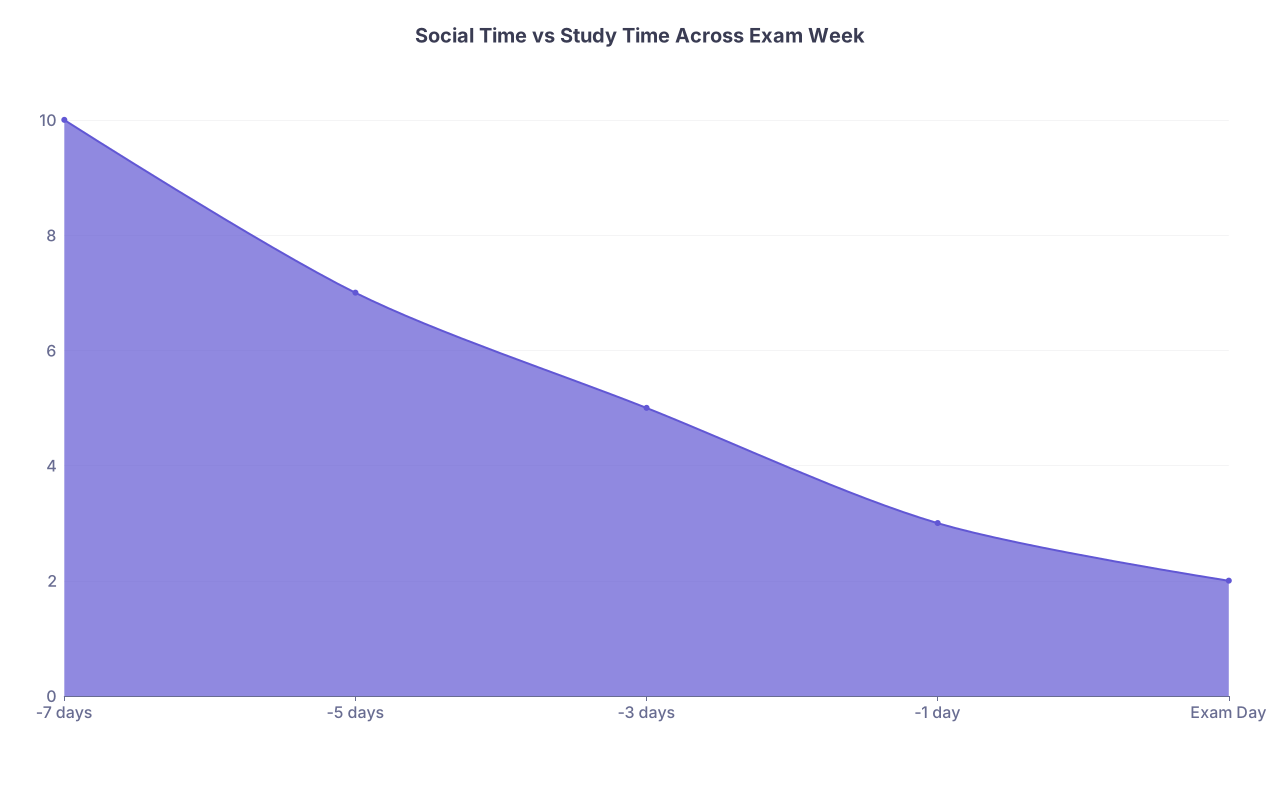
| Category | Value |
|---|---|
| -7 days | 10 |
| -5 days | 7 |
| -3 days | 5 |
| -1 day | 3 |
| Exam Day | 2 |
Think “social minutes per day” dropping somewhat, but never to zero.
Practical example during exam crunch:
- Morning:
- 8:00–12:00: Focused study (practice questions)
- Break:
- 12:00–12:20: Quick walk, voice note reply to a friend, or short call
- Afternoon:
- 1:00–5:00: Focused review
- Evening:
- 6:00–6:20: Check in with partner or family
- 6:30–9:00: Light review / Anki
- 9:00–9:30: Wind-down, no screens
You are still a human being. Your brain is not a Step 1 machine.
Step 5: Use “Micro-Connection” Instead of All-or-Nothing
You probably overestimate how much time you need to “have a social life.”
You do not always need a 4-hour hang. You often need:
- 5 minutes to send a voice message
- 10 minutes to reply thoughtfully to 2–3 people
- 15 minutes to share a coffee or walk
Build a “micro-connection toolkit”:
Voice messages
- Efficient, personal, done while walking
“Hey, quick update, med school is killing me, but I miss you. What is new with you?”
- Efficient, personal, done while walking
Standing mini-check-ins
- Example:
- Every Tuesday at 8 p.m., a 15-minute call with a friend.
- Every Sunday afternoon, short text updates with your closest group chat.
- Example:
Study-adjacent social
- Walking to class with someone
- Two-minute meme exchange between Anki blocks
- Lunch with classmates instead of eating alone over your notes every single day
“Reply budget” system
- Give yourself 10–15 minutes a day for replies.
- During that block:
- Answer 2–4 meaningful messages
- Ignore the rest until tomorrow
You are not on call for your social life.
These micro-connections are usually enough to:
- Keep relationships alive
- Avoid feeling isolated
- Reduce guilt with family / partner
Without torpedoing your study time.
Step 6: Boundaries Script – What to Actually Say to People
Here is where students freeze: “How do I explain this without sounding like I do not care?”
You use short, honest scripts. Delivered once, then reinforced by consistency.
To a partner
“Med school has a weird way of swallowing all my time if I let it. I care about us and I do not want to disappear. Here is what I can realistically do:
- One night a week where I am fully present with you (no studying).
- Quick check-ins most nights, even if it is just 10–15 minutes.
During exam weeks I will be more stressed and less available, but I will still do a short daily check-in. If that ever stops working for you, tell me early, not when it has been boiling for months.”
To a close friend
“I am buried in first-year right now. I might be slower to reply, but I do not want to lose this friendship. I can usually do short calls or voice notes, and I will be freer after exams. If I do not respond fast, it is not personal. It is just survival mode.”
To family who expect long calls
“I really want to keep you in the loop, but long calls are hard to fit in regularly. Could we switch to a short weekly check-in (15–20 minutes), and then we plan a longer call once a month when I know my exam schedule?”
To med school classmates pushing you to go out constantly
“I like hanging out, but I have to protect my grades and my sleep. I will usually do one night out a week max, and during exam weeks I am probably a no. Please keep inviting me though—I will come when I can.”
You are not asking permission. You are stating reality with care.
Step 7: Fix the “Study-With-Friends” Trap
Let me be direct. Most “group studying” in first year is fake productivity.
Common pattern:
- You join a study group.
- You spend 40% of the time finding a room, getting coffee, talking about how behind you are.
- You leave tired and more stressed, and not actually caught up.
You need to enforce one rule: Social or study. Not both at the same time, except in very controlled ways.
If you want to study with others, you do it like this:
Diagnostics first
- Only join groups where everyone:
- Does questions
- Teaches each other
- Actively works
Not groups where people passively scroll slides together.
- Only join groups where everyone:
Time-bound
- 60–90 minute blocks.
- Clear start and end times.
Defined structure Example:
- 10 min: Each person lists weak topics/questions.
- 40–60 min: Rapid-fire teaching, questions, explanation.
- 10–20 min: Review what is still confusing.
Social time AFTER, not during
- “We do one focused 60-minute block, then 20 minutes of social decompression.”
If your current “study group” does not allow this, call it what it is: a social event. Treat it like one and schedule it accordingly.
Step 8: Monitor Two Vital Signs – Burnout and Performance
You have a plan. Now you need feedback loops.
There are two vital signs you must monitor weekly:
- Academic performance
- Burnout risk / mental state
1. Academic performance
Quick weekly check:
- Am I keeping up with:
- Anki / spaced repetition?
- Assigned material?
- Practice questions?
- Have my quiz/exam scores stayed:
- Stable?
- Trending up?
- Sliding down?
If your performance is:
- Stable or improving → your social load is fine or even protective.
- Falling steadily → you adjust. Not by nuking social life. By:
- Cutting green / black activities
- Tightening yellow
- Preserving red but shorter
2. Burnout risk
Pay attention to these warning signs:
- You dread every single study block.
- You feel emotionally flat even during things you used to enjoy.
- Sleep is wrecked (either insomnia or oversleeping regularly).
- You start fantasizing about quitting weekly.
When burnout signs climb:
- You do not delete the red social category.
- You often need to:
- Shorten study marathons
- Increase quality, not quantity, of study
- Protect rest and red social time even more fiercely
This is counterintuitive: Sometimes the solution to worsening grades is not more study hours, but better study methods plus a bit more human contact.
Step 9: A Concrete 4-Week Reset Plan
If your social life feels wrecked right now, use this 4-week reset. Don’t overthink—just implement.
Week 1 – Assessment + Triage
- List:
- Main people
- Main activities
- Label each: Red, Yellow, Green, Black
- Have 2–3 short boundary-setting conversations (partner, one friend, one family member).
- Build a simple weekly template:
- 2 red social anchors
- 1 off-duty evening
- 1–2 yellow touchpoints
- Run it for a week. No optimization yet.
Week 2 – Tightening and Micro-Connections
- Add:
- 10–15 minute daily reply block
- 1–2 micro-connection habits (voice notes walking to/from class)
- Cut:
- 1–2 black activities (late-night doom scrolls, random parties on weekdays)
- Watch:
- Are you actually less lonely?
- Are your study blocks improving in quality?
Week 3 – Exam Week Simulation (Even if No Exam)
- Pretend it is “mild exam week.”
- Scale:
- Shrink yellow and green events by half.
- Keep red events but shorter (30–60 minutes if possible).
- Study:
- Slightly more hours, slightly higher intensity.
- Evaluate:
- Could you live like this during a real exam week without imploding?
If the answer is yes → your triage system works.
Week 4 – Real Adjustment
Based on 3 weeks of evidence:
- If grades solid + you feel ok:
- You can add 1 more yellow activity or extend an existing one.
- If grades slipping:
- Remove 1 green activity.
- Check your study method (questions > re-reading).
- If burnout signs rising:
- Shorten study blocks.
- Add 1 more micro-connection or 1 more hour of true rest on the weekend.
By week 4 you should feel:
- Less guilty when social
- Less anxious when studying
- Less chaotic overall
Visualizing the Process
Here is the whole “social life triage” flow in one snapshot:

| Step | Description |
|---|---|
| Step 1 | Start: Feeling unbalanced |
| Step 2 | Cut green/black activities |
| Step 3 | Protect red social time + rest |
| Step 4 | Maintain current balance |
| Step 5 | Schedule 2 red anchors/week |
| Step 6 | Add micro-connections |
| Step 7 | Reassess weekly: grades + mood |
| Step 8 | Grades okay? |
| Step 9 | Feeling burned out? |
The Bottom Line
You are not choosing between:
- Being a robot with a 4.0
- Or being social with mediocre grades.
You are choosing between:
- A chaotic, guilt-ridden “all or nothing” life
- Or a deliberate, triaged life where:
- The right relationships stay alive.
- Your grades are stable.
- Your brain does not burn out by February.
The key moves:
- Triage ruthlessly – People and activities into red, yellow, green, black. Stop pretending everything is equally important.
- Schedule connection, do not improvise it – 1–2 red anchors weekly, 1 off-duty evening, micro-connections daily.
- Scale, do not erase, during exams – Compress social time, keep it alive, and monitor both grades and burnout like vital signs.
You are allowed to be a good friend, partner, and child while also being a serious medical student. You just cannot afford to be a lazy planner.