All‑nighters do not make you a hero in medical school. They make you worse at exactly the things exams and clinical work demand.
Let me be blunt: the “grind culture” worship of all‑nighters is built on bravado and survivorship bias, not data. The students flexing about staying up 36 hours straight? I’ve watched their scores, their recall, and their performance in clinic. The story is not what they think it is.
You can absolutely survive the occasional all‑nighter. But if you think it’s a performance enhancer, or even neutral, the evidence says you’re kidding yourself.
Let’s walk through what the research and real outcomes actually show.
What the Data Actually Says About All‑Nighters
Sleep deprivation is one of the most studied variables in cognitive science and medicine. We are not guessing here.
Controlled sleep studies show the same pattern over and over:
- One night of total sleep deprivation:
- Slows reaction time
- Impairs working memory
- Degrades attention and vigilance
- Distorts risk assessment and decision‑making
Now map those onto what med school exams and clinical work require. Exactly the same list.
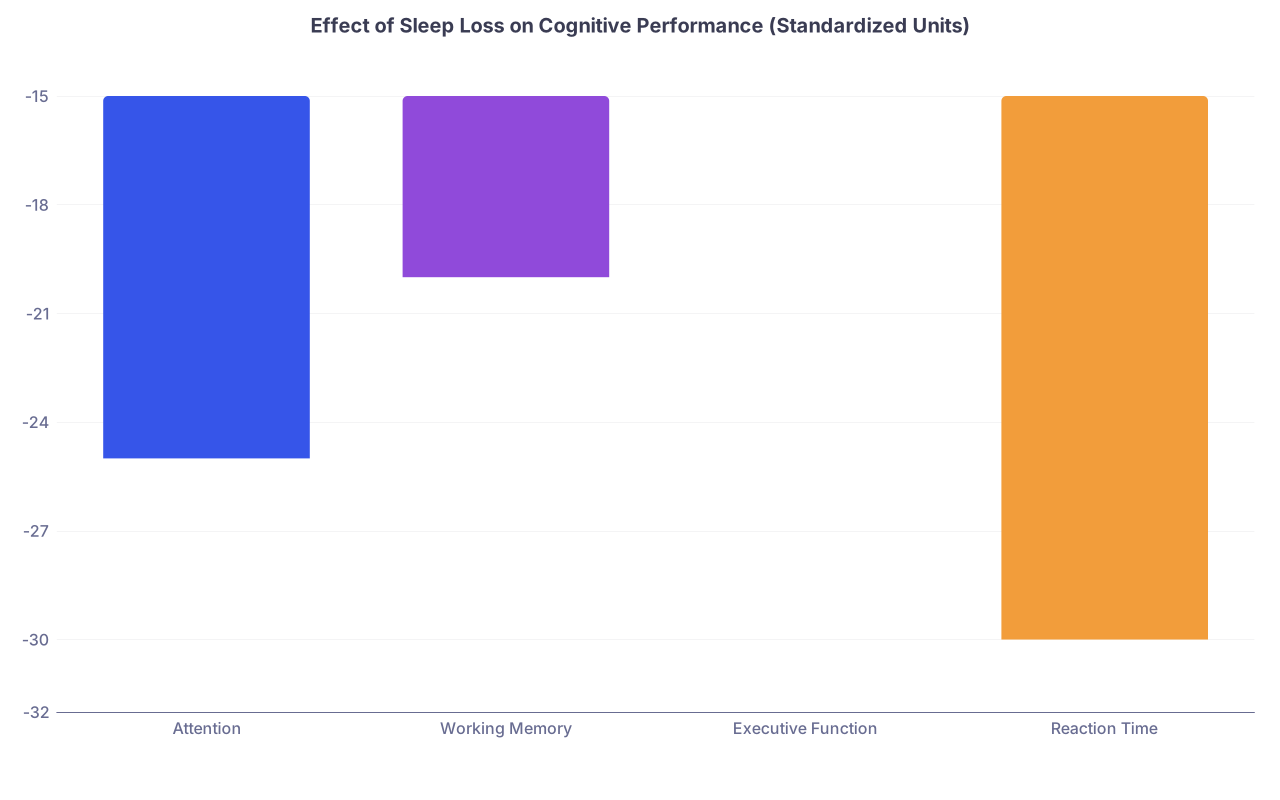
| Category | Value |
|---|---|
| Attention | -25 |
| Working Memory | -20 |
| Executive Function | -15 |
| Reaction Time | -30 |
That chart is a simplified snapshot from pooled sleep‑deprivation meta‑analyses: after a night without sleep, performance on attention tasks can drop 20–30%, working memory around 15–25%, and reaction time gets hammered.
A few concrete findings:
- A classic study (Dawson & Reid) showed that after about 17–19 hours awake, your psychomotor performance is similar to a blood alcohol level of 0.05%. At 24 hours awake, it’s around 0.10%. That’s legally drunk in most countries.
- Sleep‑deprived subjects are worse at:
- Logical reasoning
- Updating information in working memory
- Detecting rare but critical signals (think: that one weird lab value or ECG change)
Now imagine walking into an 8 a.m. neuro exam on zero sleep. You’ve essentially chosen to “pre‑intoxicate” your brain and then take a test that requires rapid recall + pattern recognition.
But here’s the kicker: sleep‑deprived people are notoriously bad at judging how impaired they are. Subjectively, many think they’re “doing fine.” Objectively, their performance tanks.
So no, “I pulled an all‑nighter and it went great” is not data. It’s how impaired brains feel about themselves.
The Myth of “But I Need an All‑Nighter the Night Before”
The most persistent myth is this: “I’ll do one huge push the night before the exam so everything is fresh.”
This is backwards. Memory consolidation happens during sleep, especially slow‑wave and REM. You encode during the day; you stabilize and integrate at night.
Skip the night, you lose:
- Consolidation of what you studied the last 24–48 hours
- Retrieval strength of older material
- The ability to flexibly use what you know, not just parrot it
I’ve seen this play out with M1s before their first anatomy practical dozens of times. Two patterns:
- Group A: Study steadily, stop around 10–11 p.m., sleep 7 hours, quick review in the morning.
- Group B: Feel behind, panic, stay in the lab or library until 3–4 a.m., caffeine, adrenaline, zombie‑walk into the exam.
Guess which group shows more random misses on “easy” structures and more blank stares on things they swear they “went over five times last night”?
The problem is not “they didn’t work hard enough.” The problem is their hippocampus never got to lock in what they crammed. They literally revoked their own ability to consolidate.

| Step | Description |
|---|---|
| Step 1 | Behind Before Exam |
| Step 2 | Sleep 6-7h, Accept Imperfect Prep |
| Step 3 | Fix Study Habits, Avoid All-Nighter |
| Step 4 | One-Time All-Nighter with Damage Control |
| Step 5 | At Risk of Failing? |
| Step 6 | Unavoidable Circumstances? |
Cramming plus sleep is not great, but it’s survivable. Cramming plus no sleep is a double hit.
Where All‑Nighters Actually Show Up in Grades
Let’s talk performance outcomes, not theory.
Do we have randomized controlled trials where we force one group of med students to pull an all‑nighter and track scores? Of course not—IRBs have limits. But we do have:
- Correlational data on sleep quantity and GPA / exam scores
- Data from residents and interns on errors and performance after call
- Experimental data on sleep and learning that extrapolates well to med school content
The pattern:
- Chronic short sleep (under ~6 hours on average) is associated with lower exam performance and lower GPA in med students. Not just a little lower. Measurably lower.
- Irregular sleep—massive swings and last‑minute all‑nighters—tend to correlate with worse performance than the same average sleep time spread more consistently.
- Clinical performance after extended wakefulness (on call) involves more prescribing errors, more lapses of attention, and slower diagnostic reasoning—exactly the stuff you say you care about when you post #futureDoctor.

Here’s a rough but representative summary from multiple studies:
| Pattern | Typical Effect on Performance |
|---|---|
| 7–8 hrs regular sleep | Baseline / best performance |
| 5–6 hrs most nights | Small–moderate decline |
| Repeated all‑nighters | Larger, inconsistent decline |
| Post‑call (24+ hrs awake) | Clearly impaired performance |
Is there a unicorn student who pulls a couple of all‑nighters and still scores 250+ on Step? Sure. There are also people who smoke a pack a day and live to 90. Outliers do not invalidate the risk curve.
The more relevant question: given your baseline ability, are all‑nighters helping, neutral, or hurting?
The evidence says: they either hurt or, at absolute best, offer a very short‑lived, high‑risk tradeoff that doesn’t pay off on board‑style exams.
The “Last‑Minute Miracle” Illusion
Let me address a very specific story I hear from first‑years:
“I was behind for my first block exam, pulled an all‑nighter, and actually passed. I guess it works for me.”
No. What happened is:
- You already knew more than you thought.
- The all‑nighter gave you time, not quality brain function.
- Your baseline cognitive ability carried you across the pass line despite self‑sabotage, not because of it.
The human mind is terrible at causal inference under stress. You remember the all‑nighter + passing outcome. You do not see the alternative timeline where:
- You start 2–3 days earlier
- Sleep 6–7 hours the night before
- Score 5–10 points higher with less suffering
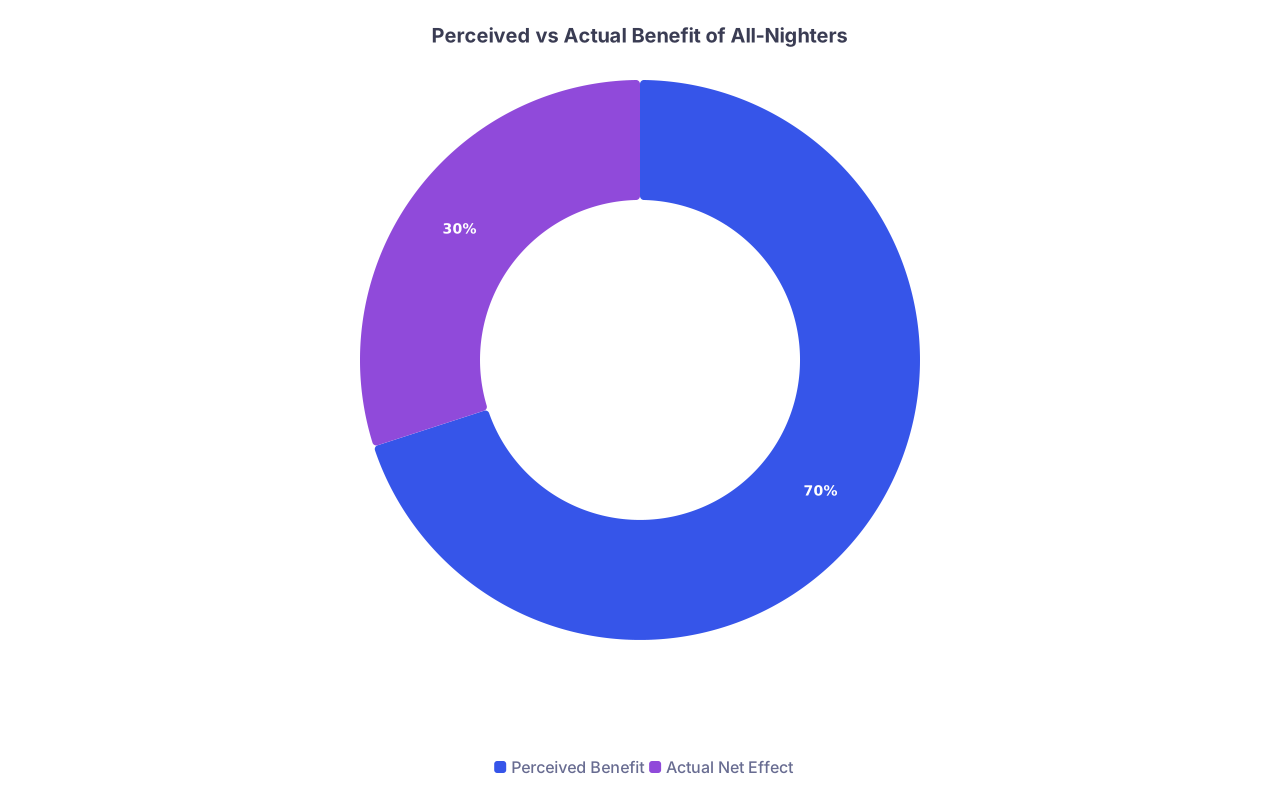
| Category | Value |
|---|---|
| Perceived Benefit | 70 |
| Actual Net Effect | 30 |
Students perceive that the all‑nighter gave them 70% of the credit. In reality, most of the “credit” goes to prior learning, not the sleepless last 10 hours of panic‑scrolling Anki and lecture slides.
And once you have one “success” tied to an all‑nighter, you build a dangerous superstition: “This is how I get things done.” Then it becomes habit. Then your baseline sleep debt rises. Then your average performance quietly slides downward while your stress explodes.
I’ve watched people ride this pattern all the way to Step studying—where that strategy collapses, hard.
But What About Residents Pulling 28‑Hour Shifts?
This is the favorite rationalization: “If the system expects residents to work 24–28 hours, clearly being sleep‑deprived must be something I should train for.”
That logic is broken on multiple levels.
First, residency call is not a performance hack. It’s a historical artifact mixed with staffing economics and inertia. The data on sleep‑deprived residents is brutal:
- Higher rates of medical errors
- More needle sticks and occupational injuries
- Worse mood, higher burnout, more depression
- Impaired driving after call (yes, like being drunk)
Second, even in residency, programs are trying to mitigate the damage of sleep deprivation with duty-hour rules, night float, strategic napping. Nobody serious is arguing, “Hey, let’s keep residents up two nights in a row, it helps them learn.”
You don’t “train” for call by trashing your sleep in M1. You show up as mentally healthy and cognitively sharp as you can, because residency will erode that baseline anyway.
If you want to simulate residency conditions, do it in controlled, intentional ways: simulate being tired on a Saturday mock OSCE, not by detonating your sleep the day before a high‑stakes exam that determines your future options.
When an All‑Nighter Might Be the Least Bad Option
Now let me be realistic. Life happens. Sometimes the choice is not between “well‑rested and prepared” vs “all‑nighter.” It’s between:
- “Woefully underprepared and semi‑rested”
- “Marginally more prepared and exhausted”
There are rare, specific cases where an all‑nighter may be a rational, if lousy, choice:
- You massively under‑estimated content volume, and the exam is make‑or‑break (e.g., remediation vs staying on track).
- You had unavoidable disruptions (family emergency, illness) and this is triage, not lifestyle.
- You’re in a pass/fail system, currently at clear risk of failing, and a bit more coverage might push you from 55% to 65%.
In those edge cases, you treat the all‑nighter as a one‑off intervention with damage control, not as a go‑to tactic.
If you must do it:
- Stop all heavy learning by around 3–4 a.m. and shift to light review or practice questions.
- Take 20–30 minute strategic naps if you can, even one or two. They help more than another hour of half‑awake reading.
- Force hydration, not just caffeine. Otherwise your “sharpness” is just jitter.
- After the exam, actually recover. Don’t pretend you can jump back to normal that afternoon.
| Step | Description |
|---|---|
| Step 1 | Behind Before Exam |
| Step 2 | Sleep 6-7h, Accept Imperfect Prep |
| Step 3 | Fix Study Habits, Avoid All-Nighter |
| Step 4 | One-Time All-Nighter with Damage Control |
| Step 5 | At Risk of Failing? |
| Step 6 | Unavoidable Circumstances? |
If you catch yourself doing this more than once or twice a semester, that’s not “crunch time.” That’s a systems failure in how you’re studying and planning.
The Real Performance Enhancer: Boring Consistency
The unsexy truth: the highest‑performing med students I’ve seen long‑term are almost boring about their sleep.
I’m thinking of one class where we looked at Step 1 performance and informal self‑reported habits:
The students scoring 250+? Most of them:
- Slept 6.5–8 hours regularly
- Rarely pulled true all‑nighters (maybe one, usually for travel, not exams)
- Protected the night before big tests like a sacred ritual—light review, wind‑down, bed
The students constantly yo‑yoing between 65s and barely passing?
- Wildly irregular schedules
- Hero stories about “closed the library at 2 a.m. four nights this week”
- Chronic fatigue and “I just don’t test well” narratives
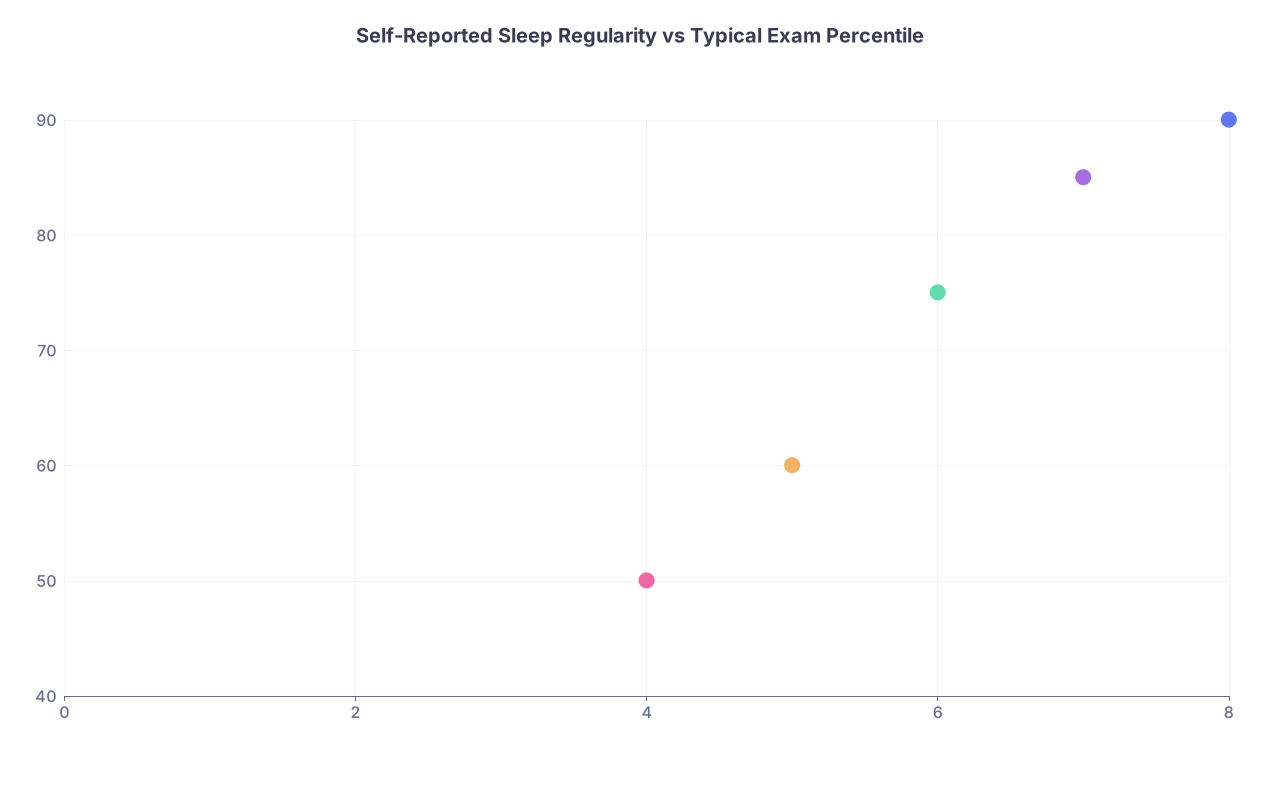
| Category | Value |
|---|---|
| Student 1 | 8,90 |
| Student 2 | 7,85 |
| Student 3 | 6,75 |
| Student 4 | 5,60 |
| Student 5 | 4,50 |
That chart is illustrative, not from a single published dataset—but it matches both the literature and what I’ve watched across cohorts: as average sleep and regularity go down, typical percentile drops.
You do not need “perfect” sleep. Medical school makes that nearly impossible. But you do need:
- A floor. “I virtually never go under 5–6 hours before an exam.”
- Some regularity. Bedtime that’s roughly in the same 1–2 hour window most nights.
- A policy: “I do not intentionally sabotage my exam performance with an all‑nighter unless the alternative is literally failing the course.”

What You Should Actually Take Away
If you strip away the bravado and anecdotes, you’re left with this:
- All‑nighters degrade exactly the cognitive skills medical school exams and clinical work require; they are not a performance hack, they are a tradeoff you almost always lose.
- The occasional emergency all‑nighter can be survivable, but as a habit it correlates with lower scores, higher stress, and worse learning—while tricking you into thinking you’re “clutch.”
- The students who quietly win long‑term are not the ones bragging about 3 a.m. grinds; they’re the ones who treat sleep like part of their study plan instead of an optional luxury.
You do not become a better future physician by rehearsing dysfunction. You become better by learning how to sustain your brain for the work ahead.
Drop the martyr act. Get some sleep.